
Article disponible en français
Notebooks of life · Travels · 20 min
Approaching the places, the wanderings and the retreats where the earth keeps memory of the human quest.

Series: Le Puy-Arès 2026: an account of an inward journey | Article 3
3 July 2026
Dear readers,
In this article I continue the account of those three weeks, from 8 June to 29 June, spent far from my keyboard, wandering between Le Puy-en-Velay in the Haute-Loire, Decazeville in Aveyron, and then Arès in the Gironde. In the two previous instalments of this series, ‘The breach and the path‘ and ‘The step and grace‘, I shared with you some observations on the quality of human sharing among the walkers of the Camino de Compostela, and my impressions of the inner silence that long-distance walking makes possible. In this one, I should like to share with you the reflections inspired in me by two days spent in Conques, that village in Aveyron renowned for its Romanesque abbey church and its stained glass by Soulages. It is also a major stage for pilgrim-walkers on the Via Podiensis, one of the few that still offers a Christian welcome today, with masses and the liturgy of the hours at the abbey church, and a hostel kept by the Premonstratensian canons.

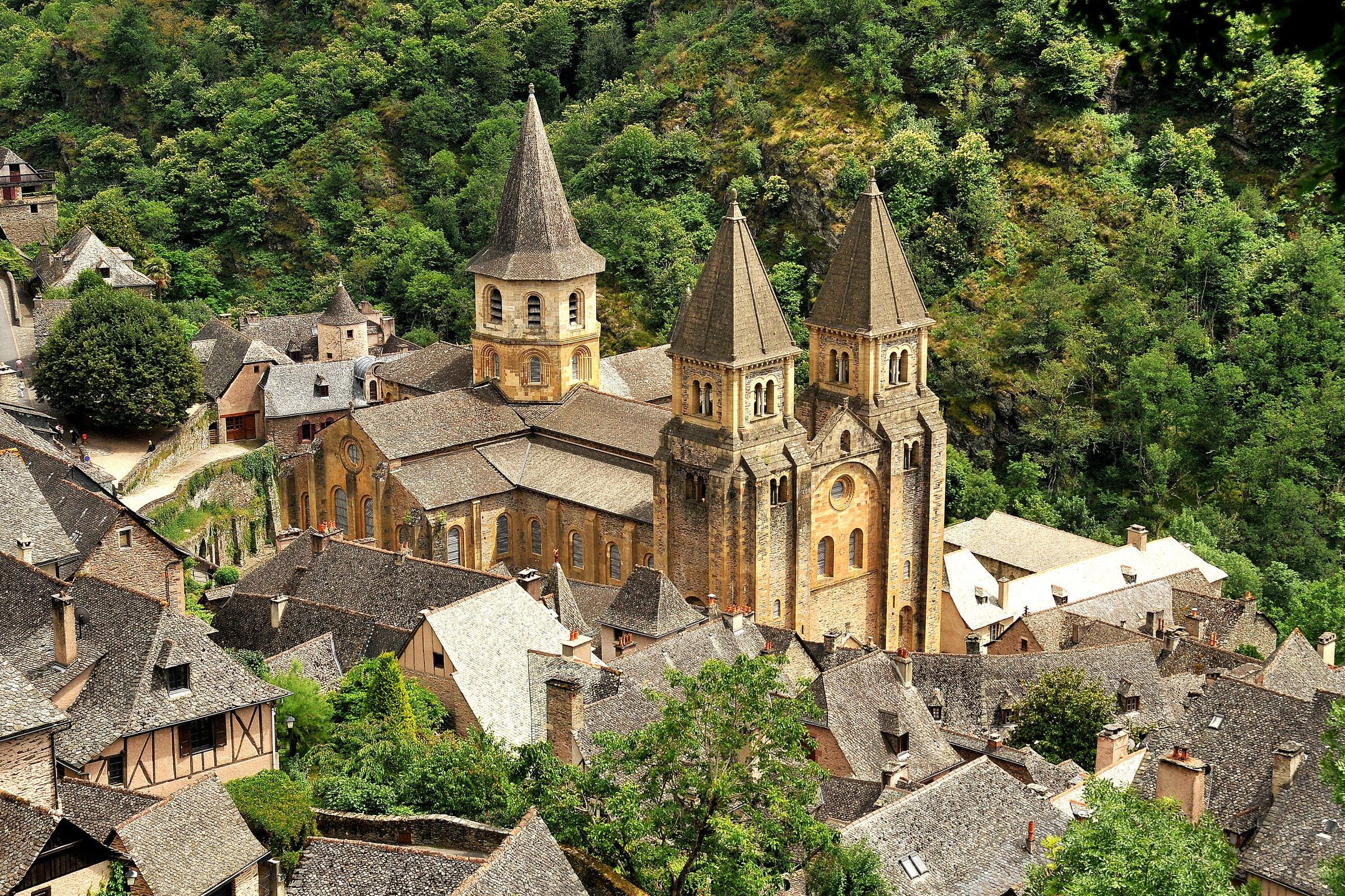
On Wednesday 17 June, I left the hostel at Golinhac at around six in the morning. I wanted to make the most of the cool air to cover the greater part of the 21 kilometres of the stage before the heat rose and made the walking arduous. The route begins as a gentle climb as far as Espeyrac, rises a little further over six kilometres, then runs along a plateau until it turns into a narrow path descending towards Conques. Towards half past ten, I set off along this path, strewn in places with large stones that make it uncomfortable underfoot, catching sight now and then, far below, of the rooftops of the village at the bottom of the narrow, wooded valley of the Dourdou. And then, quite suddenly, after a last effort of walking, Conques reveals itself at last, nestled in its valley of schist, its abbey church with its spires reaching towards the sky and its medieval bearing still preserved.
Arriving in the middle of the village a little after eleven, I make first for the abbey hostel, situated behind the abbey church, to leave my pack there, since check-in does not begin until three in the afternoon. I now have all the time I need to explore this place I had wished to visit for several years, and which is the very reason I chose this section of the Via Podiensis. Setting out from Le Puy-en-Velay and arriving in Conques to discover this renowned abbey church made immediate sense to me. Being sensitive to Romanesque architecture, whose major buildings are often raised on powerful telluric sites, I had no doubt that I should live through enriching moments here and make discoveries of my own. The stage on to Decazeville, which brought my walk to an end and of which I shall tell you in the next article, then imposed itself by virtue of the presence of a station from which to take a train towards Bordeaux.
And yet, rather than making straight for the abbey church, I preferred first to wander through the streets of the village, to take a meal in a restaurant, and then to settle and rest in the hostel dormitory. I did not wish to rush my discovery of this building that had drawn me towards it, without first being freed of my domestic cares and in a state of complete receptivity, ready to catch the subtlest messages that this magnificent structure might send me.

Late in the afternoon, towards five o’clock, I finally resolve to make my way to the abbey church.
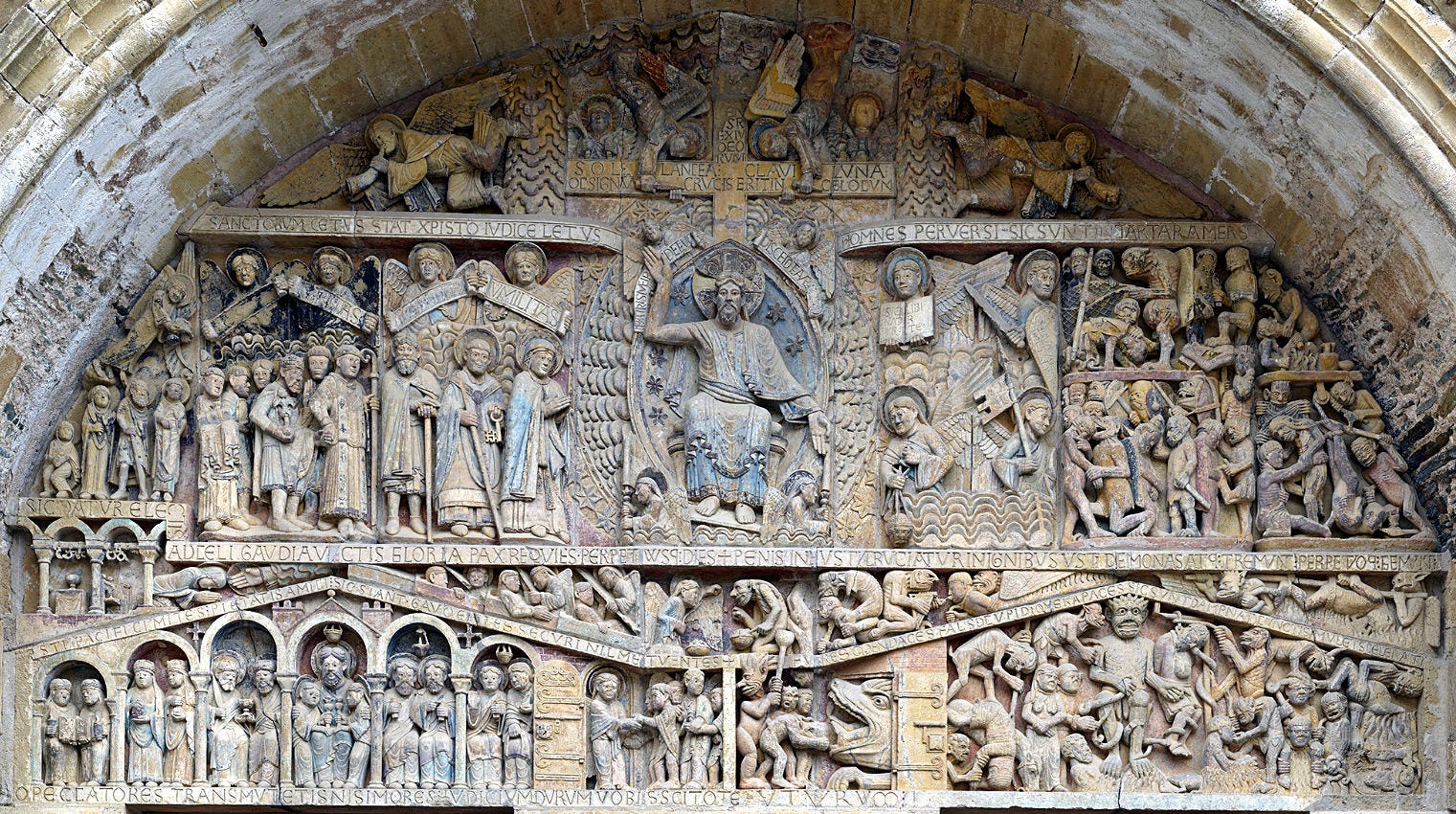
Before even crossing its threshold, I find myself stopped dead, astonished, before the tympanum that crowns its portal: a narrative in stone devoted to the parousia of Christ, that moment when, according to Christian theology, he will return to separate the just from the damned at the Last Judgement.
I picture a twelfth-century pilgrim, walking towards Compostela, hoping for the forgiveness of his sins or the healing of someone dear to him. This vessel of stone impresses him by its stature, and because it holds the relics of Saint Foy, a Christian martyr beheaded at twelve or thirteen years of age at the beginning of the fourth century for refusing to sacrifice to the Roman gods, whose many miracles are recorded in the Book of the Miracles of Saint Foy, written in the eleventh century by the monk Bernard of Angers. Suddenly summoned by this terrible narrative, he finds himself questioning his fate after death, and thus his conduct here below.
Let us examine with him what he discovers. At the centre, a Christ in Majesty, dressed more as an emperor than as a god, sits at the heart of a mandorla composed of seven concentric almond shapes that seem less to enclose him than to trace the expansion of his energy. Nothing moves upon his face: he blesses no one, heals no one, looks at no one in particular, a rare thing in this art, which invites one to pause before going any further.
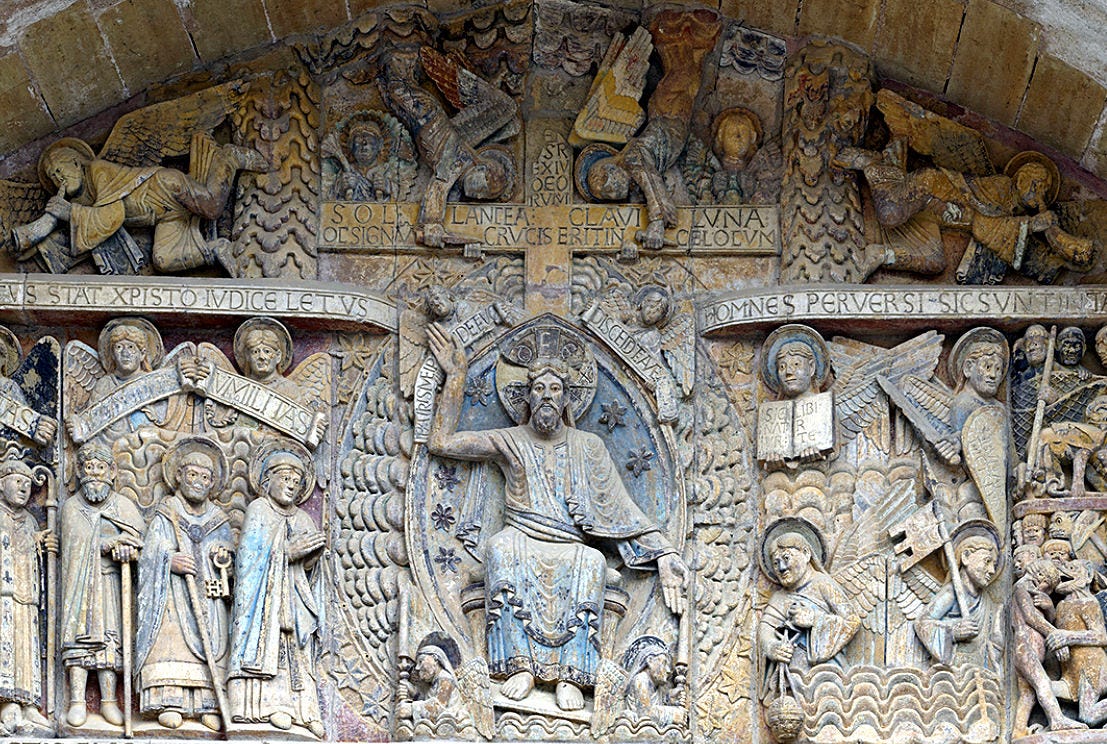
His right hand is raised, and I follow this arm upwards to see what it points to. High above, a cross stands over the mandorla, borne by two angels who also hold, each of them, a distinct object: a nail, a lance-head, the very instruments of the torment suffered by this body before it became this impassive judge. The throne of the parousia, from which Christ prepares to judge the world, is exactly the instrument on which the world put him to death. This cross, raised like a standard, calls to mind the trophies of antiquity, those posts on which victors hung the weapons of the vanquished foe: Christ does not return only as judge, he returns as victor, and what he has vanquished becomes a mark of glory. On either side, two angels blow into long oliphants, the trumpets of the Last Judgement, and in them I also hear the shofar sounded in synagogues during the month of Elul, which precedes Yom Kippur, a day improperly called the Day of Great Atonement when it is above all the day of great self-examination.
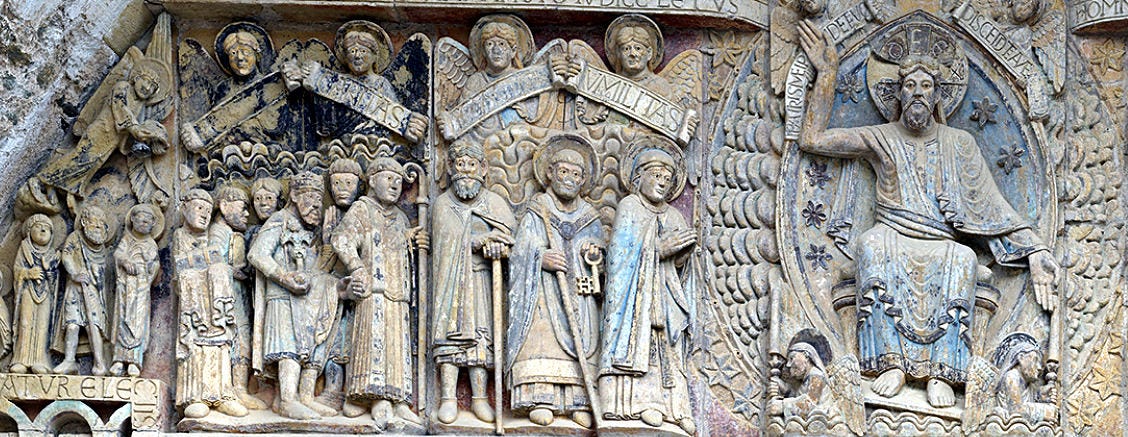
Christ’s right hand, before it is lost towards the sky, also opens onto what stands at its own level, on that same side: a procession advances, led by a woman with joined hands whom I recognise by her simplicity as the Virgin Mary, even before making out, carved on the scroll an angel unfurls above her: Humilitas, Humility, not a title of glory but the virtue of the handmaid who effaces herself before what she serves.
Behind her, Saint Peter holds a key, doubtless that of the gate of Paradise visible further below. Then comes a figure leaning on a long staff, whom I take, without certainty, to be Dadon, the first hermit of the place, then a churchman holding a crozier, an abbot rather than a bishop, from what I know of the history of this site. His hand holds that of a last figure bearing a sceptre carved with a fleur-de-lys: Charlemagne, the legendary emperor whose generosity towards the abbey is matched only by the audacity of including him in this procession of saints. This gesture of the guiding hand I notice only now: it is not his own steps that carry the emperor towards Christ, it is the hand of this churchman. Even the powerful, the stone seems to say, need someone to lead them, and one senses here the power once held by Catholic prelates, who crowned, and at times even commanded, the kings and emperors who had become their armed arm.
Above this group, an angel unfurls a second scroll, Caritas, Charity: a quiet form of justice on the sculptor’s part, reserving for this churchman and for the one he leads the virtue that gives without counting the cost, rather than the sterner humility of the woman who opens the procession.
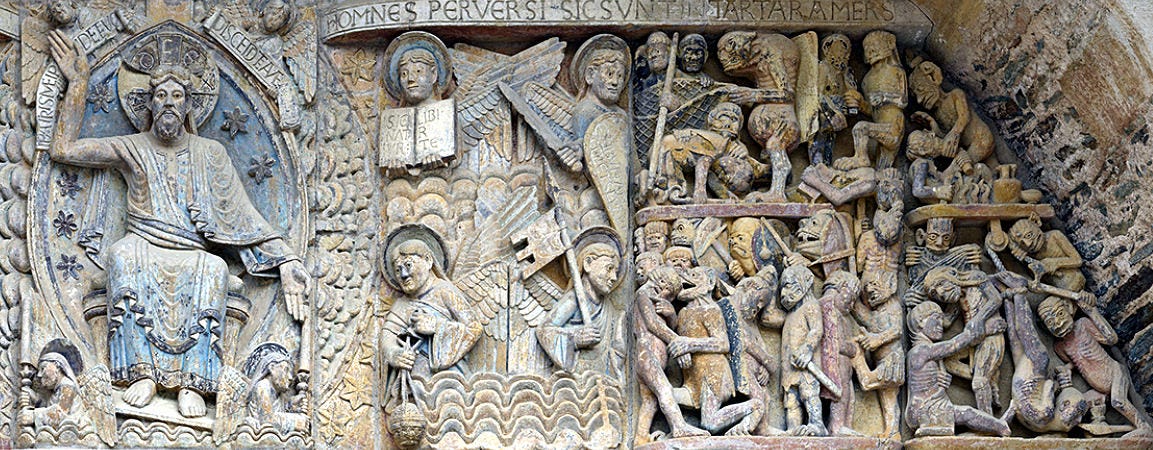
His left hand, meanwhile, opens onto a wholly different landscape, at this same height. An angel there holds an open book on which a Latin inscription, half effaced, may still be made out: ‘Signatur liber vitae’, ‘the book of life is sealed’. The Apocalypse makes this the evidence in the trial being played out here, each soul judged according to what is written within it, and I recognise in it the echo of what every Jew hopes for during the Days of Awe that separate Rosh Hashanah from Yom Kippur: to be inscribed, then sealed, in that same Book. The same image, in two worlds once wholly apart.
Beside this angel, two others stand on guard, one armed with a sword and shield, the other with a lance, and I think of the cherubim of Genesis, posted at the entrance to the garden of Eden, the flaming sword forever barring the way to the Tree of Life. Here, it is no longer a garden that is being guarded but the very gate of paradise: these angels are holding back, in the most literal sense, the already seething throng of the damned pressing at the frontiers of hell.
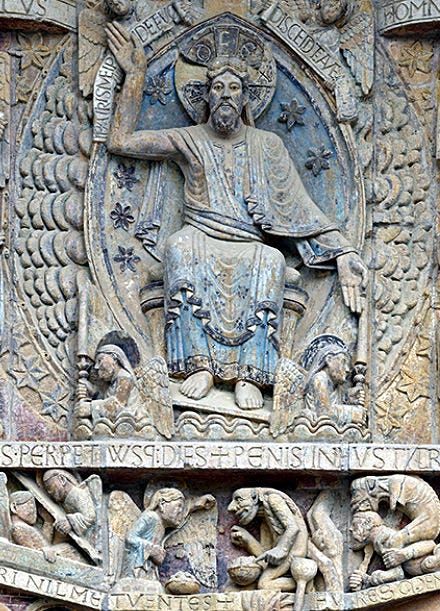
I return to Christ, and only then do I notice what is taking place just beneath his feet, perhaps the most intimate scene of the whole tympanum: an archangel holds a two-pan balance, which calls to mind the weighing of souls in the frescoes of ancient Egypt, while a small demon with a sly smile discreetly presses a finger on one pan to tip the scale. This tiny gesture, almost comic amid such solemnity, seems to me the truest possible depiction of our small inner negotiations, that part of ourselves which, at the very moment of assessing itself with sincerity, still seeks to falsify the result. Deceiving oneself is one of the first obstacles, and one of the hardest to overcome, along the spiritual path.
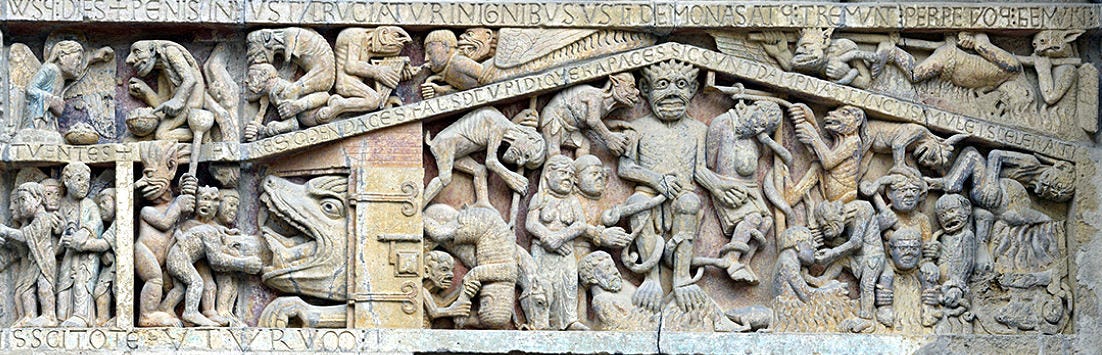
After this weighing, the eye need only follow the slope of the lintel to understand which side gives way to ruin. To Christ’s left, everything comes apart: a shaggy demon armed with a club drives a throng of naked, damned souls towards a monstrous, gaping mouth. Hell is shown here not as a place one enters but as a mouth that digests, which shifts the question from punishment to the more disturbing one of the dissolution of all individual form. It is worth recalling here that the first word for sin in the Hebrew of the Torah, ḥet, denotes an error of direction rather than a codified moral notion: hell, as the consequence of its accumulation, would then be the loss of our true individuality, of our spiritual identity.
Further along, Satan presides with an almost administrative detachment, his feet resting on the belly of a damned soul lying in the flames, surrounded by scenes in which each vice receives its punishment with great precision: the proud man falls from his mount just as he seeks to dominate, the miser remains hanging from his money-bag, the slanderer loses the tongue that had been his weapon, the drunkard endlessly vomits what could never satisfy him. None of these tormented souls is punished by a force outside his own life: each continues, for eternity, the very gesture that undid him. The hell of Conques may not be a sentence so much as the prolongation of the loss of self.
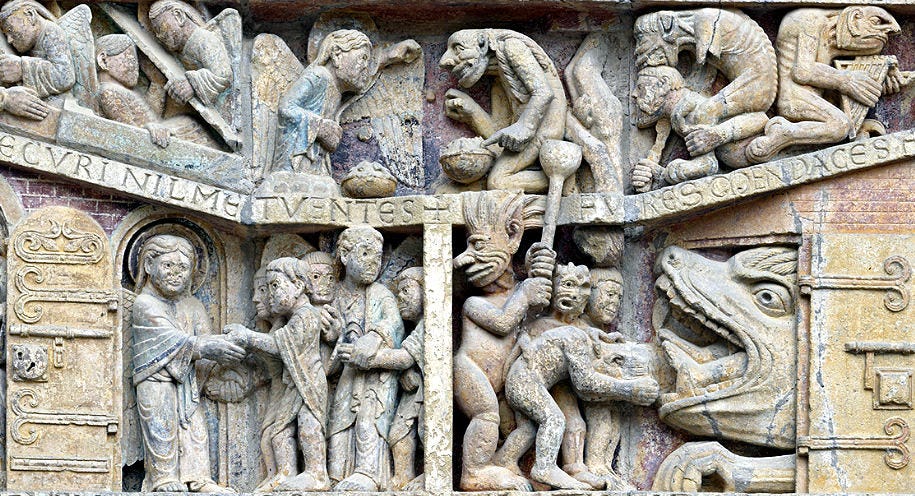
To the right of Christ, on this same register, a partition separates this chaos from a wholly different world, though less sharply than it first appears. A doorkeeper welcomes here the souls who have just escaped what they had, an instant before, come so close to sharing: they are still shown as seized with feeling, holding hands with one another at the gate of paradise. One of them, before fully crossing the threshold, still turns her head towards the other side of the partition, towards that club-bearing demon, who seems almost sorry to see her slip from his grasp.
This last backward glance, at the very moment of salvation, tells us something true about the way we actually leave what has long held us: never in one clean movement, but always with that lingering look we cannot help but trail behind us, the look that killed Lot’s wife, turned back towards Sodom, or that undid Orpheus who, leading Eurydice back from the underworld, could not help turning towards her before reaching the light.
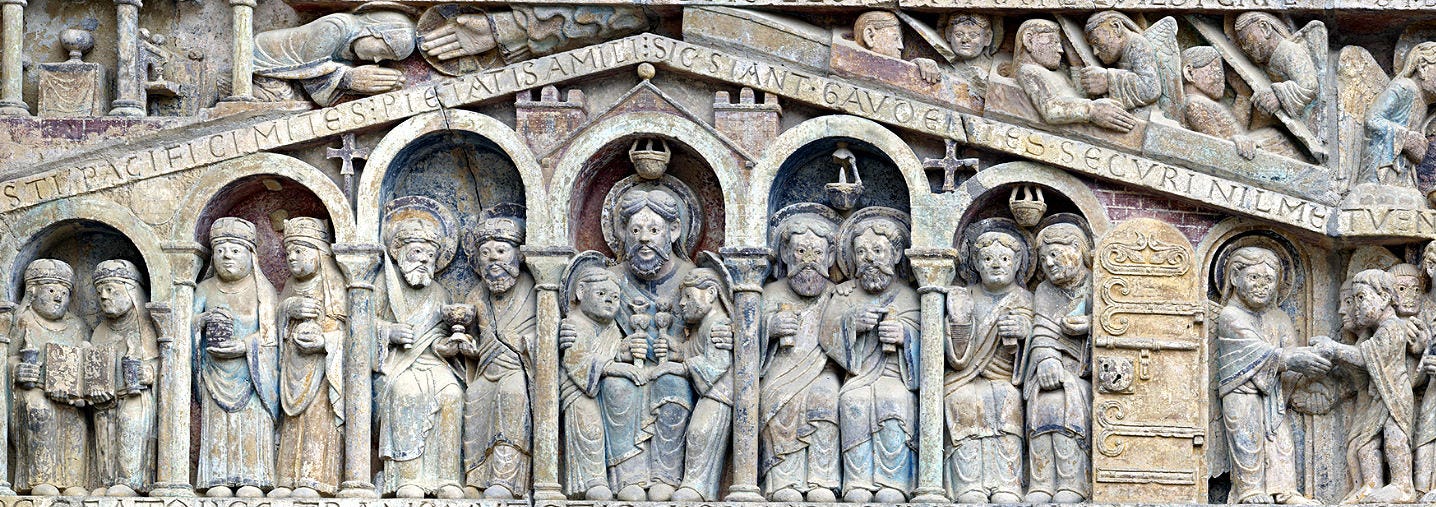
It is only further on, once this threshold is crossed, that disorder gives way to a peace that no longer trembles: beneath small arcades, serving as temporary dwellings, virgins carry their lit lamps, martyrs their palm or their chalice like trophies without pain, prophets their scrolls, which they no longer need to read, apostles their book, which holds no more mystery. At the centre sits the patriarch Abraham, recognisable by his two sons huddled against him, Ishmael and Isaac: his bosom has become the first image of rest after death. Here, at last, nothing moves in disorder, but I do not forget that reaching this point required that one last head turned towards what was being left behind.
I remain a long while without moving, my gaze passing from the face of Christ to his two hands, pointing to what lies above and below our human condition: the heaven from which the trumpets sound that rouse us from our spiritual sleep, and the earth on which we go on repeating our sleepwalking gestures, hurrying as one body in the wrong direction. I sense that this tympanum may tell not two fates but a single movement, split in two: on one side, that in us which knows how to stop, to consider life as a gift and a wonder to be cultivated, and which begins by standing at peace, without any anger, with what it has lived; on the other, that which goes on endlessly wanting, judging, justifying itself, demanding without gratitude or attention to others. Not two categories of human being, but two possible states of each of our instants, the whole tympanum standing as an invitation to discern on which side of the lintel we find ourselves at this precise moment.
My thoughts return then to my modest pilgrim: how did he read this warning, in a world where hope could only be conceived as the expectation of a paradise after death, a reward for servile obedience to an order upheld by nobility allied with the Church, each man confined to the chance of his birth with no hope of change here below? Could he read, carved at eye level, this sentence that already set him before the stakes of his own conduct:

‘O peccatores, transmutetis nisi mores, judicium durum vobis scitote futurum‘,
which means roughly: ‘O sinners, unless you reform your ways, know that judgement will be harsh for you’?

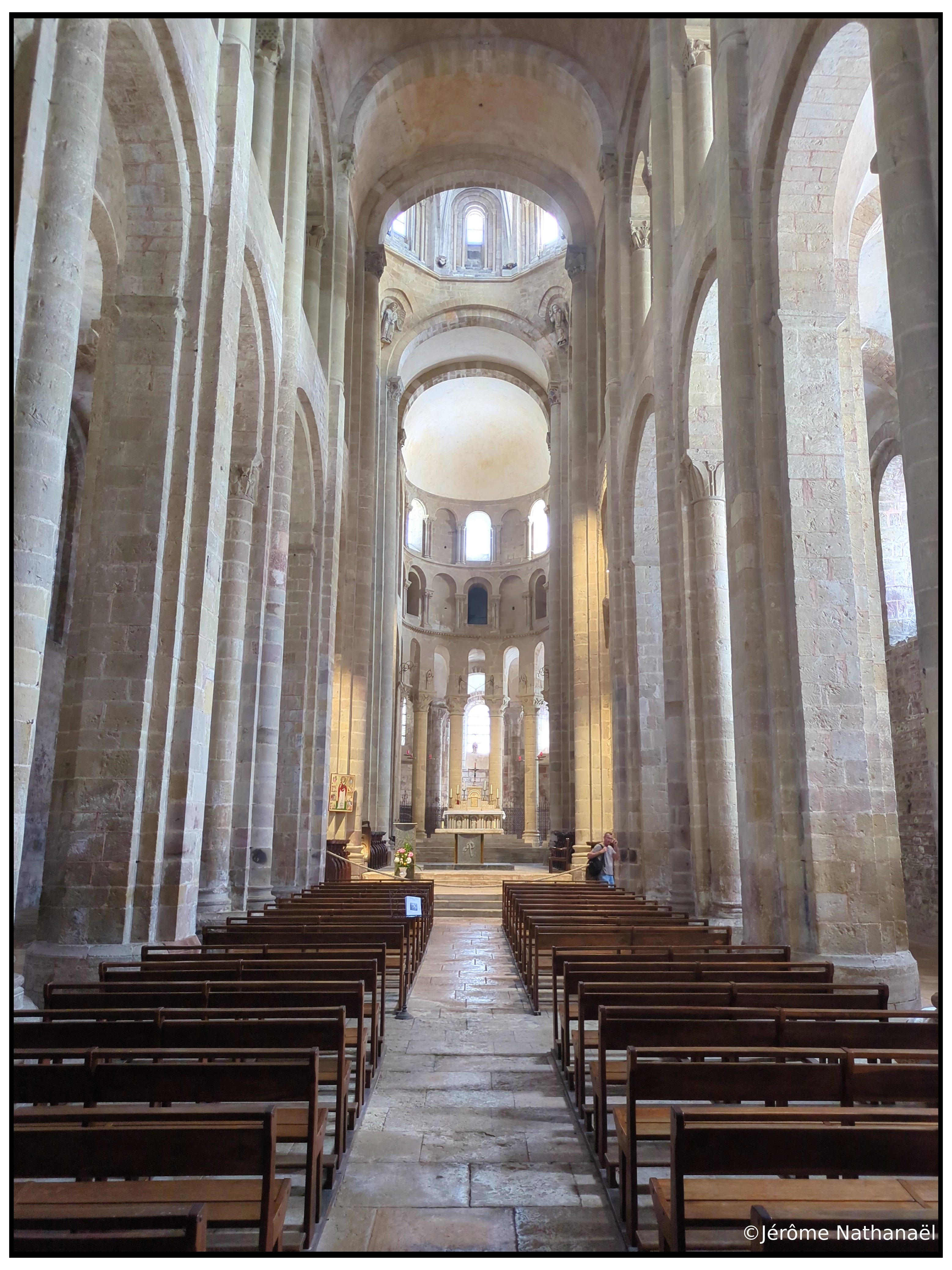
After the tympanum’s severe and demonstrative admonition, doubtless completed some decades after the main structure of the abbey church, this fearsome tympanum that cast our poor pilgrim into fear and trembling, he now enters the imposing vessel of stone, where he throws himself into supplication and tears, imploring G‑d to forgive him his faults, before perhaps going to confess to a priest, Christ’s representative on earth, empowered to absolve him of his sins.
I too, after this long and attentive contemplation, follow him into the abbey church, and there everything shifts into another dimension. Subscribing neither to the theology of the redemption of sins through Christ’s death on the cross, nor to the power of a priest, as much a sinner as anyone, to wash me of my faults, while tenderly respecting my Christian brothers who find in these certainties the strength to improve themselves and to carry Jesus’s message of love, it is something else that seizes me and touches me to the depths of my being. This nave, so high and so austere, fills me at once with a gentle, serene energy that I sense to be of a high vibratory level.
I wander slowly through the aisles, immersed in a deep inner silence, feeling beneath my feet different qualities of energy according to where I stop. Then I sit, in turn, at various places on the benches arranged there as in any Christian place of worship, facing the centre where, at the crossing of nave and transept, stands the altar reserved for the priests’ use. I spend some time chanting psalms in Hebrew, psalms of praise or thanksgiving, in gratitude for Life, the Wholly Other, the Nameless, who allowed me to arrive here and to discover this place, built long ago by men who were as conscious of telluric and cosmic forces as they were skilled in the architectural proportions that can bring them into resonance. Then I remain there, for a long while, resting in the meditative peace that gradually deepens, as I open myself to the particular vibrations that reign here, beyond any religion, any dogma, any word.
Finally, I decide to take a few dowsing measurements, to verify my intuitions. I discover that the abbey church is very probably aligned with an underground watercourse that runs beneath the nave and another that runs beneath the transept, and that their crossing point lies roughly at the level of the altar, the place of the highest energy, vibrating at around 2,300,000 Bovis units, a very high level. Let us recall that, today, within the framework of this method that I practise, the minimum vibratory level considered healthy for an ordinary person is around 12,000 to 15,000 Bovis. The abbey church of Conques is thus, as I had sensed, an exceptional building, radiating over the whole village, which also explains the importance it took on for the pilgrims of Compostela.

During my two days in Conques, I shall also attend vespers and compline, not out of religious conviction, I think it needless to stress this again, but because I love to hear singing, in these privileged spaces that certain places of worship are, the soft and peaceful chants that accompany the liturgy of the hours, and to share in the faith of others, so diverse among human beings. And, as I write these words, there returns to my memory a text by the young Rainer Maria Rilke, drawn from his Book of Monastic Life, which I give you here in my own translation.
"I have many brothers wearing cassocks
in the south, where laurel grows in cloisters.
I know how humanly they fashion their Madonnas,
and dream, at times, of youthful Titians
through whom God passes in a glow of embers.

Yet however far I bend down into myself:
my God is dark, and like a weave
of a hundred roots that drink in silence.
Only this: that I rise up out of his warmth —
no more do I know, for all my branches
rest deep below and only wave in the wind."

To bring this article on the abbey church of Conques to a close, I have still to tell you about its stained glass, that other work, a contemporary one this time, which Pierre Soulages patiently brought into being there between 1986 and 1994.
The story begins well before the official commission: Soulages, born in Rodez, discovered the abbey church at the age of twelve during a school trip, and never ceased, throughout his life, to recall that it was there, he said, that he had felt his first artistic emotions. It was this childhood imprint that the french Ministry of Culture revived in 1986, when the Delegation for the Plastic Arts and the Directorate of Heritage commissioned him to create the building’s one hundred and four stained-glass windows, a project that would occupy the artist for seven or eight years, until 1994.
To refuse painting, that was Soulages’s first gesture: he wanted no windows that would amount to mere adapted paintings, coloured designs offering, by transparency, an image that could just as well have been painted on canvas. It was in the spirit of Cistercian renunciation that he set his search, referring to the statute issued by the order’s General Chapter in the twelfth century, in the wake of Bernard of Clairvaux’s reform: ‘Vitreae albae fiant, et sine crucibus et picturis‘, ‘let the windows be white, and without cross or images’. Soulages was thus seeking neither a colour nor a biblical story to tell, but a quality of light: he said he had wanted only to serve this architecture as it had come down to us, respecting the purity of its Romanesque lines and proportions, rather than superimposing upon it some reconstructed or dreamed-up Middle Ages.
What remained was to invent, quite concretely, a glass that did not yet exist. Soulages first looked towards alabaster, too thick for the window bays; he toured the glassmakers of Europe and the United States, without finding that translucent, shifting glass he had in mind, a glass that would let light through but not sight, so that nothing, within this enclosed space, might draw the pilgrim’s attention outward. Failing to find it, he decided to invent it himself, and from January 1988 began a collaboration with the CIRVA in Marseille, then with the Toulouse master glazier Jean-Dominique Fleury and the Saint-Gobain glassworks.
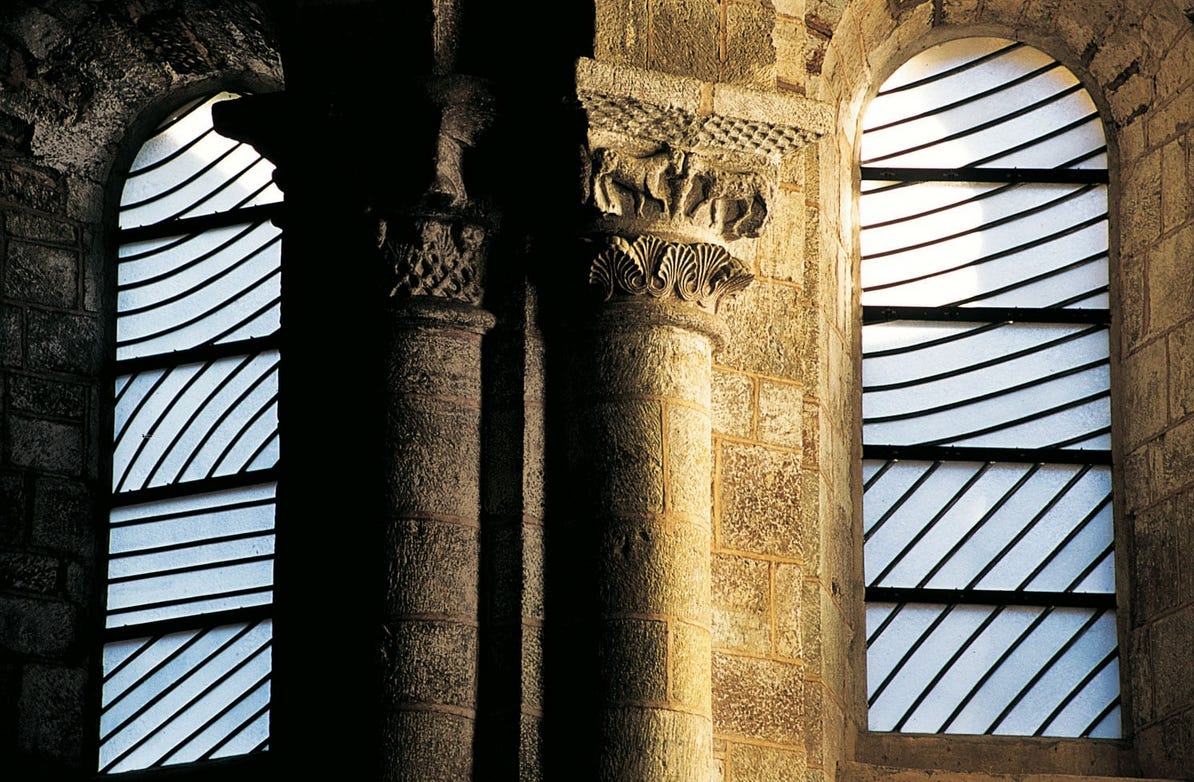
The work amounted, in some respects, more to laboratory research than to studio craft: nearly four hundred failed attempts in Marseille, then three hundred more at Saint-Gobain, not counting the trials carried out at Saint-Rambert, close to seven hundred attempts in all, spread over seven years, before arriving at the technique finally adopted. The principle eventually settled upon was to crush molten glass to obtain grains of differing sizes, calibrated and then fused by heat within a single mould: it is this variable granulometry, not a simple ground surface, that allows the translucency of the material to be modulated at will, without ever making it entirely transparent. Set directly into the window openings, without a traditional border, these irregular panels each carry their own unevenness, their patches of greater or lesser density, their very imperfections becoming the signature of each piece within the unity of the whole. The saddle bars, the metal frames that usually support a stained-glass window without ever claiming a place within it, are here fully integrated into the composition: Soulages compared the rhythm of their undulating lines to a breath, a silent melody running through each bay in dialogue with the eleventh-century Romanesque volumes.
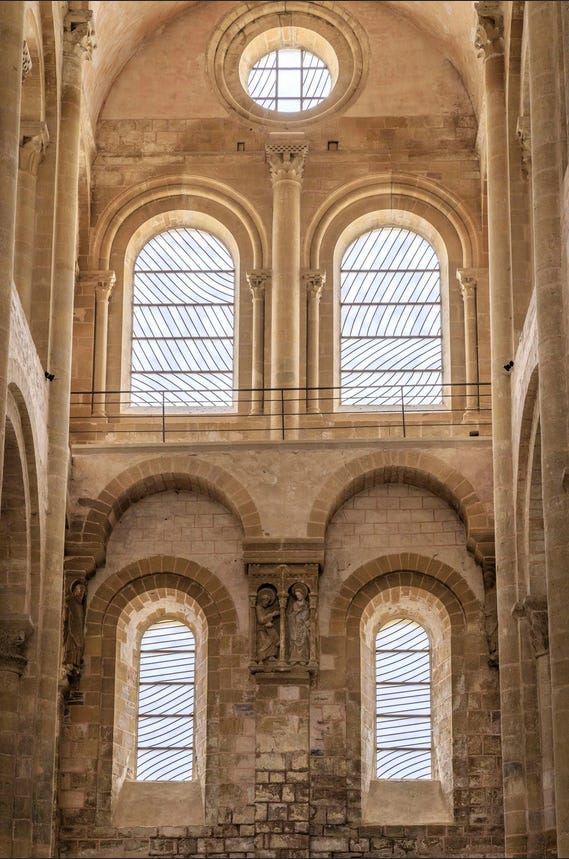
Coloured despite itself by the red and ochre sandstone of the stone and by the blue schist of the surrounding landscape, this glass, colourless in itself, composes, hour after hour and season after season, a light that Soulages wanted to carry contemplation, silence, concentration, inwardness, not a further decoration added to the Romanesque building, but a continuing dialogue with it, eight centuries after other hands had carved, on the neighbouring tympanum, a wholly different vision of the relation between stone and light.
Soulages’s stained glass forms, indeed, a striking counterpoint to the iconography of the tympanum: on one side, a Romanesque art that narrates and judges, on the other a contemporary, abstract art that falls silent and simply lets the light do its work, two spiritual regimes within a single building, separated by nine centuries, one cataphatic (which speaks and shows), the other apophatic (which withdraws to make room). Together they transform the abbey church into a prodigious place of inwardness, inviting an exploration of the self according to our own inner fluctuations, ceaselessly drawing our gaze back within, letting us taste only the modulations of light upon our quieted soul, allowing us to escape the distraction that biblical representations would have constituted, so as to leave us open before the Mystery.
Through this sublime work, it seemed to me that Soulages had brought the abbey church into a new dimension, transforming a place inhabited by ancient representations of the divine into a renewed place, enjoying a great upward projection already favoured by the sobriety of Romanesque art, but perhaps even more so by an approach that meets the simplicity of Zen. This work also recalls to us the affirmation that the Wholly Other remains beyond all representation, whether pictorial or conceptual, as it is said in the Decalogue:
‘You shall not make for yourself a carved image, nor any likeness of what is in the heavens above, or on the earth beneath, or in the waters under the earth. You shall not bow down to them, nor serve them.’ Exodus 20:4–5
Soulages’s stained glass thus opens for us, on the very site where a magnificent tympanum saturates us with images born of theological reflection, onto a spirituality of stripping-away and of the Living’s shifting simplicity.
It is perhaps this contrast, between an ancient spirituality, still full of teaching for anyone who wishes to make of it a path of real progress, and the spirituality yet to be born that these innovative windows suggest, which seem to me to resonate with the wake of the twentieth century’s Words of Life, such as Dialogues with the Angel or The Sign, that will remain for me the most fruitful experience of my stay in Conques.

That is all for today! In the next article, I shall tell you about my discovery of Decazeville, a former mining and steel town now in decline, struggling to find a second wind, whose history genuinely moved me, for among my forebears I count workers and trade unionists, such as my paternal great-grandfather, who was a committed activist in the CGT during the time of the french Popular Front.
Until then, fair winds to you all,
Jérôme Nathanaël
Next article : « Memory and the walls », Decazeville, a stricken mining town, Gustave Moreau's Stations of the Cross, and street art.
© 2026 - Dialogues of the New World — Jérôme Nathanaël

To continue
Have you known a place where something within you fell silent, shifted, or was illuminated in a particular way? Share this living experience in the comments to invite us into movement.
If you would like to say more about a place that matters to you, a contribution of around a page for the Waymakers section. It will be published under your initials, a pseudonym, or anonymously, as you wish. Other readers will be able to respond to it and enter into dialogue with you.
New here? The Opening page introduces the author, the project, how to take part, contact details and the calendar.