
Article disponible en français
Notebooks of life · Travels · 11 min
Approaching the places, the wanderings and the retreats where the earth keeps memory of the human quest.

Series: Le Puy-Arès 2026: an account of an inward journey | Article 1
29 June 2026
Dear readers,
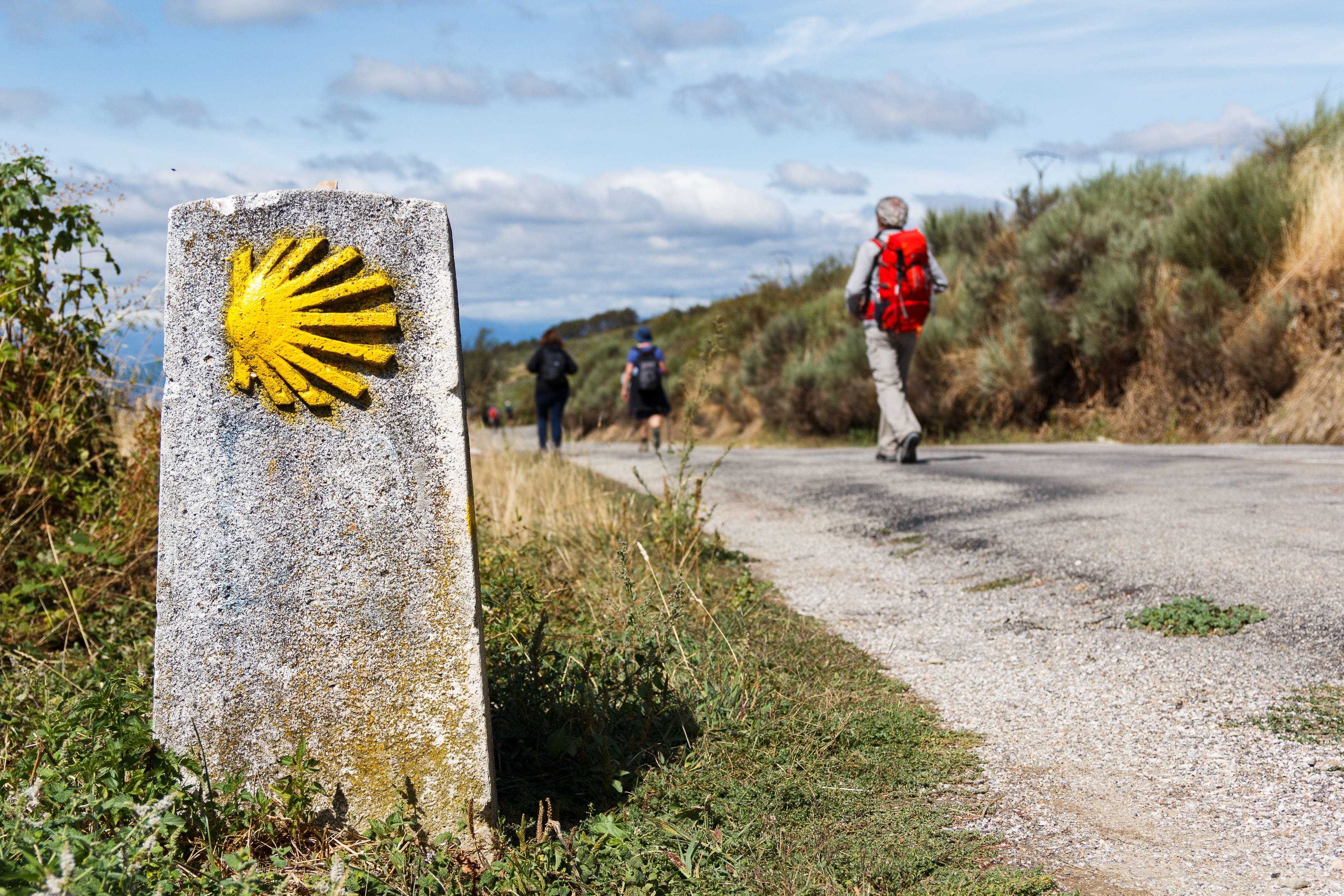
Here I am, back at my writing table. I have reopened my laptop, which had lain dormant since the 8th of June, and found the keyboard again in order to write to you. Over these three weeks, I walked for ten days along the Via Podiensis of the Camino de Santiago, waymarked as the GR65, that is to say the 225 kilometres separating Le Puy-en-Velay from Decazeville, passing through Conques and its splendid Romanesque abbey church, before joining the village of Arès in the Gironde, where Michel Potay received, in 1974 and 1977, what became The Revelation of Arès, a prophetic text on French soil.
I had initially intended to publish a few short pieces during my journey, in order to keep in touch with you and not break the rhythm of these Dialogues, but the daily walking, most often solitary save for brief moments, drew me entirely away from that project. Then the time of inward retreat at Arès finished off my resolve to abandon it, and so I decided to wait until my return to the Paris region before sharing with you a few impressions of this period. After three weeks of total disconnection, from current affairs as much as from social media, I feel this afternoon something like an unease at changing garments, at setting aside those of the walker and the man at prayer, confronted with nothing but his own inward solitude and the mystery of the Wholly Other, in order to put on once more those of the author who would wish to say, with words, those poor stammering and clumsy witnesses, what he has gleaned by way of teaching during these moments of life.

For as soon as we leave the language of objects to enter that of ideas or of the inner life, the incommunicable part increases, for want of a shared experience to fill the words used with meaning. One and the same word may then, depending on the person, cover meanings that are wholly contrary, or trigger mental reflexes that render it inaudible when another word would have aroused interest. Draw up the list of words thus rendered unusable, as sources of confusion or misunderstanding, and you find yourself reduced to a language of staggering poverty!
One must therefore take the risk of being misunderstood, or of being stamped with some more or less comfortable label, which will shut you into a dark and narrow room from which it will be difficult to escape. Moreover, in this age of TikTok, Instagram and YouTube, channel-hopping is the order of the day, and a form of house arrest, being confined to one’s assigned category, has become common practice. The temptation to remain silent would thus be great, were it not for the will that drives me, without any desire to shine, to contribute however little towards pointing to horizons of hope and renewal, and towards seeking out spaces for dialogue and spiritual progress.
Happily, this difficulty in communicating a complex thought or subtle feelings without provoking misunderstanding proves to be lessened with those who read me regularly, who grow accustomed to my language and wish to penetrate my thought and my world. So thank you, my dear readers, whom I have made it a habit to picture reading me, in order to encourage myself to continue this work of writing. It is therefore with greater joy and momentum that I now continue this text.

To come to the heart of the matter, I must explain why I chose to walk this section of the Camino de Santiago rather than follow another waymarked trail, as I have done in the past. I might, for instance, have returned to the GR of the Écrins or the Queyras, where the elevation gain and loss can exceed 1,000 metres within a single day, where the passes can rise to 2,900, and which correspond more closely to my love of mountains and high places, rather than choosing this path of modest slopes, with a maximum ascent of 550 metres, culminating at 1,369 metres on the Aubrac plateau.
But I wished to discover this pilgrim way, one of the great constructions of western medieval civilisation, in which the religious and the political did not merely intersect but were intimately interwoven at every stage of its history. Walked from the ninth to the seventeenth century by millions of pilgrims in search of the forgiveness of sins, of graces for the departed, and of some form of direct communication with the divine, the pilgrimage to Compostela then underwent a long decline before being reborn from 1987 onward, the year in which the Council of Europe proclaimed the Camino de Santiago the ‘first European cultural route’. The contemporary pilgrimage, undertaken by millions of walkers whose motivations blend spiritual quest, sporting challenge and self-discovery, thus perpetuates this founding tension between the intimate and the collective, between the inward path and the construction of a civilisational identity.
Walking a section of the Via Podiensis, which links Le Puy-en-Velay to Santiago de Compostela in Spain, one of the two most frequented routes along with the one setting out from Vézelay, thus allowed me to combine meditative and spiritual walking with meeting today’s walker-pilgrims, so as to question them about their motivations and their experiences. I had even planned to conduct a few interviews before abandoning the idea, thinking that spontaneous exchanges would be less formal and more authentic, and above all less intrusive.

And so, each day, whether by chance at a meal stop, near a fountain, or in the evening at the pilgrim hostel, I was able to talk with a good many people, around forty in all, in conversations that were at times long and searching, reaching into personal and intimate matters, and at other times more concise and superficial, but always with a quality of spontaneity and simplicity that stands as one of the strongest observations I made during the journey. I always perceived in those I spoke with, whose differences of culture, sensibility or social standing were quickly apparent, the same need for humanity and authenticity, as though the mere fact of being on this path already created a common bond strong enough to venture sharing and exchange. Affinities of varying strength might reveal themselves, sometimes limiting the depth or the duration of the exchange, but each had dared, each had felt the desire to discover the other.
For the path humbles us and brings each person back to simple things, through which social masks, any wariness, and automatic reserve are softened. The walker has sore feet, he has blisters, he is perhaps tired from the weight of his pack, he will be glad to learn that the hostel is not much further, or that there is a water point nearby where he can refill his flask. And in the evening, each recounts the wonders or the mishaps of the day. People are no longer entirely separate, wary of one another; a slender but real bond connects them.
Of course, I had already experienced this among mountain folks, those one meets at high altitude, but they are a particular type of person. On this path, it was truly a matter of the ordinary man and woman in the street, sometimes even people for whom this was their first experience of walking, those same people I might pass in city streets and see step aside without a word should I address them, or, worse still, who might feel accosted and shoot me a fierce glance in return should I merely look at them on the underground.
Was it because these walkers, men and women alike, were pilgrims on the way to Compostela that something in their hands and their hearts consented to open more readily to another? Was it because they were, sometimes even confusedly, open to questioning, about themselves, about the meaning of their presence in the world, that they found themselves to be more human? I allow myself to believe so, for it seems to me that this kind of questioning, whether formulated consciously or as a mute yearning dressed in the desire to reconnect with nature and escape the stress of cities, renders whoever is stirred by it more available and more permeable to another.
By contrast, clinging to one’s certainties, sometimes even forcing oneself still to believe in them in order to survive, believing in one’s social role, one’s fortune, one’s identity, renders one more readily rigid and distant towards whoever is perceived as different, confining the person within the bottleneck of a fixed ego, anxious to guard its vital space. It is easier to identify with a role and with firmly settled convictions than to consent to espouse the movement of life and its ever-renewed teachings. This is why doctrines, whether religious, political or philosophical, can divide human beings as much as they help them to live, folding them back upon themselves or upon their communal identity.
But when a human being accepts his fragility, when he consents to welcome his questions and his inward contradictions and to walk patiently alongside the unknown and the mystery, when he ceases to feed his fears in order to honour every beauty, every smile, every birdsong, then perhaps he may learn and grow otherwise, perhaps he may recognise in the other his fellow, his companion on the way. Perhaps it is something of this that touches the walkers on the road to Compostela.
For very few of them seemed to me to be walking it as a Christian pilgrimage, perhaps one in ten at most, yet all of them lived it as a pilgrimage of life, a moment in which to draw closer to it, to taste it differently, to step outside the confinements of daily life in order to feel something one intuitively senses as closer to one’s inmost being. Once again, I was able here to gauge just how heavily the sum of constraints generated by our modern societies weighs upon the possibility of truly living, and how much this engenders sufferings and frustrations that isolate people and confine them to a survival far removed from the best of themselves.
But when the individual decides to take a step sideways, when he allows himself to leave his charted road in order to take, if only for a few moments or a few days, a new way, to walk a path inhabited by an inspiring memory, to practise an activity that reconnects him with his creativity, or a little with his essential self, then something occurs. A breach can open in the citadel of habits, of automatisms, of certainties within which he has shut himself away to protect himself and to ward off the atavistic fear of the dangers of a world that forever eludes him, and in which another, his gaze or his acts, may be the worst danger, as Sartre reminded us in the celebrated line spoken by Garcin at the close of No Exit: ‘Hell is other people.’ Through this breach, Life forces its way in, awakens our humanity; it speaks within us through new emotions, startling thoughts, unexpected behaviours.
Thus on the path, this Life circulates more strongly and more swiftly, passing from person to person, as though each encounter mended a little of what has been torn, among men, since the beginning. It reweaves the bond of trust that the first murder, that of Abel by Cain, began to destroy, and which the immense succession of violence, injustice, domination and falsehood filling the centuries has rendered as fragile and tenuous as the memory of our origins, somewhere in the womb of the sacred Earth, sown by Heaven.

It might perhaps be enough for this fragile experience, this opening practised for a moment within the heart and the mind, to take on its full importance in the life of whoever receives it consciously and with gratitude; it might perhaps be enough for him to remember it, to make of it a permanent reminder within his existence and a help in avoiding being too quickly overtaken by the atavistic impulses of fear and withdrawal into oneself, for his journey travelled towards Compostela to become, day by day, a resolute walk towards the star of Love.
For whoever cultivates the memory of his most luminous moments and of instants of complicity with his neighbour, whoever keeps the taste of them so as to remain awake to the beauty of the world, better preserves himself from the brutal shadows of social reality and can begin to spread around him another quality of presence.
And this quality of presence, woven of kindness and openness to Life, restores meaning, a direction and a hope, to every moment and every place in which we are able to embody it. It pushes back a little the tumults and the angers that roll across the surface of the earth, and bears witness that another world is possible, if we begin to build it within ourselves.
“See, I have set before you this day life and good, death and evil... Choose life, that you may live, you and your descendants.” Deuteronomy 30:15 and 19.

So much, then, for a first share of my reflections and experiences lived through during these three weeks. As this section, my Notebooks of life, is not intended to hold long texts or essays, but rather reflections drawn from my personal life, I shall share the rest with you in forthcoming articles. I shall thus speak to you of the spiritual benefits of walking, of the abbey of Conques and Soulages’ stained-glass windows, of Decazeville the blighted, and finally of my week of pilgrimage at Arès, at the site of the Revelation of 1974 and 1977.
Until next time!
Jérôme Nathanaël
© 2026 - Dialogues of the New World — Jérôme Nathanaël
Next article : « The step and grace », on the spiritual benefits of walking.

To continue
Have you known a place where something within you fell silent, shifted, or was illuminated in a particular way? Share this living experience in the comments to invite us into movement.
If you would like to say more about a place that matters to you, a contribution of around a page for the Waymakers section. It will be published under your initials, a pseudonym, or anonymously, as you wish. Other readers will be able to respond to it and enter into dialogue with you.
New here? The Opening page introduces the author, the project, how to take part, contact details and the calendar.
Merci Jérôme pour ce partage "initiatique".
Effectivement, ce Sentier nous invite à avancer dans ce chemin qu'est la connaissance de soi.
Comme vous le mentionez si bien, l'effort affaiblit nos barrières et nos limites pour mieux se rencontrer dans l'autre, et ainsi, pour mieux reconnaître l'autre en nous.
On dit que ce Chemin suit le tracet de la Voie Lactée; comme si les étoiles, dans leur éclat et dans leur ordre, cherchaient à illuminer l'observateur éclairé...
Vivement la suite,
Emmanuel