
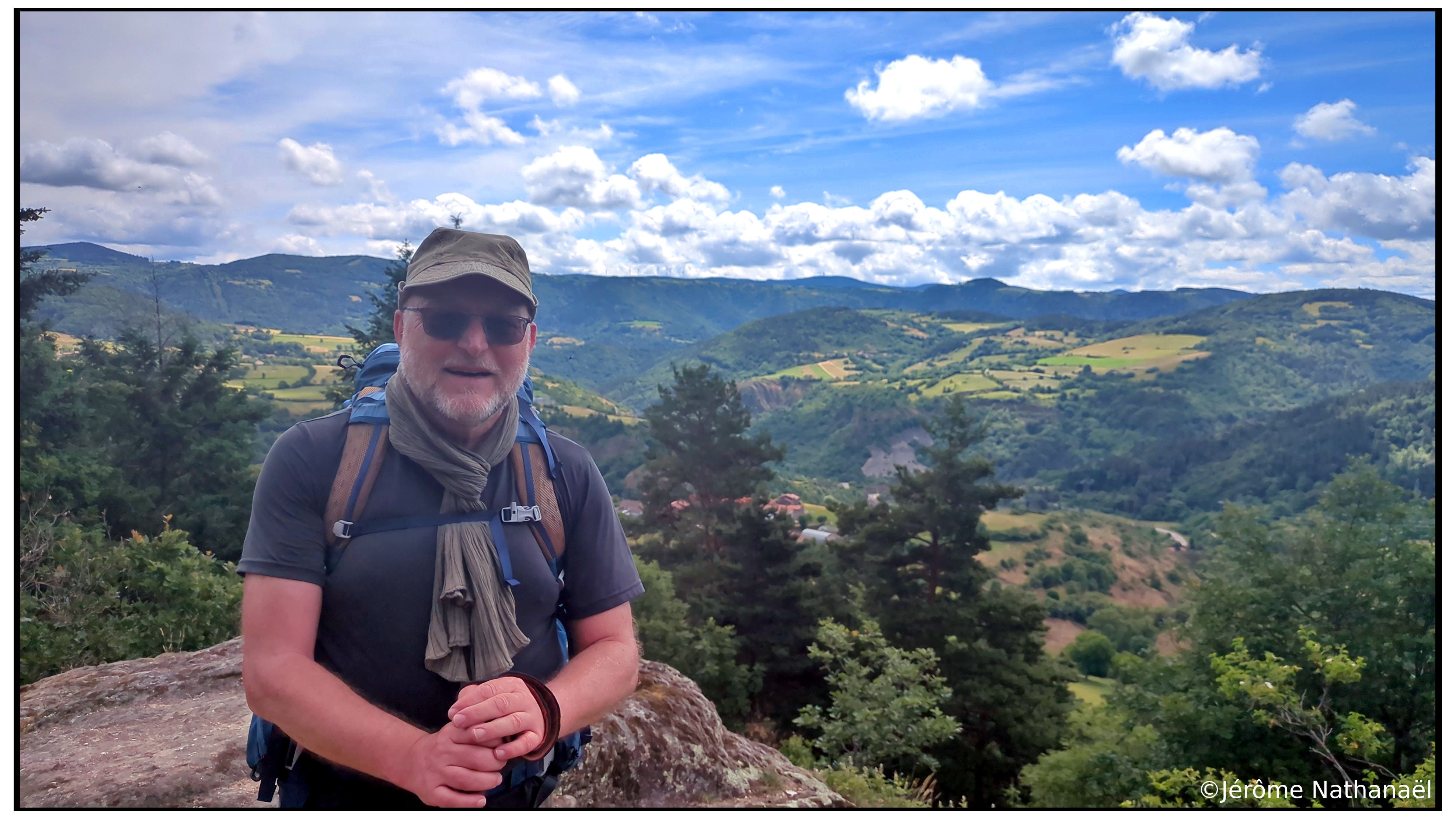
Article disponible en français
Notebooks of life · Travels · 12 min
Approaching the places, the wanderings and the retreats where the earth keeps memory of the human quest.

Series: Le Puy-Arès 2026: an account of an inward journey | Article 2
1 July 2026
Dear readers,
At the end of ‘The breach and the path‘, I promised to return to the spiritual benefits of walking as I experienced them during those ten days on the Via Podiensis. I venture into it today, with the caution the task demands and which I already explained at length in the previous article: to speak of the fruits of an intimate experience is always a perilous exercise, for neither the body nor the inner life lends itself easily to translation into concepts, and what I lived through those kilometres resists, in part, the putting into words I am nonetheless about to attempt.

I remember precisely the moment I felt that something was happening which no longer belonged to the order of mere physical exercise. It was towards the end of the first day, somewhere before Saint-Privat-d’Allier, under a fine rain that could not decide whether to stop or to worsen. My feet already ached a little, I had already covered some twenty kilometres, with a few unpleasant stretches along tarmacked country roads, my pack suddenly felt heavier than at the outset, and yet, quite suddenly, I sensed a kind of calm settling in, an inner release that had no connection with the state of my body.
It is this strange dissociation between the fatigue that persists and the peace that settles in despite it, almost alongside it, that reminded me of what I find on every long walk along a GR trail: walking does not act by suppressing the discomforts of existence, it works a profound change upon what discomfort means.

By the second day, I felt my habitual concerns, my responsibilities, the files left pending in Paris, receding at a speed I no longer knew to be possible, not that I had forgotten them, but they had ceased to be the reference points from which I thought of myself. I had become, quite simply, a walker among other walkers, reduced to elementary concerns, the next fountain, the state of the weather, the distance to the hostel, and this lightening, far from impoverishing me, made me available in a way that is difficult for me to attain in my city life.
There was something here like a shedding of self without a loss of self, a furlough from my own history, a temporary suspension of the multiple identities, professional, social, familial and others, in which, like all of us, I ordinarily hold myself. This happy effacement of my habitual identities was nonetheless nothing like an annihilation or a troubling depersonalisation: it was rather a setting-down, in the sense that one sets down a burden one had been carrying without even being aware of it.
The ego does not die on the path, but it loses, for a time, its function as vigilant guardian, that ever-watchful instance which assesses, compares, protects and, in so doing, separates. This progressive stripping-away joins what the desert traditions, whether the Desert Fathers of Egypt, the Sufis walking towards Mecca across the arid expanses, or Jesus’s forty days in the desert before his public life, have always recounted: the physical trial of privation creates the conditions for an inner freedom that no reasoning, however rigorous, manages to produce on its own.

Before setting out, I was wary of the very idea that long walks might be raised to the rank of a genuine spiritual exercise, fearing I would find in it a rather facile celebration of a gesture that is otherwise so ordinary, so apparently devoid of any symbolic weight. I have practised Buddhist walking meditation, slow and deeply inward, but it is practised over relatively short durations and without a load, whereas this time it was a matter of walking for several days, without any particular demand for attention, but carrying, over long distances, a pack that, even reduced to the bare minimum of equipment, remains far heavier than for a single day’s outing in the high mountains.
I had to revise that judgement within the first few days. There exists an alchemy between mind and body that sedentary life habitually dissociates, shutting each into its own register, the one busy, agitated, turned towards anticipation, the other reduced to a function of transport, almost forgotten so long as it does not fail. There, I was able to recover, step after step, that accord between the rhythm of the walking and the rhythm of reflection: a moment when thought ceases to run ahead of the body or trail behind it, when it matches the step exactly, neither faster nor slower, in a kind of synchrony that produces a mental calm which seated meditation, though practised for years, has rarely given me with such self-evidence.
There is an almost mechanical explanation for this, which I offer without pretending to exhaust its complexity: the deliberate slowness of the step imposes upon the mind a tempo it does not choose but to which it ends by submitting, and this rhythmic constraint, far from being a hindrance, liberates a form of deep thought, less agitated by the rapid associations and anticipatory anxieties that clutter our urban daily life.
I do not claim that all my thoughts, during those ten days, were of this contemplative quality. There were hours when I was confronted with the weariness of walking, when I counted the remaining kilometres, along with fairly banal inner conversations about the rising heat or the aches in my feet. But these moments of more intense presence, when they occurred, had a clarity I have found in no other practice.
This synchrony between step and thought found a further extension in another register, that of solitude itself. There is a difference in nature between imposed isolation, the kind one knows in a city where one can feel dreadfully alone in the midst of the crowd, and chosen solitude, which excludes no one but depends on no one either to feel fully alive. It was the latter I practised on the path, walking alone most of the time, by choice as much as by circumstance, and it was nothing like an ordeal to be overcome: it is a territory I know and have long appreciated, the very one my long-standing meditative practices had already taught me to inhabit without unease, seated, motionless, eyes half closed.
But walking added to this what stillness does not give: its incarnation in movement. The hours spent without exchanging a word, sometimes three or four hours at a stretch along the least frequented sections between two stages, produced an inner silence of the same nature as that of the most austere retreats, traversed this time by the body in motion, by the changing landscape, by the very fatigue that became an object of attention among others rather than a discomfort to be ignored.
Thus, walking alone, for long stretches, through a landscape that renews itself without ever demanding anything from you in return, prolonged within my body what meditative practice had already laid down in my mind, a psychic sobriety, a capacity to find myself fully sufficient unto myself in the absence of any outward gaze to confirm it. If the path taught me nothing fundamentally new on this point, it offered this already acquired sobriety a moving ground on which to exercise itself differently.

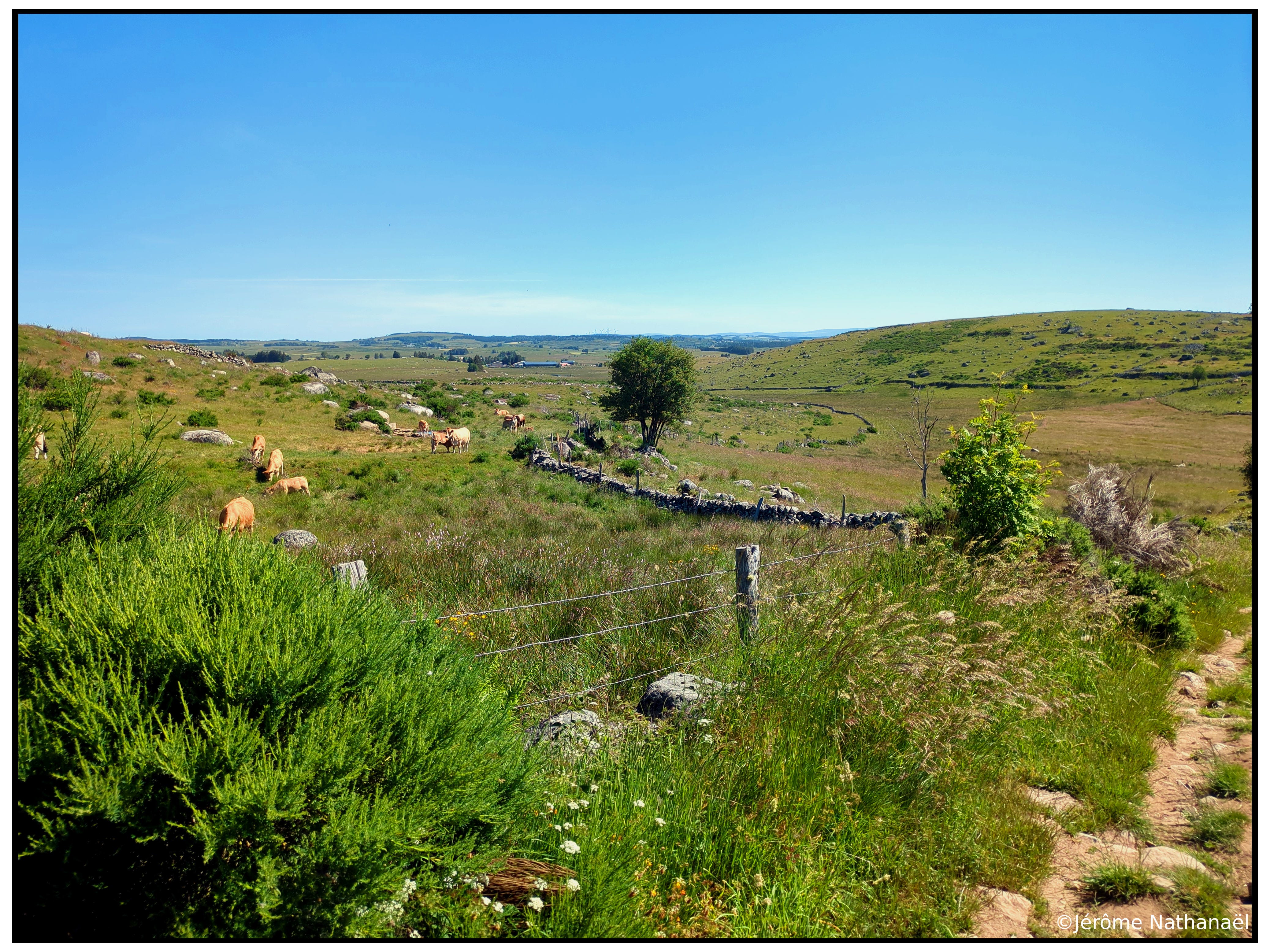
I would not wish, however, to idealise this ten-day walking experience to the point of erasing what was harsh about it. Prolonged walking hurts, in a quite concrete way, and this pain is not a detail one could dispense with while keeping the benefits: it is, I believe, one of their conditions. René Daumal, in his reading of the ascent of summits, saw in it a living metaphor as much as a concrete practice of inner elevation, requiring conscious effort and a form of freely consented suffering as prerequisites to any authentic transformation.
I climbed no summits during those days of walking — the Aubrac plateau, despite its 1,369 metres, remains almost deceptively gentle compared with the Écrins, which I love more — but I found there the same logic on a reduced scale: it was precisely because the body suffered a little, because each stage demanded a real and renewed effort, that the mind consented to let go of its habitual resistances. A discipline too comfortable, I suspect, would not have produced the same effect. There is, in asceticism, whatever tradition carries it, this true intuition that the crossing of a physical threshold opens a corresponding inner threshold, and that, often, one does not go without the other.

But what perhaps unsettled me most was the way my perception of time ceased to function as usual. I do not mean here some ecstasy outside time, nothing so spectacular, but a strange impression of dilation, where a day of walking, six or seven hours during which almost nothing objectively noteworthy occurred, nonetheless seemed to me to contain more lived reality than certain days of my ordinary existence, in which I am sometimes occupied with managing the absurd constraints imposed by the workings of society. It is not, of course, that time was truly dilated, but rather that my attention, freed from its habitual solicitations, screens, notifications, various obligations fragmented into dozens of daily micro-decisions, finally settled upon what was there, before it, with an unaccustomed acuity.
Every stone on the path, every cloud, every greeting exchanged with another walker became a complete event in itself, unattached to what had preceded it and not anxiously projected towards what would follow. This is perhaps, more than anything else, what the contemplative traditions call presence: not an absence of thought, but a thought that ceases to flee the instant in which it finds itself, an attention to the almost nothing that then takes on its true, full dimension.

I have already recounted, in my previous piece, how struck I was by the spontaneity of my exchanges with the other walkers, and I do not wish to return to it in detail. But I must point out that this relational quality constitutes, in my eyes, a spiritual benefit in its own right, an unexpected grace, and not a merely pleasant side effect of walking.
Surveys conducted on the Camino de Santiago indicate that only around four walkers in ten set out for explicitly spiritual reasons, the other motivations falling under sport, tourism or a simple need for a break, and yet, whatever the initial motivations, the dimension of self-transcendence remains what pilgrims most unanimously report as the fruit of the experience. I verified this every evening, in the shared kitchens of the hostels, where strangers spoke of themselves with a frankness that would have been unthinkable in any other social context.
It is not so much that the path makes people better than they are; it is rather that it temporarily strips away the layers of social caution which, in ordinary times, prevent us from showing ourselves as we are. And this reciprocal unveiling, fragile and temporary, seemed to me an authentic experience of communion, in the most stripped-down sense of the term, not the ritual communion of an assembly of believers sharing a single symbol, but the more elementary communion of tired bodies recognising, in other tired bodies, a shared vulnerability, a shared need for rest, cool water and a kind word at the end of the day.

There is a final dimension I cannot pass over in silence, because it questions my own approach as a spiritual seeker. The sociologist Danièle Hervieu-Léger has shown that the contemporary pilgrim most often walks in search of the meaning of his life, or in search of a faith not yet born, of a sacred that no longer needs an altar, rather than being carried by an already firmly established belief, and I recognised myself in this description, which would have been quite inconceivable to a medieval pilgrim walking towards an apostle’s tomb.
Likewise, according to a 2018 Pew Research Center survey, a little over ten per cent of Western Europeans would today define themselves as spiritual without being religious and, although I fully own the inheritance of several traditions, I no doubt belong to this sociologically recent category, which invents, as it goes, the forms of a sacred that no institution any longer marks out. This has evident advantages, a freedom of inquiry, a demand for personal verification that I claim as my own, and an equally real drawback, one I felt on the path itself: the absence of a shared ritual framework obliges each person to reconstruct alone the meaning of what he is going through, which is at once an opportunity and a demanding challenge.
This is perhaps why the stop at Arès, with its more precise anchoring and its particular spiritual memory, came so naturally to close these days of walking: after the fruitful but diffuse wandering of the path, I needed a place that would stand on its own, independently of whatever I projected onto it.

I would be dishonest if I claimed that this state of inner receptivity, of inhabited silence and acute attention, remained intact upon my return. From the very day after my return to Paris, once the boots were put away, I found again the difficulty of preserving, amid the ordinary tumult of an urban life reinvested with its obligations, the quality of presence acquired step by step over those three weeks. The spiritual benefits of walking are not definitive gains one could carry home in one’s luggage like a souvenir; they are states that can quickly fade if one does not take care to sustain them, through short, regular walks, through a renewed vigilance over whatever, in our daily agitation, draws us away from this availability to the real.
What I can say, on the other hand, is that something of the path continues to work within me, quietly, like an imprint: I catch myself, on certain mornings, deliberately slowing my step in my own neighbourhood, paying attention to the contact of my foot on the pavement, a gesture trifling in appearance, but one that reconnects me, for a few seconds, to that quality of attention which the Via Podiensis offered me without my having truly sought it.

In the coming pieces, I shall tell you of the abbey of Conques and its Soulages stained-glass windows, then of Decazeville and its industrial desolation, before finally leading you to Arès and that week of retreat which gave the whole journey its true meaning. But I wanted first to leave you with these few reflections on what the simple act of putting one foot before the other, day after day, can work within us, without dogma, without an obligatory sacred destination, with fidelity to the next step as its sole requirement.
Until next time,
Jérôme Nathanaël
© 2026 - Dialogues of the New World
Next article : « The judgement and the light », on the spiritual benefits of walking.

To continue
Have you known a place where something within you fell silent, shifted, or was illuminated in a particular way? Share this living experience in the comments to invite us into movement.
If you would like to say more about a place that matters to you, a contribution of around a page for the Waymakers section. It will be published under your initials, a pseudonym, or anonymously, as you wish. Other readers will be able to respond to it and enter into dialogue with you.
New here? The Opening page introduces the author, the project, how to take part, contact details and the calendar.