
Article disponible en français
Notebooks of life · Travels · 24 min
Approaching the places, the wanderings and the retreats where the earth keeps memory of the human quest.

Series: Le Puy-Arès 2026: an account of an inward journey | Article 4
6 July 2026
To Émile L., my great-grandfather.
Dear readers,
Here is the penultimate article in this series, in which I share with you what my walk taught me, from Le Puy-en-Velay to Decazeville, passing through Conques, where I discovered the abbey church and its stained-glass windows, and then my spiritual retreat in the town of Arès. You will find the three preceding articles by following the link above, which points to the complete series.

Today I turn to what my visit to Decazeville inspired in me, the final stage of my walk, which I had to reach in order to find a train to Bordeaux. As with the previous stages, I wanted to avoid the worst of the heatwave, and so I left Conques very early, after a last meditation in the abbey church, still empty and, to my great surprise, already open, lit only by the first light of day. The stage is somewhat long, nearly 24 km, with some pleasant shaded stretches but also over-long spells on small tarmacked country roads which, with the heat added, eventually become genuinely wearisome, so that I was very glad to arrive at my destination in the early afternoon.
As I was not taking the train to Bordeaux until the middle of the following afternoon, I was able to visit Decazeville, learn about its history, and discover, in this stricken town, the scars of a bygone age. Through the late afternoon I walked whole streets lined with shops abandoned long ago and dwellings decaying little by little, and shared moments of conversation, in the bars or along the way, with some of the town’s inhabitants. I saw poverty, submerged in a kind of weary melancholy, borne like a fatality from one generation to the next, without any means of escaping it. And yet good humour was readily expressed, and I found there the remnants of a working-class fellowship that was not entirely dead.
I likewise noted the town's efforts to raise itself from the slow shipwreck inflicted upon it by the closure of the mines and the steelworks that had once made its dynamism and vitality, as well as its determination to honour the memory of the modest lives which, for more than a century and a half, until the closure of the last mine in 2001, succeeded one another in this place of terrible toil, as it did the memory of the union struggles that had, in their own time, stirred the whole of France, and some of her greatest writers.
I also discovered that Decazeville, unable to recover its lost industrial prestige, has become one of the great strongholds of street art, where the finest practitioners of that discipline come from far and wide to bring the abandoned walls of a wounded past back into flower with their colours and their imagination.
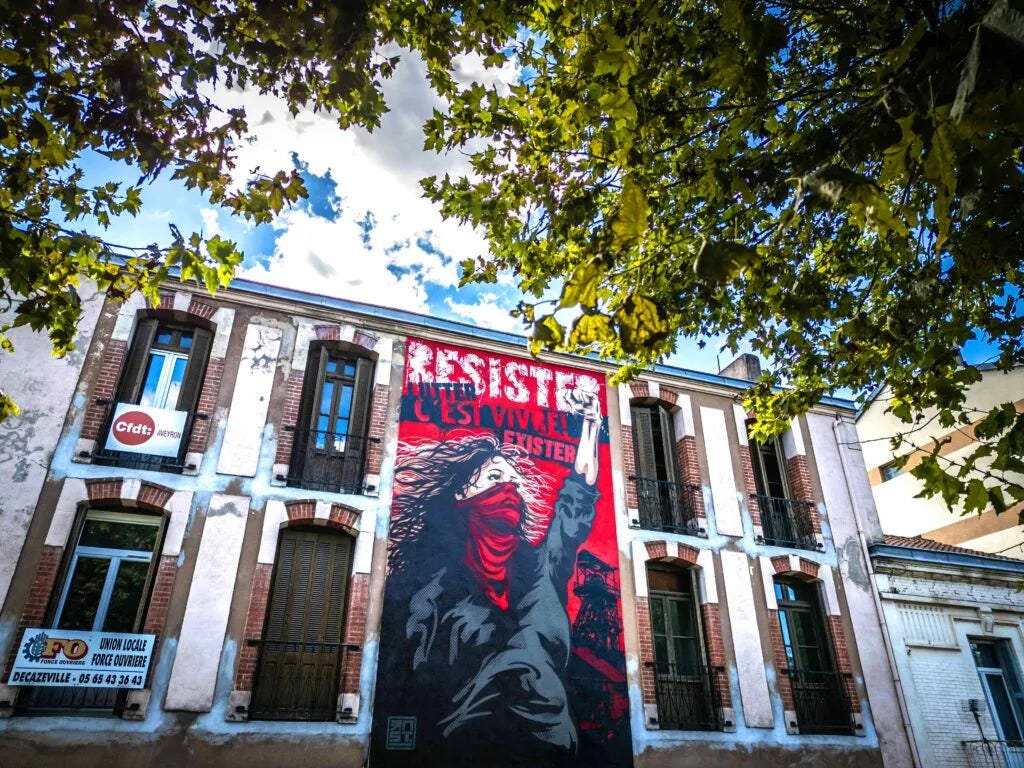
And I found all of this full of beauty and grandeur. I imagined these dignified and proud men who refused to bend any lower than their exhausting labour already forced them to, asking only to be able to go on enduring and feeding their families, demanding at the very least to be respected, to be regarded as human beings and not as flesh for work. And I wept over all these injustices, those particular ones and all the others that everywhere weigh upon my human brothers. I felt rising up from deep within me the words and the struggles of certain of my ancestors, workers and CGT trade unionists of 1936, such as my paternal great-grandfather, who frightened me a little as a child, because he had grown enormous and looked so formidable, especially when he talked politics with my father, thundering against all those who betrayed the cause of the people.
What would you say today, Grandad Émile, you who were stern and good, faced with the setbacks to “workers’ rights”, as you used to call them, concealing behind your old trade unionist’s words a heart overflowing with such a longing for a better world? You would no doubt weep with me, and, beyond our differences, you who used to chide me because I was, as you put it, nothing but a “runaway hippie who didn’t want to work”, we would be together still, at the bedside of this sick world...
Thus, after the moments of light, contemplation and silence at Conques, I found myself once again at the very heart of human suffering and its memory, as though I already needed to repeat to myself that “the truth is that the world must change”, as the Revelation of Arès, transmitted through Michel Potay, affirms as early as 1974, at the precise moment when the world, with the oil crisis, was beginning to tip into the slow civilisational erosion whose acceleration we now recognise.
Yes, no spiritual awakening is worth anything if it does not contribute, in one way or another, to the betterment of the world and to the common good. It must be said again and again, for today, perhaps more than ever, the temptation is strong to merely preserve one’s own little personal space of self-development, forgetting the fundamental rule of the spiritual life: everything that I receive must be reworked in the fire of my heart, and then given back around me.

It was amid these thoughts and memories that I entered, alone, the following morning, the church of Notre-Dame de Decazeville, a morning when the town still seemed to be digesting its own silence, that particular silence of places which lived too long on the noise of machines to bear, today, anything other than the echo of their absence. Fourteen canvases were waiting for me there, painted by Gustave Moreau between 1862 and 1863, left unattributed for close to a century before it was finally agreed to restore them to their author and list them, in 1965, as heritage worthy of protection. Nothing in the biography of this Symbolist painter, enamoured of Greek mythology and transfigured biblical figures, destined him for this mining town, which he never saw born, nor grow, nor decline.
And yet, standing before this Way of the Cross painted for a pain other than his own, hung upon the walls of a church that a businessman had built for a population he had himself summoned up out of industrial nothingness, I felt that Decazeville, too, had its own fourteen stations, not those of a God-man freely consenting to his Passion, as Christian theology proclaims, but those of a people who had chosen nothing of what was to make, and then unmake, their life.
It is this path, this Way of the Cross of an entire people, that I should now like to walk through with you, station by station, keeping Gustave Moreau’s paintings as a presence simply set at the edge of the text, just as they are set at the edge of this town which almost ignores them, and yet this path seems to tell, more truly than any other, its most intimate history.

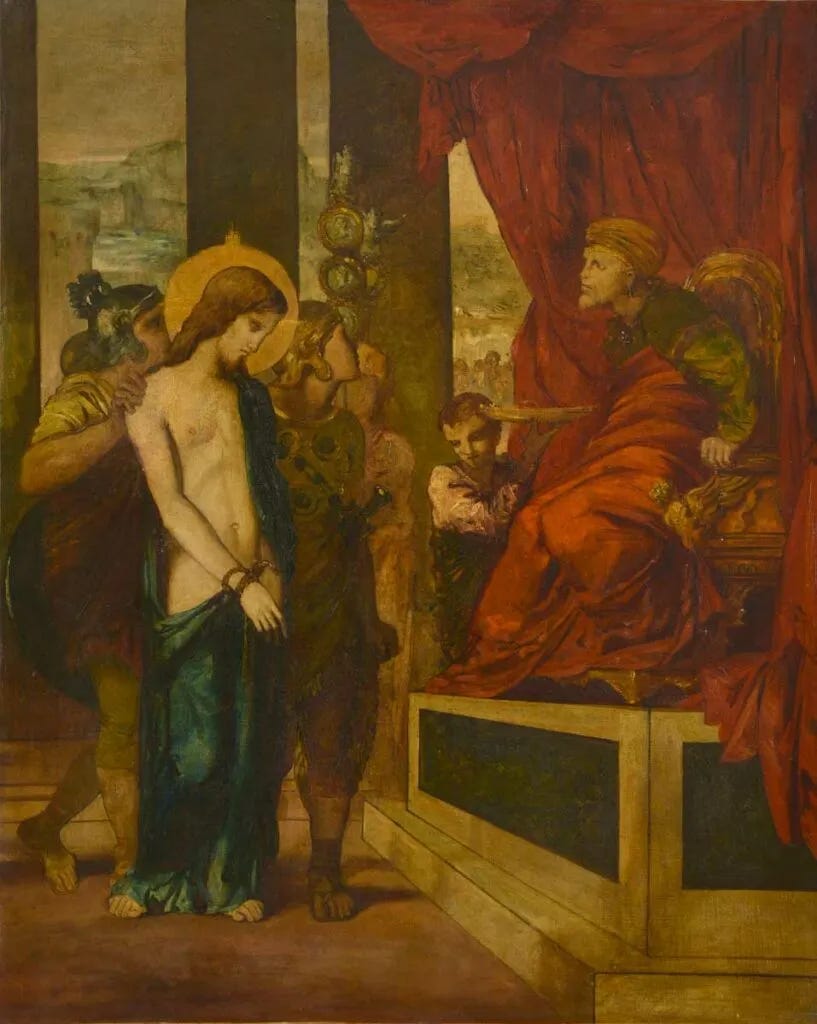
I. Jesus is condemned to death — the city is condemned to be born
Élie Decazes, the founder of Decazeville, was a fallen favourite, a statesman whom power had carried to the summit under Louis XVIII before rejecting him brutally, a victim of the intrigues of a court whose rules he had believed he had mastered, and who found in Aveyron coal the means to rebuild a fortune and a position that political disgrace had stripped from him. From this strictly private reconversion, decided in the drawing rooms of Paris and not in the valleys of the Lot, there arose, in under twenty years, an entire industrial conurbation, sprung up almost from nothing, which would soon surpass in productive power coalfields that were, nonetheless, older, such as that of Le Creusot.
Entire generations of workers came from all across Aveyron and beyond to people this new town. Of this place that was to give them their living — and sometimes their death — not one of them had decided anything at all: no one asked them whether they wanted this industry, this name, this dependence upon a man they would never meet. They arrived, driven by the necessity of surviving the upheavals of a society grappling with the Industrial Revolution. The condemnation, this time, does not strike a single man in a courtroom, as in the Gospel. It strikes, by the sole force of a decision taken elsewhere, far away, in a world that was not theirs, an entire people called into being in a town bearing the name of the powerful man who founded it — a name that this people will nonetheless bear even in its civil records, every time it becomes necessary to write: born at Decazeville.

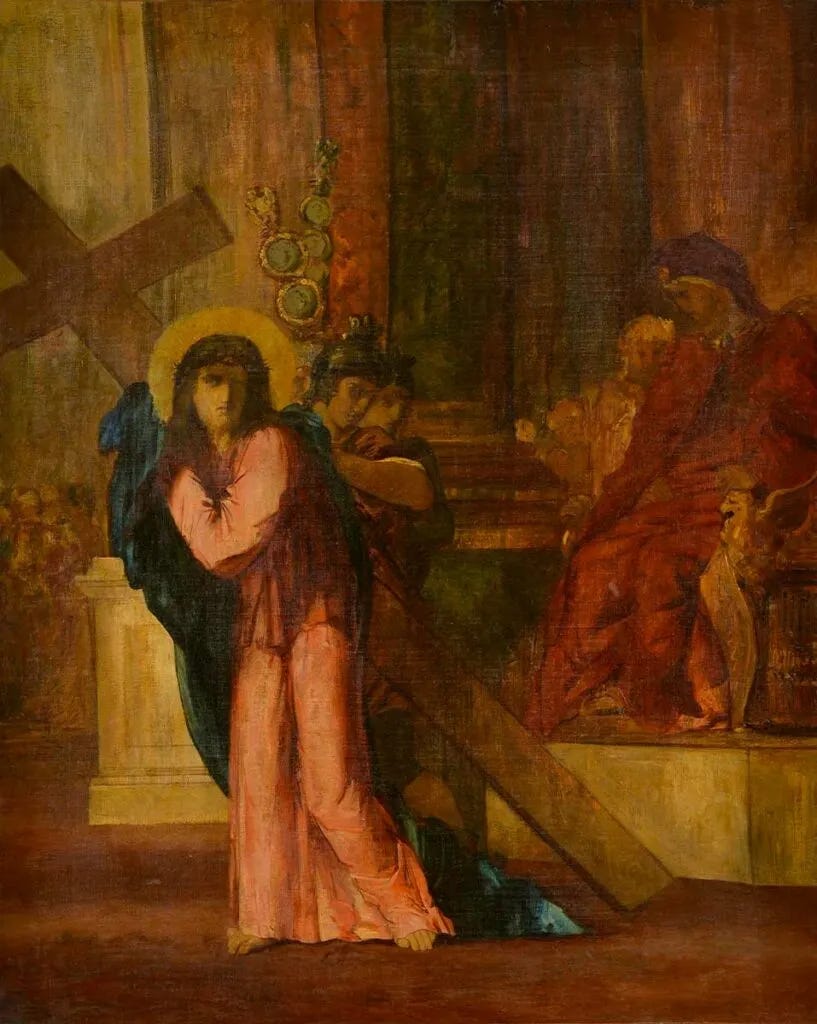
II. Jesus takes up his cross — the weight of the workers’ daily life
In the hardest periods, the wages of the miners and the foundry workers could collapse to a level so low that it sometimes left them scarcely enough to live on — it was always the worker who paid the price of the bad years. The rest tells the essential part of their condition: the workers and their families lived on whatever wage the Company was willing to grant them, they were housed in whatever workers’ dwellings it was willing to let to them, they bought their goods at the company store, which it alone owned and whose prices it alone set, and they had their children treated in the dispensaries it had deigned to fund.
The cross, here, is not a wooden object loaded upon one’s back for a single day of torment: it is an entire architecture of dependence, meticulously organised, in which the wage the Company grants with one hand it takes back with the other in rent and provisions, and which envelops life from birth to death, borne every morning without respite, without any true Sunday of rest, since even rest itself was negotiated under the gaze of that same owner of the premises, the tools and, so to speak, the lives.

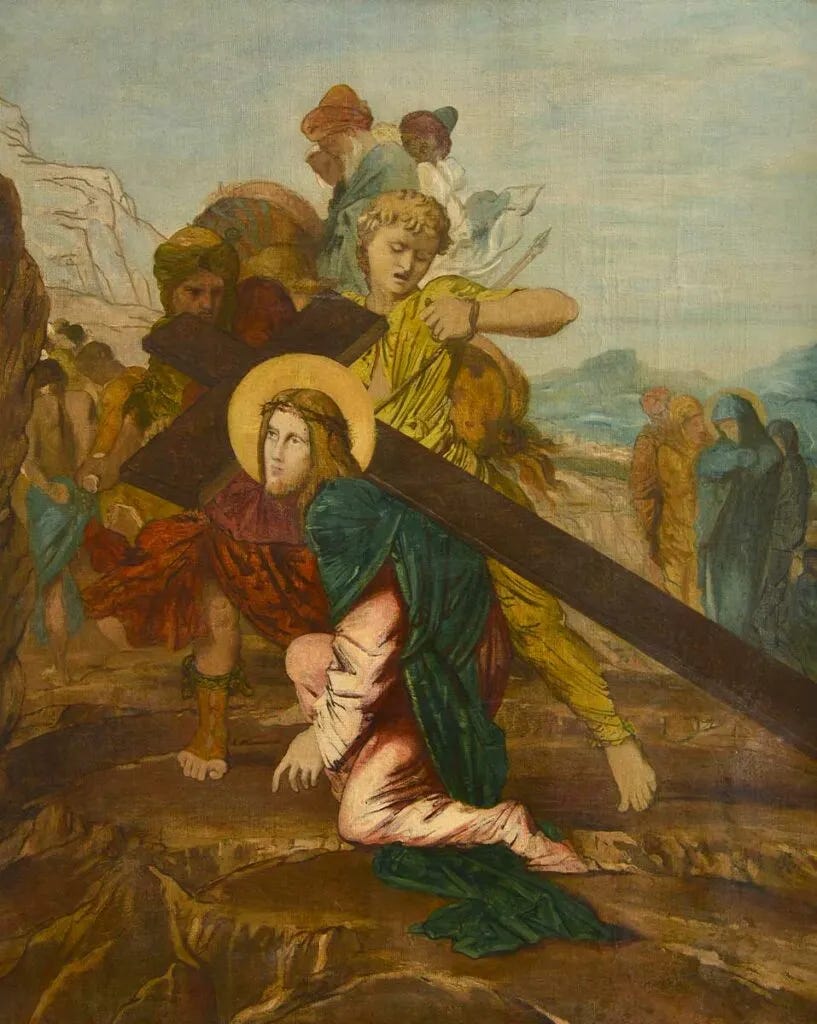
III. Jesus falls the first time — the Aubin shootings, 1869
In 1869, fourteen people fell dead beneath the bullets of a company of troops sent to restore an order the strike had just disturbed, deaths among which were numbered women who had come to support their men, and a child of seven, whose presence at the scene of the tragedy says, by itself, how much the workers’ struggle was never a matter reserved to the workers alone, but engaged entire families, down to their most vulnerable flesh.
The first fall in a Way of the Cross is often the most unexpected of all: the fall in which one discovers, with an almost childlike stupor, that the body, already, will not hold out over the distance imposed upon it from the very outset, that the promise of redemption through work runs straight into the starkest violence. Victor Hugo, deeply shaken by this episode, found in it the matter for his Ode à la misère; Émile Zola, some years later, would draw from it part of the underground energy that runs through the whole of Germinal. Literature, here as almost always, arrives after the blood, never before it, as though it needed the proof of the fallen body before it would finally consent to speak.

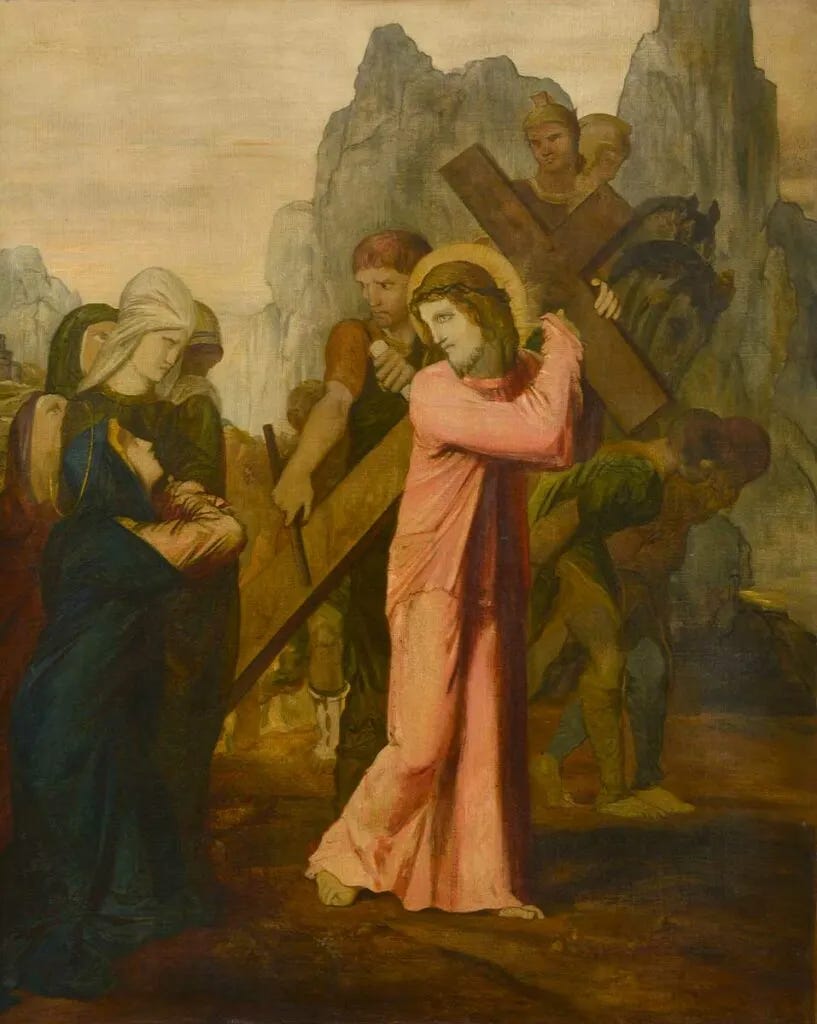
IV. Jesus meets his mother — what cannot be handed down
A very high proportion of the working-class families of the Decazeville coalfield left behind them, when it came to inheritance, no transmissible legacy whatsoever: no land, no house of their own, no capital of any kind, nothing but the memory of work accomplished and the obligation, for the child, to begin again at exactly the point where the father had begun, without the least material asset to cushion the fresh start.
The meeting between mother and son, in the tradition of the Way of the Cross, is a moment of overwhelming, mutual recognition at the very heart of an announced disaster, a glance exchanged that changes nothing of the outcome but says everything of the love that endures. Here, the meeting is more an absence than a fullness: that of a lineage with nothing to bequeath, save the oral memory of the work itself, gestures learned by imitation rather than inherited as patrimony, and that silent obligation upon whoever remains, never formulated yet always understood, to take up exactly the same cross that the grandfather, and then the father, had already carried before him.

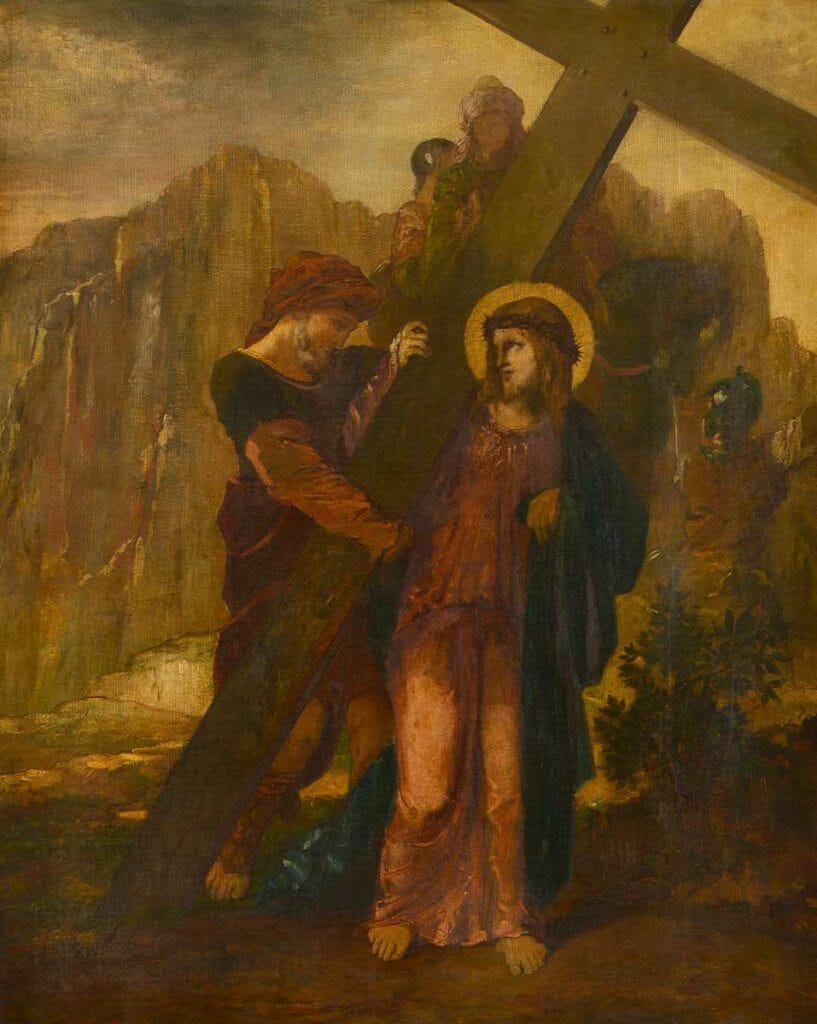
V. Simon of Cyrene helps Jesus carry his cross — working-class solidarity
It is here, I believe, that my own family line resonates with this text, for the connection imposes itself of its own accord: among my forebears I count CGT trade unionists, men who chose, at one moment or another of their existence, to carry for others a burden they had strictly no personal obligation whatsoever to carry. Simon of Cyrene, in the Gospel account, is no enthusiastic volunteer who rushes forward to relieve Christ out of pure, spontaneous charity: he is requisitioned, pulled from the crowd almost against his will, just as any ordinary man might be pulled from his ordinary life and associated, without having sought it, with a suffering that was not his own.
And yet, from this initial, almost forced requisition, there is born a gesture that far exceeds mere circumstantial obligation: that of not leaving a man alone beneath the weight that crushes him, of momentarily making common cause with him. It is exactly this gesture that the strikers of 1886 embodied, in their own way, in the streets of Decazeville, and later some fifteen hundred miners who refused to come back up from the bottom of the pits during the winter of 1961, resolved to prevent their closure, each one becoming, for the other, that unexpected Simon whom nothing obliged to stop.

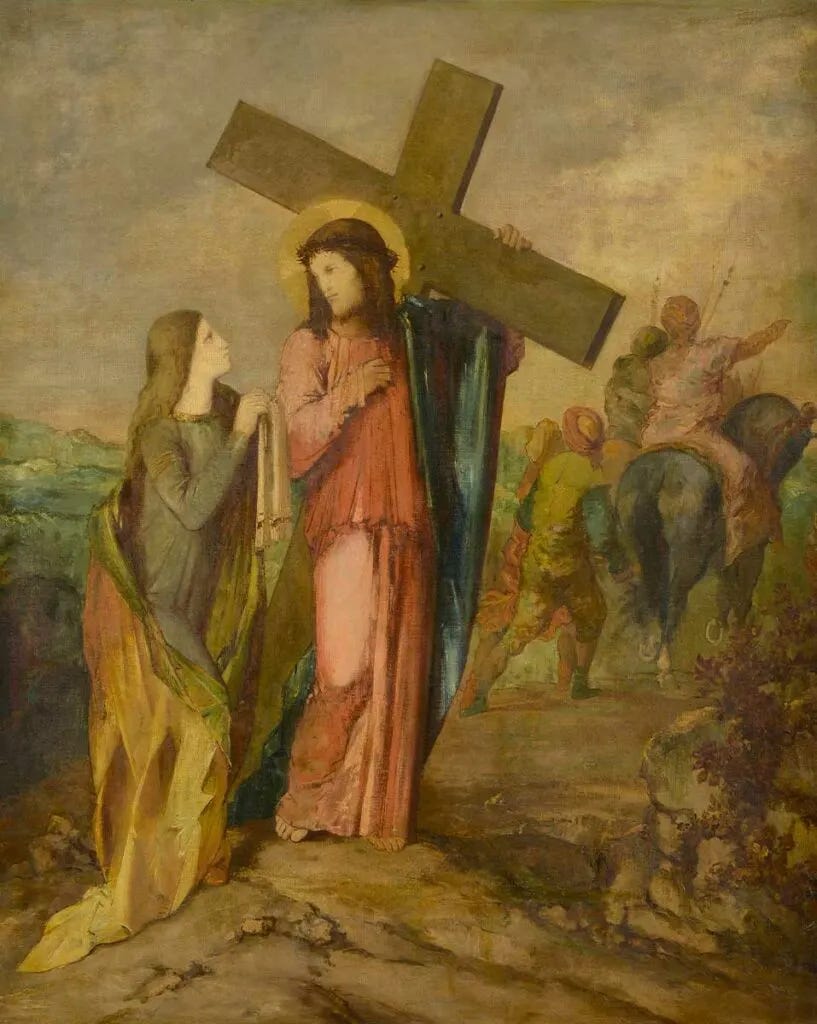
VI. Veronica wipes the face of Jesus — the face imprinted in literature
Veronica, in the tradition, does not act head-on against the power that condemns: she acts against the forgetting that threatens to erase everything once the body has vanished. She wipes the face of Jesus, simply so that a lasting trace of it might remain, an imprint that nothing could ever again wholly dissolve.
Victor Hugo and Émile Zola each accomplished, in their own way and by means proper to their art, this same gesture for Decazeville: not out of any passing activism nor fleeting sympathy for a cause that would have remained external to them, but because literature, when it is faithful to what it has seen or sensed, retains the imprint of a suffering long after the bodies that truly bore it have vanished from living memory, long after the last direct witnesses have themselves passed away.

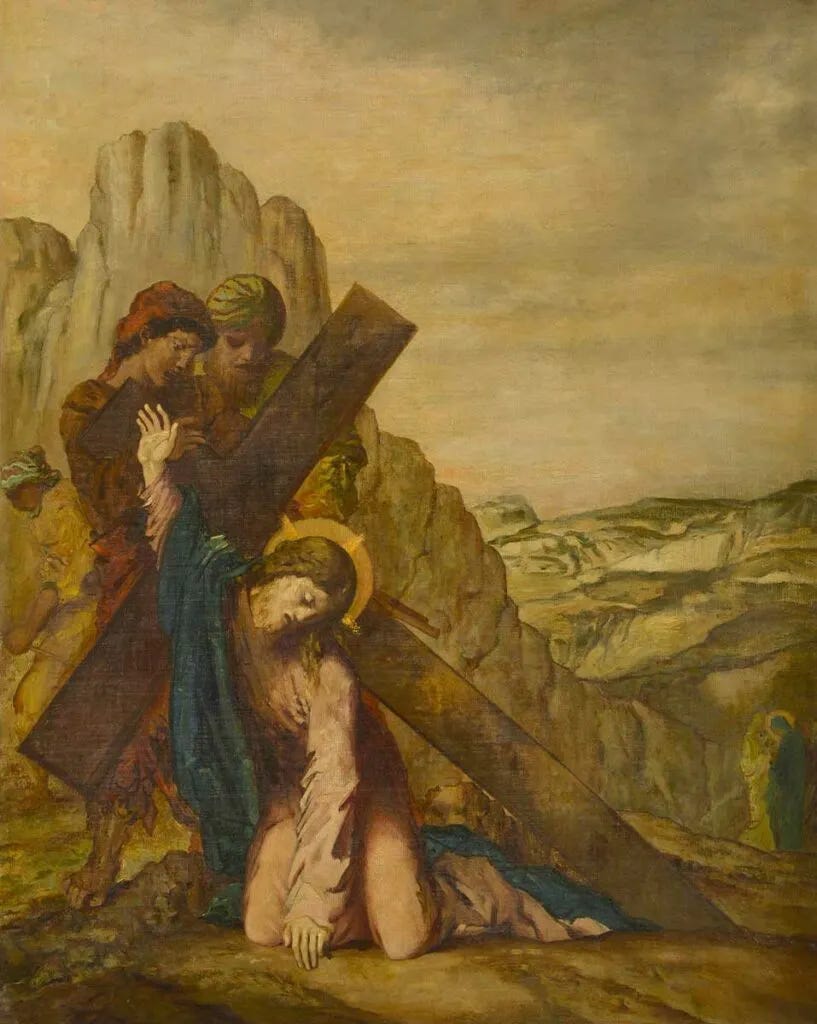
VII. Jesus falls the second time — the strike of 1886
During this strike, Watrin, a director detested for the harshness of his management, was thrown from a window by a crowd whose patience had run out; there followed one hundred and eight days of unbroken strike action, a mobilisation that went far beyond the purely local, since Jean Jaurès himself came to support their cause from the national tribune, while figures as various as General Boulanger sought to draw from it a political profit of their own.
The second fall, in the tradition of the Way of the Cross, is always heavier than the first, precisely because one already knows, from experience, the exact weight of the cross, and one falls again despite that knowledge, on account of accumulated exhaustion. But 1886 also marks, for Decazeville, the very first time the town exists for the whole of France as something other than a mere anonymous coalfield among others: from now on it exists as a national cause, as a name pronounced in the National Assembly, as a symbol of a labour movement marching towards its own consciousness, and, even though the strikers had not won their case, that victory will remain part of the history of men’s struggles for their dignity.

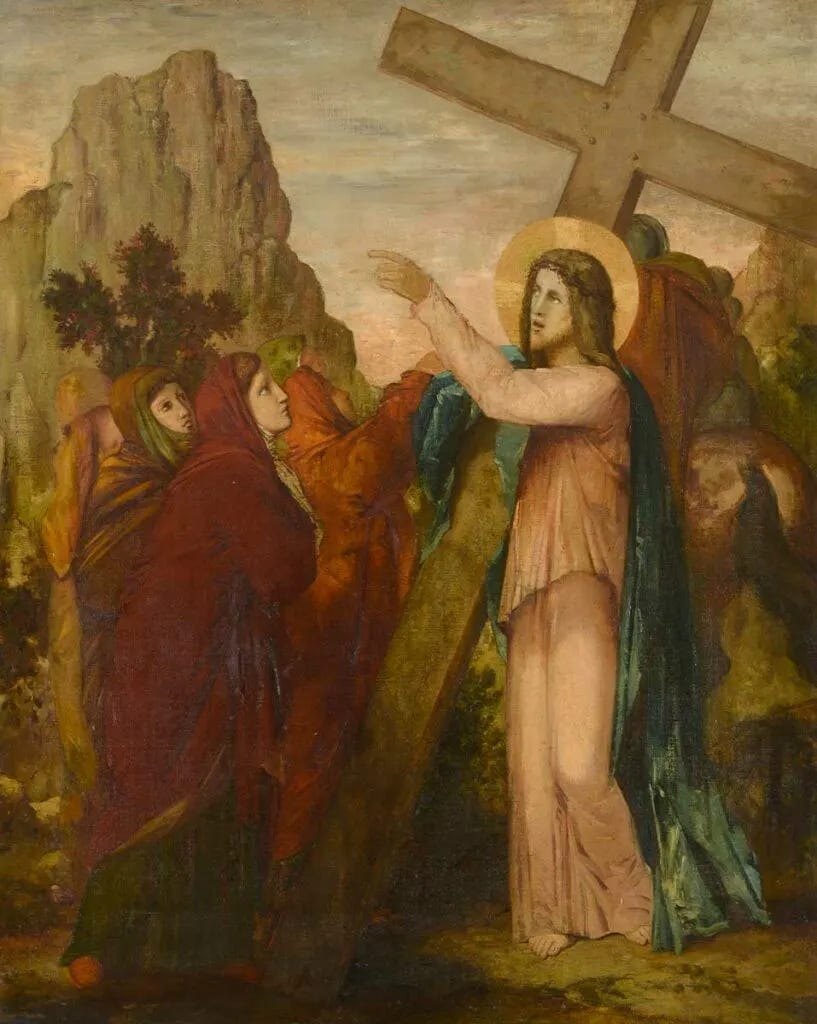
VIII. Jesus meets the women of Jerusalem — the women of the mining basin
Accounts of the struggle, even the most sincere and the best documented, readily name the charismatic leaders, the martyrs who fell beneath the bullets, the tribunes who came from the capital to harangue the crowds. They far more rarely name, almost never in fact, the women who ran the household and the domestic economy while the men went down into the mine or toiled in the foundries, the women who queued at the company store, who raised the children alone through the long weeks of unpaid strikes, and who wept for their dead without that intimate grief ever becoming a chapter in its own right within the official history.
Jesus, upon this road, stops precisely for them, addressing them, though nothing obliged him to do so amid the urgency of his own march towards death; I should like my own text to stop likewise, if only for the length of a station, to acknowledge the merit of those whom the official mining history has for so long left out of frame, in the patient shadow of kitchens and evening vigils. One could almost believe, looking at them, that he was already standing there beside them, long before any canvas kept memory of it.

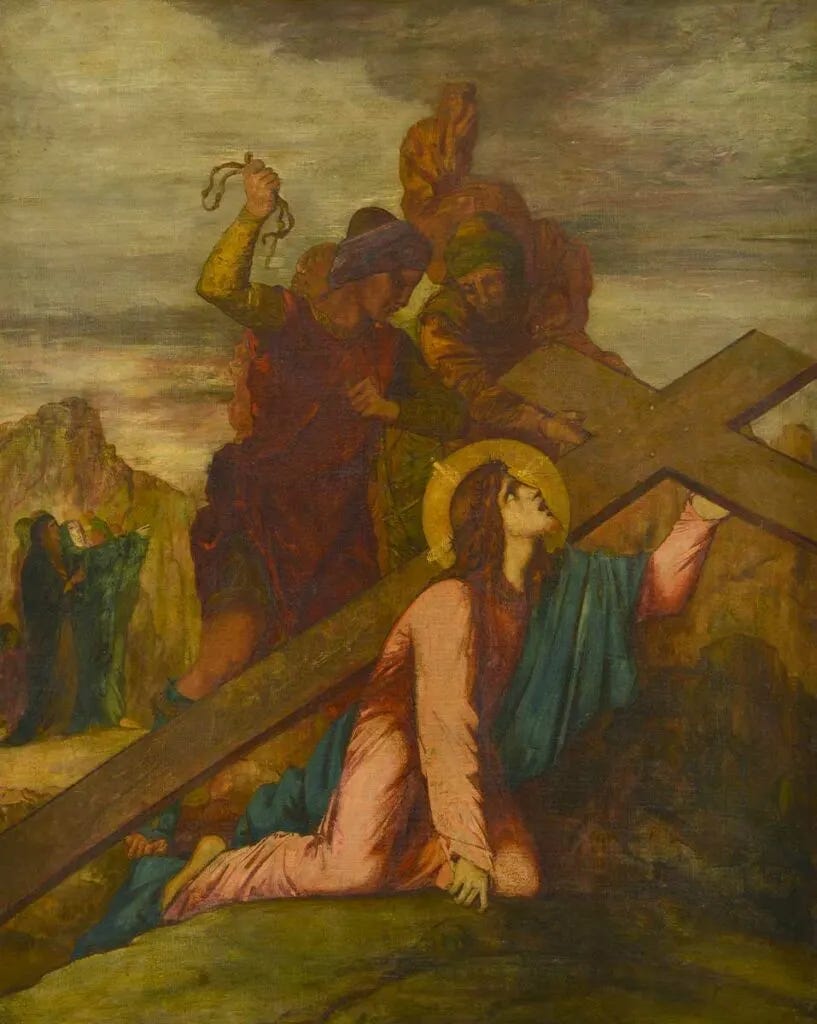
IX. Jesus falls the third time — the underground strike, 1961–1962
That year, some fifteen hundred miners refused to come back up to the surface, and chose to spend Christmas shut away at the bottom of their own pits rather than passively accept the scheduled closure of their tool of work, in a gesture of resistance as desperate as it was profoundly dignified.
This is the third fall on this path, the closest to us in time, and yet already the fall of a battle lost in advance, whose outcome was sealed well before the first miner went down to shut himself in willingly underground: one can resist, with real and well-documented courage, in the dark depths of a mineshaft; one cannot resist indefinitely an economic decision taken in the air-conditioned offices of a distant administration, for whom the Decazeville coalfield had become nothing more than a line on a balance sheet to be cleaned up.

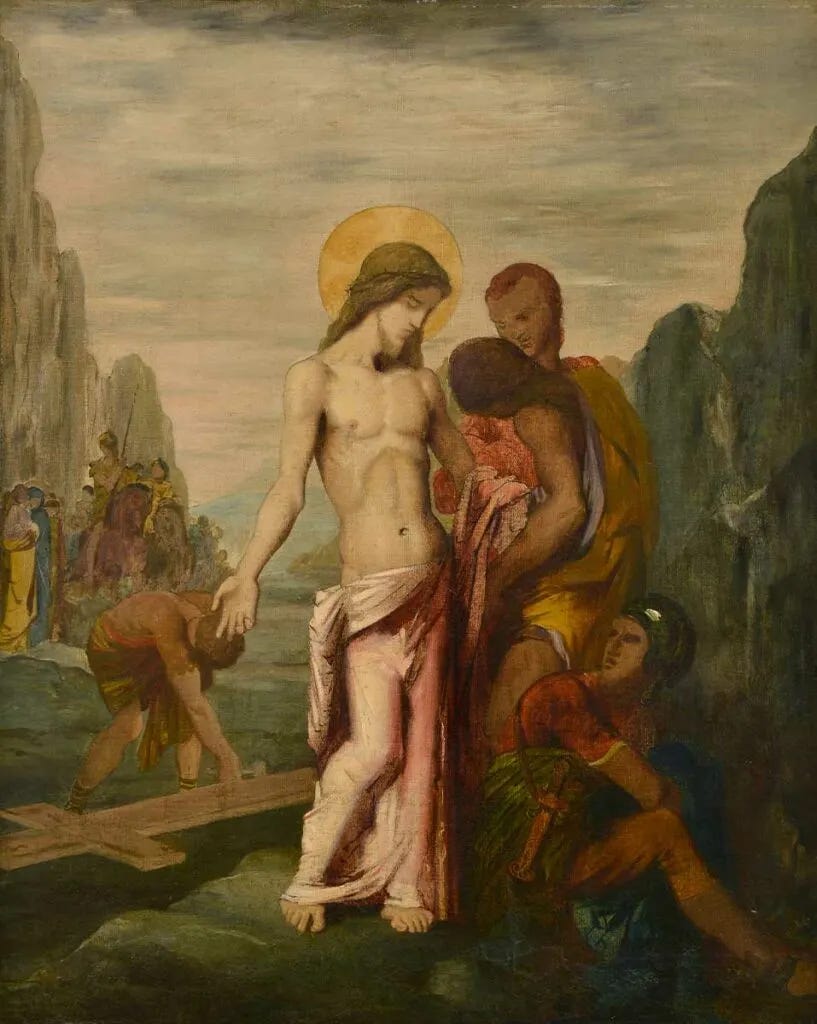
X. Jesus is stripped of his garments — the closure
Then came the stripping itself, methodical and administrative: the pits progressively closed one after another, the blast furnaces and the factories extinguished for good, the town laid bare of what, for more than a century and a half, had constituted its sole and only economic reason for being, its very justification as a town at all.
It is not one man alone who is stripped of his garments before the crowd here, as upon Golgotha, but an entire town of its productive identity. And beneath it, one discovers a social body that no longer quite knows what it is now, once stripped of the very thing for which, precisely, it had been brought into being almost two centuries before, a body more vulnerable still than in the days of the mines and the furnaces, with nothing left to defend, cast into a destitution with no horizon.

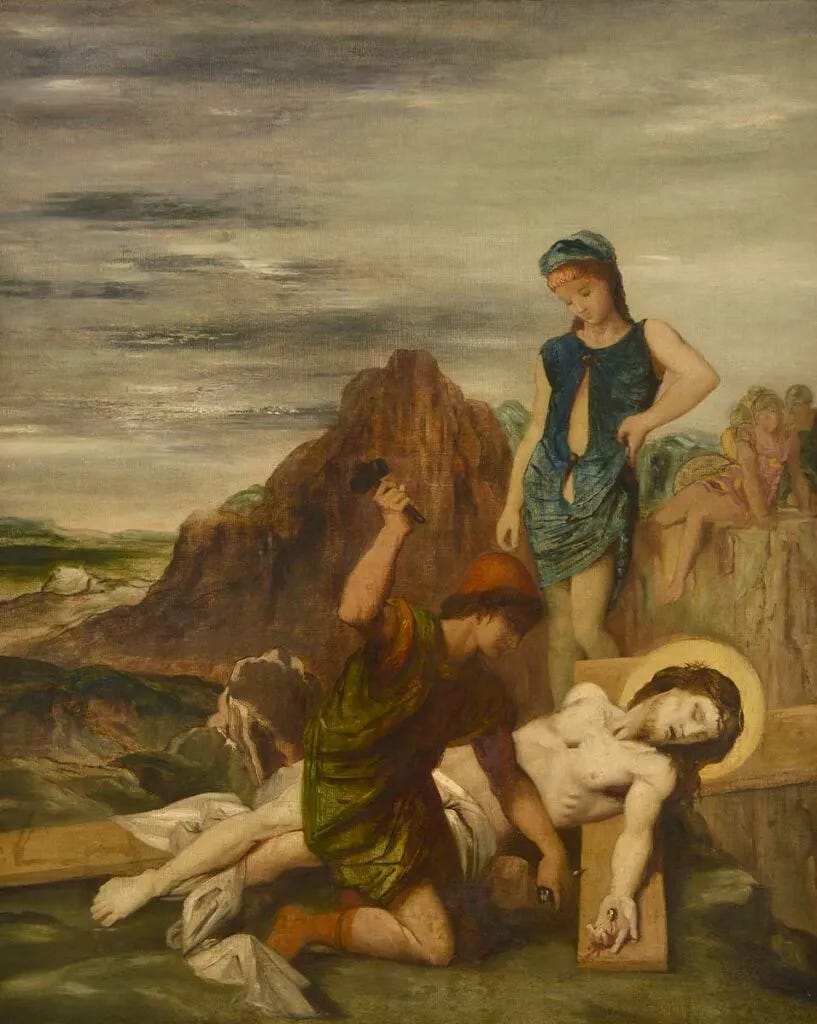
XI. Jesus is nailed to the cross — unemployment
In Decazeville, the unemployment rate remains, even today, higher than the national average, the figure obtained from self-reported data collected by Insee in 2022 standing as high as 22 per cent, a figure that presumably includes people in part-time work only, a situation no longer taken into account in France Travail’s unemployment statistics. The consequence is simple: the town, which numbered 15,000 inhabitants in 1930, then 10,000 in 1975, now numbers only around 5,000. Shops are closing, houses stand empty and decay, and the remaining population is growing steadily older.
No one is nailed any longer to the wood of a cross, but entire existences are nailed to a cold statistic, to that same dependence which, a century and a half earlier, had founded the town under the name of a man it had not chosen, and which still holds it today: dependence upon the decision of an investor who does not come, upon a reconversion plan decided in a prefecture or a ministry, upon subsidies that must be solicited rather than earned by work alone. None of this resolves itself through the simple passage of time, for want of some new master of the place, industrial or institutional, willing this time to offer real work rather than a mere name upon a pediment.

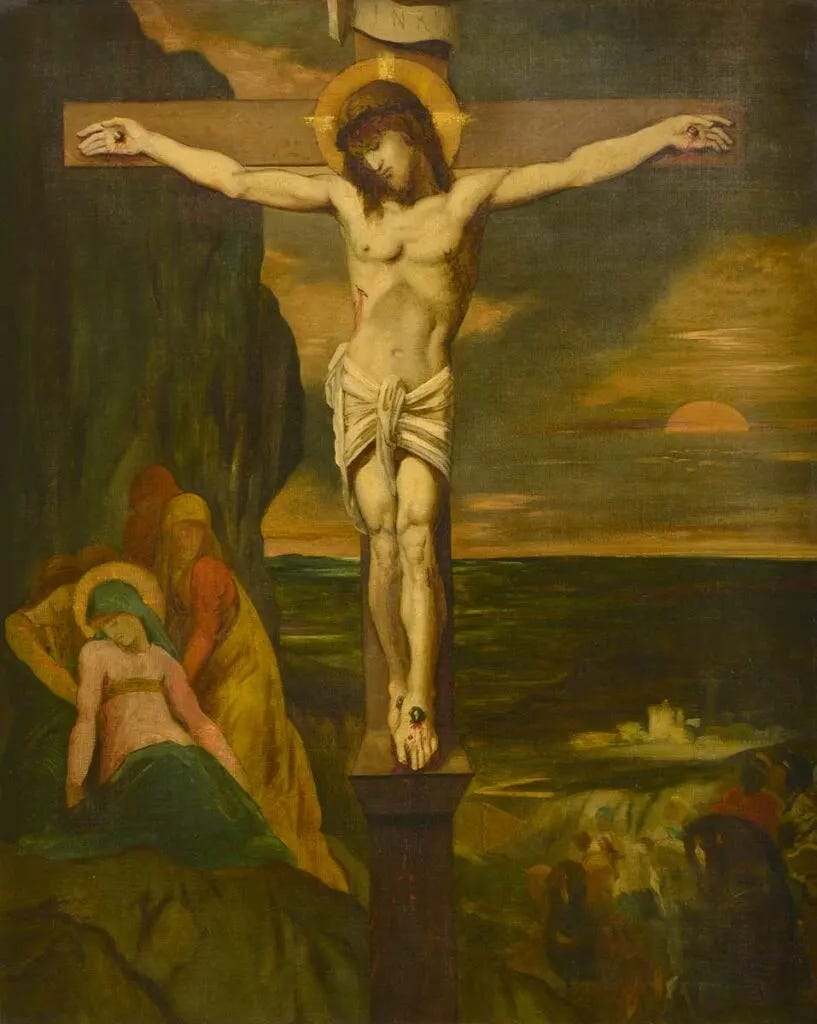
XII. Jesus dies on the cross — the wasteland
It was the high street that struck me that day, before I even went into the church: the majority of its shops have pulled down their shutters, some of them so long ago that the decayed state of what remains visible behind the shop window leaves no doubt whatsoever as to how long ago they closed. This is not the first time this sorry spectacle has stopped me in my tracks: I recall an almost identical stupor at Lens, on coming out of the Louvre-Lens museum, and at Pau, during a simple stopover before crossing into Spain.
Decazeville thus joins, upon my own path, a geography wider than itself, that of those French towns where the same deindustrialisation has left the same emptiness, the same high street no longer truly alive. Here as elsewhere, industrial wastelands still dot the urban landscape, town planning remains at the poorly controlled mercy of successive closures rather than subject to any coherent plan, the population declines inexorably year after year. It is before this observation, which no longer even comes as a surprise, so often has it repeated itself from one town to the next, that my own walk comes to a standstill, with not the slightest lyrical escape, without any possibility of a premature flight towards some easy consolation.
For there is nothing to redeem in this particular station, nothing to turn artificially into a premature hope that would betray the truth of the moment. The body is dead; one must consent to leave it dead for as long as is needed, in the full nakedness of that observation, before laying any legitimate claim to anything else.

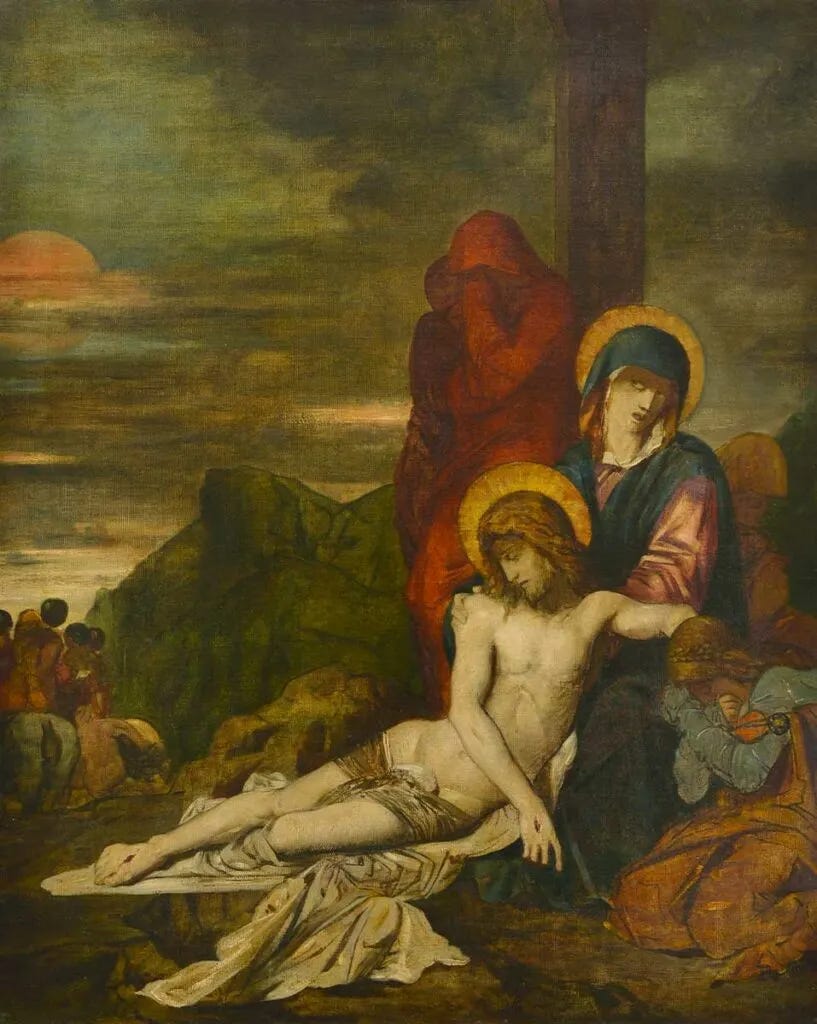
XIII. Jesus is taken down from the cross — the work of memory begins
One does not raise the dead, whatever strength of desire one brings to it. But one can, failing to resurrect them, at least stop turning one’s gaze away from their body, and that, in itself, is already a genuine beginning, a first step out of denial. The work of memory that has been under way for several years now in Decazeville, in various associative, municipal and artistic forms, is in no way a triumphantly proclaimed resurrection, nor any final settling of accounts with the industrial past: it is simply the precise moment at which an entire community at last consents to look squarely at what has really happened to it, without seeking any longer to dress it up in a façade of optimism, nor to deny it out of modesty or wounded pride.
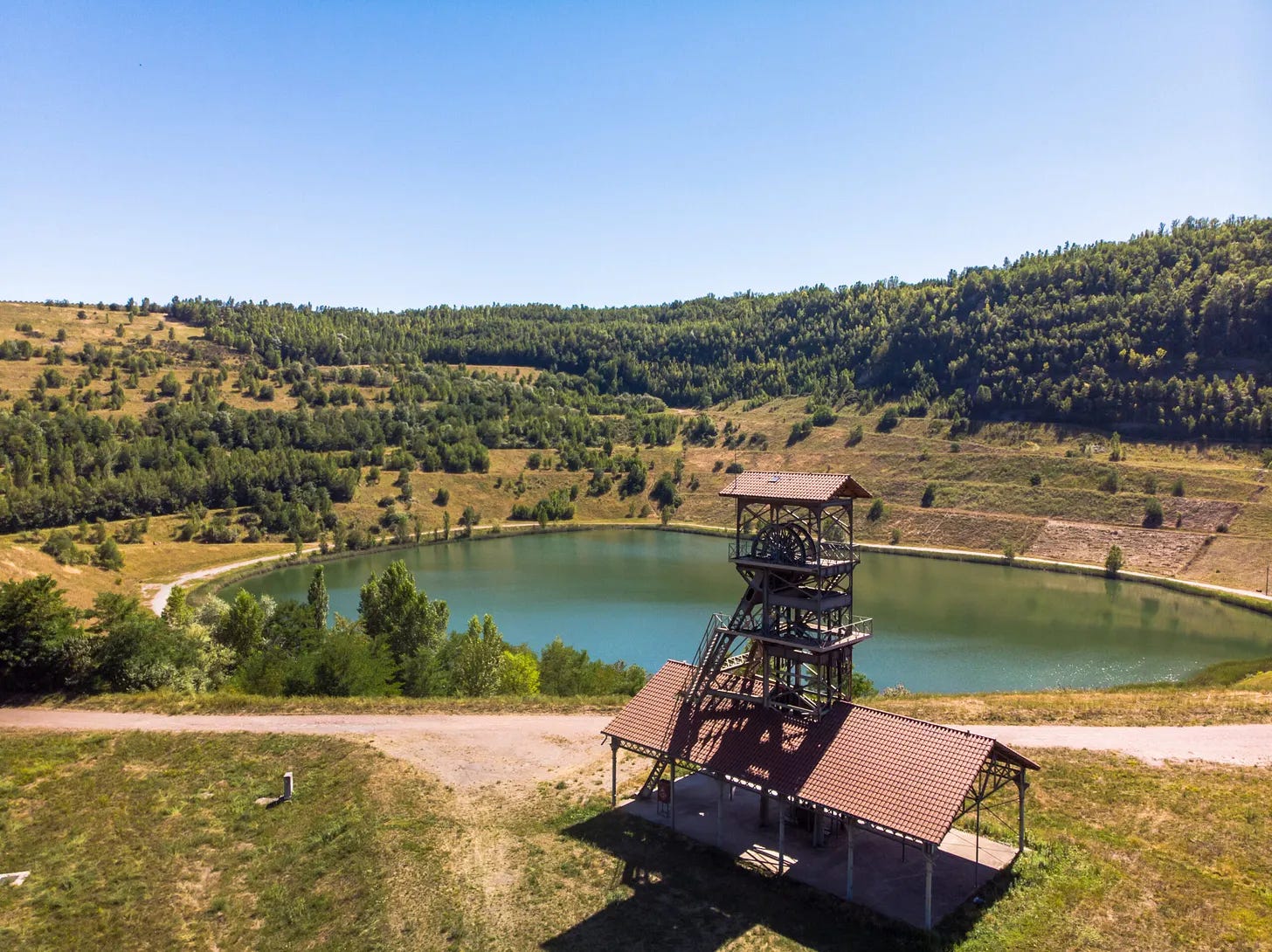
This work has taken, in Decazeville, a concrete and visitable form: a museum of mining and industrial heritage now brings together the photographs, the tools, the gestures of a vanished trade. La Découverte itself, which was once the largest open-cast coal mine in France, has been restored as a vast promenade space, which you can see in the header photograph of this article, and heritage signage there retraces, step by step, the history of the site for whoever cares to stop. The headframe has been preserved there, the sole survivor of all those that once bristled across the mining basin: twenty-two metres of steel framework raised against the sky, which once allowed the miners to descend to the underground galleries, one hundred and fifty metres below, into a darkness no museum could ever fully restore. To see it still standing, alone, above what was once a chasm of earth and coal and which today shelters a peaceful lake, is already, in its own mute way, a refusal of complete oblivion — the first stone, in short, of this work of memory I have just spoken of.

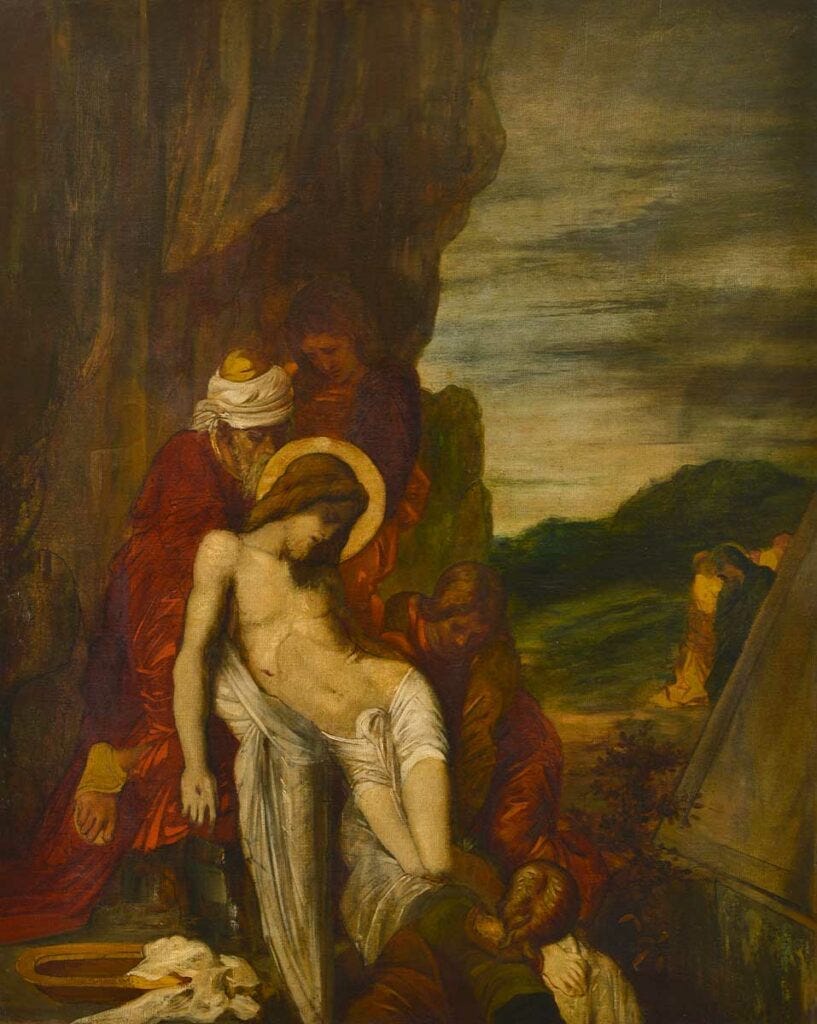
XIV. Jesus is laid in the tomb — Mur Murs
It was there, on the flank of the lake that today occupies the bottom of La Découverte, a few steps from the still-standing headframe, that the artist Saype came, in 2019, during the first edition of the Mur Murs festival, to paint a monumental fresco directly onto the grass, in biodegradable pigments he makes himself, depicting a child across eighty metres of ground. A drone was needed to see it in its entirety, and it should be understood, looking at the photographs that survive of it, that it was destined to fade away of its own accord within a few weeks, beneath the regrowing grass. A work condemned from its very first day to disappear: perhaps the truest image of all with which to open what follows.
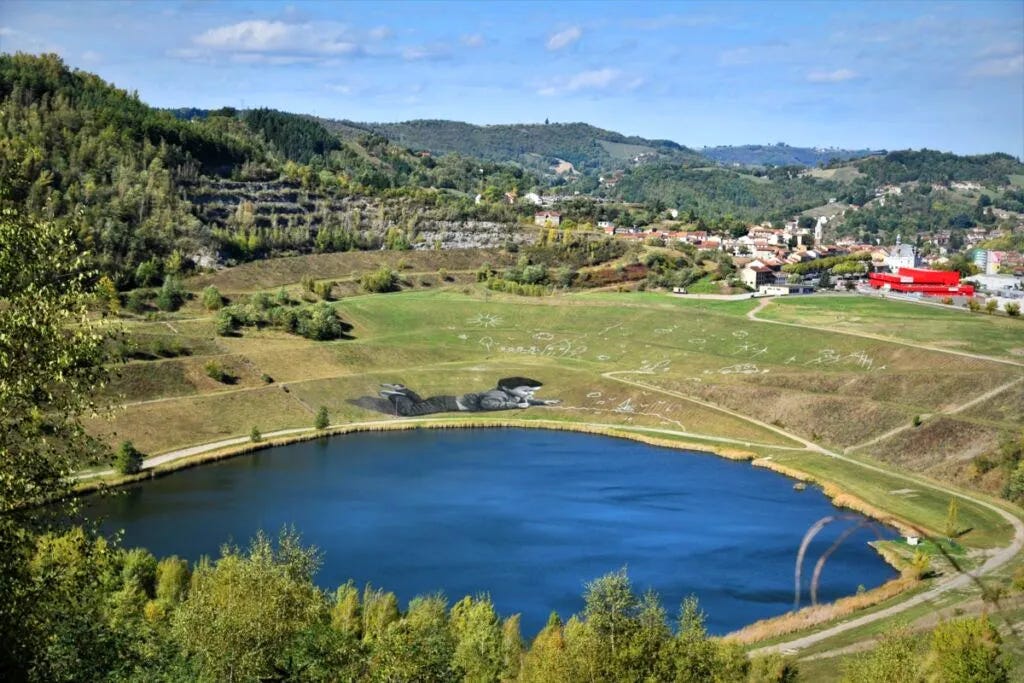
On the wall facing the headframe, another fresco from 2019, this one intended to last, retraces the whole history I have just walked through: the galleries and the tools of the miners, the portrait of the man who cast the last steel of Decazeville in 1987, then the decline of the steel industry, and finally the lake and the vegetation that have reclaimed the site. It was painted by vocational students training in boilermaking at the local secondary school, together with the artist Al Sticking — as though the town had chosen to paint its own story with the hands of those who would inherit its future rather than its past.
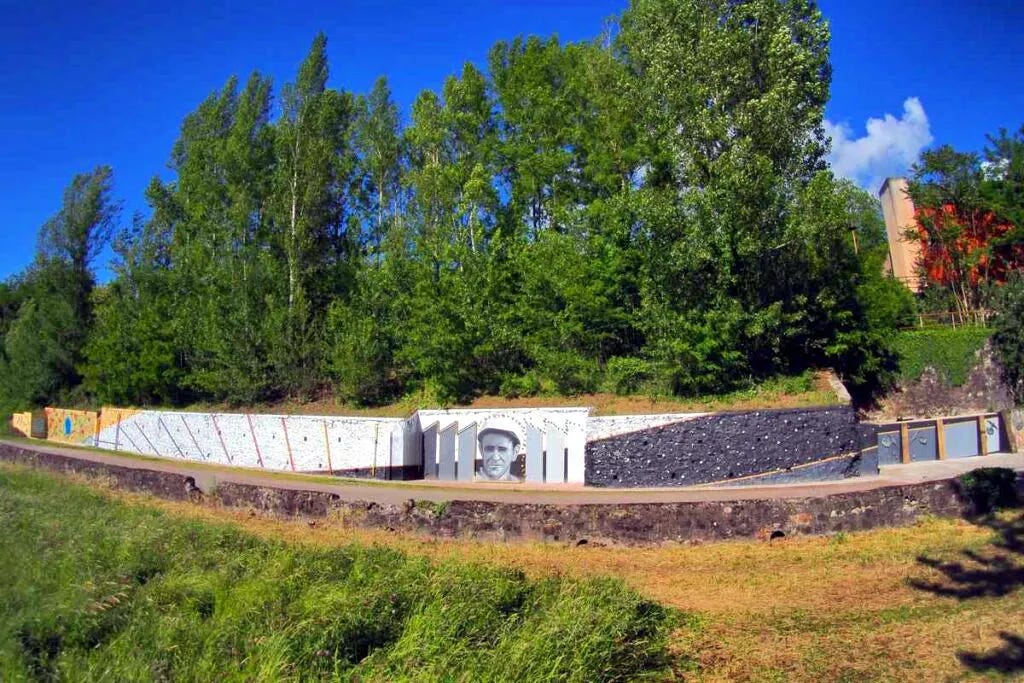
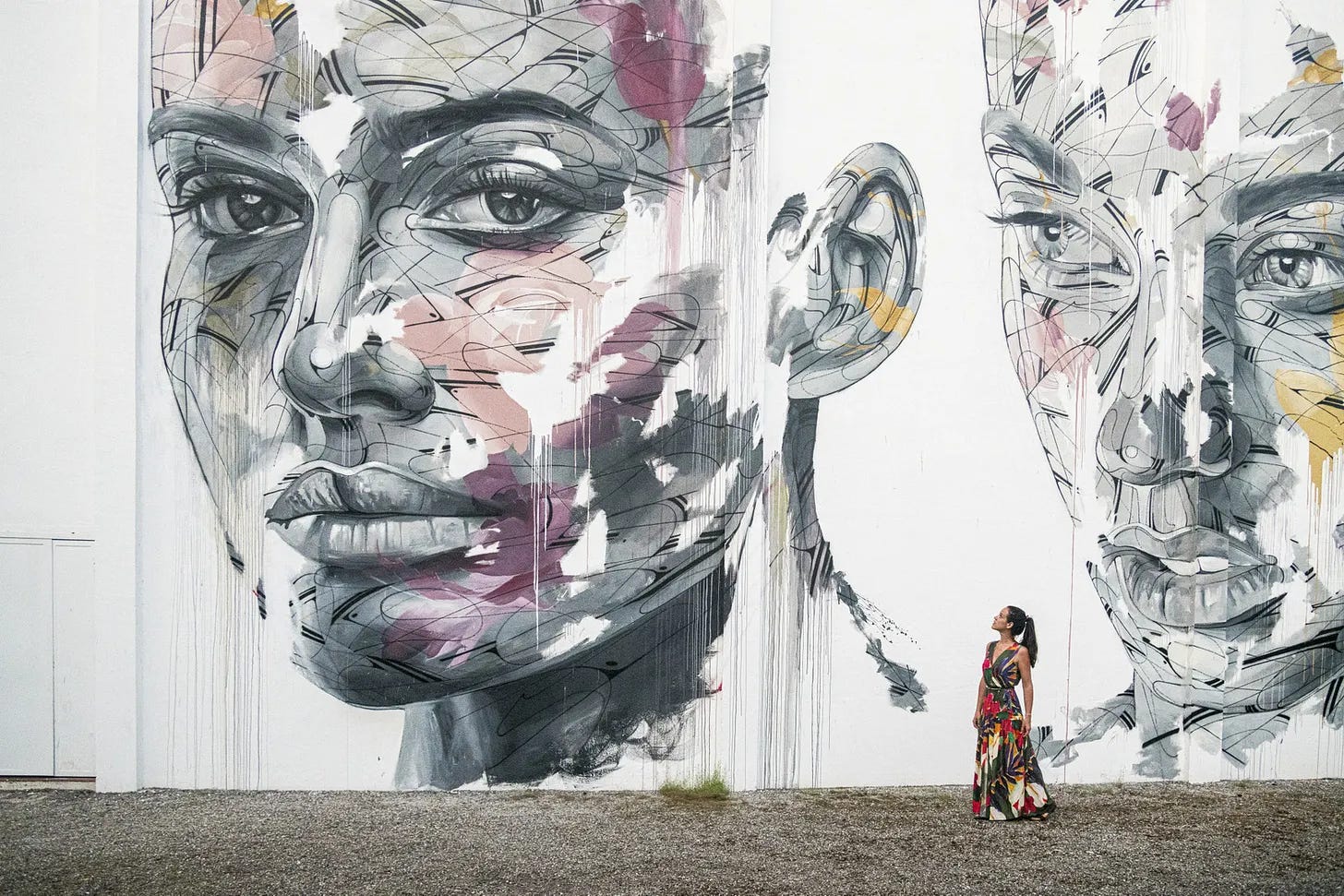
What Saype and Al Sticking painted there are but two gestures among sixty-odd others, carried out since the festival’s first edition, across Decazeville and the neighbouring communes, to the point that this entire mining territory has become one of the most singular urban art trails in France, recognised as far away as the United States.
This is in no sense a resurrection in the full meaning of the term: the industrial tomb remains a tomb, and nothing will come to reopen the pits or relight the blast furnaces. But a tomb that one takes care to paint, including with paintings one knows to be perishable, is no longer quite a place of passive oblivion; a community takes back there, upon the very surface of its walls, control of a narrative that had long been confiscated from it by the offices of a Company now gone.
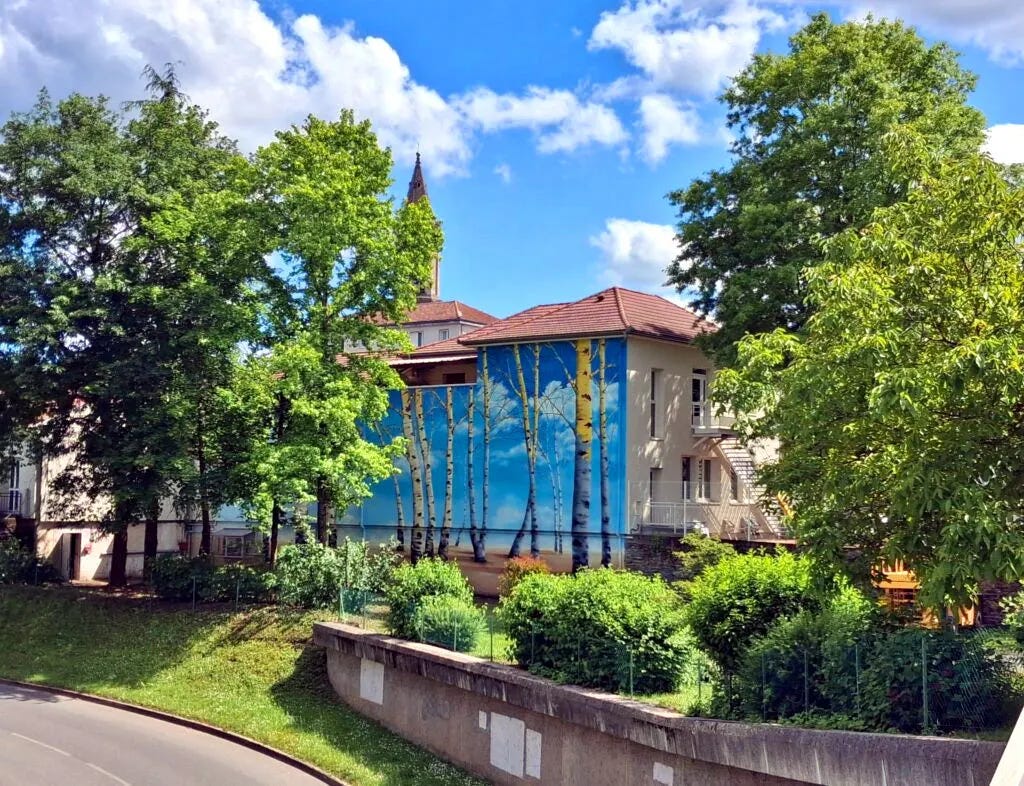
On the wall of the Jean Moulin school there now stands a forest of birches, nearly ten metres high. A first, more modest version had come into being in 2019, painted with the help of close to one hundred and fifty children, but it disappeared, erased by the building’s insulation works. The artist painted a second, larger version, and gave it this title: Still Standing, Now and Forever. The birch, he says, is a pioneer tree, the first to grow back on devastated ground.
That this fresco, too, should have had to die once before being reborn larger still is perhaps the best answer Decazeville could give to its own Way of the Cross: not a resurrection won once and for all, but a renewed choice to keep standing, whether on a wall or on a grassy slope, whatever might otherwise be extinguished, for as long as there remains someone who wants the light to cover over, if only for a while, what the coal had for so long darkened.

I came out of the church of Notre-Dame without having prayed, at least not in the sense of praying to ask for something one does not have; I had only looked, at length and without haste, at fourteen canvases painted for a Passion other than that of this particular town, and which nonetheless suited it like a garment which, by a singular accident of history, would fit it almost perfectly. These canvases were only recognised, catalogued, and named with any certainty a full century after their silent execution, Gustave Moreau himself having wished to leave them unsigned.
Perhaps Decazeville, too, awaits its own deferred, still incomplete recognition, not that of some official patron saint, nor that of a founder whose statue one might celebrate, but rather that, more modest and probably truer at heart, of a people who bore, without having chosen it, a cross that was not originally their own, and who is beginning today, wall after wall, fresco after fresco, to write its history at last with its own hand.

That afternoon, I took the train towards Bordeaux and Arès, my heart laden with emotion, filled with admiration for these women and men who had, for generations, toiled here to survive and had struggled to the very end with dignity, and full of gratitude, too, for having received this lesson in greatness, which places me under an obligation, I who am their younger brother, a poor man’s son as they were.
It was towards Arès, in the Gironde, that I was heading this time, for a few days’ pilgrimage to the very place where, according to Michel Potay, the risen Jesus appeared to him in 1974 in his body of glory, and dictated to him this sentence, which I find quite radiant: “What their fathers asked Me for on the night when they were cold and hungry, which they did not get from those who used to speak in My Name, I bring to a successful end today, for they did not sin out of envy, they kept their hearts generous.” (The Sign 28:17)
It is, then, of my week spent at Arès that I shall speak to you next, for the final article in this series.
Until then, may the wind of freedom and love blow through your hearts and your minds!
Jérôme Nathanaël
Next article : « Doing and believing » - Neither believing nor not believing: at Arès, only the doing — the lived experience — allows us to judge what surpasses reason.
© 2026 - Dialogues of the New World

To continue
Have you known a place where something within you fell silent, shifted, or was illuminated in a particular way? Share this living experience in the comments to invite us into movement.
If you would like to say more about a place that matters to you, a contribution of around a page for the Waymakers section. It will be published under your initials, a pseudonym, or anonymously, as you wish. Other readers will be able to respond to it and enter into dialogue with you.
New here? The Opening page introduces the author, the project, how to take part, contact details and the calendar.