
Article disponible en français
The World We Cross · The age under strain · 70 min
Reading what our age puts to the test — in us and in our civilisations.

Series: Israel-Palestine: beyond the war of narratives | Article 3 — A century and a half of sabotaged peace: anatomy of a machine for manufacturing fatalism
In this article:
The deadlock was not written in advance
The first Jewish immigrations: fleeing before building (1881-1917)
The British double promise: the architecture of the conflict
Haj Amin al-Husseini: the systematic Islamisation of a territorial conflict
The theological locks against acceptance of Jewish presence
The pattern of rejected partitions
The occasions of peace deliberately sabotaged
The Israeli-Egyptian peace: political courage changes history (1978-1979)
Camp David 2000: deconstructing a myth without absolving anyone
The second Intifada and the destruction of the peace camp (2000-2005)
Arab normalisation and Iranian strategy: what 7 October set out to destroy
The conflict as a matrix of conspiracism
What a hundred and fifty years of history teach

“14 May 1948 is the most important day in Jewish history since the destruction of the Temple. We have become a free people in our own country.”
— David Ben-Gurion, proclamation of the State of Israel, Tel Aviv, 14 May 1948“15 May 1948 is the day of the catastrophe. Hundreds of thousands of Palestinians were driven from their homes, their lands, their lives. This wound has never been closed.”
— Palestinian collective memory, Yawm al-Nakba

The deadlock was not written in advance
Imagine a cartographer who surveys the territory of the Israeli-Palestinian conflict and sees in every frontier not a natural datum engraved since the beginning of time, but the fossilised trace of a human decision — a treaty signed in colonial haste, a war launched then lost, a forced or acquiesced exodus, an agreement signed then circumvented, an outstretched hand rejected, an opportunity deliberately destroyed. Every checkpoint, every settlement, every suicide bombing, every refugee camp maintained by design, every rocket fired at civilians, every section of the separation wall is the scar of a precise choice, taken by identifiable actors at a locatable historical moment. There is no destiny here — there is history, and history is made of decisions.
This is the argument that this article will demonstrate by traversing a hundred and fifty years of this conflict: the current impasse is not the ineluctable product of ancestral hatred between two peoples condemned never to coexist. It is the product of a series of precise choices that have, at every decisive turning point, closed doors that other choices could have kept open. And these choices reveal a pattern whose regularity, over a century and a half, is genuinely stunning: every time a partition of the territory has been proposed, it has been accepted — with reluctance, with pain, with legitimate reservations — by the Jewish or Israeli side, and rejected in its entirety by the Arab or Palestinian side. And at every refusal, the outcome obtained by the party that had refused proved worse than what it had rejected.
This pattern is not a partisan argument; it is a documented historical observation that we shall traverse together, from the Peel Commission of 1937 to the Camp David negotiations of 2000, by way of the UN partition plan of 1947 and the Oslo Accords of 1993. It does not, for all that, exonerate the Israeli responsibilities in the current impasse, which are real, documented, and will be named without restraint. But it forbids the convenient narrative that would make Israel the sole party responsible for the impossibility of peace.
A few words for readers who are encountering this series through this article. The first article dissected the two extremisms that feed on each other — radical Palestinian Islamism and the Israeli far right of Greater Eretz Israel — showing how each camp furnishes the other with the justification for its existence and the energy it could not sustain alone. In that context, Haj Amin al-Husseini was presented as one of the founding figures of the Islamisation of the conflict. The second article sought out the other voices — Zionist and Palestinian alike — who saw the catastrophe coming, sought a different path, and were systematically silenced by their own camps. This article goes back in the chronology of that double sabotage, from the first Jewish immigrants of the late nineteenth century to 7 October 2023, to see precisely by whom and how the opportunities were destroyed. Understanding is the minimal condition for ceasing to be mistaken about the solutions.
A necessary clarification about what this article is not. It is neither an indictment of Israel, nor an absolution of the Palestinian leadership, nor a trial of European colonialism, which, while it bears a real responsibility for the seeds of the conflict, is not in itself sufficient to account for a century and a half of deliberately destructive choices. The responsibilities are multiple and unevenly distributed: those of the colonial powers who planted the seeds of the conflict with cynicism; those of the leaders of both peoples who at every turning point chose outbidding over compromise; those of the regional powers who instrumentalised the Palestinian cause for ends that had nothing to do with the welfare of the Palestinians. These responsibilities will be named with the same rigour regardless of which camp is concerned.

The poisoned foundations
Ottoman Palestine: neither lost Eden nor permanent war
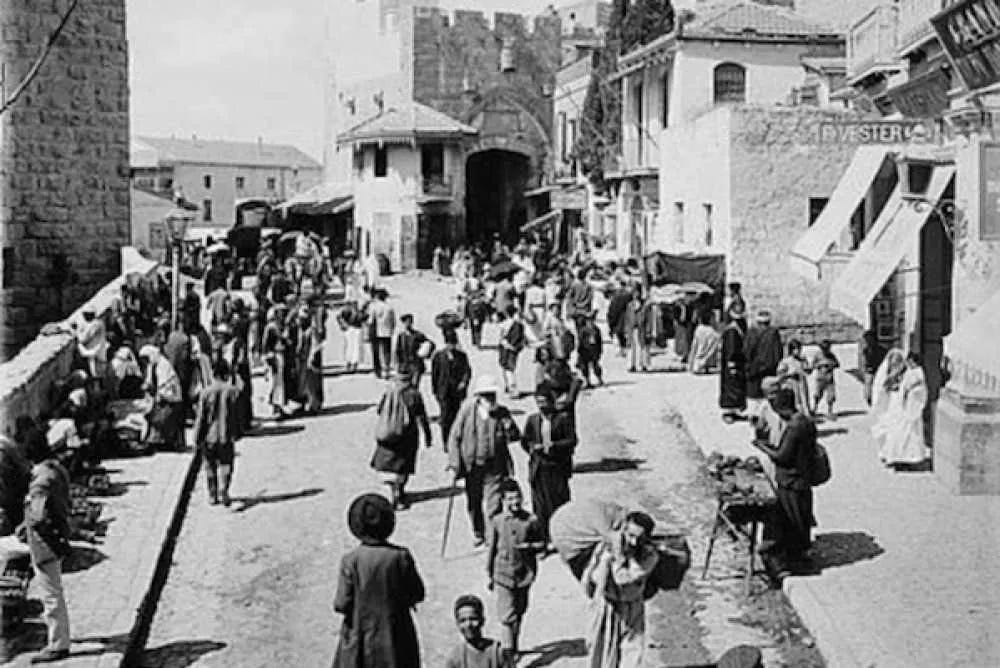
The Palestine of the late nineteenth century is neither the idyllic tableau of perfect coexistence that some pro-Palestinian narratives project into the past, nor the terra nullius — land without people — that certain propagandists have sometimes invoked to deny any pre-existing Arab presence. It is a complex territory forming part of the declining Ottoman Empire, populated by Muslim and Christian Arab communities, by Jews long established there, and, from the 1880s onward, by those waves of Jewish immigrants arriving from Eastern Europe in the context of the nascent Zionist movement. Tensions with the local Arab populations begin during this period, and they are documented — as we have noted — as early as 1891 by Ahad Ha’Am, a proponent of cultural Zionism. They are not yet war, but they carry the seed of it.

The first Jewish immigrations: fleeing before building (1881-1917)
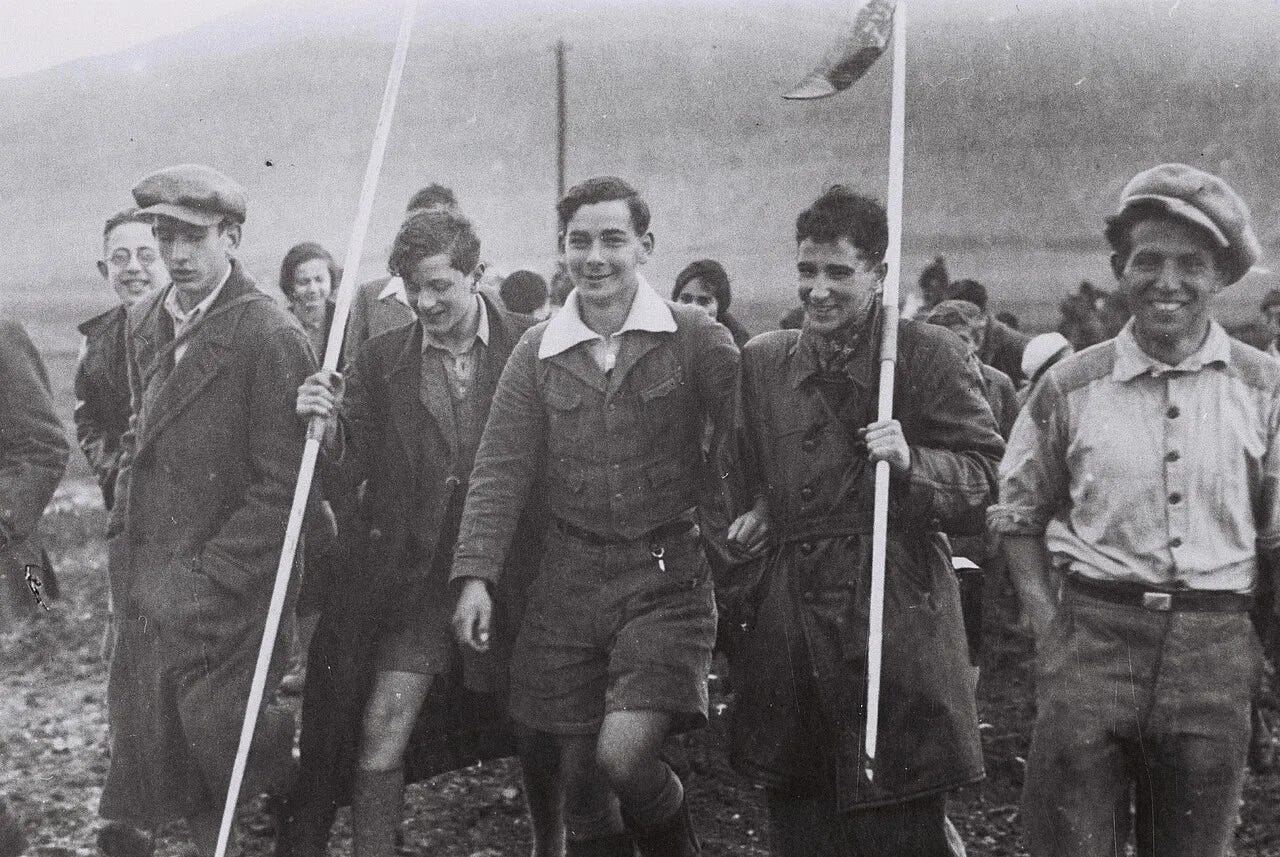
To understand 1948, one must understand 1882. Not as an arbitrary point of departure, but as the moment when a Jewish immigration that had existed for centuries in Palestine changes radically in nature and in project.
The Jews do not arrive in Palestine at the turn of the twentieth century as strangers come to colonise an unknown territory. A continuous Jewish presence is documented there from Antiquity; the communities of the Old Yishuv in Jerusalem, Safed, Hebron and Tiberias bear witness to it, and as early as the 1880s the Jews constitute the majority of the population of Jerusalem. The second article of this series recalled that an equally real and deeply rooted Arab presence coexisted with this continuity; both facts are true, and it is precisely because they are both true that the conflict is tragic rather than simple. What the first aliyot (waves of immigration) introduce is something else: no longer families integrated into the Ottoman fabric over generations, but an organised movement of national return carrying an explicit political project.
The first aliyah begins in 1882. Its immediate trigger is precise and must be named: the assassination of Tsar Alexander II on 1 March 1881 unleashes in Russia a wave of pogroms in the shtetlech, the Jewish towns and villages of Ukraine, Poland and Bessarabia. The Russian government responds not by condemning these massacres, but by institutionalising them: the May Laws of 1882 forbid Jews to settle in rural areas, to own land, to practise the liberal professions. They are laws of disguised progressive expulsion. Between 1881 and 1914, approximately two million Jews leave the Russian Empire — the great majority for the United States, a minority for Palestine. These first immigrants of the Zionist movement are not conquerors borne along by an ideology of domination: they are, for the most part, survivors rebuilding. The Bilu movement, a Hebrew acronym drawn from Isaiah — Beit Yaakov lechu venelcha, “House of Jacob, come, let us go” — brings together students who decide, after the pogroms of 1881, to wait no longer for the uncertain grace of the European nations.
The second aliyah (1904-1914) differs in texture and ambition. It is carried by young Jewish socialists, often marked by the Russian Revolution of 1905 and a new wave of organised violence: the Kishinev pogrom of April 1903 had killed forty-nine people and mutilated hundreds more, under the indifferent gaze of the tsarist police. These immigrants bring with them a structured political ideology: collective labour, the kibbutzim — agricultural communities founded on collective ownership and egalitarian sharing — and the renaissance of the Hebrew language as an instrument of nationhood. David Ben-Gurion, who would proclaim the birth of the State of Israel in May 1948 and who disembarked at Jaffa in 1906 aged twenty, belongs to this generation. It is this generation that will found the institutions that become the State of Israel.
The Palestine they join is neither empty nor without tensions. The land purchases by the Jewish National Fund, founded in 1901, pose a real and documented problem from that era: the sellers are often absentee urban notables living in Beirut or Damascus, whose lands are cultivated by Arab fellahin. When the land changes hands, it is these peasant families who lose their way of life. This reality feeds a concrete hostility towards the purchasers, which unscrupulous Palestinian leaders would know how to transform, as we shall see, into the fuel of war. As the second article of this series has documented, Ahad Ha’Am writes as early as 1891 that Zionists who ignored this reality would be preparing a catastrophe. No one truly listened.
The third aliyah (1919-1923), the fourth (1924-1929) and above all the fifth (1933-1939) — this last comprising massive numbers of Jews fleeing Nazi Germany — amplify these tensions within the framework of a British Mandate that possesses neither the political coherence nor the moral will to arbitrate them honestly.

The British double promise: the architecture of the conflict
If one seeks a foundational act of the impossibility in which the conflict has entrenched itself, one must look not towards Tel Aviv, nor Gaza, nor Ramallah, but towards the offices of the Foreign Office in London, between 1915 and 1917. We recall here briefly the two contradictory commitments made by the United Kingdom over the same territory, with the insouciance of an empire that believed it could manage the consequences from a distance, and which was gravely mistaken — elements we have already touched upon in the second article of this series.
The Hussein-McMahon correspondence (July 1915 — March 1916) promises the Sharif Hussein of Mecca, in exchange for an Arab revolt against the Ottoman Empire allied to Germany, the independence of a vast Arab state covering the greater part of the Middle East, including, according to interpretations still debated by historians, Palestine. The Arab Revolt does indeed take place, commanded by Hussein’s son with the help of the legendary Lawrence of Arabia, and plays a real military role in the Ottoman defeat. The promise is honoured on certain territories; it will not be honoured on Palestine.
The Balfour Declaration of 2 November 1917 is a sixty-seven-word document that changed the destiny of a region. The Foreign Secretary Arthur Balfour writes to Baron Walter Rothschild that the British government views with favour the establishment in Palestine of a national home for the Jewish people, while specifying that nothing shall be done which may prejudice the civil and religious rights of existing non-Jewish communities in Palestine. This specification, formulated as a guarantee, is in reality a logical impossibility in a territory that the two commitments promise simultaneously to two distinct peoples.
The global context of November 1917 illuminates the scale of the calculation: the war is not won. The October Russian Revolution has just broken out and threatens to take Russia out of the war, which would free German divisions for the Western Front. The Lloyd George government seeks levers of mobilisation everywhere. The Balfour Declaration is not an act of generosity towards the Jewish people: it is an instrument of war, designed to obtain the support of American Jewish communities in order to influence Woodrow Wilson — the President of the United States, then still neutral — whose entry into the conflict on the side of the Allies had become London’s absolute priority. The Palestinian people are not consulted. They are not even named directly: the Declaration speaks of “the existing non-Jewish communities in Palestine”, as if a majority population on its own land were an administrative category to be managed rather than an actor to be heard. This initial act of rendering-invisible is perhaps the original fault of the British colonial enterprise in the Levant, from which all subsequent ones derive.
It is in this void that everything plays out. The British have promised the same territory to two peoples, without giving themselves either the means or the will to arbitrate the consequences. The Arab population of Palestine, unconsulted, unrepresented, deprived of political frameworks after centuries of Ottoman administration, finds itself confronted with an organised and growing Jewish immigration in a territory that London manages according to the strategic interests of the moment. A genuine popular frustration, an Arab national identity under accelerated construction, a colonial authority simultaneously omnipresent and incoherent: all of this constitutes an extraordinary political combustible awaiting a spark.
What is needed to ignite this combustible is a man capable of naming it, of channelling it — and above all of radicalising it beyond any possible compromise. This man emerges in 1921, in the form of a major colonial blunder by the British themselves.

Haj Amin al-Husseini: the systematic Islamisation of a territorial conflict
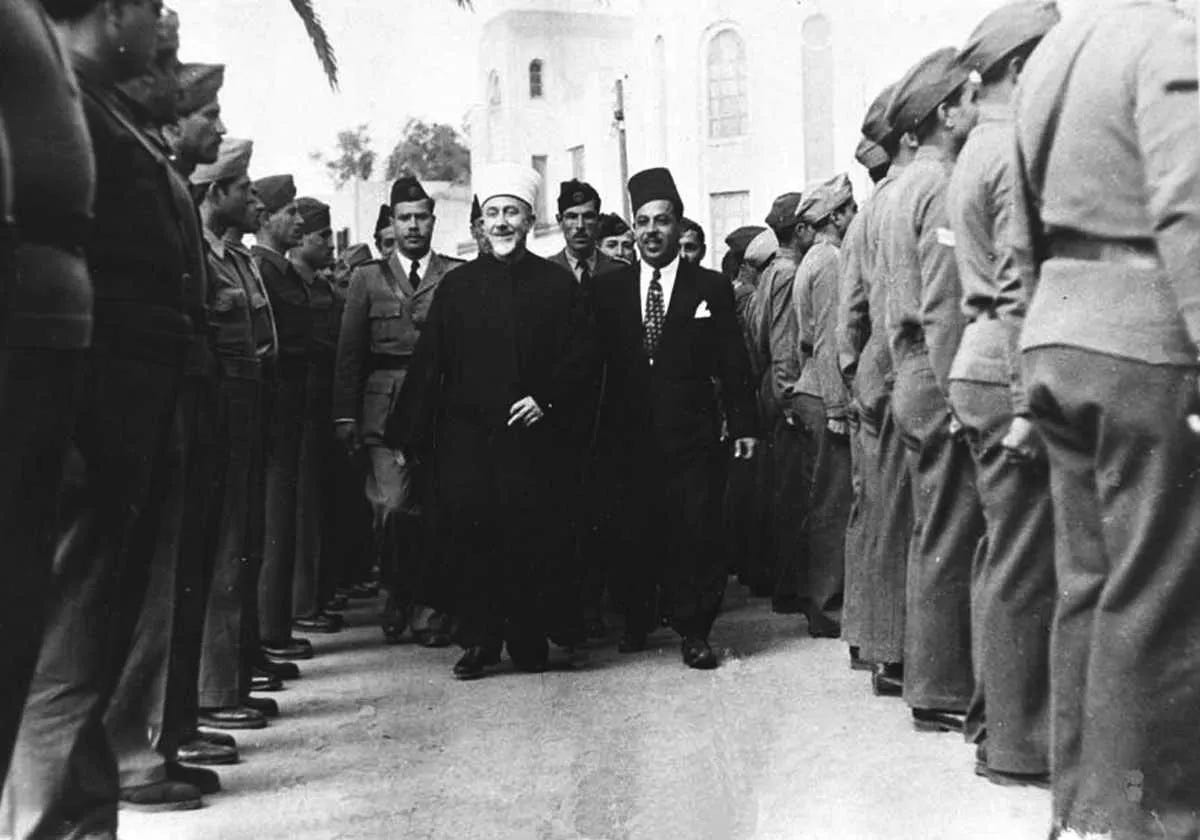
His name already appears in the first article of this series, where he was presented as one of the three founding fathers of radical Palestinian Islamism, alongside Hassan al-Banna and Sayyid Qutb, and where his collaboration with the Nazi regime was documented in its darkest detail: his meeting with Hitler in Berlin in November 1941, his interventions with the Bulgarian, Romanian and Hungarian governments to oppose any transfer of Jewish children to Palestine, demanding that they be sent to Poland — that is to say, to the extermination camps. These facts need not be repeated here.
What this article will unfold is what precedes 1941, the strategy that al-Husseini methodically constructed in Palestine from his appointment, because it is precisely this that explains why the opportunities for partition collapsed one after another even before the Shoah and the creation of Israel entered the equation.

His appointment of 1921 and the foundational colonial error
In 1920, the British have to appoint a Grand Mufti of Jerusalem, the supreme religious leader of the Muslims of Palestine. The internal election designates Raghib al-Nashashibi, representative of a family of Palestinian notables renowned for their pragmatism and their openness to negotiation. The British ignore this result and appoint instead the defeated candidate, Haj Amin al-Husseini — from a rival family and then twenty-six years old. The motivations of the High Commissioner Herbert Samuel remain disputed by historians: perhaps the desire to hold in balance the rival Palestinian clans, perhaps a misplaced confidence in al-Husseini’s capacity to be tempered by his youth.
The result is one of the most ill-judged decisions in British colonial history. Al-Husseini understands immediately what this position offers him: religious authority over Islam’s holy sites in Palestine, notably the Temple Mount, and above all control of the revenues of the waqfs, the Islamic religious foundations administering mosques, schools and landed properties. He thus disposes of an autonomous financial base that he will use to construct a personal political apparatus.

1929: transforming a dispute into a holy war
In August 1929, a relatively limited dispute breaks out in Jerusalem over the Western Wall, the last remnant of the destroyed Temple, the most sacred site of prayer and memory in Judaism: Jews had installed benches and partitions for women during the Yom Kippur prayers, a modification the British would judge illegal.
Al-Husseini seizes the opportunity. From his networks of mosques and associations, he spreads the rumour that the Jews are plotting to seize the al-Aqsa Mosque and the Dome of the Rock. Within days, what had been a dispute over prayer furniture becomes, in the narrative he orchestrates, a religious war for the defence of Islam’s third holiest site. The ensuing riots kill 133 Jews, among them 67 in Hebron in two days — a Jewish community present in that city for millennia. In Safed, twenty more Jews are killed. These acts of violence are not spontaneous: they are prepared and directed, and they do precisely the work al-Husseini expected of them.
The conflict has just changed in nature. What might have remained a nationalist and territorial tension between two communities sharing a disputed territory is now, in the Arab consciousness he has worked upon, a holy war for the defence of Islam. This ideological pivot of 1929 is decisive; the Hamas charter of 1988, as the first article of this series has shown, is its direct descendant, forty years later.

The methodical elimination of the moderates
What the second article of this series has documented through the fate of the Palestinian voices who sought an arrangement — those notables, mayors and intellectuals who were assassinated or forced into exile for having explored paths of coexistence — al-Husseini is the central organiser of all of it. The Nashashibi family, his historic political rivals, represented a different line: realism, the conviction that a territorial arrangement is possible and preferable to a war that the Arabs risked losing. He treated the Nashashibis and their allies with the same method he employed against the Jews: intimidation, violence, expulsion or assassination.
Between 1936 and 1939, during the Great Arab Revolt, his militias kill several hundred moderate Palestinian Arab notables — more than the British forces during the same period. This internal purge is fundamental to understanding why the Palestinian leadership that presents itself at the negotiating tables of 1937 and then 1947 has neither the will nor the political room to make a compromise. The moderates had been eliminated. Violence did not serve only to combat the Jews; it structured Palestinian politics in such a way as to render any compromise politically suicidal for whoever dared to propose it. This is a legacy whose effects run forward to the present day.

The revolt of 1936-1939: a legitimate uprising confiscated
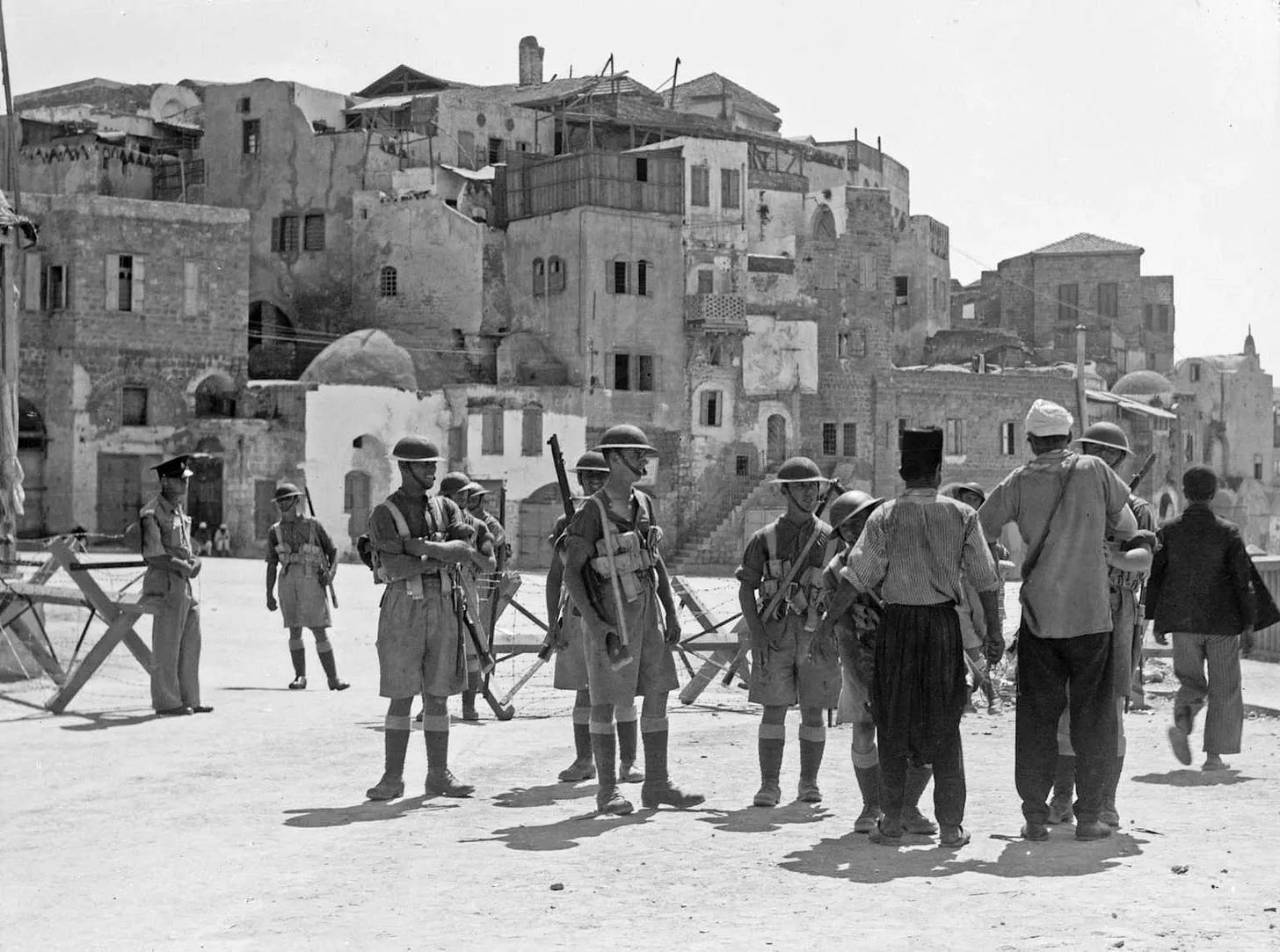
The Great Arab Revolt has real and legitimate causes. The 1930 Passfield White Paper, named after Sidney Webb, Lord Passfield, Colonial Secretary in the Labour government, had severely limited Jewish immigration and Zionist land purchases, responding to Arab pressure following the pogroms of 1929. But, under the joint pressure of Zionist organisations and a portion of the British Parliament, Prime Minister Ramsay MacDonald had practically emptied it of its substance as early as February 1931, in a letter to Chaim Weizmann that the Arab press immediately dubbed the “Black Letter” — proof, in their eyes, that London systematically ceded to the Jews as soon as they mobilised. The fifth aliyah, swelled by the arrival of Jews fleeing Nazi Germany after 1933, transforms the demography of Palestine at a speed that profoundly alarmed the Arab populations. The general strike of April 1936 carries a genuine popular frustration.
Al-Husseini takes hold of it adroitly, gradually displaces the secular leaders who were negotiating with the British, imposes his authority over the armed bands, and transforms what might have been a movement of political pressure into an insurgency of which he controls the command and the objectives. The paradoxical result: the Jews of Palestine, compelled to organise themselves militarily in response, reinforce the Haganah, the clandestine defence militia founded as early as 1920, and create in 1941 the Palmach, its elite strike unit, thereby acquiring the combat experience and command structures that will prove decisive in 1948.

Exile and the pan-Arab strategy
The Great Revolt that al-Husseini had orchestrated turns against him: the British, after three years of insurgency, decree his dismissal and issue an arrest warrant against him in 1937. He flees Palestine in disguise, crosses Jordan, takes refuge in Iraq, where he attempts to launch a pro-Nazi coup in 1941 — the Rashid Ali al-Gaylani putsch, which he actively supports and which fails in the face of a British counter-offensive. Forced to flee again, he makes his way to Iran, then Turkey, before reaching Rome and then Berlin in November 1941. This choice is not that of a refugee seeking any asylum: it is a deliberate ideological and strategic alliance with the regime that shares his central objective — the elimination of the Jews.
In Berlin, he is received by Hitler in person, is housed in a requisitioned villa, receives a monthly stipend from the German Reich, and disposes of offices and radio studios. From these positions, he continues to work his influence, no longer only on Palestine but on the entire Arab world. He broadcasts radio programmes in Arabic from Berlin and Rome, which interweave Nazi propaganda and Quranic rhetoric to forge in Arab consciousnesses a vision of the Jew as racial, civilisational and religious enemy all at once. It is he, more than any other actor, who introduces the Protocols of the Elders of Zion — a tsarist forgery recycled by Nazi propaganda — into the mosques and Quranic schools of the Middle East, presenting them as an authentic revelation of the mechanisms of a supposed world Jewish conspiracy.
He coordinates the rejection of the UN partition plan of 1947 by the Arab League, transforming this refusal into military mobilisation. From November 1947, even before the proclamation of the State of Israel, he coordinates the first armed attacks against the Jewish communities of Palestine. The military alliance of Egypt, Jordan, Syria, Iraq and Lebanon that invades the territory on 15 May 1948, with the publicly declared objective of “throwing the Jews into the sea”, bears in part his organisational imprint.
His legacy, as the first article of this series has documented in detail, crosses the decades without fading. The Hamas charter of 1988 carries his mark in its antisemitic formulations, in its definition of Palestine as an inalienable Islamic waqf, and in its doctrine of jihad as the only legitimate response. The lineage is intellectual, political and documented: Qutb, the other founding father analysed in the first article, gave al-Husseini’s system its mechanics of total and permanent war.

The theological locks against acceptance of Jewish presence
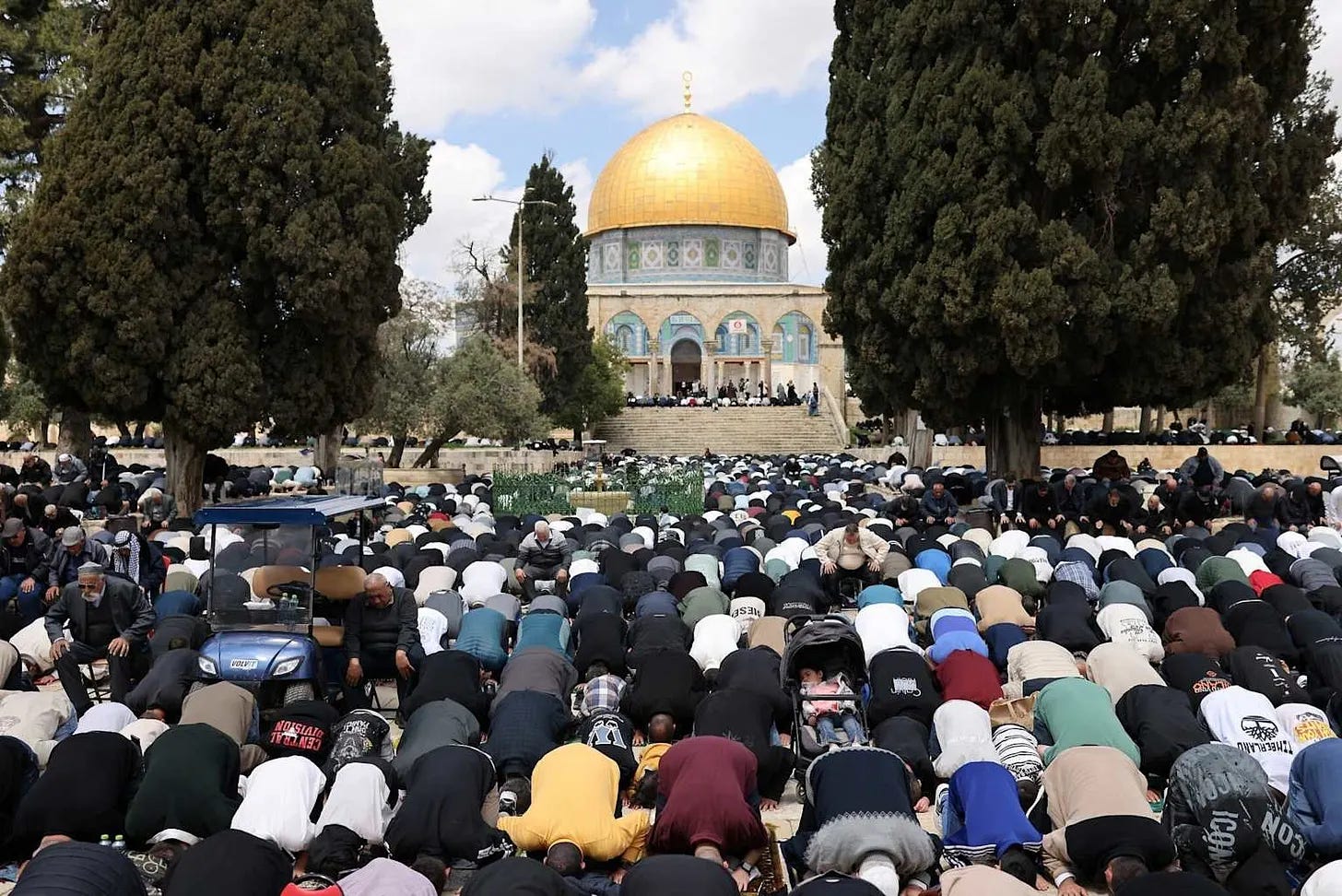
To understand why the successive rejections of the plans for partition of Palestine between Arabs and Jews — which we shall detail in the following section — are not tactical errors, nor even simple political calculations, but often genuine ideological coherences, one must look squarely at what the rigorist interpretation of Islam renders structurally impossible. This interpretation is to be carefully distinguished, as this series emphasises at every opportunity, from Islam in its millennial richness and diversity. We take up and deepen here elements already sketched in the previous articles, for readers approaching the series through this text.
The first obstacle is the concept of dar al-islam, the domain of Islam, opposed to dar al-harb, the domain of war. This distinction, developed by classical jurists from the eighth century onward, implies that any land once integrated into the Islamic domain by conquest cannot leave it. Withdrawal is theologically assimilable to a defeat that faith cannot validate. Palestine, conquered by the Arab armies in the seventh century and governed — except during the parenthesis of the Crusades — under Islamic authority until 1917, falls into this category. Rigorist jurists who invoke this doctrine cannot recognise a sovereign Jewish state on this land without committing what is, in their conceptual framework, a religious betrayal, not a simple political concession. The difference is not one of degree: it is one of kind.
The second obstacle is the historical status of Jews as dhimmis in classical Islamic tradition. This status, often presented in an either too favourable or too unfavourable light depending on the commentator’s position, was a form of conditional tolerance: Jews and Christians could practise their faith and retain their property in exchange for a special tax (jizya) and precise limitations on their civil rights. This regime, unequal and sometimes oppressive depending on the era and the dynasty, was nonetheless a form of coexistence. What it absolutely excluded was Jewish political sovereignty over an Arab and Islamic land. A Jewish state represents in this framework not an injustice of degree but an ontological inversion of theological order. This is why Arab leaders who could, personally and pragmatically, have accepted a territorial arrangement did not do so: the theological and popular pressure they would have had to confront was precisely this, and not a simple nationalist preference.
The third obstacle is the doctrine of the hudna — the truce. In classical Islamic jurisprudence, a truce with a non-Muslim enemy is legitimate but temporary: it is a tactical instrument, not a definitive solution. Any permanent peace with a non-Islamic state on lands of Islam would be, in this framework, theologically illegitimate. This is why the Muslim Brotherhood, of which Hamas is the Palestinian branch as the first article has documented, has always refused to characterise its ceasefires as peace: this word, in their framework, is an ideological concession they cannot make without disavowing themselves. This is also why the formula of the inalienable Islamic waqf in Article 11 of the 1988 charter is not a political posture; it is a theological position whose internal coherence, once this framework is understood, appears entirely logical and rigorous.
These theological impossibilities do not explain everything. They do not explain the choices of secular leaders such as Nasser, nor the geopolitical calculations of the Arab states that used the Palestinian cause for regional hegemonic ends. But they explain why the compromises that pragmatic actors might have negotiated always ran up, in the final instance, against a popular and religious resistance that Arab leaders knew to be insurmountable within their own society. This dimension is not merely political — it is cultural and spiritual, which connects directly with the question the fourth article of this series will address.

The pattern of rejected partitions
The Peel Commission and the first partition (1937)
This must be stated with clarity, because the dominant narrative systematically conceals it: Arab violence against the Jewish communities of Palestine predates by two decades the creation of the State of Israel. It cannot therefore be explained as a reaction to that creation, nor to the occupation of 1967.
The riots of Tarpat in August 1929 — which we saw above how al-Husseini orchestrated from a dispute over the Western Wall — had already prefigured this logic of total exclusion: 67 Jews massacred in Hebron in two days, a two-thousand-year-old community annihilated in forty-eight hours by organised popular violence. This is not a conflict between states; it is the refusal that the other should exist there.
The Great Arab Revolt of 1936-1939 convinces the British of the necessity of a lasting political solution. The government then commissions a royal commission of inquiry, six members, presided over by Lord Robert Peel, former Secretary of State for India, charged with examining the causes of the uprising and proposing solutions. The commission spends six months in Palestine, hears hundreds of witnesses from both camps, and delivers its report in July 1937 after a rigorous undertaking that the protagonists themselves acknowledged. This report is one of the most important and least cited documents in the history of the conflict, because it contains the first official proposal for territorial partition, and because its diagnosis of the deep causes of the incompatibility between the two national projects retains a lucidity that seventy years of subsequent history has not disproved.
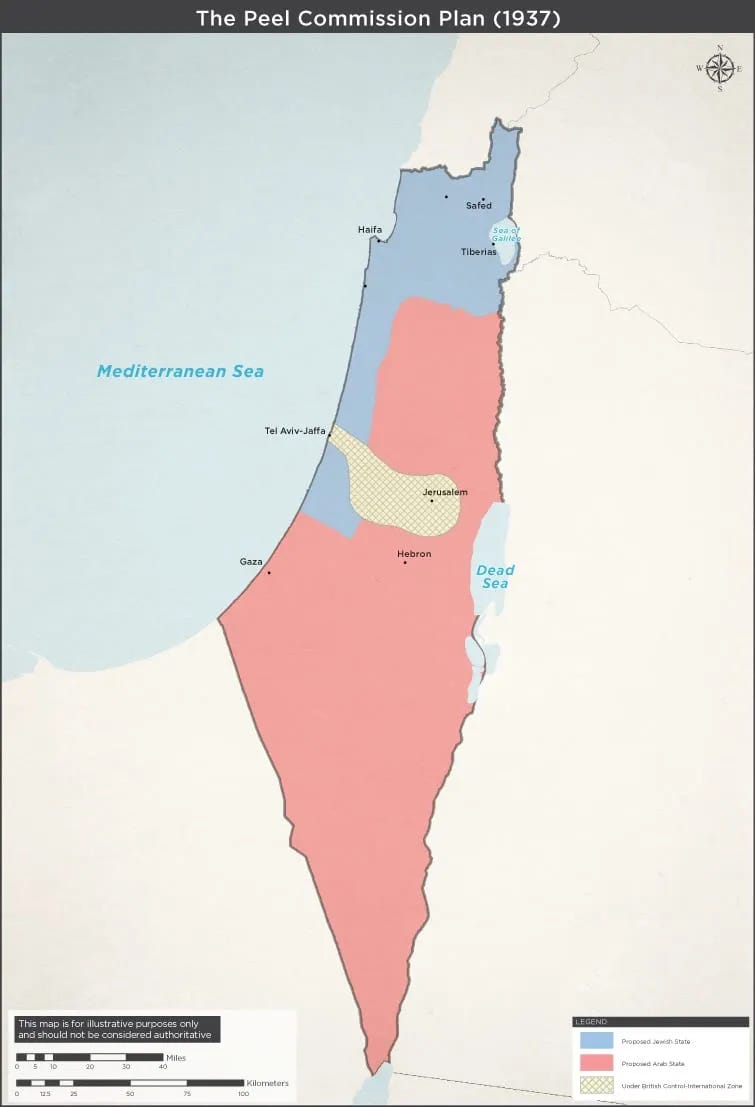
The Peel Plan divides Mandatory Palestine into three zones: a Jewish state covering approximately 33 per cent of the territory (the coastal plain, Galilee, the Jezreel Valley), an Arab state covering approximately 67 per cent (most of the rest), and a zone under British mandate including Jerusalem. The Jewish Agency accepts the principle of partition, with substantial reservations about the size of the territory allocated. The Arab Higher Committee, directed by al-Husseini, rejects the entire proposal without a counter-proposal.
The context of 1937 gives this refusal a particular gravity. Hitler has been in power for four years. The Jews of Germany and Austria are fleeing. Palestine is at that moment the only territory where a mass Jewish immigration is still possible, the United States having closed its doors with the Immigration Act of 1924, and the other European democracies also refusing to receive the refugees in significant numbers. To reject a Jewish state in 1937 is to reject a lifeline for tens of thousands of people that no one else, at that date, is willing to receive. This reality does not resolve the question of the rights of the Palestinian Arabs; it complicates it in a way that history has made tragic.
It is here that the pattern announced in the introduction manifests itself for the first time in full clarity. Had the Peel partition been accepted in 1937, an Arab Palestinian state would have existed on 67 per cent of the territory ten years before the UN plan, within frontiers incomparably more favourable to the Palestinians than those that all subsequent arrangements have offered. The Nakba of 1948 would probably not have taken place. Every refusal has consequences, and these too belong to history.

The partition plan of 1947: in the shadow of the Shoah
The systematic assassination of six million European Jews between 1941 and 1945 transforms the world’s moral equation in a way that no diplomatic mechanism had anticipated. European guilt — legitimate, immense, and entirely warranted — translates into massive political support for the creation of a Jewish state.
In February 1947, exhausted by three years of simultaneous Jewish and Arab insurgency and unable to arbitrate between its two contradictory promises, Great Britain hands the file to the United Nations and announces its withdrawal from the Mandate. The UN then constitutes a special committee, UNSCOP, eleven member states carefully chosen from outside the great powers to ensure neutrality, which spends several months in Palestine hearing the representatives of both camps. The Jewish delegates cooperate fully. The Arab Higher Committee refuses to participate, repeating the pattern of systematic boycott of any body liable to produce a partition.
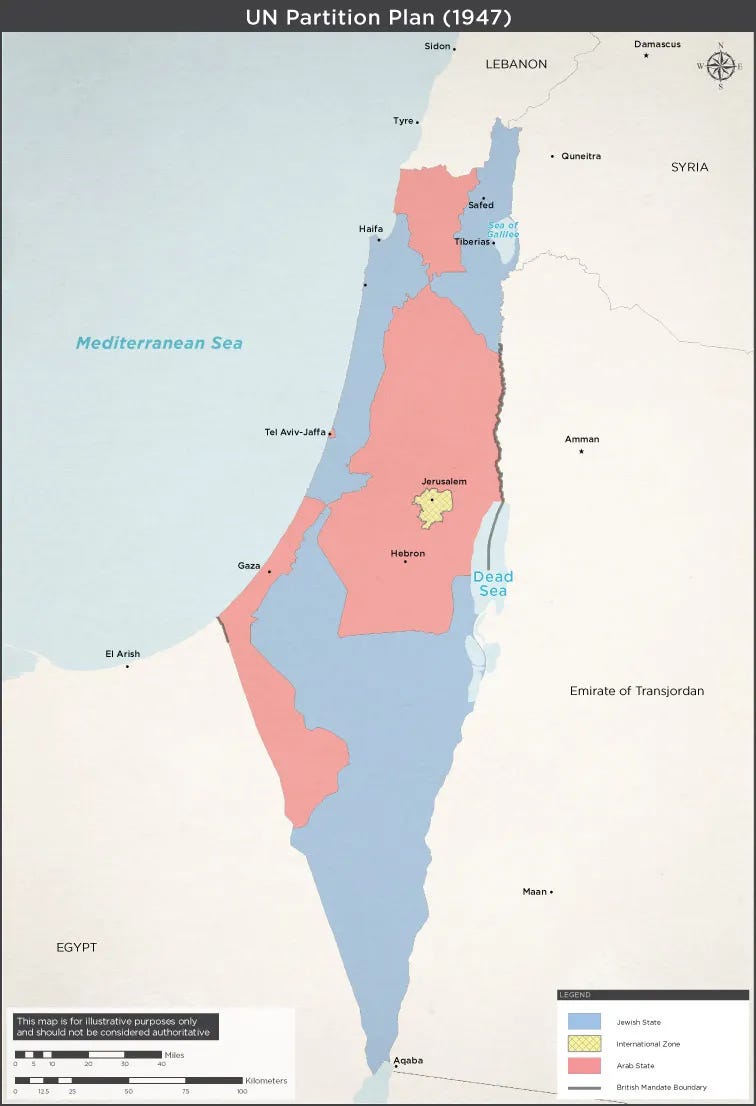
UNSCOP delivers its findings in September 1947: a majority of its members recommends partition into two states; a minority proposes a binational federal state. It is the majority solution that is put to a vote. The partition plan adopted by the UN General Assembly on 29 November 1947, Resolution 181, allocates 56 per cent of the territory to the Jewish state and 43 per cent to the Arab state, with Jerusalem placed under international administration.
This vote of November 1947 is less a triumph of international justice than a product of the nascent Cold War. The Soviet Union votes in favour — Stalin hoping that a Jewish state in Palestine, partly populated by socialists, might constitute a Soviet bridgehead in the Middle East against the Western powers. The United States votes in favour, Truman imposing this decision against the reluctance of the State Department and the Pentagon, who fear alienating the oil-producing Arab countries. Great Britain abstains, exhausted and humiliated by its inability to manage the Mandate.
This vote, presented retrospectively as the international legitimation of Israel, is in reality the product of a conjunctural alignment of the nascent Cold War that neither the Soviets nor the Americans would have anticipated six months earlier. The pattern repeats itself with a disconcerting precision: the Jewish institutions accept the plan, lamenting its limitations. The Arab states reject it unanimously and publicly announce their intention to prevent it by force of arms.

The foundational wounds
1948: two legitimate memories of the same event
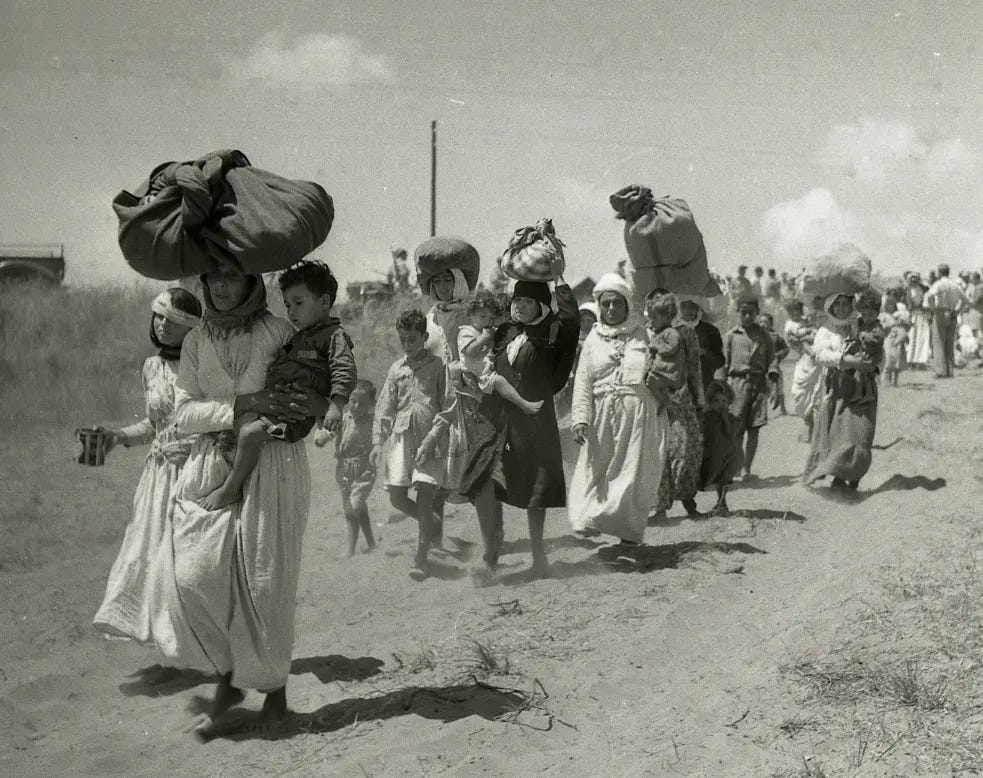
On 14 May 1948, Ben-Gurion proclaims the independence of the State of Israel. The following day, five Arab armies — Egypt, Jordan, Syria, Iraq, Lebanon — invade the territory to prevent the implementation of the partition plan their governments had rejected. At the end of ten months of war of extraordinary violence, the State of Israel controls 78 per cent of Mandatory Palestine — 22 per cent more than the UN had allocated to it — and signs armistices with all its adversaries. Jordan annexes the West Bank. Egypt controls Gaza. The Arab Palestinian state that the partition plan had provided for is never proclaimed.
During this war, between 700,000 and 750,000 Palestinian Arabs leave or are expelled from the territory of the new state — this is the Nakba, the catastrophe. The work of the Israeli New Historians — Benny Morris, Ilan Pappé, Avi Shlaim — who exploited the declassified Israeli archives in the 1980s, established that this displacement was neither solely the product of Arab calls to flee, nor exclusively the result of a pre-established plan of ethnic cleansing. It was, according to locality and circumstance, a mixture of spontaneous flight amplified by fear, of direct expulsions documented in several cases (Lod, Ramla — a town of the coastal plain, not to be confused with Ramallah in the West Bank — and several villages in the Jerusalem region), and of military logic in the context of a war in which each camp feared for its survival.
One must hold together, without cancelling one by the other, these two realities: the legitimacy of the creation of Israel, necessary after the Shoah and rendered inevitable by the Arab rejection of the partition plan; and the real, documented and lasting trauma of the Nakba, which tore from their land hundreds of thousands of people who had not personally chosen the war their leaders had decided. These two memories coexist within the same event. The inability to hold them together without cancelling one is one of the deepest roots of the impossibility of dialogue.

The double exile that no one places side by side
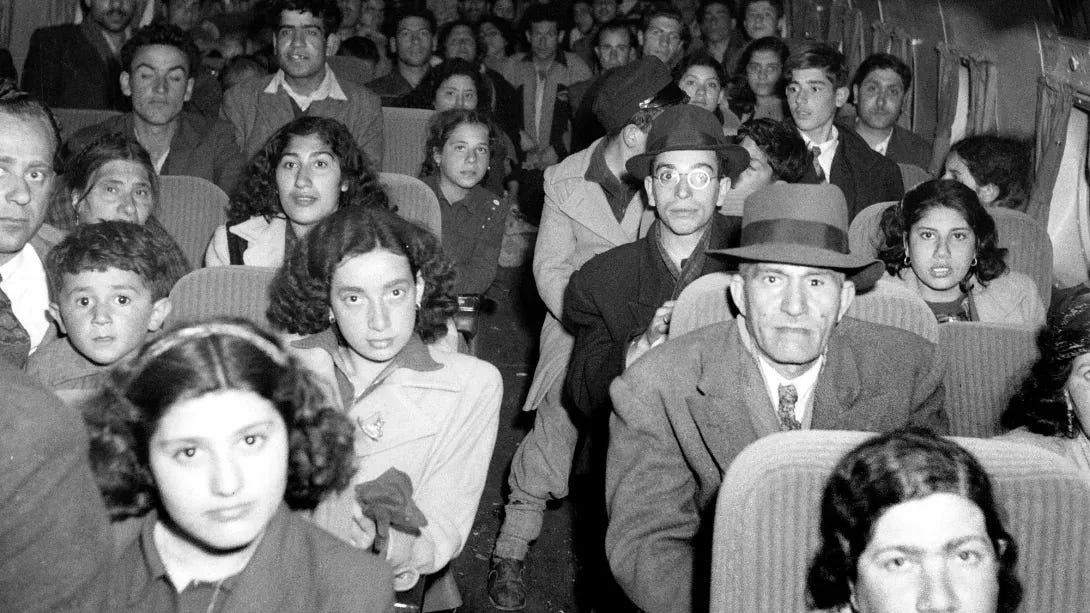
The Palestinian Nakba is not the only mass uprooting that this period produces. A symmetrical exile, almost exactly contemporary, has been effaced from the dominant narrative with a consistency so remarkable that it cannot be fortuitous: the 700,000 Palestinian refugees of 1948 are named, documented, commemorated — rightly so — but the hundreds of thousands of Jewish refugees expelled from the Arab countries are almost systematically absent from that same narrative.
Between 1948 and the early 1970s, some 850,000 to a million Jews left the Arab countries and Iran, the great majority under duress, in forms ranging from direct expulsion to popular violence by way of economic and legal pressures that made any normal life impossible. The Farhud of Baghdad in 1941, a pogrom that had massacred hundreds of Iraqi Jews, had given warning of what was to come. The Iraqi confiscations of 1948 and 1967, the Egyptian expulsions following the nationalisation of the Suez Canal, the forced departures from Morocco, Tunisia, Libya, Yemen, Syria: in each case, communities sometimes two thousand years old were torn from lives built over generations.
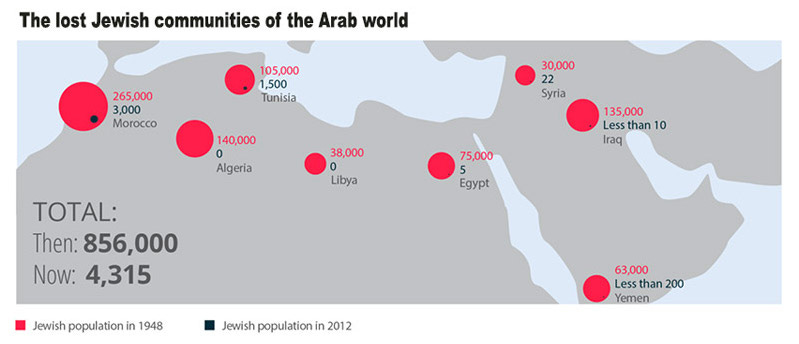
Israel absorbs these refugees — the Mizrahim, who today constitute almost half the Israeli population — at a considerable human and economic cost for a nascent state already under military and economic pressure. It does not maintain them in camps of permanent waiting. It does not establish a transmissible refugee status for their descendants. The Arab host states of the Palestinian refugees, with the partial exception of Jordan, have on the contrary deliberately maintained these populations in precarious statuses, without full civil rights. Lebanon forbids Palestinians by law from practising dozens of professions, keeping them in structural dependency in the camps. Nasser proclaimed it without circumspection as early as the 1950s: the Palestinian problem, kept raw, is an instrument of political mobilisation and pressure on Israel and the West.

The UNRWA: a humanitarian agency become a political instrument
The UNRWA, the United Nations Relief and Works Agency for Palestine Refugees, created by General Assembly resolution in December 1949, embodies institutionally this deliberate perpetuation. The agency was born of a genuine emergency: hundreds of thousands of displaced persons without resources, in provisional camps, awaiting a political settlement that was not arriving. But its structure was rapidly shaped by the neighbouring Arab states, which refused to integrate the refugees into their societies — UNRWA offering them a convenient alternative: maintaining these populations in the camps, under UN tutelage and Western financing, without having to naturalise them or grant them civil rights.
Its mandate is unique in the world and will remain so: unlike the UNHCR, the United Nations High Commissioner for Refugees, created the same year to manage all other refugees on the planet with the objective of their reintegration or resettlement, UNRWA transmits refugee status to descendants in perpetuity, according to a definition that exists nowhere else in international law. This mechanism transforms 700,000 refugees of 1948 into more than five million registered refugees in 2026 — a figure that grows mechanically with each generation. Its governance reflects these contradictions: the agency operates in territories controlled by political factions hostile to any settlement, employs tens of thousands of local staff recruited from the camps themselves, and has systematically resisted independent audits of the neutrality of its educational activities. Journalistic investigations and reports from monitoring organisations have nonetheless been able to document the presence in its school textbooks of content inciting violence and denying the existence of Israel. This mechanism is not humanitarian in its logic; it is political in its structure.
In January 2024, the Commissioner-General of UNRWA himself admitted that Israel had provided damning information on twelve employees of the organisation implicated in the attacks of 7 October 2023. Nine were dismissed within the hour, and several major donor countries — the United States, the United Kingdom, Germany, Canada, Australia — immediately suspended their funding, before gradually restoring it under humanitarian pressure, revealing the impasse in which this institution places the international community: held hostage by an agency whose excesses it can neither acknowledge nor accept the disappearance of without a replacement solution.

The Suez crisis: when Washington draws the limits (1956)
In October 1956, Israel invades the Sinai in secret coordination with France and Great Britain, who seek to overthrow Nasser following his nationalisation of the Suez Canal in July. The military operation is a success. But Eisenhower, the President of the United States, is furious at having been kept in the dark and refuses to allow two European colonial powers to dictate American policy in the Middle East at the height of the Cold War. He demands withdrawal, and Israel withdraws.
This sequence contains a lesson that history will repeat: without American cover, Israeli military victories do not hold politically. It explains the permanent asymmetry between Israel’s military power and its diplomatic dependence on the United States — an asymmetry that will fuel decade after decade the conspiracist theories about the “Jewish lobby” controlling Washington, whereas it is in reality Washington that has imposed and continues to impose limits on Tel Aviv. This confusion between the reality of an asymmetric strategic bond and the imaginary of a world Jewish conspiracy is one of the intellectual sources of contemporary antisemitic conspiracism — to which we shall return.

The 1967 war and the structural turning point
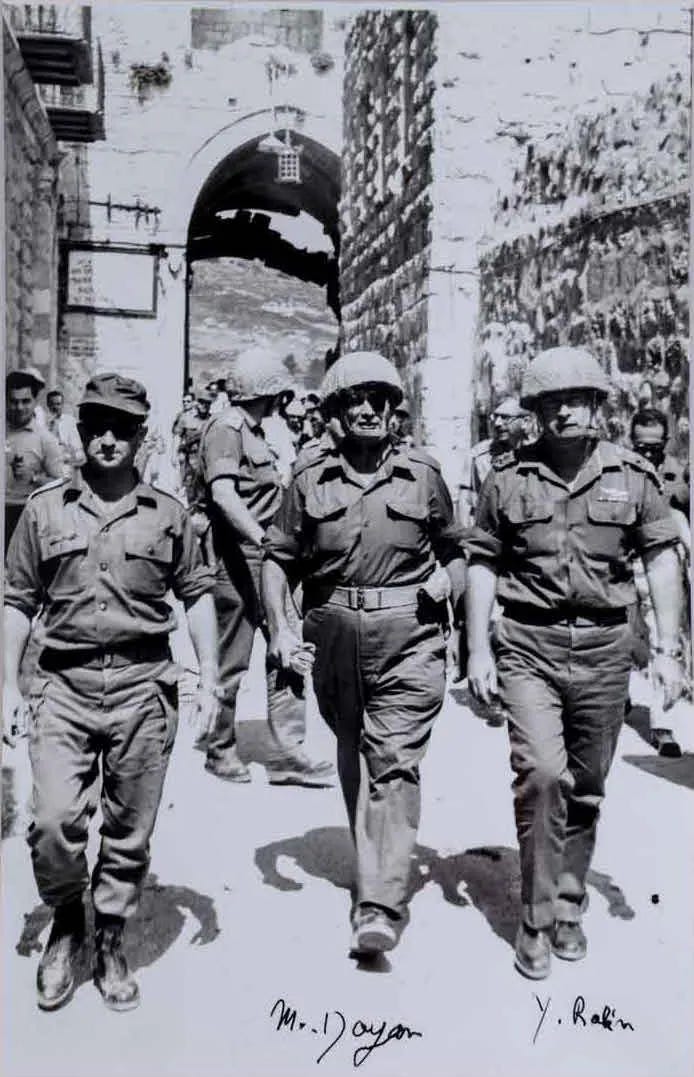
The Six-Day War (5-10 June 1967) is, alongside 1948, the second foundational event without which the contemporary conflict is incomprehensible. It is triggered by an Israeli pre-emptive strike, but the context preceding it is inseparable from this choice: since May 1967, Nasser has massed 100,000 Egyptian soldiers in the Sinai on Israel’s frontiers, closed the Strait of Tiran to Israeli ships — an act internationally recognised as a casus belli — and obtained the withdrawal of the UN interposition forces that had separated the two armies since 1956. Jordan and Syria have signed offensive military pacts with Egypt, and the Arab radio stations openly broadcast calls for the annihilation of the Jewish state. Israel, whose strategic depth amounts to only a few dozen kilometres, chooses to strike first rather than await an attack. In less than a week, it conquers the West Bank, including East Jerusalem and the Temple Mount, Gaza, the Egyptian Sinai and the Syrian Golan.
What is at stake in 1967 is a structural shift: Israel moves from the status of a state born of the 1948 war to the status of an occupying power over territories inhabited by more than a million Palestinians. The international law of occupation applies from that point forward — the Geneva Conventions, notably their Article 49, which prohibits the transfer of the civilian population of the occupying power into the occupied territories. This is precisely what successive Israeli governments will systematically do in developing the settlements, in documented and unanimously condemned violation of the UN Security Council.
The victory also restructures the international narrative of the conflict in a way that must be named plainly: before 1967, Israel was perceived by the world left as a pioneering socialist state and a refuge for survivors of the Shoah. After 1967, it becomes an occupier. This narrative transformation is not entirely unjust — the occupation begins there, with the settlements that will follow. But it is immediately instrumentalised: in the same period, the Soviet Union, through its propaganda services, begins systematically producing and distributing a narrative that makes Israel the armed wing of American imperialism. The UN Resolution 3379 of 1975, which declares that “Zionism is a form of racism”, adopted by the Soviet-Arab-Third-World bloc, is the culmination of this strategy. It will be repealed by Resolution 46/86 in December 1991, a few days after the dissolution of the USSR — the connection is explicit.

1973: the Yom Kippur War, the oil shock and Kissinger
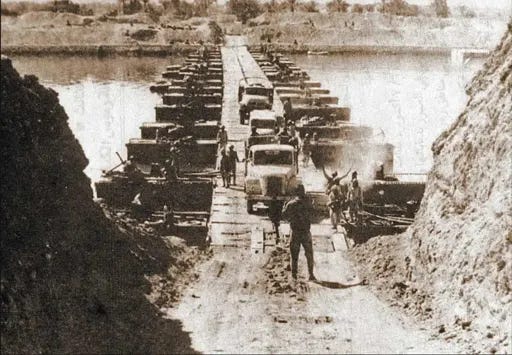
The October War of 1973, the Yom Kippur War — launched by surprise on the day of the great Jewish fast by Egypt’s Sadat and Syria’s Assad to recover militarily the territories lost in six days in 1967 — almost turned to catastrophe for Israel in its opening hours, before its counter-offensive restored the situation at considerable cost. It ends militarily in a belated and dearly bought Israeli victory — more than 2,500 Israeli soldiers killed in nineteen days — but OPEC, under the impetus of Saudi Arabia, decrees an oil embargo against the Western countries that had supported Israel during the war.
The price per barrel quadruples within weeks, queues lengthen at filling stations across the United States and Europe, and heating rationed in several countries transforms a war in the Middle East into a domestic crisis felt in every Western home. For the first time, the Israeli-Palestinian conflict directly affects the daily lives of Westerners, and permanently changes their political relationship to the subject.
It is in this context that Henry Kissinger, Secretary of State under Nixon and then Ford, deploys what the American press would call shuttle diplomacy. The principle is simple in its mechanics, formidably complex in its execution: Kissinger travels personally between the belligerents’ capitals — Tel Aviv, Cairo, Damascus, Amman, Riyadh — by air shuttle, carrying each party’s proposals to the other himself, without ever bringing them directly to a table together. This choice has a precise logic: Kissinger knows that direct meetings between Arab and Israeli leaders are politically impossible in 1973-1974; no Arab head of state can be photographed shaking hands with an Israeli without risking his domestic political stability. The shuttle circumvents this obstacle by making the American negotiator the only visible intermediary, the one who politically absorbs the cost of the exchange.
Between October 1973 and September 1975, Kissinger makes dozens of trips, negotiates two disengagement agreements between Israel and Egypt and one between Israel and Syria, and lays the foundations for the process that will lead, under Carter, to the Camp David Accords of 1978. His method embodies a vision of the Middle East as the strategic chessboard of the Cold War: the objective is not a just peace but a stable equilibrium, not the resolution of the conflict but its management at a level of tension tolerable to American interests. This vision — realist in the philosophical sense, cold in the human sense — will produce real diplomatic advances but will leave the deep causes of the conflict intact, causes that the management of symptoms neither was intended nor had the capacity to treat.

The occasions of peace deliberately sabotaged
The Israeli-Egyptian peace: political courage changes history (1978-1979)
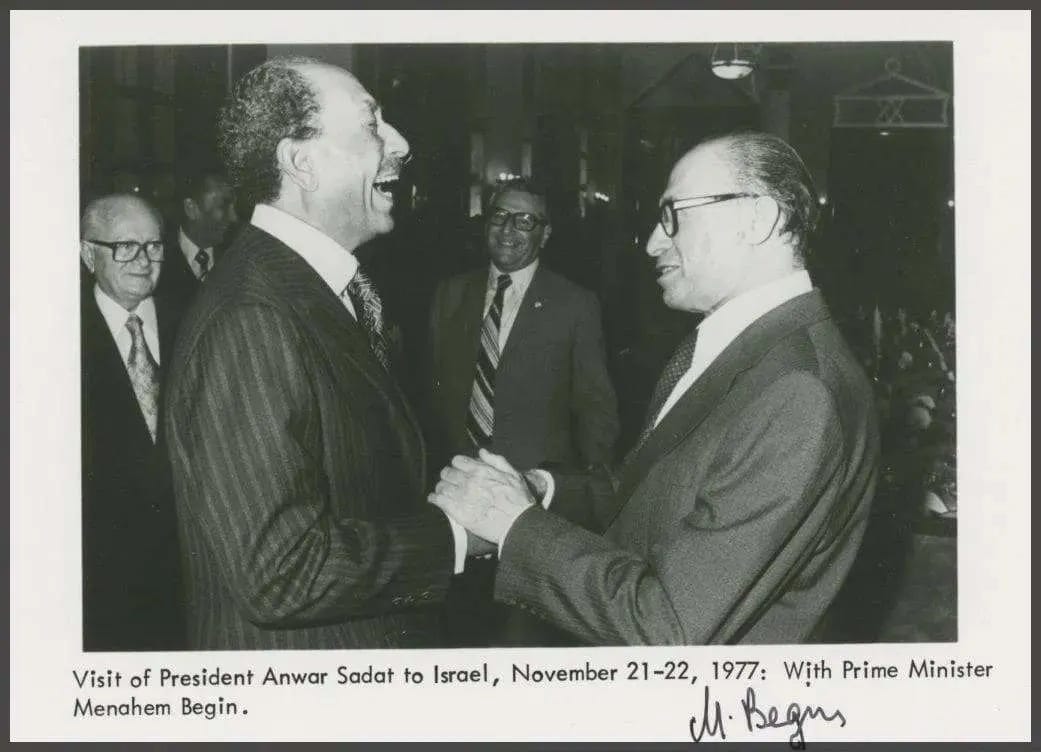
In November 1977, Anwar Sadat accomplishes a gesture that no one had anticipated: he boards a plane for Tel Aviv and addresses the Knesset, the Israeli Parliament. It is the first official visit by an Arab leader to Israel since the creation of the state. In a sober and courageous speech, he says what no Arab leader had said publicly: the war has lasted long enough, peace is possible, and he has come to seek it. The effect on Israeli public opinion is staggering; millions of people who had grown up in the certainty that the Arabs wanted their destruction see for the first time an Arab president speaking to them face to face, in their own assembly. This single gesture changes something in the psychological fabric of the conflict that neither UN resolutions nor ceasefires had managed to touch.
Jimmy Carter seizes this opening. In September 1978, he invites Sadat and Begin to the presidential retreat at Camp David, in the mountains of Maryland, and confines them there for thirteen days, deliberately isolated from the world, without press, without the agenda of other affairs of state. Carter involves himself personally with an intensity that few American presidents have matched on a foreign dossier: he himself drafts compromise proposals, navigates between the two men whose personalities are antagonistic — Sadat is visionary and impatient, Begin conducts himself like a meticulous jurist clinging to details — and relaunches the negotiations several times when they are on the verge of failure. The thirteen days produce two texts: a framework for peace for the Middle East as a whole, and a specific framework for the conclusion of a peace treaty between Israel and Egypt.
The treaty signed in March 1979 settles the bilateral questions with a clarity that few peace agreements have achieved: Israel returns the entirety of the Sinai to Egypt, including the Israeli settlements built there after 1967, evacuated by force if necessary, in exchange for full diplomatic normalisation, recognition of Israel, and a guarantee of free passage through the Suez Canal and the Strait of Tiran. It is a complete territorial exchange — land for peace in its clearest formulation — and it holds: the Sinai was returned, the frontier has been peaceful for forty-five years, and the Egyptian embassy in Tel Aviv has never closed even in periods of tension.
What does not hold, however, is the Palestinian dimension of the accords. The first of the two Camp David texts explicitly provided for autonomy for the inhabitants of the West Bank and Gaza within five years, intended to lead to a negotiated permanent solution on their status. Begin had accepted this framework, but his interpretation of “autonomy” was radically different from that of Sadat and Carter: for him, autonomy concerned the persons, not the territory, which by definition excluded any form of Palestinian sovereignty over the land.
From the moment of his return to Israel, the Begin government accelerates Jewish settlement of the West Bank, as if to materialise in concrete an interpretation of the accords that his partners did not share. The Palestinian dimension of Camp David is stillborn, sabotaged from within by the Israeli party that had signed it.
Sadat returns to Cairo ostracised by the Arab world: Egypt is expelled from the Arab League, Arab embassies close in Cairo, and Sadat is treated as a traitor in the streets of Baghdad, Damascus and Beirut. He pays this courage with his life — assassinated on 6 October 1981, the exact anniversary of the Yom Kippur attack, by members of Egyptian Islamic Jihad who had infiltrated his own army during a military parade. His principal killer, Khaled Islambouli, cries out as he fires: “I have killed the Pharaoh.”
This precedent weighs on every Arab leader who comes after him: making peace with Israel can cost one’s life, and his successors, beginning with Hosni Mubarak, drew the lesson by maintaining with Israel a cold peace — technically observed but emotionally abandoned, without popular normalisation or cultural cooperation, a peace of states without a peace of peoples. This is perhaps the deepest limit of the Kissinger-Carter method: one can compel governments to sign; one cannot force societies to be reconciled.

Oslo 1993: the hope and the seeds of its failure
The Israeli-Egyptian peace proves that an Arab-Israeli agreement is structurally possible. But it does not resolve the Palestinian question, Begin having set about emptying the autonomist dimension of the accords of its substance, and it remains a peace between states — cold and deserted on the human level. What is missing on the Palestinian side is a legitimate and recognised interlocutor, capable of signing on behalf of his people. For fifteen years, this condition seems out of reach.
Arafat’s Palestine Liberation Organisation is classified as a terrorist organisation by the United States and Israel — not without reason: its factions have multiplied attacks between the 1960s and the 1980s, from the massacre of Israeli athletes at the Munich Olympic Games in September 1972 to aircraft hijackings, embassy attacks and lethal operations against civilians in Israel, Europe and Lebanon. Meanwhile, the first Intifada breaks out in 1987 in the camps of Gaza and spreads to the West Bank in the form of a spontaneous popular uprising that no one had anticipated. And that same year, Hamas is founded — the Palestinian branch of the Muslim Brotherhood — which immediately begins to challenge the secular PLO’s claim to represent the resistance. Three simultaneous obstacles, three reasons to believe that any negotiation is durably impossible. Yet a glimmer would appear — by a path that no one had mapped.
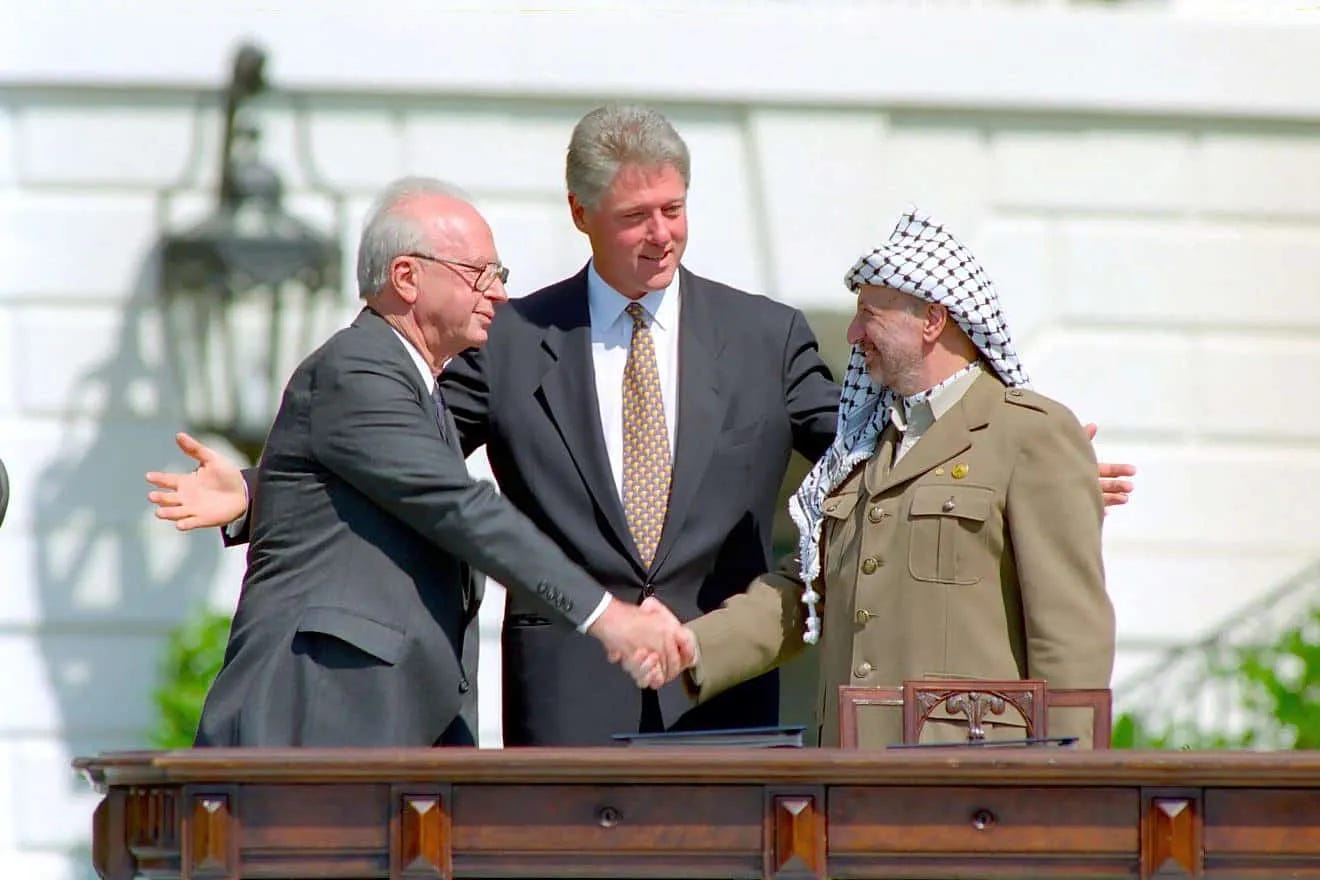
The handshake between Yitzhak Rabin and Yasser Arafat on the White House lawn on 13 September 1993, under the visibly moved gaze of Bill Clinton, represents the moment closest to a resolution of the conflict that the history of this region has produced. But to understand that moment, one must go back to the discreet backstage that made it possible, because Oslo was not born in Washington, nor under American pressure.
It all begins in the autumn of 1992, in villas on the outskirts of Oslo, in secret conversations between academics, mid-ranking Israeli officials and PLO representatives, organised by the FAFO Institute, a Norwegian research centre. The Norwegian government, discreet and without strategic interests of its own in the region, provides the logistics and diplomatic cover. These meetings, ignored by the chancelleries, produce in a few months more real advances than years of official negotiations, precisely because they take place without cameras, without public declarations, without the pressure of national opinion to be managed. This is the paradox of Oslo: the most spectacular peace proposal of the conflict was negotiated in complete secrecy, by people who did not yet have an official mandate to do so.
The accords are born in an exceptional context on two counts. The first is geopolitical: the fall of the Soviet Union in 1991 has removed the principal financial and military patron of the radical Palestinian factions, and the Gulf War has just isolated Arafat — who had supported Saddam Hussein — from his Gulf financers. Arafat is short of funds, his organisation in disarray, and he knows that without an agreement he will be overtaken by the Islamists of Hamas who are on the rise. The second context is ideological: the liberal optimism of the post-Cold War period produces a real window of opportunity, which courageous negotiators on both sides — voices subsequently silenced, such as those the previous article has documented in detail — seize in Oslo in secret. On the Israeli side, Yitzhak Rabin and Shimon Peres understand that demographics leave them little time: governing indefinitely a Palestinian population without granting it either equality or independence is a moral and political dead end. On the Palestinian side, Arafat is playing for his political survival.
But what Oslo also contains, concealed by the enthusiasm of the White House ceremony, is the architecture of its own fragility. The accords establish mutual recognition — the PLO recognises Israel, Israel recognises the PLO — and create the Palestinian Authority as the embryo of a civil administration in the West Bank and Gaza. But they defer to final-status negotiations precisely the most difficult questions: Jerusalem, the fate of the refugees, the definitive borders, the future of the settlements. In leaving these questions open for five years, they give each camp — and above all the extremists on both sides — the time and space to sabotage them. An agreement of process without an agreement of substance is a structure that holds only if all the actors play the game. They will not all do so.
Hamas launches its first major waves of suicide bombings in 1994-1996 — buses blown up in Jerusalem, shopping centres in Tel Aviv — with the explicitly declared strategy of destroying the peace process by bloodshed: every attack is designed to radicalise Israeli public opinion, reinforce the right and weaken Rabin. Meanwhile, the settlements continue to expand in the West Bank under all Israeli governments, including those that profess allegiance to Oslo, adding each year thousands of new residents to a territory whose final status is supposed to be negotiated.

The assassination of Rabin: what a bullet killed (1995)
On 4 November 1995, in Tel Aviv, Yitzhak Rabin is assassinated after a large peace rally. His murderer is called Yigal Amir; he is a law student, a religious nationalist, and convinced that the Torah forbids ceding lands of the Land of Israel and that killing the head of government who was resolving to do so is a pious act. It is not an Arab enemy who kills Rabin: it is the internal logic of Jewish extremism described in the first article of this series, arrived at its most murderous conclusion.
What the death of Rabin has killed, beyond the man, is the existence of an Israeli leadership that had made the inner journey of recognition of the other, that carried an irrefutable military legitimacy, and was thereby capable of drawing a part of the Israeli right into the peace process. Rabin had understood that one does not make peace with one’s friends. This understanding was buried with him.
The five years following Rabin’s assassination are those of methodical deceleration. Netanyahu, elected in May 1996 on a security platform, applies the Oslo Accords to the bare legal minimum while allowing the settlements to expand. His successor Ehud Barak, elected in 1999 with an explicit peace mandate, wants to settle everything at once — Jerusalem, the refugees, the borders, the settlements — before his own government collapses. This haste will be both his strength and his weakness.

Camp David 2000: deconstructing a myth without absolving anyone
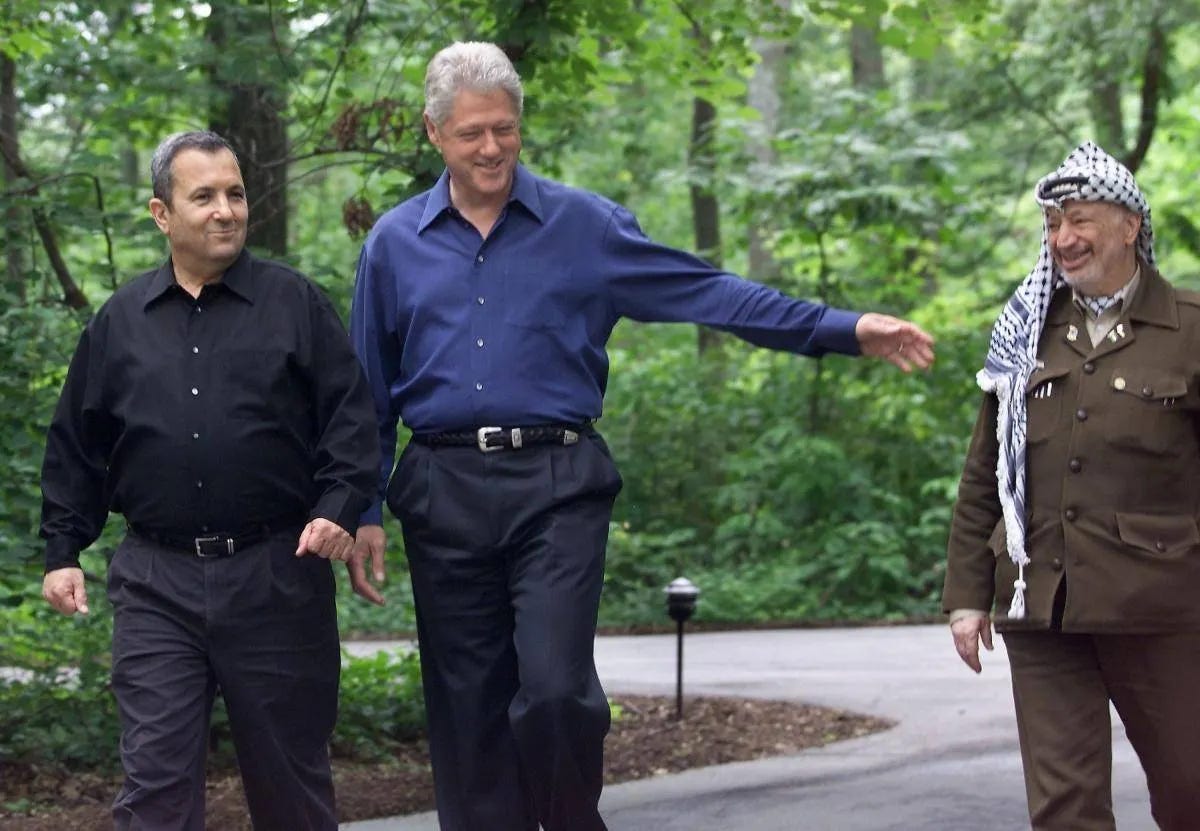
In July 2000, Ehud Barak, Yasser Arafat and Bill Clinton meet at Camp David to attempt what Oslo had promised and deferred: negotiating the final status. This attempt arrives seven years late, in a political context on both sides deeply degraded by Hamas’s attacks and the continuous expansion of Jewish settlements in the West Bank.
The moment is poorly chosen on almost every count. Barak is politically weakened in Israel: his governing coalition is crumbling, ministers have resigned even before the summit to protest the anticipated concessions, and he knows he has only a few weeks before his government falls. Arafat, for his part, had never wanted this summit at this moment: he had explicitly asked Clinton not to convene it before having prepared the ground, judging that conditions were not ripe. Clinton overrides him; his second mandate ends in January 2001, and he wants his peace agreement before leaving — the Lewinsky affair and the impeachment proceedings need to be erased by a historic diplomatic legacy. This pressure of the American calendar weighs on the entire dynamic of the summit, in a way that professional diplomats subsequently analysed as a fundamental error of method.
The fifteen days of Camp David, from 11 to 25 July 2000, unfold in an atmosphere of accumulated mistrust that this bucolic Maryland residence cannot suffice to dissipate. The two delegations barely speak to each other directly: Clinton and his team navigate between them in the manner of Kissinger in his time, carrying proposals that each party receives without knowing exactly what the other has said. This format, useful in an exploratory phase, reaches its limits when the questions are at the complexity level of Jerusalem or the right of return.
The Israeli proposals are real and represent a step forward from all previous official positions — this must be said plainly. Barak offers a restitution of 91 per cent of the West Bank initially, with the possibility of reaching 94 per cent in time, and accepts the principle of a Palestinian state. But the shortcomings are substantial and are not matters of detail. Concerning East Jerusalem, Barak suggests a functional sovereignty over certain Arab neighbourhoods — a deliberately ambiguous term that avoids the words full sovereignty — and refuses any Palestinian sovereignty over the Temple Mount, Islam’s third holiest site, at the heart of the identity of every Arab leader. No Palestinian president can sign an agreement that formally abandons any claim to sovereignty over al-Aqsa without being overthrown or assassinated within the week. On the refugees, the right of return is refused in its very principle, and the financial compensation proposed is presented as a substitute for recognition — which Arafat, owing to the fragility of his political position, cannot publicly accept without disavowing the Nakba. On territorial contiguity, the proposed Palestinian state is surrounded and cut through by settlement blocs that compromise its real geographic viability; the maps show a territory in archipelago rather than a coherent state.
Robert Malley, a member of the American delegation at Camp David, publishes as early as 2001 in the New York Review of Books an analysis that profoundly nuances the official version, earning him years of hostility from the American-Israeli establishment before being largely validated. The American negotiator Aaron David Miller would also write, years later, that the United States had too systematically adopted the Israeli point of view during the negotiations, and that Clinton had lacked the neutrality necessary to be a credible mediator in Palestinian eyes.
The documented truth is twofold, and one must hold both its components without abandoning either. The Israeli offer was real but imperfect, and some of its conditions were structurally unacceptable to any Palestinian leader who had to justify them before his people. Arafat, for his part, presented no developed counter-proposal; he said no without offering an alternative, which is a real fault in a negotiator, whatever the legitimacy of his substantive objections. The most clear-eyed Palestinian negotiators acknowledged this privately: Arafat was a man of resistance, not a man of compromise, and Camp David asked precisely the opposite of what he had built himself upon over forty years.
The consequences of this failure are disproportionate to the duration of the summit. The transformation of this missed encounter into the definitive proof of congenital Palestinian bad faith — a narrative imposed by Clinton in his closing press conference, which designates Arafat as the sole party responsible for the failure — will serve for twenty years to disqualify every peace initiative. Every time an Israeli leader is questioned about the possibility of an agreement, the answer will be: “we tried at Camp David.” The mythologisation of this failure, whose causes were complex, into a definitive verdict on the impossibility of peace is perhaps the most enduring collateral damage of July 2000.

The walls built
The second Intifada and the destruction of the peace camp (2000-2005)
Two months after the failure of Camp David, on 28 September 2000, Israeli opposition leader Ariel Sharon — a general of war, architect of the settlements in the West Bank, a figure of the hard nationalist right — walks onto the Temple Mount, escorted by a thousand policemen and bodyguards. The visit is legal under Israeli law, which recognises the right of non-Muslims to visit the site. It is politically a calculated provocation, and Sharon knows it. The Temple Mount, Islam’s third holiest site, is also the most sacred site in Judaism, and this geographical superposition unique in the world makes every symbolic act performed there a political declaration that the other camp cannot ignore. Sharon comes there to assert Israeli sovereignty over the site at the precise moment when the Camp David negotiations have just foundered on exactly this question. The Palestinian reaction is immediate and massive.
What breaks out the following day and will last five years bears the name of the Al-Aqsa Intifada — the uprising of the al-Aqsa Mosque. If Sharon’s visit is the spark, the tensions accumulated over years are the combustible: the failure of Camp David, which had just concluded without agreement; the sense within part of the Palestinian population that Oslo had produced no tangible result in everyday life; and the conviction, cultivated by Hamas and the radical factions, that no compromise was possible or desirable. The Intifada is not orchestrated in its first weeks, expressing a real anger. But anger, however real, does not justify the violence that follows.
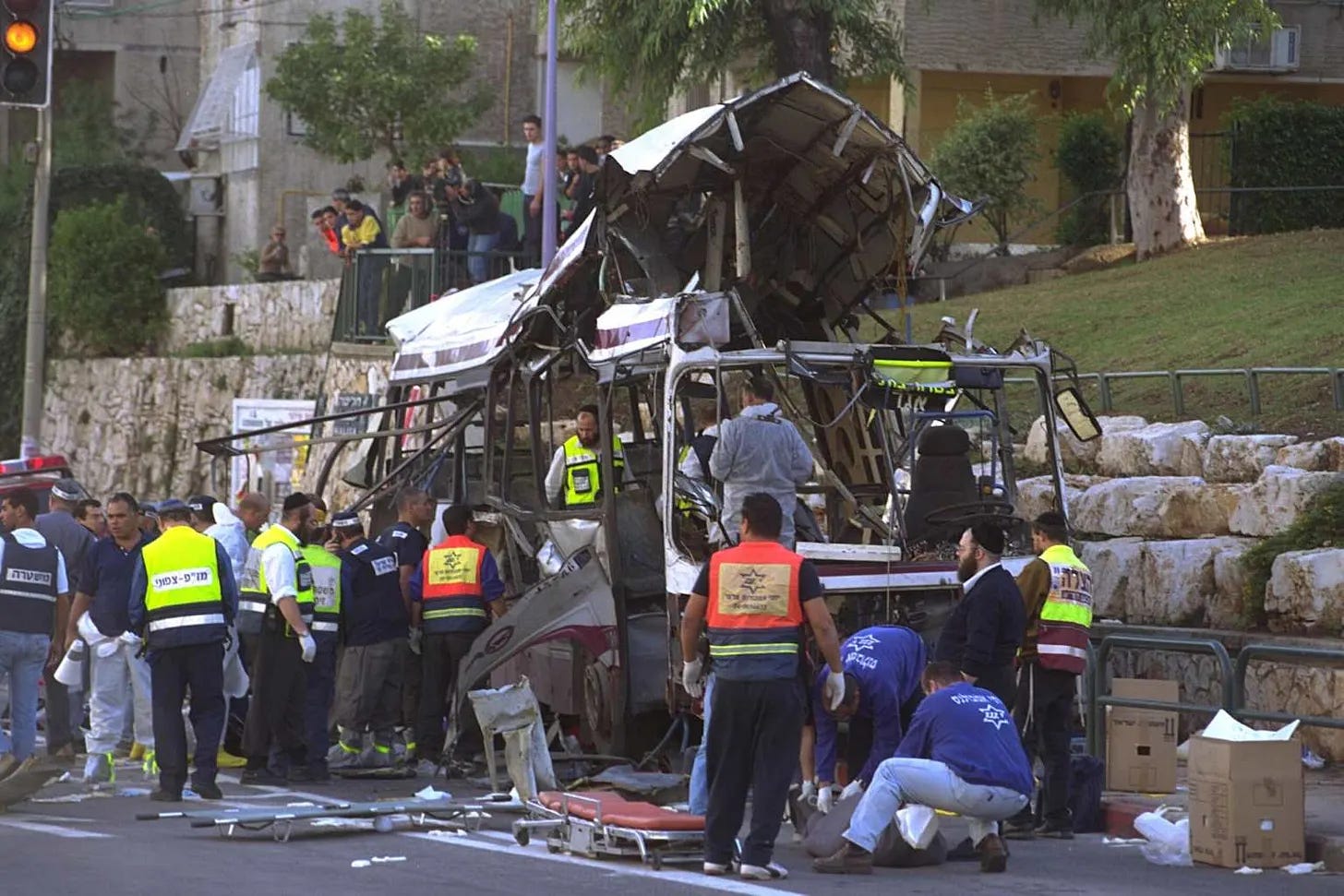
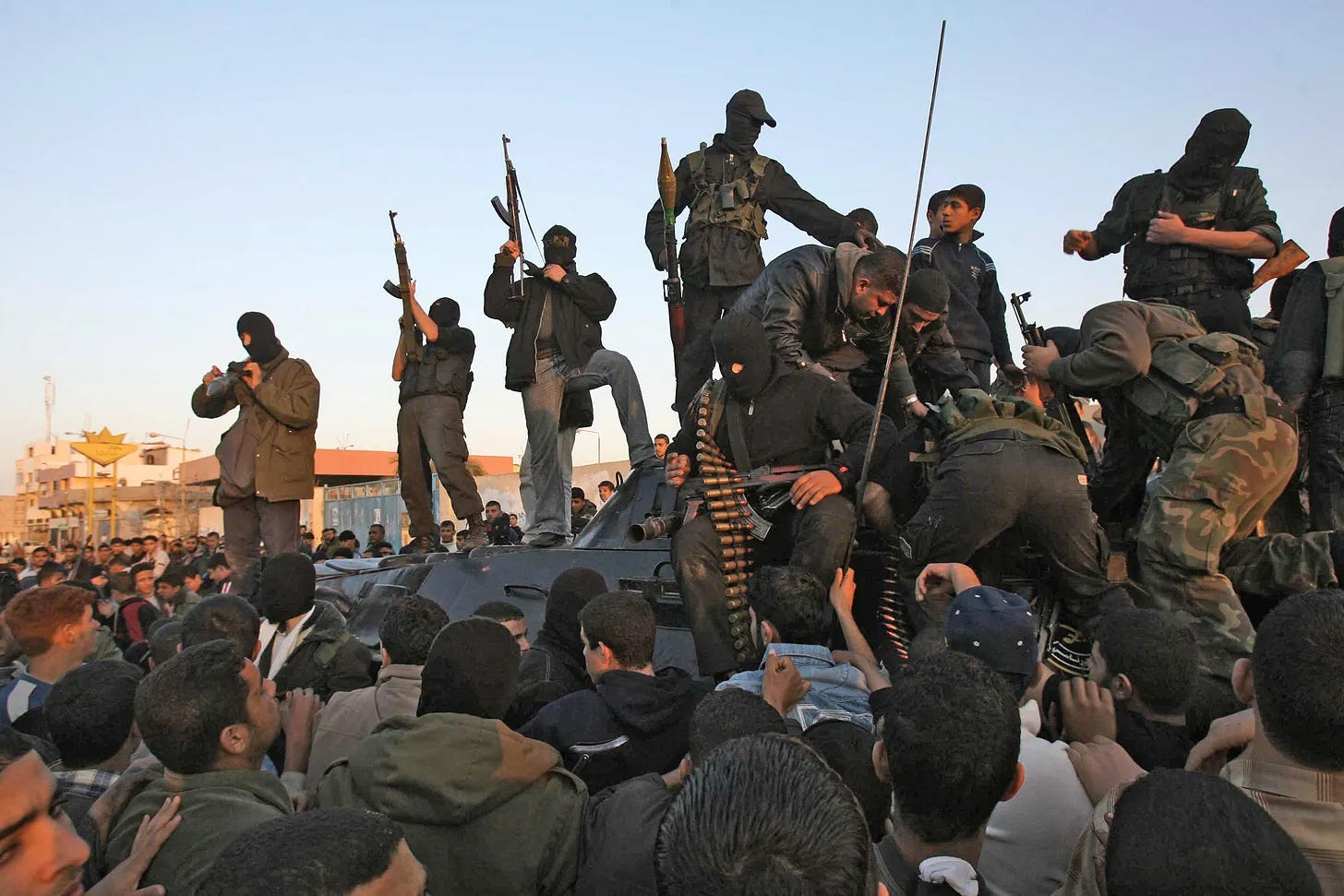
For Hamas quickly takes strategic control of it, and Hamas has no interest in this anger leading to anything other than the destruction of the peace process. Suicide bombings multiply at a rate Israelis had never experienced: buses explode in Jerusalem in the early morning, in crowded pizzerias on Friday evenings in Tel Aviv, in markets in Haifa, in discotheques frequented by teenagers. More than a thousand Israelis are killed in this way over five years, the majority of them civilians, in attacks designed to maximise terror in ordinary life, to make taking the bus or going out to dinner an act of courage. The psychological effect on Israeli society is profound and lasting, in a way that figures alone do not convey: an entire society learns to live with the fear of the morrow, to look at abandoned bags in public transport, to calculate unconsciously the risks of every outing. This normalisation of fear changes societies from within, slowly but irreversibly.
The Israeli response is militarily effective and politically devastating on the international level. Operation Defensive Shield of April 2002, an offensive into Palestinian cities in the West Bank to dismantle terrorist cells, includes the siege and battle of the Jenin refugee camp, and gives rise to an acute international controversy: Palestinian organisations denounce a massacre of several hundred civilians, which UN and journalistic investigations would reduce to approximately fifty dead, the majority of them combatants, in intense street fighting. The final figure does not convince the Arab publics already mobilised, and Israel’s image in the world deteriorates at a speed its leaders had not anticipated. The policy that follows, of targeted elimination of Hamas leaders — Sheikh Yassin in March 2004, Abdel Aziz al-Rantisi in April 2004 — raises international legal questions about the right to political assassination that jurists continue to debate.
The separation wall, whose construction begins in 2002, encapsulates in itself the ambiguity of this period: effective on the security level, since attacks diminish drastically in the zones covered, it traces in concrete and barbed wire a de facto frontier that is not that of 1967 but encompasses settlement blocs, fragmenting the Palestinian territory still further and anticipating frontiers that the final-status negotiations have never ratified. The International Court of Justice issues in 2004 an advisory opinion declaring the route illegal in the sections that deviate from the Green Line, the 1949 armistice frontier, internationally recognised as the boundary between Israel and the Palestinian territories. Israel ignores it.
The Israeli peace camp — Peace Now, the intellectuals, the former military men who had turned to dialogue, those described in the second article of this series as voices structurally silenced — is politically decimated for a generation by the combination of the failure of Camp David and the violence of the Intifada. How does one defend peace when the pizzerias and the buses are exploding? How does one argue for a Palestinian partner when twenty-one young Israelis, many of them from the former Soviet Union, are killed in the bombing of the Dolphinarium discotheque in Tel Aviv on a June evening in 2001? The discourse of peace empties of its substance in the eyes of an Israeli majority who had believed in Oslo and feel betrayed. Sharon wins the elections of 2001 and then of 2003 on an unambiguous security platform.
The second Intifada will have killed not only civilians on both sides — approximately 1,000 Israelis and more than 3,000 Palestinians according to the figures of B’Tselem, the Israeli human rights organisation — but also the political possibility of an Israeli majority for peace in the decade that followed. This particular killing is perhaps the most difficult to quantify, and the heaviest in its consequences.

The Palestinian fracture: two authorities for one people
The unilateral Israeli withdrawal from Gaza decided by Sharon in August 2005 is one of the most complex episodes of this period to evaluate honestly. On the level of facts, Sharon, the father of the settlements, the man who had built more than any other Israeli leader, orders the forced dismantlement of the twenty-one settlements of the Gaza Strip and the complete withdrawal of the army — an operation that would be carried out in ten days, giving rise to televised scenes of Israeli soldiers forcibly evacuating residents clinging to their homes.
On the level of interpretation, opinions remain profoundly divided. For some, it is a unilateral gesture of peace proving that Israel can withdraw from territories it had administered since 1967, the maintenance of control over the borders, airspace and territorial waters being justified by Hamas’s seizure of power in Gaza — an organisation that has made the destruction of Israel its explicit programme and possesses real military capabilities — rockets and an offensive tunnel network, both documented. For others, this control, whatever its stated justification, constitutes an occupation that perpetuates itself by other means. This debate is ardently disputed among jurists and political scientists, and neither reading can be held to be definitively closed.
This withdrawal takes place without coordination with the Palestinian Authority, Sharon deliberately refusing to negotiate it with Abbas, arguing that there is no partner — reproducing thereby the pattern that followed Camp David. The Palestinian Authority inherits a liberated territory without having been an actor in that liberation, which further weakens its legitimacy in the eyes of a population that already accords it little credit.
The Palestinian legislative elections of January 2006 produce a result that all international observers certify as regular and that almost all had seen coming without wishing to anticipate: Hamas wins 74 seats out of 132, Fatah 45. This is not an ideological victory for Islamism but above all a protest vote against the Palestinian Authority of Arafat and then Abbas — an authority that had rotted over ten years in power: documented embezzlement, clan clientelism, ostentatious enrichment of the cadres who live in prestigious villas while the populations of the camps grow poorer, inability to produce the slightest tangible result in everyday life despite billions in international aid. Hamas, meanwhile, runs networks of schools, dispensaries and social aid that function; its social arm is its real electoral force, far more than its jihadist programme. The Palestinians sanctioned ten years of corruption, and they voted Hamas.
The Western response is a political strategy whose consequences run through to 7 October 2023. The United States, the European Union and Israel refuse to recognise the elected government, impose economic sanctions on Gaza, block fiscal transfers due to the Palestinian Authority. The democratic principle — elections are the foundation of legitimacy — is suspended because the result is displeasing. This double standard escapes no one in the Arab world, and it lastingly feeds the Hamas narrative according to which the West claims to want democracy but refuses its results when they contradict its interests. It is difficult to fault Hamas on this precise point.
What follows in 2007 is not a seizure of power: it is a civil war. Between June and July 2007, Hamas and Fatah clash militarily in the streets and buildings of Gaza with a ferocity that international observers on the ground describe as a conflict in its own right. Summary executions multiply on both sides — Fatah men thrown from building rooftops by Hamas fighters, Hamas members shot in the streets or tortured in Palestinian Authority prisons in the West Bank. The number of Palestinian dead in this fratricidal war is estimated at several hundred — a figure that the official narrative of both parties has always minimised, and which the international media barely covered, occupied as they were with the Israeli-Palestinian conflict as if no intra-Palestinian violence existed. At the end of these weeks of combat, Hamas controls the whole of Gaza militarily, and Abbas dissolves the national unity government, appointing a crisis government in the West Bank. The fracture is consummated.
What results is a situation without precedent in the history of this conflict and without any visible political solution: two Palestinian entities that regard each other as illegitimate, governed by ideologically irreconcilable factions, separated geographically by Israeli territory, incapable of holding elections since 2006 without one or the other contesting the result in advance. Gaza under blockade and jihadist government. The West Bank under a semi-autonomous authority whose electoral legitimacy has evaporated since Abbas’s mandate, theoretically limited to four years, has run for seventeen years without renewal. Any Israeli, American or European leader who speaks of a Palestinian partner for a final-status negotiation must answer a simple question: which one? On whose behalf? With what democratic mandate?
The fracture that results has made any negotiation with a unified Palestinian leadership structurally impossible ever since. The Palestinian responsibility in this fragmentation must be named here, without indulgence: it is not exclusively the product of external manipulation, even if Israel had an interest in this division and sometimes facilitated the conditions for it. It is also the result of a profound incapacity to build political institutions capable of transcending clan rivalries and personal power logics — a pathology that the Palestinian leadership has carried within itself since the al-Husseini years, and for which ordinary Palestinians pay the highest price.

The arithmetic of the settlements
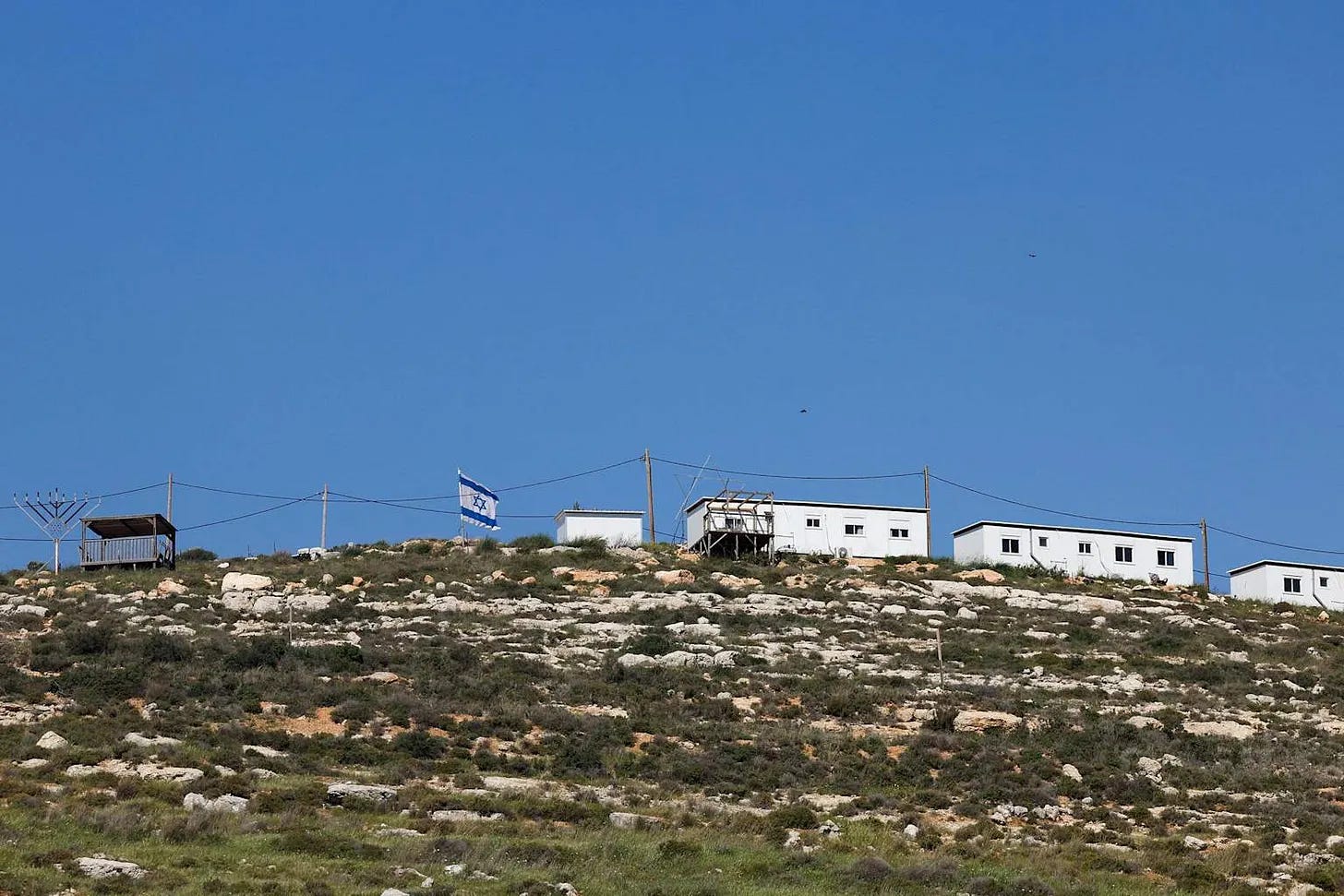
Meanwhile, the implantation of Israeli civilians in the West Bank has continued without interruption. The figures on this subject are the most sober and irrefutable argument concerning Israeli responsibility for the progressive destruction of the two-state solution. In 1993, at the moment of the signing of the Oslo Accords, approximately 100,000 Israeli settlers lived in the West Bank. In 2026, there are more than 700,000, spread across several hundred settlements linked by a network of reserved roads that cut the Palestinian territory into discontinuous enclaves whose geographical contiguity, necessary to any viable state, is compromised a little further with each year.
This progression is not accidental, and it is not recent. To understand its deep logic, one must go back to 1967 and the Gush Emunim movement, the “Bloc of the Faithful”, which, in the wake of the Six-Day War victory, develops a political theology of settlement that the first article of this series has analysed in detail: territorial conquest as a religious act, every dunam of the West Bank covered with a settlement as a step towards messianic redemption. This ideology, a minority position in the early years of the state, progressively becomes an organised political force, with powerful lobbies, a network of allies in the army and the administration, and a capacity to bring down governments on the question of territorial concessions. It creates on the ground settlements that become established facts, which successive governments find politically too costly to undo.
But these settlements are not only the affair of messianic religionists. They are also, for a significant portion of Israeli decision-makers, a territorial security strategy that precedes any ideological framework: in the event of withdrawal, where will the frontier run? Better to have settlements on the hills than to leave the West Bank as a territory from which rockets could reach Tel Aviv, Ben-Gurion airport or Jerusalem in a matter of seconds. This security logic is sincere among some of its advocates, and it is not without foundation in a country whose width along the 1967 Green Line would not exceed fifteen kilometres at its narrowest point.
To this is added a third dimension, demographic, which Israeli leaders rarely address in public but which has structured their private calculations for decades: the fear of being demographically submerged by an Arab population with a high birth rate. In the 1960s to the 1980s, certain Israeli demographers projected that integrating the Palestinians of the West Bank and Gaza into a binational state would produce an Arab majority by the horizon of 2020-2030, ending the Jewish character of the state.
This demographic fear — real in its projections, partially disproved since by the fall in the Palestinian birth rate and the rise in Jewish immigration — has nourished two contradictory policies: the refusal of formal annexation, which would create Israeli citizenship for millions of Palestinians, and the refusal of withdrawal, which would create a viable Palestinian state. The result is a structural impasse — neither annexation nor withdrawal, neither equality nor independence — from which no one in successive Israeli governments has been willing to bear politically the cost of finding a way out.
This arithmetic progression, regular, continuous, accelerated under each government regardless of political colour but particularly under Netanyahu governments, follows a precise and documented cycle: after each wave of Palestinian violence, after each series of attacks or rocket bombardments from Gaza, the Israeli government, whatever its orientation, approves new housing in the settlements in the name of national security or under pressure from its right-wing allies. Palestinian violence and settlement expansion thus feed on each other in a vicious circle that the first article of this series described as the codependency of extremes: the Hamas rockets on Israeli territory since 2007, tens of thousands of launches over almost twenty years, deliberately targeting Israeli civilians, have provided every Israeli government with the political cover to approve new settlements against which the United States and Europe protest feebly before ultimately accepting them as a fait accompli. Each expansion in turn feeds the Palestinian radicalisation that justifies the next series of rockets. To name this mechanism is not to excuse the violence; it is the only way of understanding why it persists.
This is not a security policy in the military sense of the term. It is a deliberate policy of territorial fait accompli that makes it geographically more and more difficult to imagine a viable and contiguous Palestinian state. In international law, the Fourth Geneva Convention, signed by Israel, and numerous Security Council resolutions, including Resolution 2334 adopted unanimously in December 2016, characterise this policy as illegal. Israel contests this interpretation with its own legal arguments that serious jurists examine. This debate exists; but the fact that the Security Council voted unanimously — with the United States abstaining for the first time rather than exercising its habitual veto — is itself incontestable.

Arab normalisation and Iranian strategy: what 7 October set out to destroy
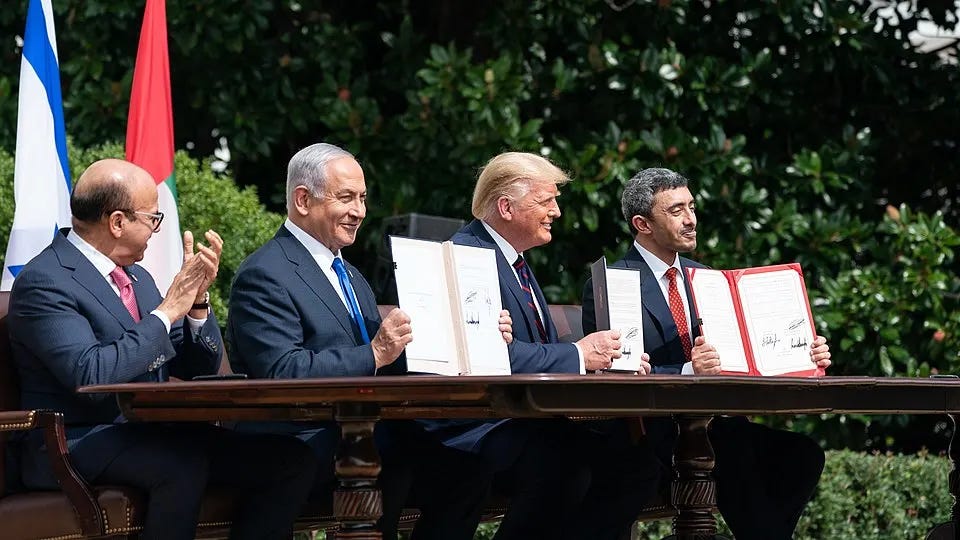
At this stage — Gaza under Hamas control and subject to severe restrictions, the West Bank fragmented by settlements, a Palestinian leadership fractured, an Israeli peace camp decimated — the impasse seems total and definitive. But the history of this conflict reserves one final geopolitical surprise: it is precisely when an exit from the conflict by regional diplomatic means becomes conceivable for the first time in decades that it is violently destroyed — by those who claim to be defending the Palestinian cause.
To understand 7 October 2023 in its full strategic logic, one must understand what was happening in the months and years preceding it. This attack did not emerge from a void, nor even solely from the situation in Gaza or the tensions in the West Bank. It is also, and perhaps above all, a calculated response to a regional geopolitical shift that threatened to render Hamas and its Iranian sponsors structurally obsolete.
The Abraham Accords signed in September and October 2020, under Trump administration mediation, normalised diplomatic relations between Israel and the United Arab Emirates, Bahrain, Morocco and Sudan. What these Accords revealed publicly was what Western chancelleries had known for years but had not dared to say: the Gulf Arab states in particular no longer possess any real Palestinian solidarity. They maintain a facade of it, kept up for internal communication — Arab populations remaining sensitive to the Palestinian cause — but their deep geopolitical interests go in a radically different direction. What truly preoccupies them today is Iran, its nuclear programme, its regional expansion through proxies, its systematic destabilisation of Yemen, Lebanon, Iraq and Syria. Faced with this common threat, Israel, with its intelligence capabilities, its military technology, its missile defence systems, becomes a natural ally, far more useful than the pan-Arab solidarity of an impotent Arab League.
The Abraham Accords do not settle the Palestinian question; they deliberately circumvent it. For the first time since 1948, Arab states normalise their relations with Israel without making the creation of a Palestinian state a prior condition, breaking the Arab League consensus since the 2002 Arab Peace Initiative, which had made this condition the key to all normalisation. This shift is of considerable geopolitical importance: it deprives the Palestinians of their traditional diplomatic lever, the one that had made their cause the obligatory passage of any relationship between Israel and the Arab world.
After these 2020 accords, something larger was being prepared in 2022-2023: a normalisation between Israel and Saudi Arabia, the most influential country in the Sunni world, guardian of Islam’s holy sites, funder of madrasas worldwide and an indispensable actor in any Islamic legitimacy. Had Saudi Arabia normalised its relations with Israel, it was the entire architecture of Arab refusal since 1948 that would collapse. The negotiations were advanced, conducted discreetly with American mediation, and the political price that Israel was agreeing to pay was precisely the resumption of a process towards a Palestinian state — a condition set by Crown Prince Mohammed bin Salman to justify the agreement before his public opinion and before the kingdom’s religious guardians. Netanyahu, in his public declarations of the summer of 2023, seemed ready for this compromise, even if his far-right government allies, Ben Gvir and Smotrich, opposed it vehemently.
It is in this precise context that 7 October 2023 occurs. For Hamas, and even more so for Iran — which finances, arms and coordinates its regional strategy — an Israel-Saudi Arabia agreement would represent an existential catastrophe. It would have signified that Arab normalisation with Israel was possible without resolving the Palestinian question, reducing Hamas to what it structurally is: a regional terrorist organisation without diplomatic future, whose jihadist programme does not represent the Palestinians but serves the geopolitical interests of Tehran. Hamas officials themselves declared in the weeks following 7 October that the objective was to “blow up the normalisations” and to “remind the world that the Palestinian question cannot be ignored.” The brutality of the massacres committed by Hamas’s killers is inseparable from this strategic calculation: it was necessary to trigger an Israeli response of sufficient extreme violence to render it politically impossible for any Arab government to continue, under the eyes of its shocked public opinion, to normalise its relations with Israel.
The strategy has partially worked in the short term. The Israel-Saudi Arabia agreement is suspended. The Emirates and Bahrain have maintained their embassies but reduced their visible cooperation. Public opinion across the Arab world, traumatised by the images of Israel’s military response in Gaza, has rendered any normalising advance politically untenable. Hamas’s war machine has achieved its immediate strategic objective, at the cost of 1,200 Israeli deaths, hundreds of Palestinian victims killed by its own misdirected rockets, and the near-total destruction of Gaza in the Israeli riposte that followed.
Iran is the strategic sponsor of this logic. The Islamic Republic since 1979 has made the Palestinian cause the central ideological marker of its foreign policy — not out of disinterested solidarity with a Sunni people that the Shia mullahs of Tehran consider theologically inferior in their own religious hierarchy, but within the framework of a regional hegemonic rivalry with Saudi Arabia and a power policy vis-à-vis Israel and the United States. Khomeini theorised as early as 1979 that the destruction of Israel was a religious obligation — Al-Quds as a cause unifying the entire Islamic world, Sunni and Shia alike, behind the leadership of the Iranian revolution. This hegemonic ambition needs the Israeli-Palestinian conflict in order to exist: a Palestine at peace with Israel would empty Iranian rhetoric of its principal fuel.
The axis of resistance it has built and financed over thirty years — the Lebanese Hezbollah, created in 1982 with the Revolutionary Guards; Hamas, whose military budget it multiplied tenfold after 2007; Palestinian Islamic Jihad, directly under the command of the Revolutionary Guards; the Yemeni Houthis, who fire missiles towards Eilat and block the Strait of Bab-el-Mandeb; Iraqi militias attacking American bases — is a system of low-cost proxy warfare that is extraordinarily effective. Tehran projects its power onto five theatres simultaneously without putting a single Iranian soldier in the front line, spending a fraction of what a direct war would cost, and maintaining a plausible ambiguity that allows it to deny responsibility for each incident. The question that imposes itself: does Iran have an interest in Palestinian peace? The answer, reading forty-five years of Iranian policy, is clearly no: a pacified Palestine would be the greatest repudiation of the Islamic revolution since 1979, for it would demonstrate that the cause Tehran uses as a lever of regional domination can be resolved without it, and in spite of it.

The conflict as a matrix of conspiracism
To understand why the Israeli-Palestinian conflict occupies a place so disproportionate in the world political imagination — far beyond its real geographical or demographic weight — one must see how it has been actively used for decades as a matrix for the production of conspiracisms that go far beyond it.
The architect of the first connection is al-Husseini himself. Returning from Berlin after the war via Cairo, he carries with him the Protocols of the Elders of Zion and the Nazi propaganda methods, which he diffuses in an Arab world where they had until then circulated only marginally. He translates them, commentates them, embeds them in a Quranic rhetoric, and makes of them a reading-grid of the Palestinian conflict for generations of believers. The connection between European racial antisemitism and Arab political anti-Zionism is his personal work — documented and deliberate. It is not a spontaneous drift; it is a strategy built with precise tools, to a precise timetable.
From the 1960s onward, Moscow takes the relay. The Soviet intelligence services invest massively in the production of a worldview that makes Israel the armed wing of American imperialism and the Jews the masters of a network of global domination. This vision is distributed through Western communist parties, national liberation movements funded by Moscow, and directly in the Arab countries through a subsidised press. The KGB archives published after 1991 confirm that this strategy was deliberate, planned and financed — this was not ideological spontaneity but systematised state propaganda. UN Resolution 3379 of 1975, which declares that “Zionism is a form of racism”, is the public culmination of this work. Its repeal in December 1991, a few days after the dissolution of the USSR, indicates without ambiguity who had been its driving force.
Khomeini’s Iran and that of his successors adds, from 1979 onward, a third source of nourishment to the propaganda system. The Palestinian cause is transformed there into an instrument of foreign policy exported as proof of the Judeo-American corruption of the world. Former president Ahmadinejad added Holocaust denial as a calculated provocation aimed at delegitimising the moral foundations of Israel. This rhetoric has contaminated far beyond the Shia world — Sunni currents, secular Arab nationalist movements, and even fringes of the Western left that found in this framework a reading-grid for post-September 11 American imperialism that their own ideological traditions could no longer furnish with equal clarity.
What social media has done since 2010 is to democratise and internationalise in a few years what decades of state propaganda had constructed. Islamist anti-Zionism; far-left antisemitism dressed up as anti-Zionist moral authority — a documented phenomenon in notable progression since 7 October, notably in academic circles and the radical factions of the left — and general conspiracism now find themselves on the same algorithms, sometimes in the same comment threads, producing an ideological fusion that the strategists of the twentieth century would not have anticipated. Far-right antisemitism, while always present, has experienced a relative erosion in Western Europe, where the radical left has taken over the baton under the guise of anti-Zionism.
The accusation of “genocide” levelled against Israel over the months of war in Gaza — in a context where massive civilian losses accumulate in one of the most densely populated territories in the world, Hamas having deliberately interwoven its military infrastructure into the civilian fabric, including hospital and school buildings — is a legally precise term whose application to this situation is the subject of serious and still ongoing debate among specialist jurists. Yet it circulates as a definitive judgement on the same channels as depictions of Jews as octopuses controlling the world, without those who disseminate it seeing any contradiction.
What deserves to be stated plainly: the Israeli-Palestinian conflict did not create global antisemitism. It furnished a pre-existing antisemitism with a politically respectable reformulation. Anti-Zionist rhetoric allows positions to be held that would be immediately recognised as antisemitic if they concerned any other group, by clothing them in the vocabulary of human rights and international law. This instrumentalisation of law in the service of hatred does not invalidate international law; it imposes a vigilance that honest defenders of the Palestinian cause should be the first to exercise.

What a hundred and fifty years of history teach
This pattern of deliberately sabotaged peace initiatives, announced from the very first line, deserves to be reread in its full historical extent. In 1937, the Peel Plan proposes an Arab Palestinian state on 67 per cent of the territory — accepted by the Jewish Agency, rejected by the Arab Higher Committee. In 1947, the UN plan proposes an Arab state on 43 per cent — accepted by the Jewish representatives, rejected by all Arab states. In 1993, Oslo proposes a process towards two states within the 1967 borders — accepted in principle but blown up by the extremists on both sides. In 2000, Camp David proposes substantial compromises — a negotiation aborted without a serious counter-proposal on one side, an imperfect offer on the other. At each stage, the outcome for the party that refused or failed is worse than what it had rejected.
This pattern does not produce an easy conclusion, and it would be intellectually dishonest to pretend that it absolves Israel of its own responsibilities, notably the systematic settlements in the disputed territories, which render the two-state solution geographically more and more difficult, the documented repression in the West Bank and the policies that have contributed to radicalising populations. These responsibilities are real and weigh heavily in the current impasse.
It would be equally dishonest to pretend that Israeli responsibilities exhaust the subject. The other face of the pattern is Palestinian, and it runs through this article from end to end: the systematic refusal of any partition from al-Husseini in 1937 to the boycott of UNSCOP in 1947; the methodical elimination of the moderate voices that might have led to a compromise; the rejection without counter-proposal of imperfect but real offers; the corruption of the Palestinian Authority that delivered Gaza to Hamas; Hamas’s strategy of destroying every peace process through bloodshed, from the attacks of 1994 to 7 October 2023, calculated to blow up Arab normalisation. None of these responsibilities is erased by Israeli faults, exactly as Israeli faults are not erased by them. Intellectual honesty about this conflict consists precisely in never using the errors of one camp to absolve those of the other — a principle that almost every commentator violates, according to the camp they have chosen.
The most painful lesson of this history is perhaps this one: peace was possible on several occasions, and it was destroyed — sometimes by strategic calculation, sometimes by ideology, sometimes by the refusal to assume before one’s own population the political cost of a painful compromise. The South African Truth and Reconciliation Commission, the Northern Ireland peace process that culminated in the Good Friday Agreement of 1998, the Franco-German reconciliation after three wars in seventy years: these precedents prove, nonetheless, that apparently impassable dead ends can be transcended. They also prove that this transcendence always requires more than an agreement signed under constraint: it requires a transformation of national narratives, a recognition of the wounds of the other, and a leadership capable of taking its own population in a direction it does not always wish to go.
It is precisely here that politics finds its limits — and where the question changes in nature. If political solutions alone — the maps, the treaties and the road maps — have systematically failed whenever they were not accompanied by a deeper transformation, what can one seek beyond the maps? What is there, in the spiritual traditions of these two peoples, and in the memory of reconciliations that seemed equally impossible, that might nourish this transformation that politics alone has not been able to produce?
It is to this question — the only one that truly matters, now that all the observations are laid down, and the most difficult to formulate without naivety or despair — that the final article of this series will turn.
© 2026 - Dialogues of the New World — Jérôme Nathanaël
Next article: The night of the Jabbok: seeing in the face of the enemy the face of G-d

To go further
In the face of the trials of our time, what ancient teaching, what new wisdom or what personal experience still helps you to hold steady, to understand, or to discern? Share your thoughts in the comments and let us benefit from your perspective.
If you wish to speak to the upheavals of our age, send me a contribution of roughly one page for the Waymakers section. It will be published under your initials, a pseudonym, or anonymously, as you prefer. Other readers will be able to respond and enter into dialogue with you.”
New here? The Opening page introduces the author, the project, how to take part, contact details, and the agenda.