
Article disponible en français
The World We Cross · The age under strain · 48 min
Reading what our age puts to the test — in us and in our civilisations.

Series: Israel-Palestine: beyond the war of narratives | Article 2 — The silenced voices: the other Zionism and the other Palestine
In this article:
The urgency against depth: the founding debate of Zionism
The Palestinian current of coexistence: a silenced history
Khalil al-Sakakini: educating a human being before educating an Arab
The Faysal-Weizmann agreement: what the great powers destroyed
The Nashashibis: when Palestinian moderates died for having sought compromise
The convergence nobody wanted to see
The heirs: a fragile but living infrastructure
Nusseibeh, Ayalon, Beilin, Abed Rabbo: the peace the governments refused to sign
Mustafa Barghouti: Palestinian resistance without weapons or hatred
The night of the Jabbok and interior transformation as necessity
“It is not enough for our people to settle in Palestine — its settlement must take place in dignity, in wisdom, and in peace with its neighbours.” — Ahad Ha’Am, Lo Zeh ha-Derekh, 1889
“Arabs and Jews [...] in the spirit of the most cordial goodwill, will cooperate for the development of Palestine.” — Emir Faysal ibn Hussein, agreement with Weizmann, 3 January 1919
There was another path
The previous article in this series described how Hamas and the Israeli far right feed each other, each supplying the other with the justification for its existence, each drawing from their opposition an energy it could not sustain alone. It ended on an implicit promise: somewhere in this history there had existed other voices, minority voices but living ones, clear-sighted and courageous, which had chosen another direction, among the least known and most instructive in this conflict, and whose fate deserves to be told.
Here is that account. Not to soften the picture, nor to offer the easy consolation of an idyllic counter-narrative, but because one cannot honestly account for what happened without first measuring what might have happened. To declare inevitable what was simply chosen, by those who had an interest in keeping peace out of reach, is already a way of vindicating them after the fact.
What one finds in tracing back to the origins of the conflict is troubling in more than one respect. Both peoples had, from the earliest decades of the twentieth century, thinkers and activists who saw with clear eyes the dangers into which their own camps were heading. These voices were not naive: they were often the most direct witnesses to the real tensions. They were simply capable of looking at the other without reducing him to a threat. That is why they were silenced.
The mirror this article holds up is therefore the inverse of the previous one's: not two extremisms converging in destruction, but two currents of clear-sightedness that the same mechanisms marginalised on both sides : the pressure exerted on moderates to reduce them to silence, the successive wars that narrowed the space for nuance, and the implacable logic of the extremes which demanded total loyalty, to which no prospect of coexistence was in any position to subscribe.
The urgency against depth: the founding debate of Zionism
Herzl: the state first
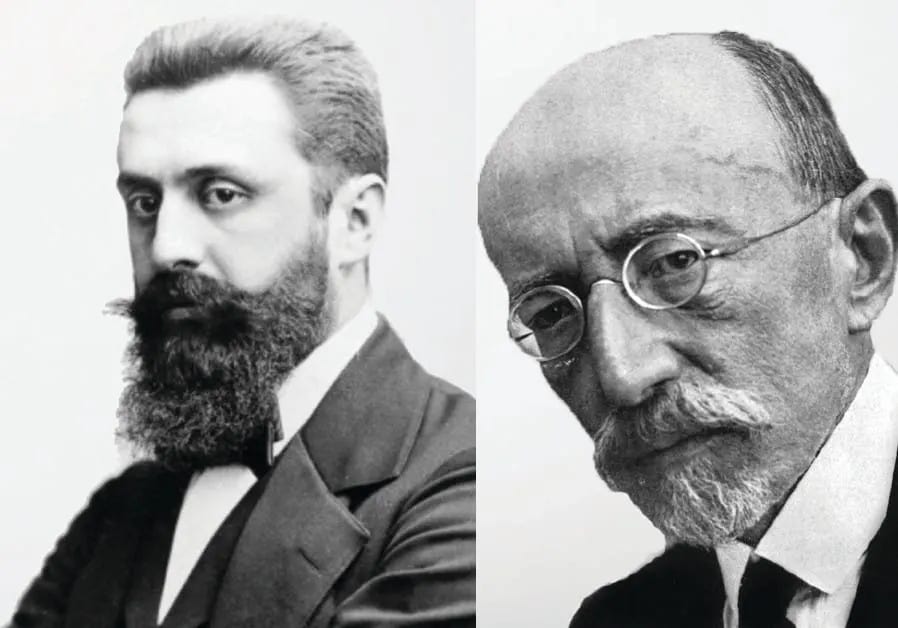
Theodor Herzl is not a fanatic. The point bears stating, because the temptation of anachronism, re-reading founding fathers in the light of abuses committed in their name by later generations, is one of the principal sources of intellectual distortion in this debate. Herzl is a Viennese journalist of the late nineteenth century, assimilated, liberal, deeply secular, who witnessed in 1894 in Paris the public degradation of Captain Alfred Dreyfus before a crowd shouting “death to the Jews,” and drew from it a clear conclusion: if antisemitism can express itself thus, with that virulence, in the birthplace of the Rights of Man and the French Revolution, then the project of Jewish emancipation in European societies is an illusion with a limited lifespan, and the only worthy response is the political sovereignty of the Jewish people in an independent state.
Der Judenstaat, published in 1896, is the manifesto of that conviction. Its logic is one of urgency: Jews in Europe are in danger, they need a refuge that is also a state, and Palestine, with its symbolic and historical weight and a continuous Jewish presence since Antiquity, is the obvious territory for this project. The question of the relationship to those already living there is not ignored, but it remains peripheral in Herzlian thought: Herzl reasons first in diplomatic and political terms, seeking to persuade the great powers and Jewish philanthropists to support his project. This is not a colonial conquest in the strict sense (no Jewish state power existed to order it) but an enterprise of negotiated establishment with the sovereigns in place, described in terms of development and modernisation, Herzl being convinced it would bring mutual economic benefits to a land he perceived, with the myopia of his era, as underdeveloped.
This thought carries within it a tension that Herzl does not resolve. His early death in 1904, at forty-four, perhaps leaves him no time; the nature of his project perhaps gave him no structural invitation to do so. He thinks for the Jews and conceives of the relationship to the other in terms of economic transaction rather than mutual recognition. His Zionism is not that of Greater Israel: he never claimed biblical borders, never presented Palestine as an inalienable divine gift. But it is a Zionism centred on itself, in which the other is present without being truly seen.
Ahad Ha’Am: ethics first
Asher Ginsberg, who wrote under the pseudonym Ahad Ha’Am, one of the people in Hebrew, is the conscience that Zionism carried within itself without always heeding it. An essayist of uncompromising rigour, he represents a Zionism that wanted not merely a Jewish state, but a state worthy of being Jewish.
His founding text on this question, published as early as 1891 after a journey to Palestine, Emet me-Eretz Yisrael (Truth from the Land of Israel), remains one of the most prescient documents in the entire history of this conflict. He observes the pioneers of the early aliyot with a gaze that is not hostile but deeply anxious, and formulates a critique that has lost none of its precision a century and a half later: “We are accustomed to believe abroad that the Arabs are all desert savages, a people like the donkey, who neither see nor hear. But this is a great mistake. The Arabs, especially those of the towns, see and understand what we are doing and what we intend, and they keep silent but wait for the moment when they can act in a way that gives them maximum advantage.”
What Ahad Ha’Am perceives is not simply a conjunctural tension linked to the excesses of a few ill-prepared newcomers: it is a structural blind spot in the Zionist project as it unfolds on the ground. Palestine is not an empty land, nor an exclusively Arab land. It is a land of multiple and ancient presences, where the Jewish yishuv had existed continuously in the holy cities well before the modern aliyot, and where the Arab population, a majority in the countryside, had developed its own rootedness that new arrivals frequently ignored with a casualness Ahad Ha’Am judged both morally faulty and politically suicidal. Recognising Arab reality as a political and moral fact of the first order, not as an obstacle to be circumvented by diplomacy or economic argument, but as a human presence to be treated with the same dignity that Jews claimed for themselves, was, in his eyes, the sine qua non of any durable enterprise.
His response to this blind spot is not the abandonment of the Zionist project, of which he was one of the most serious theorists, but its refounding on radically different bases. Rather than a state that would reproduce European national structures with their exclusivisms and jealous sovereignties, Ahad Ha’Am envisages a spiritual centre, the hearth of a cultural, ethical and intellectual renewal of the Jewish people, in a relationship of honest and respectful neighbourliness with the Arab populations of a land to which both peoples could legitimately lay claim. This vision was less spectacular than Herzl’s; it promised no immediate refuge to the persecuted Jews of Eastern Europe, those subjected to the pogroms of an antisemitic Russia, and it is this that earned it the charge of insufficiency in the years of urgency. Yet it was incomparably more lucid in its understanding of what it means to strengthen a presence in a land that is both ancestral and shared.
The disagreement between Herzl and Ahad Ha’Am was therefore not a mere academic debate about the modalities of a national project: it was the confrontation between a politics of urgency and a politics of depth. One asked how to create a state; the other asked first which state deserves to be created. These two questions were not mutually exclusive, but under the conditions of the first half of the twentieth century, with European antisemitism mounting towards its genocidal paroxysm, it was urgency that dictated its terms to depth, and not the reverse.
Brit Shalom: ethics seeks a state
Ahad Ha’Am’s thought did not remain confined to the pages of his essays. In the years 1925–1942, it found political expression in a current of remarkable intellectual coherence but deep political solitude: Brit Shalom, the Covenant of Peace, founded in Jerusalem by Arthur Ruppin, an economist and sociologist who had organised a large part of Jewish immigration to Palestine and who, precisely for that reason, understood better than anyone what that immigration implied from the other’s point of view.
Its ranks gathered names that have become major references in twentieth-century Jewish thought: Martin Buber, whose philosophy of dialogue, the I-Thou relationship as the foundation of all authentic human existence, was the metaphysical aspect of what Brit Shalom sought to realise politically; Gershom Scholem, the great scholar of Jewish mysticism, who saw in the contempt for the other the symptom of a spiritual degradation; and above all Judah Leon Magnes, an American Reform rabbi, pacifist during the First World War, and first chancellor of the Hebrew University of Jerusalem, an institution founded on the idea that Jewish presence in Palestine should be first and foremost a cultural and intellectual presence.
Judah Leon Magnes is the most audacious and most exposed figure of this current. His proposal, developed with remarkable institutional precision in his testimony before the Anglo-American Committee of Inquiry in 1946, was that of an Arab-Jewish commonwealth founded on political parity: two peoples, a single state structure, equal representation in all institutions, Jewish immigration maintained but governed by a joint council in which Arabs and Jews would have symmetric oversight. “We are not only concerned with the establishment of a home,” he said, “but with the character of the home we are building. Palestine is neither solely Jewish nor solely Arab.”
These positions earned him attack and jeering from a large part of the Jewish community, in Palestine as in the diaspora. At the hour of the Shoah, of the absolute urgency of a refuge for the survivors of the camps, proposing to negotiate Jewish immigration with an Arab-Jewish council, the Arab side having actively supported the Nazis in the person of the Grand Mufti of Jerusalem, appeared to many as a moral obscenity. Magnes was not unaware of that reality; he named it and measured its full weight. But he maintained that urgency alone could not found a viable future project: building a state after the Arab refusal of all partition plans proposed from the Peel Commission to the United Nations, and moreover in the tension of a war of survival, left unresolved the question of the political status of the Arabs who remained on the territory. This question would, however, be partially resolved by the integration into the new state of an Arab community endowed with the same civic rights as Jewish citizens, representing today twenty per cent of the Israeli population. But Magnes saw it, in his lifetime, as an incomplete foundation. He died in 1948, five months after the proclamation of the State of Israel, without having seen his project succeed and without having abandoned it.
What Brit Shalom and Magnes represent in the history of Zionism is the awareness that military and political victory does not close the questions it leaves open: a state can secure its survival in war and discover, decades later, that the conditions of durable peace remain to be built. This awareness, not a charge against the founding of Israel, but a lucidity about what the founding had had neither the time nor the conditions to resolve, was a minority position in the nineteen forties, drowned in the clamour and urgency of the fighting. It was to become a question that later generations of Israelis, those who no longer simply wanted to exist but to live in peace with their neighbours, would pose with growing acuity.
The Palestinian current of coexistence: a silenced history
Ordinary coexistence: when two peoples still shared a land
Before politics radicalised relations between the two peoples, before the grand declarations and competing national claims structured each camp’s perception of the other, there was simply a possible coexistence. The first waves of Jewish immigration to Palestine, from 1882 onward, swelled the ranks of the Jewish communities of Jerusalem, Safed, Tiberias and Hebron that had existed continuously for centuries; the newcomers were joining an ancestral presence rather than settling virgin ground. These immigrants, most of them educated and idealistic young people from Eastern Europe, bearers of a solid education and a project of collective renewal as much cultural as agricultural, encountered an Arab population composed largely of peasants, artisans, merchants and notables who regarded their arrival with curiosity mixed with economic pragmatism and growing anxiety, in proportions that varied according to place and year.
What the archives of this period reveal, if one reads them without the filters of the nationalist narratives constructed after the fact, is a complex but often fruitful reality. The concrete contributions of the early aliyot were real and measurable, and they touched on two distinct domains whose effects spread well beyond Jewish communities alone.
On the agricultural front first: the modern agronomic methods introduced by these immigrants, irrigated crops, intensive citrus growing (the famous Jaffa orange would become a worldwide symbol), arboriculture techniques and varietal selection transformed lands considered unproductive and diffused know-how that benefited populations well beyond Jewish holdings. Exchanges went both ways, and the markets where the two communities traded testified to an economic interdependence that neither side had an interest in rupturing.
On the public health front, the benefits were still more marked: the dispensaries and hospitals created by the new communities, foremost among them the Hadassah institutions, brought a modern medicine largely absent from the region and received Arab patients as readily as Jewish ones. The Zionist anti-malaria campaign, conducted from 1922 by microbiologist Israel Jacob Kligler from the Hadassah laboratories, constituted the most decisive and best-documented contribution. The first national campaign to eradicate malaria successfully in the history of world public health, it relied on the methodical draining of coastal marshes and the Jezreel Valley to eliminate in less than a decade a scourge that had decimated both communities for generations. The British Mandatory administration itself attested to this in a 1936 memorandum to the United Nations Special Committee: the campaign had been a direct factor in the growth of the Arab population in Palestine. The Anglo-American Committee of Inquiry of 1946 confirmed that the decline in Arab mortality under the Mandate, particularly infant mortality, was closely linked to the disappearance of malaria as a major cause of death in those districts. These are incontestable primary sources, not ideological arguments.
This ordinary coexistence was not an idyll: tensions over cultivable land genuinely existed and must be named with precision. The land purchases concluded by Jewish arrivals from landowners residing largely in Beirut or Damascus were legal transactions at prices willingly accepted, but these transfers of ownership ended customary tenancy arrangements, and nothing in the terms of sale had been foreseen by sellers or buyers to protect former sharecroppers. This was therefore not the colonial dispossession that some narratives constructed after the fact, but a human reality that the most clear-sighted voices of the Zionist movement, Ahad Ha’Am first among them, signalled as a source of resentment that should have been addressed differently.
What this period reveals, and that neither the caricature of an irreducible Arab hostility nor that of an idyllic harmony can describe without distorting reality, is that these two peoples could have shared a territory, in conditions that were at times tense, without their relationship being necessarily one of war, and that what existed then was not merely a precarious coexistence but a living fabric of exchanges and interdependencies that carried within it the possibility of deepening. It was politics, the great powers, unilateral declarations, contradictory promises and the fanatics on both sides that cut this thread before it could become a true bond, transforming into an existential conflict what might have become a foundation.
Khalil al-Sakakini: educating a human being before educating an Arab
The Palestine that Sakakini inhabited was one of a territory in profound recomposition: after the collapse of the Ottoman Empire at the end of the First World War, the region had passed under British Mandate in 1920, a tutelary administration entrusted by the League of Nations to London, charged with developing the institutions of a future state whilst managing the contradictory promises made to the Jewish and Arab communities, an unstable framework that was to structure, and ultimately ignite, the decades that followed.
In this context of dying Ottoman and then Mandatory Palestine, Khalil al-Sakakini (1878–1953) ranks among the most overlooked intellectual figures in Palestinian history, and that neglect is not accidental. Teacher, poet and pedagogical reformer, he embodied that current of the Arab Nahda in its Palestinian and Jerusalemite expression. His pedagogical writings posited universal humanism rather than ethnic or confessional belonging as the foundation of all human formation: “One does not educate an Arab, a Christian or a Muslim, one educates a human being, and it is only at that scale that education has meaning.”
But the actual trajectory of Palestinian education after 1948 rapidly took a direction radically opposed to this philosophy. Under Jordanian and then Egyptian administration, under the PLO, Fatah and finally Hamas, school curricula constructed an identity built on conflict, martyrdom and the exclusion of the other, precisely everything Sakakini had refused. A single example: the doctoral thesis that Mahmoud Abbas, president of the Palestinian Authority since 2005 (his mandate having lapsed in 2009 without his having been submitted to any election since), defended in Moscow in 1982 under the title The Other Side: the Secret Relationship Between Nazism and Zionism. It contested the number of Jewish victims of the Shoah, posited a collaboration between Zionists and Nazis to accelerate immigration to Palestine, and thus laid the foundations for an assimilation of Israelis to Nazis, a discourse that has not ceased to spread in certain pro-Palestinian circles since then. It says on its own what the dominant Palestinian intellectual leadership produced in place of Sakakini’s humanist heritage. Abbas did publicly describe the Shoah as the “most heinous crime of the modern era” in 2014, but that belated declaration does not rewrite the thesis. Sakakini was not merely without influence: he was deliberately sidelined. That is why he finds his place in this article.
It should be recalled that before the First World War, his relations with certain Zionist cultural circles were marked by a mutual esteem that his journals document with a candour contrasting sharply with the official postures of the time. He was not naive about the political tensions taking shape, nor ignorant of the land and demographic stakes, but he refused to allow these to define the totality of his relationship with men and women he respected as thinkers and as individuals. This capacity to distinguish persons from the political projects they carry is precisely what times of crisis make most difficult to maintain, and what Sakakini maintained for as long as conditions permitted.
In the Palestinian gallery of voices favouring coexistence, Sakakini holds the role that Ahad Ha’Am holds in the Zionist current of clear-sightedness: an intellectual who posed the cultural and ethical question before the political question, and who paid for that priority with the price of his progressive marginalisation as politics took precedence over everything else.
The Faysal-Weizmann agreement: what the great powers destroyed
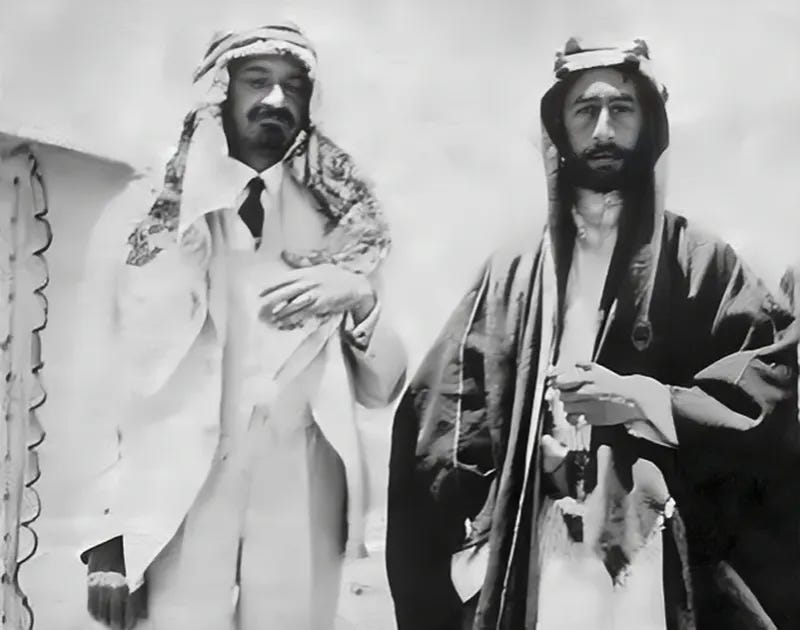
On 3 January 1919, on the margins of the Paris Peace Conference that was redrawing the world order in the aftermath of the Great War, Emir Faysal ibn Hussein and Chaim Weizmann signed an agreement that few textbooks mention. Faysal was the son of the Sharif of Mecca and the recognised spokesman for Arab aspirations to independence; Weizmann, a chemist of genius and president of the World Zionist Organization. Their text, the Faysal-Weizmann Agreement, committed both parties to cooperate in the spirit of what it called “the most cordial goodwill”: to encourage large-scale Jewish immigration to Palestine while protecting the rights of Arab peasants, guarantee freedom of worship for all faiths, entrust the Muslim Holy Places to Muslim control, and build an Arab-Jewish relationship founded on mutual recognition rather than opposition.
The very existence of this document should invalidate any reading that would present Arab opposition to Zionism as a natural and inevitable given. This is not an agreement wrested under duress, nor a capitulation: it is the explicit and formal recognition, by the most legitimate Arab representative of the time, that the Zionist project could be articulated with Arab aspirations within a framework of mutually beneficial cooperation.
But the agreement contained a clause that left it suspended on a condition external to the will of either signatory: it was contingent on the Arab independence promised by the British during the war, that promise which Lawrence of Arabia had carried through the sands of the Hejaz, not knowing that London was already betraying it on two fronts. For the British government was simultaneously conducting three contradictory policies, none of the parties being aware of the other two: in 1916, the promise of a vast independent Arab kingdom made to Sharif Hussein in exchange for his uprising against the Ottoman Empire; that same year, the secret Sykes-Picot agreements which carved that same kingdom into Franco-British spheres of influence; then in November 1917, the Balfour Declaration promising the British Jewish community London’s support for the establishment of a Jewish national home in Palestine, London thereby seeking to rally to its cause the influential Jewish communities of Great Britain, the United States and Russia, at the cost of a territorial promise on a country it had already distributed twice. Arthur Koestler summed up this triple betrayal in a single sentence: “One nation solemnly promised to a second the territory of a third.”
When France installed itself in Syria in the spring of 1920 and London stood aside, the promise of independence made to the Arabs collapsed definitively. Faysal then added a handwritten annotation in Arabic at the foot of the agreement signed with Weizmann, rendering it null and void under those conditions: “If the Arabs are not granted their independence, I am not bound by anything.” This architecture of contradictory commitments, whose full extent Lawrence himself only discovered after the war, at the cost of a disillusionment that would haunt him until his death, constitutes one of the most thoroughly documented diplomatic betrayals of that period, whose consequences the next article in this series will measure in full.
What ended the possibility of Arab-Jewish coexistence in 1919 was not the fundamental incompatibility of the peoples: it was Western geopolitics, which liquidated in a few months what two leaders had laboriously built. This reality diminishes in no way the proper responsibilities of each camp in the decades that followed, but it should weigh heavily in any judgement about what was or was not possible.
The Nashashibis: when Palestinian moderates died for having sought compromise
Palestinian society in the years 1920–1948 was not the unanimously anti-Zionist community governed by a homogeneous collective will that certain narratives have constructed. Palestinian political reality in this period was structured by a deep rivalry between two great notable families of Jerusalem whose political orientations differed on the central question of the relationship to the Jews and to the British Mandatory administration: the Husseinis, politically dominant under the charismatic and fateful leadership of Amin al-Husseini, Grand Mufti of Jerusalem, of whom the previous article in this series recalls that he went so far as to ally himself with the Nazis by creating in Bosnia a Muslim SS division that massacred civilians, and the Nashashibis, more pragmatic, more open to negotiation and compromise, but progressively eliminated by a combination of political terror and events that stripped them of any room for manoeuvre.
Raghib Nashashibi, mayor of Jerusalem from 1920 to 1934 and the leading figure of the moderate current, carried during his years in office a political pragmatism that was courageous in the context of mounting radicalisation surrounding him: he sought territorial and economic accommodations, rejected the scorched-earth policy, and maintained channels of communication with the Mandatory administration and with Jewish representatives, channels the Mufti sought to close by every available means. His nephew Fakhri Nashashibi went further still, too far to survive: in the years 1936–1939 he organised militias to counter al-Husseini’s armed groups, actively sought arrangements with the British authorities and Zionist representatives, and remained, until his assassination in Baghdad in 1941, the most exposed and most determined figure of this anti-radicalisation current.
The story of Fakhri Nashashibi has an ordinary horror to it: he was killed not by Israeli soldiers, the State of Israel did not yet exist, but by the Mufti’s partisans, abroad, as a traitor. This phenomenon of internal terror, Palestinian moderates physically eliminated by their own camp for having sought compromise, is one of the most constant factors in the Palestinian history of this period, and one of the least often named. It does not on its own explain all subsequent developments, but to pass over it in silence would be to distort the picture: Palestinian moderation was not only a minority position, but mortally dangerous for those who embodied it.
On the Jewish side, Magnes was jeered and isolated, Brit Shalom was ridiculed, but its members were not assassinated. This difference in degree of violence exercised against the moderate voices on each side is an element of the real asymmetry between the two situations that the word mirror in this series must never entirely obscure.
Musa Alami: from firm dialogue to prophetic self-criticism
Musa Alami (1897–1984) is perhaps the Palestinian figure whose course best illustrates what it means to choose construction where defeat pushed others towards destruction. His trajectory is that of a man who moved from firm negotiating positions to prophetic self-criticism, without ever abandoning either the method of dialogue or the demand he placed on his own camp.
His roots in Jerusalem were among the deepest of his time: his grandfather and father had both been mayors of the city, and his maternal family, the Ansari, descendants of a companion of the Prophet Muhammad, had for eight centuries kept watch over the al-Aqsa esplanade. His attachment to the land was not ideological: it was existential and spiritual, which made his engagement in dialogue all the more significant. As a child he had studied at the avant-garde school founded by Khalil al-Sakakini himself, creating thus a direct, biographical and intellectual link between the two central figures of the Palestinian humanist current that this article documents. He completed his legal education at Cambridge, graduating in 1924.
A brilliant lawyer and senior official of the British Mandatory administration, he was appointed as early as 1933 by High Commissioner Arthur Wauchope to meet with Zionist leaders. His direct conversations with David Ben-Gurion and Moshe Sharett, whose substance the historian Walter Laqueur has recorded, constitute one of the rare moments of Palestinian-Zionist political dialogue of that period, and their reciprocal candour deserves to be conveyed without embellishment. Ben-Gurion submitted a generous vision: the Zionists would develop the land for all its inhabitants, within a federation including Palestine, Iraq and other Arab states. Alami replied with disarming frankness: at best the Jews could hope for an enclave around Tel Aviv within a Muslim Palestine, and he would prefer the land remain undeveloped for another hundred years rather than see it developed by anyone other than the Arabs themselves. Ben-Gurion left these conversations speaking of an “experiment that failed.”
His positions were firm, to be sure, but Alami held them within a framework that the great majority of Arab leaders of the time refused: that of direct negotiation, honest face-to-face exchange, the trading of arguments rather than prior rejection. Where Amin al-Husseini imposed silence and intimidation on anyone who ventured to speak with the Jews, Alami sat at the table, set out his positions without evasion, and listened to the arguments of the other camp. It is not concession that makes him a moderate, it is the method, and the conviction that dialogue was better than armed silence.
But the consequences of his candour were immediate: Zionist leaders pressured the British to have him dismissed, which was achieved as early as 1934 and again in 1937, this time with a forced exile to Lebanon. His independence of mind, he was, according to the historian Nadi Abusaada, “the only leader of the required calibre who belonged to no party and could therefore represent them all”, nonetheless allowed him to represent Palestine at the London Conference of 1939, to participate in the preparations for the Arab League in 1944, and to found the Arab Office to defend the Palestinian cause before the Anglo-American Committee of Inquiry in 1945–1946.
That same independence made him vulnerable in his own camp: Amin al-Husseini, distrustful of any free spirit, launched in 1947 on the eve of the war, through the Arab Higher Committee he presided over, an active campaign against the Arab information offices that Alami had patiently established in Jerusalem, London and Washington, leading to the withdrawal of Iraqi funding, the only Arab state to have made any real contribution, and thus condemning these offices to closure for lack of resources. This mechanism of double strangulation, in which Alami was marginalised both by the adversary’s pressure on the Mandatory authorities and by the radicalisation of his own camp, deserves to be named as such.
It was after the Nakba of 1948 — the Arabic term meaning the catastrophe, designating the dispersion of some 700,000 Palestinian Arabs driven out or having fled in the context of the first Arab-Israeli war, and the collapse of Palestinian society as it had existed for generations, that Alami formulated what few political figures in history have the courage to assume after total defeat: he criticised his own camp with unsparing rigour. In April 1949, barely eleven months after this seismic event, he published in Beirut ‘Ibrat Filastin (The Lesson of Palestine), a text of ninety-eight pages that stands as one of the most courageous intellectual acts in Palestinian history. Alami asserts without equivocation that this collective shipwreck was not inevitable, that it was the Arabs themselves, through their internal divisions, their insufficient modernisation, the mediocrity of their regimes and their chronic inability to build genuine political unity, who had failed: “The Arabs were confronted with a challenge, the first since their liberation from foreign domination; and they did not rise to it.” He seeks no scapegoat, neither in Zionism nor in British imperialism. He simply holds the mirror before his people and asks them to look.
What distinguishes Alami from the other Palestinian political figures of his time is that his thought did not fossilise in defeat but deepened on contact with it, exactly what Ahad Ha’Am had done in the face of the excesses of the early aliyot pioneers in 1891. The two men, from opposing shores and decades apart, were posing the same fundamental question: what is lost when a people chooses intransigence without ethical depth? And both paid the same price for having posed it: isolation in their own camps.
He then devoted the second half of his life to the Arab Development Society, which he founded near Jericho on five thousand acres of arid land wrested from the desert, where he built wells, farms, a school, a clinic and housing for refugee orphans. Over seventeen years the project reached forty thousand acres, offering a response to the Nakba through autonomy and productive dignity, the exact opposite of the rhetoric of victimhood that the rest of the Arab world cultivated. But in 1967 the Israeli army invaded the ADS lands, destroyed twenty-six of the twenty-seven wells and annihilated the livestock. Alami, then in Europe, returned to rebuild everything by hand. In 1979 he confided to British historian David Gilmour: “I no longer take any pleasure in this place. I stay here out of duty. I know the Zionists have wanted us to leave for years. But I have a duty to my people.” He died in Amman on 8 June 1984 and was buried in Jerusalem, in the Bab al-Sahira cemetery.
He embodies the type of figure whom wars grind down but whom history ultimately recognises: a negotiator without illusions but without hatred, a builder where others had chosen destruction, faithful to the end to a land he had never reduced to a political programme.
The convergence nobody wanted to see
The same diagnosis from opposing shores
If one sets side by side the texts of Ahad Ha’Am, Magnes and Buber on the one side, and the positions of Alami, Sakakini and the moderate Nashashibis on the other, something strange appears: these men, who did not speak to one another directly, who wrote in different languages for different audiences, and whose political projects were often in opposition, were formulating in their respective terms the same fundamental diagnosis.
Ahad Ha’Am, as early as 1891, warned that the arrogance of those who settle while ignoring those already there prepares conflicts that diplomacy will not be able to extinguish. Alami in the nineteen thirties showed that an economic argument cannot purchase the dignity of a people for whom land is a place of belonging before it is a factor of production. Magnes in the nineteen forties warned that building a state in the urgency of survival without resolving the question of political coexistence would be to prepare decades of conflicts that neither military force nor diplomacy could probably settle. The Nashashibis in the nineteen thirties sensed that Husseini radicalisation would close windows that might never reopen. As for Martin Buber, he affirmed throughout his life that the I-Thou relationship, the recognition of the other as a person and not as an obstacle, is the only foundation on which something durable can be built between peoples condemned to share a territory.
These convergences are not coincidences: they reveal that a sound understanding of the situation and its stakes was accessible to those willing to look without turning away. It was not the absence of a diagnosis that led to the impasse, it was the refusal to let that diagnosis inform political and human choices. And that refusal came, in both camps, from the same source: the conviction that force, whether military, demographic or terrorist, could resolve quickly what negotiation did not seem able to accomplish easily.
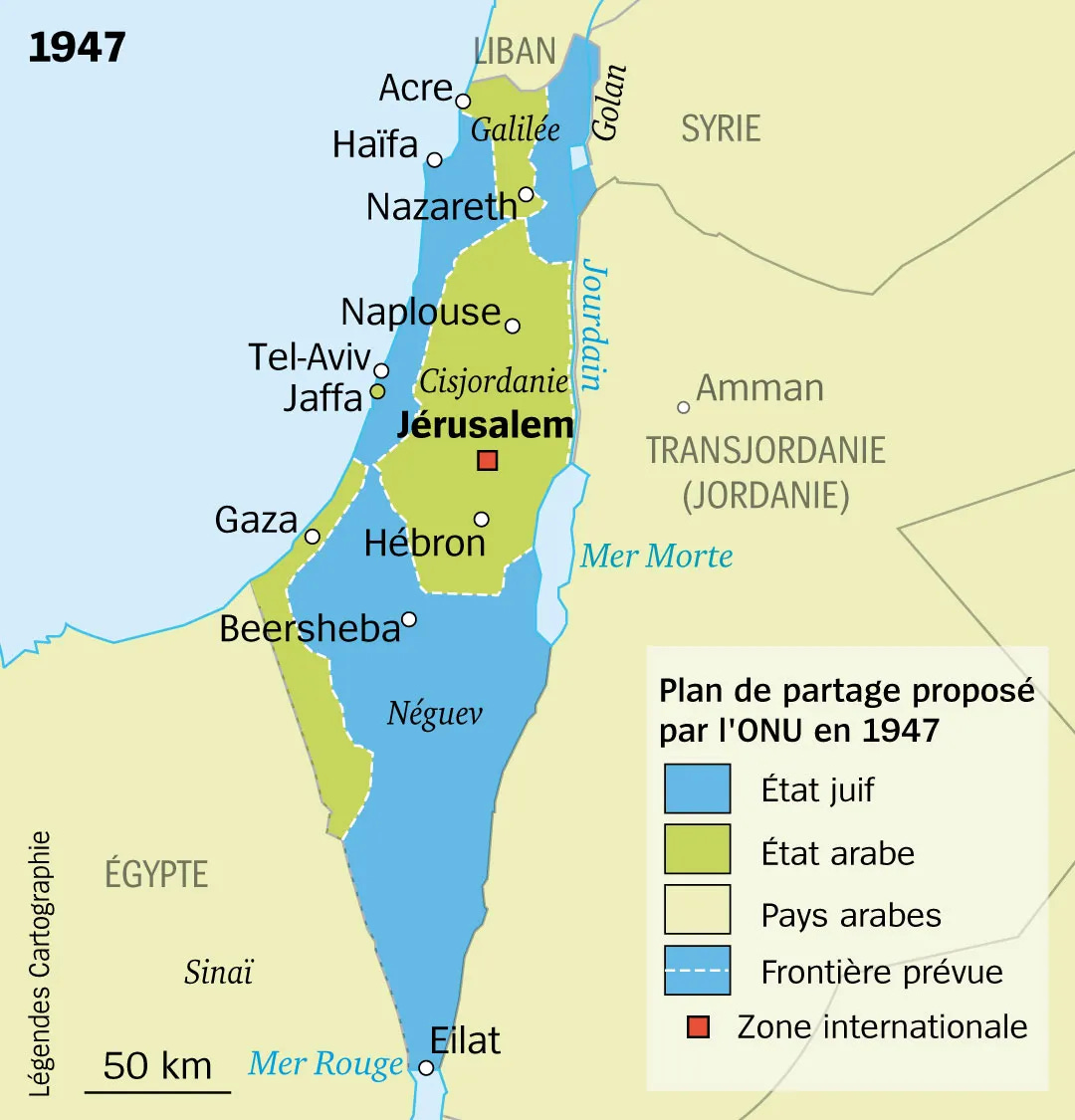
The war of 1948, launched in the immediate aftermath of the proclamation of the State of Israel in a combined attack by the armies of five Arab countries that had rejected the United Nations partition plan, confirmed the fears of the most clear-sighted. It concluded in a double reality that neither the Israeli nor the Palestinian narrative can exhaust alone: on one side the survival and military victory of the young state, what Israelis call the War of Independence; on the other the Nakba, the catastrophe in Arabic, a term introduced as early as 1948 by the historian Constantin Zureik to designate the dispersion of some 700,000 Palestinian Arabs, driven out or having fled in a context of war, a Nakba whose responsibilities remain the subject of serious historiographical debate. The Israeli “new historians”, Benny Morris, Avi Shlaim, Ilan Pappé, established from Israeli archives that expulsions were deliberately orchestrated in certain sectors; Morris maintains, however, that the exodus was to a large extent a by-product of the war and its terrors; Pappé goes further in speaking of planned ethnic cleansing. This debate is not closed, and any honest treatment of this period must name it as such, without denying the real suffering of a civilian population caught in a war it had not chosen, nor absolving the responsibilities of the Arab states that had launched it.
It is in the light of these events that Alami’s voice takes on its full dimension. Where the Nakba validated retrospectively the arguments of those who had said that coexistence was an illusion, Alami chose in ‘Ibrat Filastin the exact inverse path, that of unsparing self-criticism: holding the mirror before his own people rather than seeking a scapegoat. What no Arab leader of the time, and very few since, had the courage to formulate, which makes him, in the gallery of this article’s buried voices, perhaps the most solitary and most necessary figure.
This war of 1948 also had a largely unknown consequence, symmetrical to the Nakba, which it would be dishonest to pass over in silence. It triggered a movement that the war of 1967 was to amplify and accelerate: the forced departure or expulsion of virtually all Jewish communities from Arab and Muslim countries, communities whose presence in those lands went back, for some, more than two millennia, well before Islam itself. Some 800,000 people thus left Iraq, Morocco, Egypt, Tunisia, Yemen, Syria and other countries, under the compulsion of pogroms, denaturalisation laws, confiscation of property and persecutions linked to the rise of Arab nationalism. These Jewish refugees, whose fate is rarely mentioned in international debates on the conflict, and whose number is comparable to that of the Palestinian refugees of 1948, or greater, depending on the estimates, came massively to settle in Israel, profoundly transforming the demography and sociology of the country.
This reality made and continues to make any negotiation over territorial cessions or a hypothetical right of return for Palestinian refugees incomparably more difficult: in both cases, hundreds of thousands of displaced families carry claims of legitimacy over lands and possessions that history has wrenched from them, on both sides of a border that did not yet exist when their tragedies began.
Why did these voices lose?
The most useful question one can pose today about these moderate voices is not “why were they right?” They were right, and history has demonstrated this at a dreadful price. The question is: “why did they lose?”
On the Jewish side, the marginalisation of the voices of Ahad Ha’Am, Magnes and Brit Shalom comes down to three factors, none of which alone suffices to explain the whole. The first is the inexorable rise of European antisemitism: in the nineteen thirties and forties, Nazi persecution made the urgency of refuge incomparably more pressing than the nuances of the binational project, and those who proposed to negotiate immigration with an Arab-Jewish council faced the overwhelming moral force of millions of Jews who needed habitable land immediately — a reality that became decisive after 1945 with the discovery of the full extent of the Shoah. The second is Arab resistance, particularly that orchestrated by the Mufti, which rendered the binational project politically inaudible by stripping it of any credible Arab interlocutor after the elimination of Palestinian moderates.
The third factor, deeper still, is the logic of state nationalism, and its emergence is not abstract but directly linked to the successive Arab refusals of any shared solution. From the Peel Plan of 1937, which proposed a partition of Palestine into two states, the Arab leadership under the Mufti’s direction categorically rejected any territorial division. The United Nations partition plan of November 1947, which allocated a state to the Jews and a state to the Arabs on demographic grounds, was accepted by the Jewish Agency and rejected by the Arab League, which immediately launched hostilities. These successive refusals produced a decisive political effect: they legitimised in the eyes of the international community the claim to a sovereign Jewish nation-state, the only model that international law at the time recognised as a valid response to the absence of a negotiated solution. Once this form had been imposed as the only viable horizon, any alternative vision, binationalism, federation, shared commonwealth, was doomed to appear irremediably utopian. The Arab side, in refusing partition, had paradoxically helped render inevitable precisely what it sought to prevent.
On the Palestinian side, the mechanisms were more brutal and more direct. Husseini internal terror (assassinations, intimidations, ostracism) physically eliminated a part of the moderates and forced the others into silence or exile. Successive wars then each time reduced the space in which a nuanced position could be expressed, but each in its own way and with its own effects. The war of 1948 shattered Palestinian social and political structures, carrying away with them the class of educated and pragmatic notables, the Alamis, the Nashashibis, who constituted the natural interlocutor of a negotiation. The Palestinian leadership reconstituted itself in refugee camps and in exile, under conditions in which radicalism was not only understandable but structurally inevitable. Peoples do not construct their memory from archives; they construct it from their wounds.
The war of 1967 produced on the Israeli side its own perverse effect, as the previous article in this series observes: the conquest viewed as near-miraculous of the West Bank and Gaza opened for ultra-religious nationalists an ideological space in which territorial messianism could deploy. The settler movement gathered momentum, transforming the provisional military occupation into a permanent implantation project and rendering any future territorial concession politically and religiously more costly.
Paradoxically, the first Intifada (1987–1993) briefly reopened a window of hope, as it forced both camps to seek a political way out and led to the Oslo Accords, a major opportunity whose dimensions and causes of failure the next article will measure in full. But the second Intifada (2000–2005), with its suicide bombings in the cafés and buses of Tel Aviv and Jerusalem, brutally closed that window by anchoring in Israeli society the conviction that any territorial withdrawal would engender an immediate existential threat, which durably discredited, in both camps, those who had staked their hopes on peace. In times of total war, compromise can be assimilated to treason, and in societies where every conflict has ended in human and territorial losses that are real and not abstract, the logic of all-or-nothing commands an emotional and political force that nuance, however well-founded, cannot easily counterbalance.
What this symmetry reveals is that the marginalisation of moderate voices in both camps is not the result of any intrinsic inferiority of their ideas. Their ideas were, and remain, the most pertinent this conflict has produced. It was the configuration of forces in play that defeated them, but a configuration of forces can change. Not easily, not quickly, not without sacrifices, but it can change. Several times in the history of this conflict, moments of opening have existed that show fatality is not its definitive law, even if it is sometimes its appearance.
The heirs: a fragile but living infrastructure
There is a persistence that violent current events tend to render invisible: each war, each attack, each disillusionment has attempted to extinguish the voices of coexistence on both sides, but each time these voices have reconstituted themselves in new forms, often more concrete and more anchored in everyday life than the preceding ones. This persistence confirms one clear thing: fatality is not a law, but a succession of deliberate choices.
When four hundred thousand Israelis said no
The Peace Now movement (Shalom Achshav), born in March 1978 from an open letter signed by 348 reserve officers asking the Begin government to seize the peace opportunity offered by Sadat's visit, constitutes the most direct expression of a pacifism rooted in liberal Zionism itself. Its central argument was profoundly Israeli: prolonged occupation would corrupt the state from within, destroying the Jewish and democratic character it claimed to defend. In September 1982, in the immediate aftermath of the Sabra and Shatila massacre — perpetrated by Lebanese Phalangist militias in camps under Israeli military control, but for which the Kahan Commission, constituted by the Israeli government, attributed indirect responsibility to Israel and to the serious negligence of Defence Minister Ariel Sharon — Peace Now assembled 400,000 demonstrators in the streets of Tel Aviv, representing ten per cent of the Israeli population at the time. That figure alone testifies that a large part of Israeli society was demanding from its leaders a moral accountability that the Kahan Commission itself was to formalise.
Yeshayahu Leibowitz: orthodoxy against occupation
This movement found its most powerful intellectual counterpoint in the figure of Yeshayahu Leibowitz, biochemist, neurologist, Talmudic commentator and perhaps the greatest Israeli public intellectual of the twentieth century. An observant Orthodox Jew, but fiercely opposed to any instrumentalisation of religion by political power, he had formulated as early as 1967 with a clarity that proved genuinely prophetic what occupation would do to Israel: it would denature the state, transform the IDF into an occupation police force, and destroy the ethical character of the Zionist project. An antagonistic figure to the messianic rabbis of Gush Emunim who sacralised territorial conquest, he explicitly supported the soldiers of Yesh Gvul (There is a limit) who accepted prison rather than service in the territories, embodying the ethics of personal cost that Magnes had demanded of his own contemporaries. He declined the Israel Prize in 1993 after his nomination had provoked a political crisis. His voice remains one of the most necessary and least heard in this entire history.
Nusseibeh, Ayalon, Beilin, Abed Rabbo: the peace the governments refused to sign
The years 2002–2003 saw the simultaneous emergence, at the very heart of the violence of the Second Intifada, of two civil initiatives of remarkable ambition. On one side, Sari Nusseibeh, a philosopher trained at Oxford and Harvard, president of Al-Quds University and descendant of an Islamic family that had kept watch over the Church of the Holy Sepulchre for centuries, and Ami Ayalon, former director of the Shin Bet who concluded from his entire security career that force alone was a dead end. Their six principles of the People’s Voice surgically cut through the Gordian knots that Oslo had skirted: the 1967 borders, Jerusalem as the capital of both states, guardianship of the Holy Sites rather than sovereignty — thus separating spiritual administration from political domination — and explicit renunciation of the right of return to Israel. More than 800,000 people signed the petition. On the other side, Yossi Beilin, former Israeli minister and architect of the Oslo Accords, and Yasser Abed Rabbo, former Palestinian Minister of Culture, were secretly negotiating in Geneva a complete and detailed agreement, article by article, covering all the points that official negotiations had always left pending (borders, refugees, Jerusalem, security), signed symbolically in December 2003.
Two distinct approaches, therefore: one popular, carried by a former head of the intelligence services and a philosopher who called directly on citizens to sign; the other diplomatic and technical, conducted by two former ministers who produced what no government had dared to draft. Both converged on the same conclusion: a negotiated peace was formulable by the two civil societies simultaneously. The Sharon and Arafat governments chose carefully to ignore them. These missed opportunities will be examined in detail in the next article in this series.
Mustafa Barghouti: Palestinian resistance without weapons or hatred
On the Palestinian side, a current of structured non-violent resistance exists, and its political marginalisation despite genuine media visibility is itself a political fact. Mustafa Barghouti (not to be confused with Marwan Barghouti, leader of the Tanzim militias during the Second Intifada), a doctor and former Fatah official, founded in 2002 Al-Mubadara (the Palestinian National Initiative), a movement that refuses both the corruption of the Palestinian Authority and the violence of Hamas, advocating a popular resistance rooted in the principles of Gandhi and Martin Luther King.
Its platform articulates an end to occupation and internal democracy, women’s rights and social justice, exactly what Sakakini would have recognised as his own. In the Palestinian presidential elections of 2005, Barghouti obtained 19.8% of the votes against Mahmoud Abbas, a remarkable result for a candidate without a party apparatus, testifying that the Palestinian moderate current is not marginal when given a space to express itself. He became a member of the Palestinian Legislative Council in 2006 and briefly Minister of Information in 2007; he remains today secretary-general of Al-Mubadara and one of the most visible Palestinian voices in the international media, even though his positions after 7 October 2023, notably his justification of the attacks, considerably complicated his standing in the camp of advocates of strictly non-violent resistance.
Combatants for Peace and the others: peace through practice
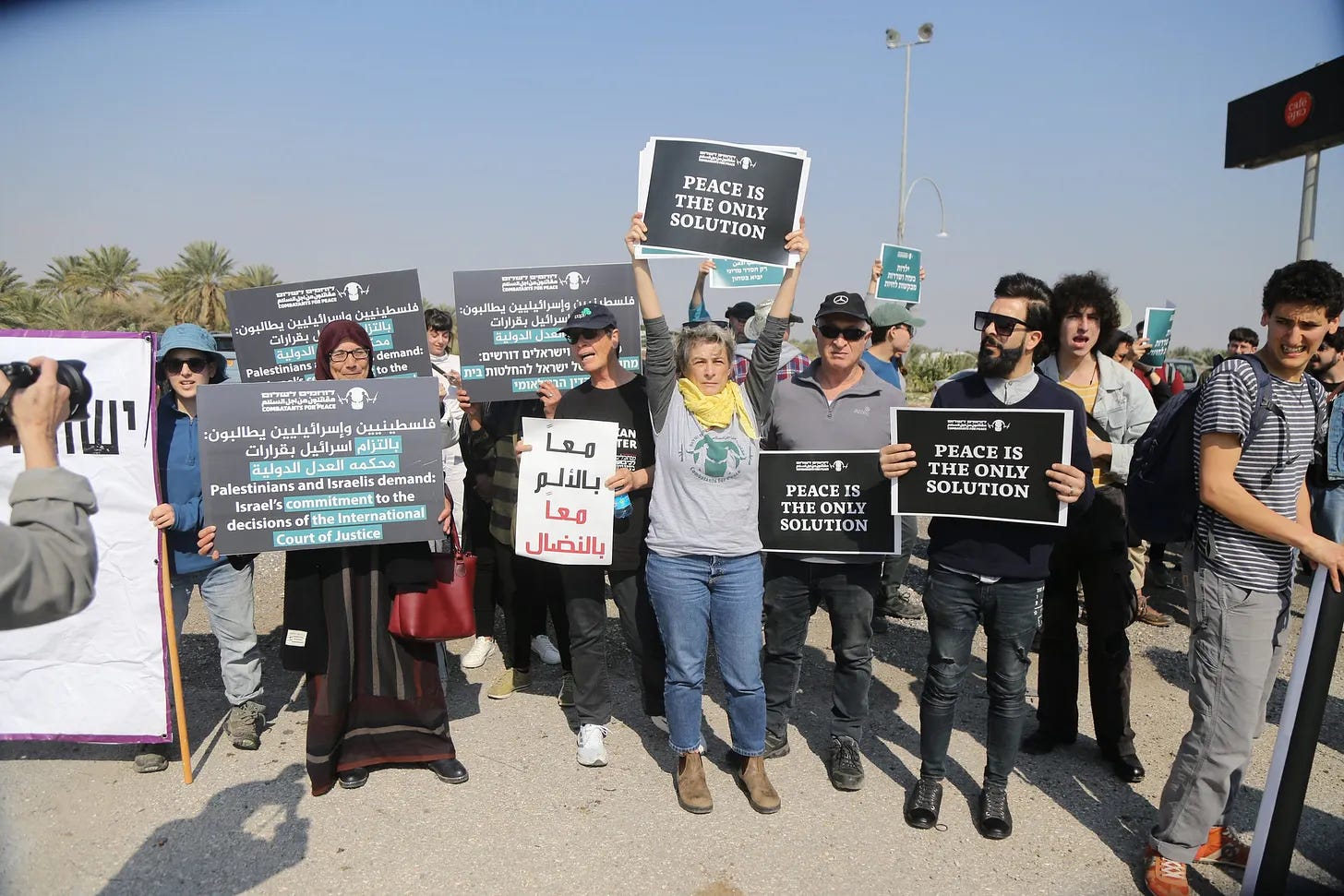
After the collapse of Oslo, the heirs of the currents that had given rise to it reconfigured themselves in more bilateral forms, closer to everyday life. Combatants for Peace, founded in 2006 by former fighters from both sides who had met clandestinely, organises binational memorial ceremonies and trains young people in joint non-violent resistance. Standing Together (Omdin Beyahad), co-directed systematically by a Jewish-Arab duo, articulates social struggle and the struggle for peace, reaching a mainstream Israeli public inaccessible to other movements. A Land for All develops an original constitutional proposal (two states, a confederation, with free movement of citizens and Jerusalem as a shared capital), transcending the logic of strict separation that the interlocking realities on the ground have rendered inoperative.
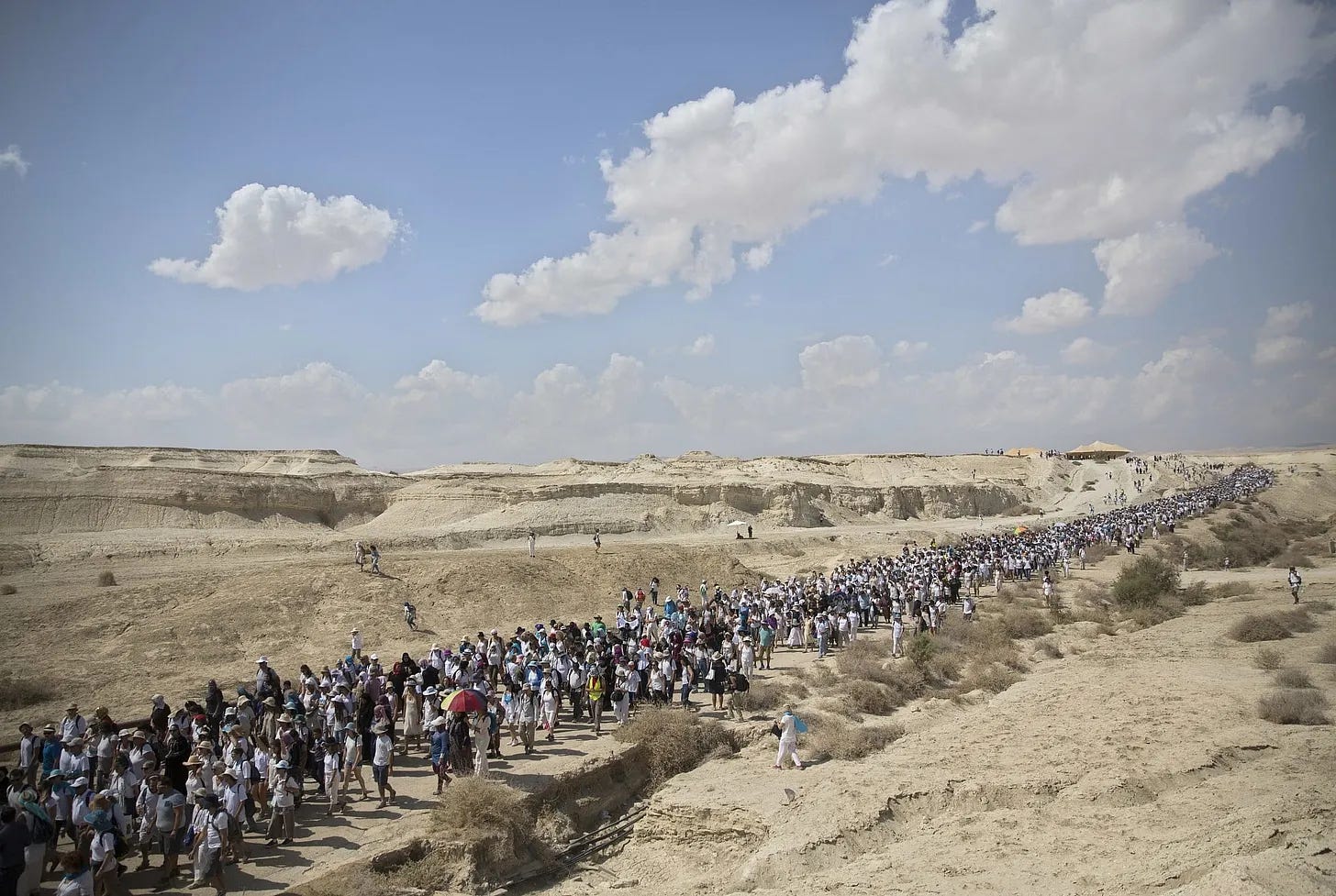
Women Wage Peace, born the day after the 2014 Gaza war and co-founded with Women of the Sun, its Palestinian counterpart, is perhaps the movement most deeply rooted in civil society of this generation. Its founding march of October 2016, crossing Israel and the West Bank to culminate in a joint Jewish and Muslim prayer on the Jordan River, brought together 4,000 women from both communities. In 2017, a new march gathered 30,000 people in Jerusalem. The movement today counts more than 25,000 members.
In the cultural register, the West-Eastern Divan Orchestra, founded in 1999 by conductor Daniel Barenboim and philosopher Edward Said (an Argentinian-Israeli Jew and an American Palestinian, two of the most prominent intellectual figures of their era), brings together Israeli and Arab musicians around a shared repertoire, embodying what Ahad Ha’Am called a cultural centre rather than a balance of power. The Arab-Hebrew Theatre of Jaffa has for thirty-five years produced plays performed in Hebrew and Arabic by mixed companies.
In the medical domain, coexistence takes an even more concrete form: lives saved together. Road to Recovery has since 2010 provided daily transport for Palestinian patients from Gaza to Israeli hospitals. One Heart for Peace, founded at Hadassah Hospital by cardiologists from both camps, saves children together, often those of the enemy, in operating theatres where politics no longer has a place.
The sociology of these movements has profoundly evolved, as the League of Human Rights analyses in its November 2025 synthesis: mixed organisations today federate more widely than the old left-wing Zionist movements, because they articulate struggles that concern all citizens (cost of living, ecology, discrimination, democracy), and no longer solely the grand geopolitical questions. The narrative being written is post-identitarian and post-statist, founded on concrete coexistence rather than abstract negotiation — exactly what Ahad Ha’Am had called for: not first a state, but first a lived ethics.
Living together as a political act
Beyond diplomatic initiatives and militant movements, a quieter and more enduring coexistence has been built into the very fabric of the societies. Neve Shalom / Wahat al-Salam (the Oasis of Peace), a village founded in 1972 on lands belonging to the Latrun abbey, has survived every war and every intifada: Jewish and Arab Israeli families have lived there together voluntarily for more than half a century, with bilingual schools, shared governance structures and a training centre open to groups from both communities.
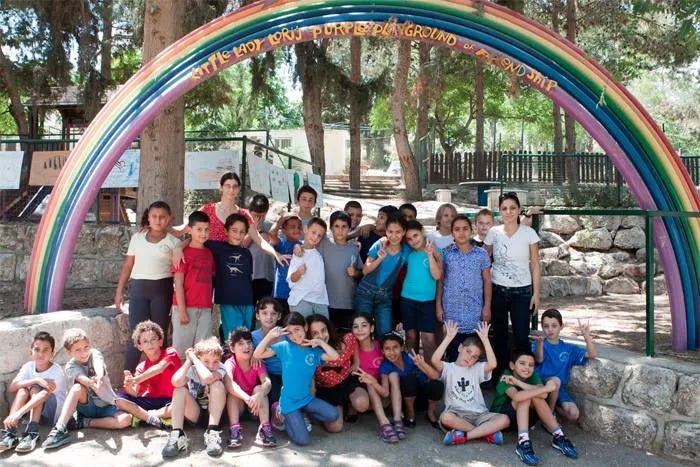
Hand in Hand (Yad be Yad), co-founded in 1997 by an Arab Israeli educator and an American-Israeli educator with fifty children, has built the only growing network of integrated bilingual schools in Israel: six campuses today, in Jerusalem, Galilee, the Wadi Ara, Haifa, Tel Aviv-Jaffa and Kfar Saba, more than 2,000 Jewish and Arab pupils taught together in Hebrew and Arabic by mixed teaching teams, with hundreds of families on waiting lists. Each class has two teachers, one Jewish and one Arab, and the values inscribed at the entrance of each school are the same in Hebrew and in Arabic: equality, empathy, responsibility, respect. During the 2024–2025 school year, under bombs and the pressure of war, all establishments completed their full year, what their director describes as the fruit of “muscles developed over years that the rest of Israeli society does not yet possess.”
The Parents Circle Families Forum, founded by Yitzhak Frankenthal whose son was killed by Hamas, brings together Israeli and Palestinian families who have lost someone close and who have chosen not to transmit their pain as a weapon: their cross-testimonies constitute one of the most authentic and most tested forms of dialogue ever developed between the two peoples.
Finally, ALLMEP (Alliance for Middle East Peace) today federates more than 160 organisations from both civil societies, maintaining the fabric of dialogue where official politics has torn it apart.
7 October: when night falls on the peacebuilders
On 4 October 2023, three days before 7 October, Women Wage Peace and Women of the Sun organised in Jerusalem a joint march, presenting a Mothers’ Appeal jointly signed: “We, Palestinian and Israeli mothers, are determined to put an end to the vicious cycle of bloodshed.” Three days later, Vivian Silver, co-founder of Women Wage Peace, was murdered by Hamas in her kibbutz at Be’eri. This atrocious coincidence says everything about what 7 October did to these movements: it struck at the very heart of those who refused the logic of violence.
The war that followed in Gaza subjected these organisations to an existential ordeal. Their members found themselves torn between loyalties that tragedy rendered simultaneously compelling and incompatible. Some of those bonds broke. But others held: Standing Together secured humanitarian convoys and organised marches towards Gaza in 2025, in a context where aid delivery was severely restricted, whether through the limitations imposed by the Israeli authorities for security reasons or the diversions documented by Hamas. Road to Recovery continued its transports under extremely difficult conditions. ALLMEP maintained its bilateral dialogues in digital format. The film No Other Land, co-produced by a binational team filming under threats, received the Oscar for best documentary in 2025, and its very existence in this context is a political act.
These voices are today more inaudible than they have been at any point since the darkest years of the conflict. But they have not disappeared. And this obstinate presence, without any logic of immediate result, without visible political reward, sometimes at the cost of life, perhaps says the essential: there exist, in both societies, men and women who have decided that the other is a person before he is an enemy, and that this decision does not revoke itself under bombs.
The night of the Jabbok and interior transformation as necessity
There is, in the story this article has attempted to tell, something that surpasses politics and that politics alone cannot formulate. All these men and women (Ahad Ha’Am, Magnes, Buber, Leibowitz, Alami, Sakakini, the moderate Nashashibis, Barghouti, Nusseibeh, Ayalon, Beilin and Abed Rabbo, the soldiers of Yesh Gvul, the mothers of Women Wage Peace and Women of the Sun), had in common, beyond their considerable differences, one characteristic that their respective adversaries did not share: they had traversed a night that had changed them and made them more human. Not in the convenient metaphorical sense, but in the sense that the biblical tradition gives to that ordeal: a real transformation that breaks and refounds, that leaves traces in the body and in the soul.
Ahad Ha’Am had traversed the reality of the pioneers of the early aliyot and refused to lie to himself about what he saw, including and especially when it was uncomfortable for the project he defended. Magnes had traversed the jeering of his own community during the most painful years of modern Jewish history and maintained his conviction not through stubbornness but because he had verified it in his own flesh. Leibowitz had traversed the official ostracism of the state he loved, refusing until his last breath to separate Judaism from ethics. Alami had traversed the Nakba, the annihilation of Palestinian society as he had known it, and chosen in ‘Ibrat Filastin the most difficult path: to turn against his own camp with the same rigour that Ahad Ha’Am had turned against his, posing the same fundamental question from the opposing shore — what is lost when a people chooses power without ethical depth? Mustafa Barghouti had traversed Israeli prisons and the corruption of his own political authority without choosing either hatred or resignation. Nusseibeh and Ayalon had traversed together the night of the Second Intifada, one a Palestinian marginalised in his own camp, the other a former head of Israeli intelligence convinced that his entire life dedicated to security through force had produced insecurity, and emerged from it with six principles of peace that 800,000 people had signed. Beilin and Abed Rabbo had traversed the failure of Oslo without concluding that peace was impossible, producing in Geneva the most complete agreement ever drafted between representatives of the two peoples.
This is why this series is placed under the sign of Jacob and Esau, those two twin brothers whom the betrayal of a stolen inheritance and twenty years of exile had turned into mortal enemies. The night of the Jabbok, in which Jacob wrestles with a mysterious being until dawn and emerges transformed, broken in one part of himself but capable for the first time of meeting his long-time enemy-brother, is not a comfortable allegory about dialogue and reconciliation. It is a precise description of the process by which a person, or a people, exits the logic of domination and exclusion to enter another logic, more difficult, more costly, but the only one that makes possible a life worthy of that name. And what is striking in the story this article has told is that this night was sometimes traversed together: a former head of the Shin Bet and a Palestinian philosopher, an Israeli negotiator and a Palestinian minister, soldiers and former fighters from both camps, Jewish and Arab mothers marching side by side on the Jordan. The Jabbok is not solely an interior metaphor — it can also be a meeting place.
The voices this article has sought to name, voices of peace from both camps, silenced by violence, by history, by the complicity of the powers and the rage of the fanatics, are the voices of those who, each in their own way, have traversed that night. They did not win. Not yet. But what they said remains true, and what they did remains real: Alami’s wells, Hand in Hand‘s schools, the scores of the West-Eastern Divan, the signatures of 800,000 strangers who wanted to live in peace. That will not be lost. These are landmarks for all those who, tomorrow, will want to make of this land what it should be.
The next article in this series will examine how peace opportunities have been systematically sabotaged over these one hundred and thirty years — not by fatality, but by identifiable actors who needed this conflict to continue for reasons that will need to be named without euphemism. Then the last article will open a direction for the future by returning to Jacob and Esau, in order to recount the steps that Jacob had to take before the night of the Jabbok and the morning when he could say to his brother, in a breath that sums up everything this article has attempted to document, “to see your face is to see the face of G-d”: the interior struggle first, then the crossing of the ford, then the humility of the one prostrate before him he had betrayed, then the gift offered without guarantee of response, and finally, only then, recognition.
For this is what these silenced voices, those of both camps, had understood: that there is no shortcut between fear of the other and peace with him, but an exacting path that both peoples will need to travel in parallel, each crossing its own night, for neither can cross the Jabbok in the other’s place, nor claim to have crossed it as long as the other has not crossed it too.
© 2026 - Dialogues of the New World — Jérôme Nathanaël
Next article : A century and a half of sabotaged peace: anatomy of a machine for manufacturing fatalism

To go further
In the face of the trials of our time, what ancient teaching, what new wisdom or what personal experience still helps you to hold steady, to understand, or to discern? Share your thoughts in the comments and let us benefit from your perspective.
If you wish to speak to the upheavals of our age, send me a contribution of roughly one page for the Waymakers section. It will be published under your initials, a pseudonym, or anonymously, as you prefer. Other readers will be able to respond and enter into dialogue with you.”
New here? The Opening page introduces the author, the project, how to take part, contact details, and the agenda.