

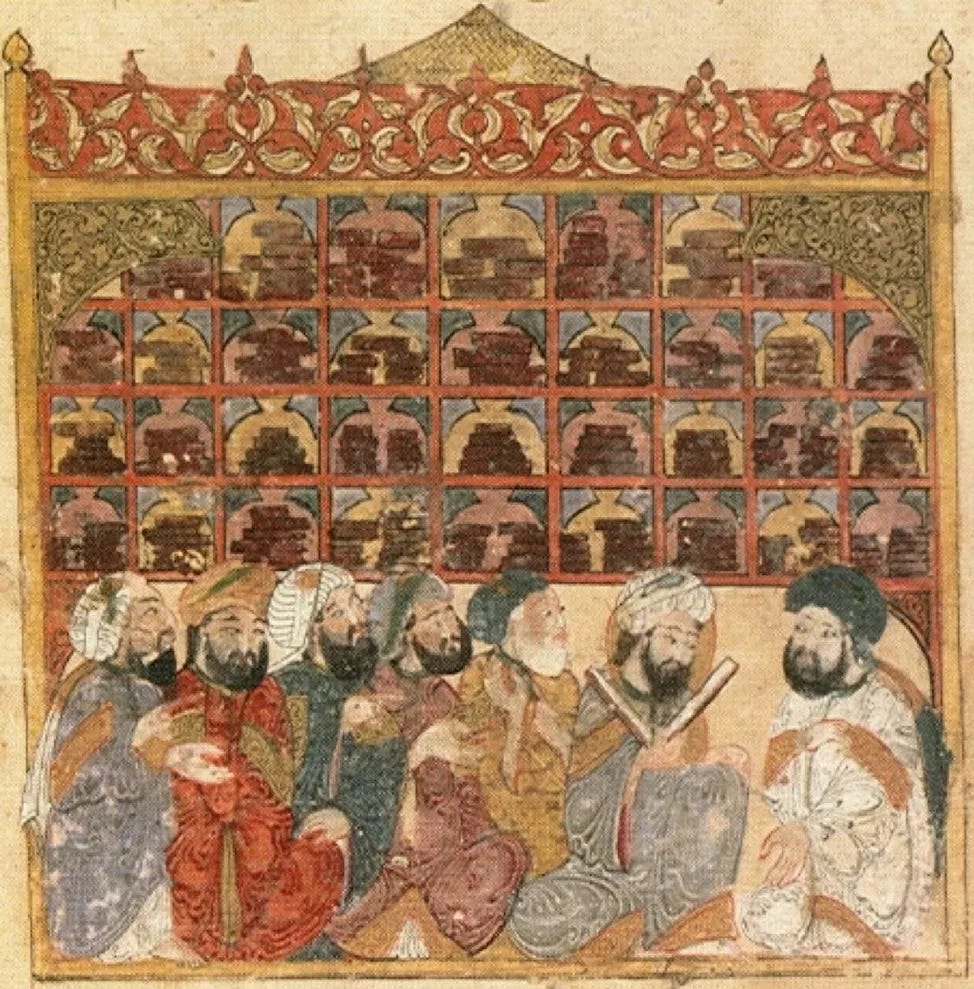
Article disponible en français
The World We Cross · New World · 65 min
To open up perspectives, test out possibilities, seek forms of life more fit to be inhabited.

Series ‘Spirituality and the organisation of societies’ · Article 3 of 6
What the inner life does to societies, what societies do to the inner life.
If this article is your first encounter with the series. The first article poses the question that carries all six: what link is there between the spiritual development of persons and the way a society organises itself, and does this link run in both directions, from the person towards society as from society towards the inner life? It formulates two hypotheses, defines what I mean by spirituality and sets out the method applied to each case, Ken Wilber’s four quadrants and seven questions, to which the following article, The bishop and the sword, added four refinements drawn from your replies. That second article followed a Church that calls upon the emperor to settle its disagreements; this one follows a caliph who wishes to settle them in place of the scholars.
In this article:
Two men in chains on the road to Tarsus
Why does a caliph wish to fix the faith?
At Medina, a community born with its leader
After the Prophet: staying, going out, judging
Conquest does not demand conversion
Who will say what the Book says?
An emperor who renounces imposing a belief
What my grid of analysis brings to light
What this study does not prove
Next time: the absent king
‘Give me something from the Book of G-d or from the Sunna of His Prophet, and I shall say it.’
The reply his biographers attribute to Ahmad ibn Hanbal before the caliph al-Mu’tasim, in 835
Two men in chains on the road to Tarsus
A letter written at Raqqa
In the spring of 833, the Abbasid caliph al-Ma’mun is far from Baghdad, on the Byzantine frontier, where he has been campaigning for several summers. It is from there, from Raqqa on the Euphrates according to most accounts, that he writes to his governor in Baghdad, Ishaq ibn Ibrahim, a letter that the historian Tabari preserved almost in full. He orders him to gather the judges of the city and the scholars who hand down the sayings and deeds of the Prophet, the traditionists, and to ask them what they think of the Qur’an: is it created, or is it the eternal word of G-d, without beginning? Those who refuse to call it created will receive no further office, and their testimony will no longer be accepted in court. The letter also says what is to be thought of those who hesitate: in it the caliph treats with contempt the common run of believers, whom he judges incapable of reflection, and still more those who invoke the tradition of the Prophet in order to have the crowd follow them. Al-Ma’mun had proclaimed this doctrine as early as 827, without seeking at that time to impose it on anyone. Six years later, he wants it signed.
A second letter follows the first, then others. Seven jurists of renown are summoned to the caliph’s camp, where he questions them himself; they give way. In Baghdad, the governor gathers the judges and the traditionists, reads them the letter, then questions them one by one, and a secretary records the answers, which he sends to the caliph. The caliph comments on them in return, name by name, with an irony that does not conceal the threat: one scholar is mocked for his ignorance, another for his past conduct, and those who do not give way will be sent to the camp, loaded with chains. This procedure would come to be called the mihna, an Arabic word that designates the trial, the test to which a metal is put to learn what it is worth.
What ‘the Qur’an was created’ means
The question may seem abstract to the reader of today. It was not. For al-Ma’mun and for the theologians known as the Mu’tazilites, who surrounded him, G-d alone is eternal, and all that is not He had a beginning: to say that the Qur’an is uncreated amounts to setting beside G-d a second eternal being, which faith in the divine unity forbids. The Qur’an is therefore the word of G-d, but a word He created, at a given moment, to send it down upon His prophet. At that time, for most of the scholars of tradition, on the contrary, the word of G-d cannot be separated from Him: it is one of His attributes, it has no beginning, and the text the believer recites is that very word, and not one made thing among others.
Behind this dispute of theologians stands a question of power, and it is this question that forms the subject of the present article: who has the right to say what the Book says? A created word, inscribed in time, can be interpreted by reason, and a caliph surrounded by rationalist theologians can present himself as the one who knows how to read it. An eternal word without beginning, handed down through the chain of witnesses from the Prophet onwards, belongs to those who hand it down. In imposing the first doctrine, al-Ma’mun was not merely settling a point of theology: he was designating the one to whom the last word belonged.
Those who give way, those who refuse
Almost all give way. Some do so by invoking a permission that the Qur’an itself grants: sura 16 exempts from the condemnation of the apostate ‘him who has been compelled while his heart remains at peace in the faith’, and this dissimulation permitted under constraint, called taqiyya, allows one to say aloud what one does not believe inwardly. Others give way to keep their office, others still because they do not attach to the question the importance the caliph gives it. Four men in Baghdad begin by refusing, then two of them end by giving way. There remain Ahmad ibn Hanbal, a traditionist of nearly fifty, renowned for his piety and for the immense collection of the Prophet’s sayings he is in the course of assembling, and a younger man, Muhammad ibn Nuh. They are put in chains and sent towards the caliph’s camp at Tarsus, in Cilicia, at the foot of the Taurus, where the empire touches Byzantium.
They will not be received by al-Ma’mun, who dies in August 833 in the course of his campaign, and they are brought back towards Baghdad. Muhammad ibn Nuh dies on the return journey, still in chains, and it is Ibn Hanbal who, according to his biographers, prays over his body. He himself is thrown into prison in Baghdad, where he remains for more than two years. The new caliph, al-Mu’tasim, brother of the deceased, has neither his elder’s taste for theology nor his interest in debate, but he has received from him the instruction to pursue the Mihna. In 835 (the year 220 of the Hijra), he has the prisoner brought before him. The interrogation lasts three days, before the caliph and his theologians. Al-Mu’tasim, according to the accounts, presses him with a kind of benevolent impatience, promises him his favour, asks him to give way at least a little. Ibn Hanbal answers each time the same thing: let him be given an argument drawn from the Book of G-d, or from the tradition of His Prophet, and he will change his mind. The theologians set reasonings against him; he replies that he does not know these reasonings and that he is waiting for a text. On the third day, the caliph has him flogged until he loses consciousness. Then he has him released. The accounts differ as to the reason, but several give this one: a crowd had gathered in front of the palace, and the authorities feared a riot. Michael Cooperson, who has compared these accounts, notes that the caliph perhaps had more to lose than the prisoner by prolonging the affair.
Sixteen years of trial
The Mihna does not stop for all that. Under the next caliph, al-Wathiq, son of al-Mu’tasim, who reigns from 842, it extends to the provinces, where the judges must likewise profess the doctrine; the historian Christopher Melchert has followed its trace as far as Basra, Kufa, Damascus, Fustat, in Egypt, and Kairouan. Even the Muslim prisoners whom the Byzantines return during exchanges of captives are questioned: those who refuse to call the Qur’an created are not ransomed. In 846, a notable of Baghdad, Ahmad ibn Nasr al-Khuza’i, who had prepared an uprising against the caliph in the name of the doctrine of the uncreated Qur’an, is arrested, questioned by al-Wathiq in person and beheaded by his own hand, according to the chronicles; his head remains on display in Baghdad for years. Then comes al-Mutawakkil, another son of al-Mu’tasim: on the death of al-Wathiq, in 847, a council of high dignitaries and Turkish generals prefers him to the young son of the deceased. He brings the trial to an end by stages, between 847 and 851 or 852, and has the opposite doctrine proclaimed. He ceases to interrogate, but he does not renounce imposing: it is now the other doctrine that becomes the doctrine of the state.
Some sixteen years separate al-Ma’mun’s first letter from the end of the Mihna. The grid I apply to each case brings two features to light from this first account onwards. The impulse here comes from the sovereign, who decides it; it is neither received by a community, like a revelation, nor sought by it, like a reform. And doubt has a precise price: first the loss of one’s office, that of judge or of any other public charge, then that of the right to testify in court, and finally the body, given over to chains, to prison and to the lash.
Why does a caliph wish to fix the faith?
A war between two brothers
Al-Ma’mun was not destined to reign alone. His father, Harun al-Rashid, caliph from 786 to 809, has remained famous as the sovereign of the Thousand and One Nights, in which he roams the streets of Baghdad by night, and in the West as the one who sent an elephant to Charlemagne; his reign marks the apogee of Abbasid power. He had promised the caliphate to his other son, al-Amin, and the eastern part of the empire to al-Ma’mun, with the succession after his brother. The agreement does not survive his death, in 809. War breaks out in 811, and Baghdad, capital of the Abbasids founded in 762 on the Tigris, where al-Amin reigns, undergoes a siege of more than a year that ruins whole districts of it. In September 813, the defeated al-Amin seeks to surrender; the soldiers of his brother’s general seize him on the river and put him to death.
Al-Ma’mun nevertheless remains at Merv, in Khurasan. In 817, he designates as his heir ‘Ali al-Rida, a descendant of the Prophet whom the Shi’ites hold to be their eighth imam, and he replaces black, the colour of the Abbasids, with the green of the descendants of ‘Ali. Baghdad retorts by proclaiming another caliph, his uncle Ibrahim ibn al-Mahdi. ‘Ali al-Rida dies the following year, and the anti-caliph flees at the approach of the army: al-Ma’mun finally enters his capital in 819, still dressed in green, before returning to black. The Abbasids had chosen this colour because a tradition announced that black banners would come from Khurasan at the end of time, before the coming of the Mahdi, the awaited guide; it is this same black that the Islamic State has taken up on its flags.
A sovereign who has conquered power by making war on his brother, and whose troops killed the legitimate caliph, needs a legitimacy that owes nothing to force. The one al-Ma’mun seeks is religious, and it passes through doctrine. I think here of the remark of a reader that I quoted in the previous article: too few landmarks can cause as much anguish as too many constraints. A society emerging from a civil war, whose capital has been starved and burnt, no longer quite knows who has authority over it, and the Mihna also answers this uncertainty: by making the caliph the one who settles questions of faith, it makes him the one who must be obeyed. Al-Ma’mun had first attempted another path. In designating ‘Ali al-Rida as his heir, he was leaning on a descendant of the Prophet whom the Shi’ites hold to be the legitimate interpreter of the Book. After the death of ‘Ali al-Rida, in 818, nothing remains to the caliph but to claim for himself, fifteen years later, the authority to interpret it.
A learned court
This same caliph is also one of the great patrons of the learning of his time. It is in his reign that the translation into Arabic of Greek works of philosophy, medicine and astronomy reaches its greatest flowering, and the chronicles attribute to him a dream in which Aristotle appeared to him to tell him that the good is what reason judges good. He gathers around him scholars of several confessions, Christians, Jews, Zoroastrians, and has theologians debate before him. An account preserved in Arabic places in 829 a discussion between Theodore Abu Qurra, Melkite bishop of Harran, and the caliph’s Muslim theologians; its historicity is disputed, and the historian David Bertaina sees in it a literary composition rather than a record, but the mere fact that it could be written says something about the image this court gave of itself.
The whole paradox lies in this reign. The sovereign who opens intellectual debate most widely is also the one who wishes to close the question of faith for Muslims themselves. One may discuss the Trinity with a Christian bishop; one may no longer, when one is a judge in Baghdad, hold the Qur’an to be uncreated. Reason, which the caliph invokes against those who hand down without reflecting, becomes the instrument of constraint. This figure will return in the series: it is not peculiar to Islam, and it is not peculiar to the Middle Ages.
The caliph of G-d
Historians do not agree on the meaning of the undertaking, and their disagreements are instructive. Patricia Crone and Martin Hinds, in a book of 1986 entitled God’s Caliph, argued that the first caliphs did not regard themselves merely as the political leaders of the community, but as the holders of religious authority, those who say what G-d wills. The title some of them bore, ‘caliph of G-d’ and no longer merely ‘successor of the Messenger of G-d’, would preserve the trace of this. In this reading, the Mihna is the last great attempt by a caliph to keep this authority in the face of a class of scholars that was forming outside him and disputing it with him. John Nawas, in a study of 2015, likewise sees in it a quest for caliphal authority rather than theological zeal; Christopher Melchert, an undertaking to bring the scholars to heel throughout the empire; John Turner has shown, for his part, that al-Mutawakkil ended the Mihna as much to rid himself of his brother’s men as out of conviction. None of these readings entirely excludes the others, and all lead back to the same question: to whom does the word of G-d belong, to him who governs or to those who hand it down?
To understand why this question could arise in this way, and why it had not arisen in the same way in Christianity, we must go back two centuries further, to Medina.
At Medina, a community born with its leader
A writing to hold tribes together
In 622, Muhammad leaves Mecca, where his preaching has earned him the hostility of the great families of the tribe of Quraysh, and settles in the oasis of Yathrib, which would soon be called Medina, ‘the city’ of the Prophet. This emigration, the Hijra, opens the Muslim calendar. The oasis is not a city in the sense the Greeks understood: it is a cluster of palm groves and fortified villages, shared between two great Arab tribes, the Aws and the Khazraj, exhausted by years of war, and several Jewish tribes, three of them principal, the Qaynuqa, the Nadir and the Qurayza, to which are added Jewish groups attached to the Arab clans. It was representatives of the Aws and the Khazraj who had invited Muhammad to come, so that he might arbitrate between them.
Shortly after his arrival, a writing regulates the relations between these groups and the emigrants who had come from Mecca. It is called today the ‘Constitution of Medina’, but the ancient sources name it simply sahifa, ‘the sheet’, or kitab, ‘the writing’, and the text has come down to us in two versions, one in the biography of the Prophet composed by Ibn Ishaq in the middle of the eighth century and handed down by Ibn Hisham, the other in a treatise on fiscal law by Abu ‘Ubayd, in the ninth century. Michael Lecker, who devoted to it in 2004 the most meticulous study, holds the word ‘constitution’ to be a misuse of language: it is a treaty between tribes, which fixes who leads each group, who pays the blood-money, who ransoms captives and who contributes to the expenses of war. The ancient sources, moreover, also call it muwada’a, a truce. Robert Serjeant saw in it the joining together of eight documents of different periods, a reading that Uri Rubin judges arbitrary.
This text is precious because it is rare. Almost everything we know of Muhammad’s life comes to us from accounts set down in writing a century or more after his death, and these accounts were composed in an empire already established, by authors who had their own reasons for telling them as they did. Historians hold the Sahifa to be one of the rare documents that probably go back to the very time of the Prophet, precisely because it does not resemble what a later age would have invented. All that follows on Medina must be read with this reservation, the same one I applied in the previous article to the persecutors’ accounts of the heretics of Languedoc.
‘To the Jews their religion, to the Muslims theirs’
One of the clauses of the Sahifa, the twenty-fifth in the usual numbering, concerns the Jews of the clan of the Banu ‘Awf. Ibn Ishaq’s version says that they form ‘a community with the believers’, Abu ‘Ubayd’s ‘a community among the believers’, and Lecker proposes reading the word otherwise, which would give ‘in safety from the believers’. What follows does not vary from one version to the other: ‘to the Jews their religion, to the Muslims theirs’. The clause is then extended to the Jews of the other Arab clans. These are Jewish groups linked to the Arab tribes of the oasis, and not the three great Jewish tribes, of which the Sahifa does not speak, or not directly. The jurist al-Shafi’i, at the beginning of the ninth century, saw in it a pact of protection that did not yet entail a poll tax.
One can measure how unexpected this sentence is. At the very origin of the Muslim community, a writing admits that men who do not share the Prophet’s faith belong with his faithful to one and the same whole, founded on mutual safety and on the common defence of the oasis, without their religion being called into question. I see in it the first place of doubt in Islam, in the sense I gave this expression in the previous article: a space where one may not believe what the majority believes without being excluded from the group. It is narrow, since it concerns only clans linked to the Arab tribes, and it is founded on a common interest more than on a principle. It exists nevertheless.
Qaynuqa, Nadir, Qurayza
It does not last. The three great Jewish tribes of Medina meet, according to the biography of the Prophet, a fate that must be told with the same frankness as the massacre of the Albigensians at Béziers, and with the same caution regarding the sources. The Qaynuqa are besieged and expelled in 624, after the victory of Badr over the Meccans. Then the Nadir are besieged and expelled in 625, accused of having plotted to kill the Prophet; part of them settle at Khaybar, an oasis to the north. In 627, after the siege of Medina by a coalition led by Mecca, the so-called battle of the Trench, the Qurayza, accused of having negotiated with the besiegers, surrender; according to the Sira, their men are put to death, several hundred according to the accounts, and the women and children reduced to captivity. The scale of the execution has been contested, notably by W. N. Arafat in an article of 1976 and by Barakat Ahmad, who judge these accounts implausible and late; their position remains a minority one among historians, who generally hold the fact to be established in principle, even if the figures are uncertain.
The pact did not survive the war against Mecca. What the external threat had not yet produced on the Prophet’s arrival, it produces within a few years: the space that allowed Jews to belong to the same whole as the believers closes as soon as their loyalty seems doubtful in a war in which the community is staking its existence. I find here, in a quite different context, the first of my hypotheses: when cohesion is threatened, fear diverts the impetus towards defence and the designated enemy.
Truces and pacts: the other’s religion recognised, but not his power
The agreements concluded in the time of the Prophet are first of all acts of war and of security, and they must be read as such. The name of truce that the ancient sources give the pact of Medina already says what kind of alliance it was: a security arrangement between armed groups, revocable like any truce, rather than a community of destiny. Historians are divided on the intention behind it. Moshe Gil, in an article of 1974, read in it a policy already hostile to the Jews, designed to isolate them from their Arab allies; Lecker considers that this reading rests on a corrupt text, and Uri Rubin, like Saïd Arjomand, sees in it on the contrary a real concession, made to win the Jews over to the Prophet’s cause. The debate remains open.
But the most famous truce of this period, that of Hudaybiyya, in 628, was concluded not with Jews but with the Qurayshites of Mecca, still pagan, for a period of ten years. It allows the Muslims to perform the pilgrimage the following year and to consolidate their alliances; it is broken in 630, after an attack by allies of Mecca on allies of the Muslims, and followed by the taking of the city almost without a fight. The jurists drew from it a doctrine of the truce, the hudna, and it is from this doctrine that the idea comes, often repeated today, of the truce as a mere pause in a war that must resume. The schools nevertheless do not agree: al-Shafi’i and Ahmad ibn Hanbal limit the truce to ten years, on the model of Hudaybiyya, and reserve it for moments when the Muslims are weak; the Hanafis and the Malikis set no term to it; in the fourteenth century, the Hanbali theologian Ibn Qayyim al-Jawziyya even admits a truce without end, as a recent study by Suleiman Mourad has shown.
Khaybar, finally, sheds more light than any other episode on the place given to another faith in these beginnings. In 628, the Prophet’s forces besiege the oasis, where Jews live, among them part of the Nadir expelled from Medina. When the oasis falls into the hands of the Muslims, tradition reports that ninety-three Jews are executed; their leader, Kinana, is killed after being tortured, according to Ibn Ishaq, so that he should reveal where his tribe’s treasure lay. The vanquished keep their lands, but as sharecroppers: ownership passes to the victors, to whom they hand over half the harvest, and they keep the freedom of their worship. This status, a subject population that keeps its religion by paying, is the precedent for what would become the dhimma. It does not protect for ever: around 642, the caliph ‘Umar expels the Jews of Khaybar in the name of a saying attributed to the dying Prophet, according to which two religions must not coexist in the peninsula, or in the Hijaz according to the versions.
These episodes allow us to say something precise. From the beginnings, the religion of the other is recognised, and the Sahifa says so in so many words, but its political power is not, and the protection granted to it depends on the balance of forces. They do not allow us, on the other hand, to assert that every truce was a decoy: the idea of systematic deceit comes above all from later juridical doctrine, and still more from its modern uses. When the founder of Hamas, Sheikh Ahmed Yassin, offered Israel in 1997 a ten-year truce in exchange for a withdrawal from the territories occupied in 1967, he specified that this hudna would amount neither to recognition of the Jewish state nor to renunciation of the claim to the whole land: this is the truce of Hudaybiyya reread as a pause in a war that must not end. I have described this lock in my series on Israel and Palestine, and I shall not return to it here.
The prophet and the leader
A decisive difference separates Islam here from Christianity, as the previous article followed it. The Church lived for nearly three centuries without political power, at times persecuted, before an emperor converted and called it to his side. The community of Medina is born with its government, and its founder is in it at once prophet, judge, lawgiver and war leader. The question of the Donatist Donatus, ‘what has the emperor to do with the Church?’, cannot be put there in the same terms, since religious authority and political authority are, from the origin, united in the same person.
That is what makes so remarkable what happens two centuries later. In a tradition where religion and government were born together, one might expect the Prophet’s successor to inherit the one as well as the other. Yet that is what the Mihna puts to the test, and it is on this point that it fails: doctrine escapes the caliph. Before coming to this failure, we must follow what happens between the death of the Prophet and the accession of the Abbasids, for several of the questions of 833 already arise in these first generations.
After the Prophet: staying, going out, judging
The ridda: when refusing the tax becomes apostasy
Muhammad dies in 632 without having designated a successor, according to Sunni tradition. The Companions choose one of the oldest among them, Abu Bakr, who takes the title of successor, khalifa, whence our word caliph. At once, a large part of the tribes of Arabia that had rallied to Medina refuse to pay him the legal alms, and some follow other men who claim to be prophets, the most famous of whom, Musaylima, had gathered a large part of the tribe of the Banu Hanifa, in the Yamama. Many of these tribes had concluded their pact with Muhammad in person, and held it to have lapsed at his death.
Abu Bakr refuses to separate prayer from alms. He wants the tribes to go on paying the one as they perform the other, and he fights them. These are the wars of the ridda, a word that means ‘turning back’ and is translated as ‘apostasy’. They last from 632 to 633; the bloodiest battle, against Musaylima, at ‘Aqraba, has left in memory the name of ‘garden of death’. The sources, late and often contradictory, do not distinguish between those who had abandoned the faith and those who merely refused the tax: in the order that is taking shape, faith and allegiance to the Prophet’s successor are one and the same, and leaving the community is treated as rebellion. Classical law would inherit this confusion, and I shall come upon it again further on.
The Kharijites, the first pure
Twenty-five years later, the community tears itself apart. The third caliph, ‘Uthman, is assassinated in 656; ‘Ali, cousin and son-in-law of the Prophet, succeeds him, but the governor of Syria, Mu’awiya, a kinsman of ‘Uthman, refuses to recognise him so long as the murderers are not punished. The two armies meet in 657 at Siffin, on the Euphrates. At the height of the battle, the Syrians, according to the best-known account, raise leaves of the Qur’an on the points of their lances to ask that the dispute be settled by the Book. ‘Ali accepts an arbitration. Part of his own supporters at once oppose it with a formula that would become their rallying cry: ‘judgement belongs to G-d alone’. They leave his camp, whence their name of Kharijites, ‘those who go out’.
Their demand is that of an uncompromising purity. For them, the Muslim guilty of a grave sin ceases to be a Muslim, and the most radical among them hold it lawful to kill those who do not share their judgement, women and children included. ‘Ali crushes them in 658 at Nahrawan; one of them assassinates him in 661, at Kufa, with a blow from a poisoned sword. The reader of the previous article will think of Novatian, who refused to readmit the Christians who had lapsed during the persecution, and of the Donatists, who held as void the sacraments given by traitors: a demand for purity that excludes, and that ends by killing. A reservation is called for here once again, since we know the Kharijites scarcely at all except through their adversaries, and since their moderate heirs, the Ibadis, who live today in Oman and in the Maghreb, long ago renounced this violence.
‘Ali, Karbala, and the imam who knows how to read the Book
The quarrel of Siffin has another consequence, more lasting still. According to Sunni tradition, as I have said, the Prophet designated no successor. Part of the community thinks the contrary. For those who would be called Shi’ites, from shi’at ‘Ali, ‘the party of ‘Ali’, Muhammad had designated his cousin and son-in-law on the way back from his last pilgrimage, during a halt at the pool of Khumm, by a saying that the Sunnis also report but in which they see a mark of affection rather than an investiture. ‘Ali became caliph only in 656, after three others, and his reign ends in war and assassination. In 680, his son al-Husayn, having set out from Medina to join his supporters in Kufa, is surrounded at Karbala, in Iraq, by the troops of the Umayyad caliph Yazid, and killed with most of the men of his family. The memory of this martyrdom, which the Shi’ites commemorate each year on the day of Ashura, is the foundation of their piety.
The separation born of it does not bear only on the person of the successor: it touches the very question of this article. To the Kharijites, who demanded that the Book alone should judge, ‘Ali is said to have replied, according to a sermon attributed to him in the Nahj al-Balagha, a collection compiled around the year 1000, that the Qur’an is a writing between two covers, that it does not speak with a tongue and that it needs an interpreter. For the Shi’ites, this interpreter is the imam, a descendant of the Prophet through ‘Ali and Fatima, whom G-d preserves from error and who knows the hidden meaning of the Book as well as its apparent meaning. For the Sunnis, this meaning is entrusted to the community and to its scholars, guardians of the tradition. From the first century of Islam, then, two answers part ways on the question of who says what the Book says: the imam, or the scholars. A minority and often persecuted, the Shi’ites would moreover make of the dissimulation permitted under constraint, the taqiyya, a doctrine of survival, broadening a permission that the Sunnis also admitted.
Those who leave judgement to G-d
Facing the Kharijites, other Muslims take the opposite position: they ‘defer’ judgement on the sinner, and leave it to G-d on the Day of Judgement. They are called Murji’ites, from this verb meaning to postpone. He who commits a grave sin remains a believer; one does not know whether he will be saved, and because one does not know, one does not cut him off from the community. This is a place of doubt of another kind, theological this time: uncertainty about the salvation of another becomes the reason for not excluding him.
This position is not merely speculative. In 734, an Arab chief of Khurasan, al-Harith ibn Surayj, whom the chronicles connect with this current, raises the province in the name of the Book and of the tradition of the Prophet, and demands in particular that non-Arab converts cease to pay the poll tax, the tax of non-Muslims, which the Umayyad governors went on making them pay. The suspension of judgement on the faith of others joins here with a demand for equality among believers. Majority Sunnism would keep the essential of it: the sinning believer remains a believer, and his fate belongs to G-d.
Scholars who keep power at a distance
One last tradition takes shape before the Mihna, and it partly explains its failure: that of the scholars who hold themselves at a distance from power. Abu Hanifa, the jurist of Kufa whose school is today the most widespread in the Muslim world, refuses an office of judge under the last Umayyads, then under the Abbasid caliph al-Mansur. He is imprisoned, and he dies in Baghdad in 767, in prison or shortly after leaving it according to the accounts; an immense crowd follows his funeral.
A few years earlier, in 762, a revolt breaks out at Medina, led by a descendant of the Prophet, Muhammad ibn ‘Abd Allah, who was nicknamed ‘the pure soul’, against this same al-Mansur. The great jurist of Medina, Malik ibn Anas, then reports a tradition according to which a divorce pronounced under constraint is void. Everyone understands what he means: the oath of allegiance that the Medinans swore to the Abbasid caliph under constraint does not bind them. The revolt fails. The governor of Medina has Malik flogged, seventy lashes according to some sources, to the point of dislocating his shoulder, and, according to his biographers, Malik repeats his tradition in public as soon as he is able to rise again.
He would go on teaching in Medina for nearly thirty years, honoured by the very caliphs who had had him beaten. When al-Ma’mun writes his letter of 833, then, he is addressing not clerics accustomed to obey, but the heirs of such men.
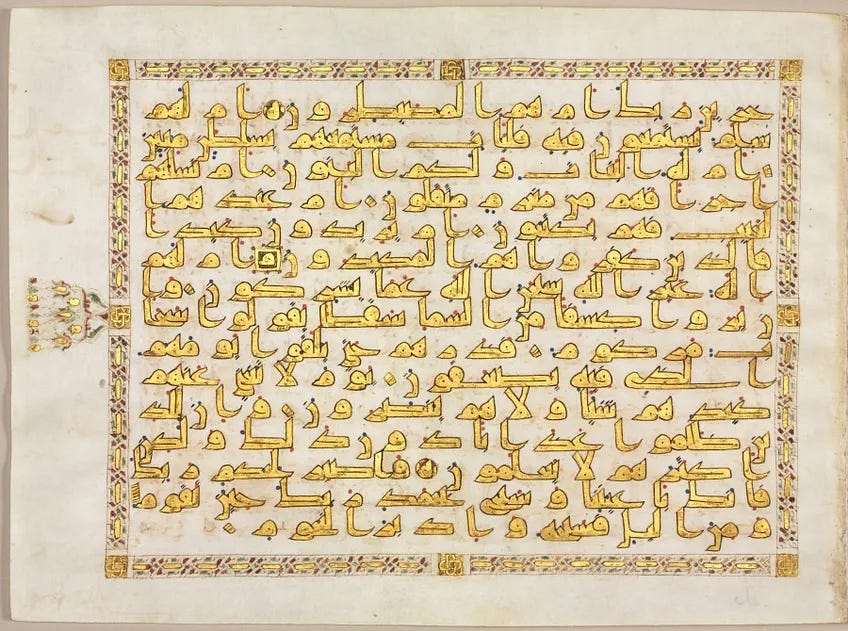
Conquest does not demand conversion
To submit, to pay, to remain oneself
In the years that follow the ridda, the armies of Medina go out of Arabia. In little more than a century, from 634 to the fall of the Umayyads in 750, they conquer Byzantine Syria and Palestine, Egypt, Sasanian Iraq and Iran, North Africa, Visigothic Spain, and push on as far as the Indus and the gates of China. No empire of Antiquity had spread so fast. One readily pictures this conquest as a conversion by the sword, and that is the image Christian Europe long handed down of it. It does not withstand the sources.
Towns and provinces most often surrender by treaty, sulh, and these treaties resemble one another. The vanquished keep their lives, their goods, their churches and their synagogues, and the right to practise their worship; in exchange, they submit to the authority of the victors and pay a tribute, which would become the poll tax, the jizya, levied per head on adult men, to which the land tax is added. The Qur’an gives its principle in sura 9: to fight those who have received the Scripture and do not believe, ‘until they pay the jizya from their hand, in a state of abasement’. The status that results, the dhimma, a word that designates at once the pact and the protection it grants, applies first to the ‘People of the Book’, Jews and Christians, whom the Qur’an acknowledges to have received a Scripture; the jurists very early extend it to the Zoroastrians of Iran, then, in conquered India, to the Hindus. It is at once a protection and a subordination: it guarantees the life, the goods and the worship of those who benefit from it, the dhimmis, ‘people of the pact’, but it does not give them equality with the Muslims. To put it in a sentence, it does not demand conversion; it makes people pay for their difference.
How the vanquished saw it
It would be convenient to judge this conquest by what the victors said of it. The vanquished left another testimony, and the historian Robert Hoyland gathered in 1997, in Seeing Islam as Others Saw It, the Syriac, Greek, Armenian, Coptic and Hebrew texts that speak of it. Several Christian chroniclers see in the conquest a punishment from G-d for the sins of the Church, or for its divisions: the Christians whom the imperial Church had persecuted for their doctrine on Christ do not always mourn the end of Byzantine rule. These are the ones called Monophysites, or more accurately Miaphysites: the Copts of Egypt and the Jacobites of Syria, who reject the definition of the council of Chalcedon, in 451, according to which Christ is a single person in two natures, divine and human, and who profess a single nature of the incarnate Word. Constantinople wants to impose the council on them and exiles their patriarchs, and on the very eve of the conquest, in Egypt, the patriarch Cyrus, sent by the emperor Heraclius, persecutes them to the point that their own patriarch, Benjamin, lives in hiding for some ten years. On the Jewish side, an apocalypse, the Secrets of Rabbi Shimon bar Yohai, whose dating is disputed and which Bernard Lewis placed in the middle of the eighth century in the form that has come down to us, depicts a rabbi saddened by the coming of the kingdom of Ishmael. The angel who speaks to him consoles him: G-d raises up this kingdom to deliver the Jews from the dominion of Edom, that is to say of Rome and Byzantium, under which they had suffered so much.
These different gazes do not agree, and therein lies their interest. They forbid us to read the conquest from a single point of view, whether that of apology or that of lament. For a Christian of Constantinople, it was a catastrophe; for a Monophysite Christian of Egypt, it replaced a master who wished to regulate his faith with a master who wanted only his tax; for the author of the Jewish apocalypse, it was perhaps the beginning of a deliverance.
A caliphate that did not want too many converts
The Umayyad caliphs, who govern from Damascus from 661 to 750, live in large part on the poll tax. A convert, in principle, ceases to pay it. Mass conversions therefore threaten the treasury, and the authorities do not encourage them; they even sometimes seek to curb them. The governor of Iraq al-Hajjaj, who holds the province from 694 to 714 with a harshness that has remained proverbial, has the converted peasants who had come to the towns in search of the status of Muslims driven out of Kufa and Basra, sends them back to their villages and goes on making them pay the tax of non-Muslims.
The caliph ‘Umar II, who reigns from 717 to 720 and whom tradition has made a figure of piety, attempts to correct this injustice by a fiscal reform: converts are to have the rights and duties of Muslims and will no longer pay the poll tax, but the lands they cultivate will remain the common property of the Muslims and they must go on paying the land tax. To one of his governors, who proposed to verify the sincerity of new converts by making sure that they were circumcised, he is said to have replied that G-d had sent Muhammad ‘to call, not to circumcise’, or ‘not to collect taxes’, according to the versions. The reform scarcely survives its author. The historian Daniel Dennett showed as early as 1950 that Julius Wellhausen’s thesis, according to which conversions were at first a way of escaping the tax, simplified a reality that varied more from province to province, but the fiscal interest of the authorities in keeping the vanquished in their religion is not in doubt.
A slow conversion, over three centuries
The conversion of the conquered peoples was therefore slow. The historian Richard Bulliet proposed in 1979 to measure it from the biographical dictionaries, by noting the moment when properly Muslim names appear in the genealogies in place of Persian or Christian names. He draws from this an S-shaped curve: a few converts at the beginning, an acceleration in the ninth century, and a Muslim majority in Iran only in the tenth century, that is, three centuries after the conquest. The method has been debated, and more recent studies, notably for al-Andalus, have contested its chronology; the New Cambridge History of Islam raises the question of constraint without settling it. Fred Donner even argued, in Muhammad and the Believers (2010), that the initial movement brought together ‘believers’ of several confessions, united by the expectation of the Judgement more than by an already distinct religion, a thesis that remains controversial.
No one, on the other hand, any longer maintains that the populations of the empire were converted by force at the time of the conquest. Conversion followed interest, social advancement, marriage, the wish to belong to a group that governed, the Arabic language, which was becoming that of administration and culture, and doubtless also conviction, which the sources rarely allow us to see. A reader wrote to me, about the first article, that one can live through a sincere transformation without understanding what is transforming us. The slow conversion of the East offers an example of this on the scale of whole peoples: many of those who became Muslims did so sincerely, and what led them to it had as much to do with the society in which they lived as with their inner life.
‘No compulsion in religion’, and what the jurists make of it
The Qur’an contains a sentence that is often quoted in this debate: ‘no compulsion in religion’ (sura 2, verse 256). Patricia Crone, who studied the way the exegetes understood it, distinguishes three early readings. According to the first, the verse was abrogated by the verses that command fighting the unbelievers. According to the second, it concerned only an episode at Medina, where parents wished to compel their children, brought up in Judaism, to become Muslims. According to the third, which prevails among the great exegetes such as Tabari in the tenth century and Ibn Kathir in the fourteenth, it forbids converting by force the People of the Scripture, Jews and Christians, who consent to pay the poll tax. The Arab pagans and the apostates, in this reading, do not benefit from it. The Mu’tazilites, the very theologians who supported the Mihna, drew from it a more general idea, which bears directly on this series: constraint cannot reach inner conviction, since faith has value only if it is free.
The reverse side of this principle must be stated plainly. Entry into Islam is free, in law at least; exit is not, and classical law punishes apostasy with death, a legacy of the confusion between faith and allegiance that the ridda had installed. This is the clearest application of one of the questions that my readers’ comments led me to add to my grid, that of the price of doubt: one may remain other; one may not become other again.
The price of remaining other
This price the dhimmis pay in another way. A text that tradition attributes to the caliph ‘Umar I, the ‘Pact of ‘Umar’, presents itself as the letter by which the Christians of Syria are supposed to have accepted their conditions as a vanquished people at the time of the conquest. Historians, among them Milka Levy-Rubin and Mark R. Cohen, show that it received its known form much later, around the ninth century. In it the Christians undertake not to build new churches nor to restore those that fall into ruin, not to display their worship in public, not to wear the clothing of Muslims nor to ride a horse with a saddle, and to rise before Muslims when the latter wish to sit down. These rules were applied very unevenly according to place and reign, often ignored, sometimes brutally reinstated by a sovereign who wished to assert his piety.
Who pays, here? The communities, through the tax and through a public self-effacement that the pact organises down to clothing. Consciences, for their part, are not questioned: where the Latin Church would later send its inquisitors to ask each believer in Languedoc what he believes, no judge comes to ask a Christian of Aleppo what he thinks of the Qur’an and of its Prophet, nor to compel him to convert. The difference from what the previous article described is clear. The medieval Inquisition wanted to know what each person believed and to impose on him the authorised dogma; the dhimma wants only each person to keep to his place.
Cordoba, 850–859: seeking martyrdom
Yet it happens that men refuse this place, and one of the strangest episodes of Christian history unfolds during the very years in which the Mihna is coming to an end in Baghdad. At Cordoba, capital of the Umayyad emirate of al-Andalus, forty-eight Christians are beheaded between 850 and 859. Most of them presented themselves of their own accord before the judge to insult the Prophet publicly, knowing that this blasphemy was punished by death; others, born of marriages between Muslims and Christians, and therefore Muslims in the eyes of the law, are executed for apostasy after declaring their Christian faith.
They are not approved by all Christians, far from it. A council gathered at Cordoba in 852, under pressure from the emir, refuses to encourage these voluntary deaths, which many Christians of the city judge suicidal and dangerous for the whole community. The priest Eulogius, who records their passions and defends them, is arrested in his turn in 859, for having hidden Leocritia, a girl of a Muslim family who had become a Christian. Before the emir’s council, he preaches the Gospel and speaks against the Prophet. His friend and biographer Paul Alvarus relates that a counsellor who knew him took him aside and begged him to utter ‘a single word’, since necessity required it, after which he could follow his faith wherever he wished. Alvarus does not say what word; the context suggests a disavowal of what he had just said. Eulogius refused, and was beheaded on 11 March 859.
It is the same bargain as in Baghdad: a public word in exchange for peace, the conscience remaining free. The judges of Baghdad who called the Qur’an created without believing it accepted this bargain, Ibn Hanbal refused it, and so did Eulogius. The lapsed of the previous article had given way to persecution; the martyrs of Cordoba go in search of a persecution that was not being inflicted on them. Some historians, such as Kati Ihnat and Kenneth Baxter Wolf, see in it a protest against the slow disappearance of their community, which was melting without violence into Muslim society through marriage, conversion and the Arabic language, which young Christians preferred to Latin.
Who will say what the Book says?
Why the Mihna fails
Let us return to Baghdad. The Mihna lasted sixteen years, it was conducted by three successive caliphs with the means of the state, and it failed. The failure stems first from what the caliphs lacked. In Sunni Islam there is neither Church, nor council, nor ordained clergy. No body of priests holds its authority from a consecration, no assembly has the power to define dogma for all, and no pope can excommunicate. The authority of the scholars rests on transmission, on the reputation that their learning and their life earn them, and on the adherence of the believers who follow them.
In this, Sunni Islam resembles rabbinic Judaism as it took shape after the destruction of the Temple, in 70: no more priestly worship, but masters, the rabbis, whose authority rests on their knowledge of the Law, on the chain that links them to their own masters and on the credit the faithful grant them. Muslim law, the fiqh, and Jewish law, the halakha, were moreover built in the same way, through the study and discussion of scholars rather than through the decision of a hierarchy. In Islam, the caliph could appoint and dismiss judges, who were his officials; he could not make a man a scholar, nor prevent the faithful from holding as such the one he had had flogged.
The Latin Church had found in the Empire a secular arm to carry out its decisions; the Abbasid caliph had the arm, but no institution distinct from himself to give his decisions the authority of a received doctrine. The judges give way, because they owe him their office; the traditionists hold firm, because they owe him nothing, and the crowd of Baghdad protects them. At the end of the trial, the caliph has ceased to be the interpreter of religion. The scholars, the ‘ulama’, become, according to a saying they like to quote, ‘the heirs of the prophets’, and it is to them, henceforth, that it falls to say what the Book says.
What the uncreated word did to the inner life
It would be reductive to understand the resistance of Ibn Hanbal, who wanted an argument drawn from the Qur’an before he would consent to change his mind, as a mere power struggle between two groups, and Wilber’s map invites me to follow the other direction as well, from organisation towards the inner life. For one who recites the Qur’an holding it to be uncreated, recitation is not the reading of a text that G-d produced one day, as He produced the mountains and the trees: it is an encounter with His very word, eternal, which passes through the human voice without ceasing to be His. The doctrine the scholars defended also protected a piety. One understands that the traditionists, who recited and handed down these words every day, were those who resisted most.
The Mihna produces, in the opposite direction, another inner experience. Those who gave way by invoking taqiyya learned to separate what they said from what they believed. This permission, granted by the Qur’an to save the lives of persecuted believers, becomes under the Mihna an ordinary way of keeping one’s office. A regime that demands a public profession of faith as the price of an office or a status does not obtain conviction: it obtains dissimulation, and it teaches it.
The word has had a long posterity, and it must first be situated. In classical Sunni law, taqiyya is a narrow exception: the verse of sura 16 refers to ‘Ammar ibn Yasir, compelled under torture to deny his faith, and the jurists limit it to constraint, advising rather that one emigrate to where one can practise freely, ‘since G-d’s earth is wide’. The Shi’ites extended it to any threat to life or property, and even to the preservation of unity among Muslims, without making it for all that a pillar of the faith. Ruse in war is another matter: the law permits deceiving the enemy in combat, on the strength of a saying attributed to the Prophet during the siege of Medina, ‘war is deceit’. It is this ruse, more than taqiyya, that is claimed by the jihadists who regard themselves as at war with the West: in the written response they addressed in March 2009 to the military commission at Guantánamo, Khalid Sheikh Mohammed and the other accused of the 11 September attacks quote this same saying, in the form ‘war is deception’, to justify the secrecy in which they prepared the attacks.
French official reports, among them the one the government received in May 2025, describe moreover among certain Islamist movements, foremost among them the Muslim Brotherhood, from which Hamas issued, a strategy of ‘entryism’ into associations, municipalities and certain institutions, and a double discourse held within our societies. To suspect for all that every Muslim word of being taqiyya would be blameworthy, and would amount to turning against believers a permission that was meant to protect them: the double discourse of some belongs to a political strategy, and it is as such that it must be judged.
The victory of the scholars, and its shadow
The caliph’s failure opens a lasting space. Since no one can define doctrine for all, the scholars must learn to live with their disagreements. In the centuries that follow, four Sunni schools of law become established, Hanafi, Maliki, Shafi’i and Hanbali, which recognise one another as orthodox, and disagreement among them, ikhtilaf, is held to be legitimate, even, according to an often-quoted saying, a mercy. I see in this a space of disagreement of great breadth, inscribed in the very structure of the law. It is not unlike the rabbinic world I evoked above, which preserved minority opinions in its texts.
But the victors close this space in their turn, and the tipping point comes quickly: the doctrine of the uncreated Qur’an, which al-Mutawakkil made his own at the turn of the 850s, at once becomes the mark of Sunni orthodoxy, and those who contest it are excluded. Ibn Hanbal himself, once freed, shows himself severe towards those who had given way, and still more towards the theologians who reasoned, even when they reasoned in defence of his own doctrine. He has al-Muhasibi placed under a ban, a master of the examination of conscience and the author of treatises on inner vigilance that would influence the whole of Muslim mysticism, because al-Muhasibi had refuted the Mu’tazilites, defenders of the created Qur’an, with their own weapons, dialectic: for Ibn Hanbal, to reason about the word of G-d, even to defend the right doctrine, was already a blameworthy innovation. According to the historian Josef van Ess, only four people followed al-Muhasibi’s funeral, in 857. The persecuted man had in his turn become a man who excluded.
Nearly two centuries later, a caliph once more puts the force of the state at the service of a doctrine, but this time it is the one that had triumphed. Al-Qadir, who reigns in Baghdad from 991 to 1031, forbids Mu’tazilite teaching in 1017. In 1018, he promulgates a profession of faith of Hanbali inspiration, the first official Sunni profession of faith. In 1029, he has three epistles solemnly read out from the palace, which condemn the created Qur’an once again and declare its partisans unbelievers, whose blood may lawfully be shed. The doctrine that the Mihna had persecuted now persecutes, with the support of the same power. In the meantime, on 26 March 922, the mystic al-Hallaj had been executed in Baghdad, after a long trial, for words in which his judges saw a claim to union with G-d: the space that the dispersal of authority had opened did not protect everyone.
A reply to the first article put it thus: a community can transmit a fidelity without transmitting the capacity to question it. The question of imitation, taqlid, which would occupy Muslim jurists for centuries, bears precisely on this point: must one follow the opinion of one’s school without going back over its reasoning, or must each person be able to return to the sources? One often reads that ‘the gate of ijtihad’, the effort of personal interpretation, was closed around the tenth century. The historian Wael Hallaq showed in 1984 that no closure was ever decided and that jurists claimed ijtihad long afterwards; imitation imposed itself slowly, up to the sixteenth century, and Shi’ite jurists never held this gate to be closed. Yet the most rigorist currents, from Ibn Taymiyya in the fourteenth century to the Salafists of today, likewise reject the imitation of the schools, in order to return directly to the text and draw from it a literal reading. Learned disagreement thus finds itself threatened from both sides, by the imitation that freezes it and by the literalism that steps over it.
The victory of the scholars protected doctrine against the caliph; it did not always protect the capacity to discuss it. I must, moreover, make to Ibn Hanbal the same correction I made to Martin of Tours in the previous article. He was not defending freedom of conscience, but the truth as he held it, and nothing in what we know of him suggests that he would have granted the Mu’tazilites the freedom that had been refused him. The distinction a reader recalled to me, not to confuse the depth of a conviction with the validity of its consequences, applies to him as to the caliph.
A patriarch at the caliph’s court
This picture would be incomplete without a counterpoint, which shows that in Islam one could sometimes debate one’s faith where one would least expect it. Around 781 or 782, fifty years before the Mihna, the catholicos Timothy I, head of the Church of the East, which in Europe was called the ‘Nestorian’ Church, is received two days running by the caliph al-Mahdi, al-Ma’mun’s grandfather. The caliph questions him on the Trinity, on the incarnation, on the way Christians regard Muhammad. Timothy left an account of these conversations, his Letter 59, which is dated to 781 according to Alphonse Mingana, who edited it, or to 782–783 according to Martin Heimgartner. One may allow for embellishment, since it is the patriarch who tells the story. But the account shows a Muslim sovereign and a Christian leader discussing their deepest disagreements with courtesy, and in it Timothy answers the question of what he thinks of the Prophet with a formula that has remained famous: Muhammad ‘walked in the path of the prophets’. The same courtesy is found more than four centuries later, in 1219, before Damietta, when the sultan of Egypt al-Kamil listens for several days to Francis of Assisi, who had come unarmed across the lines of the crusade, then has him escorted back safe and sound, as I related in the previous article of this series, The bishop and the sword.
Debate between religions could thus take place even in the caliph’s palace and under the sultan’s tent, whereas, only two generations after Timothy, debate among Muslims on the nature of the Qur’an would be settled by the lash. The place of doubt is not distributed as one would expect: it is sometimes wider towards those without than towards those within.
An emperor who renounces imposing a belief
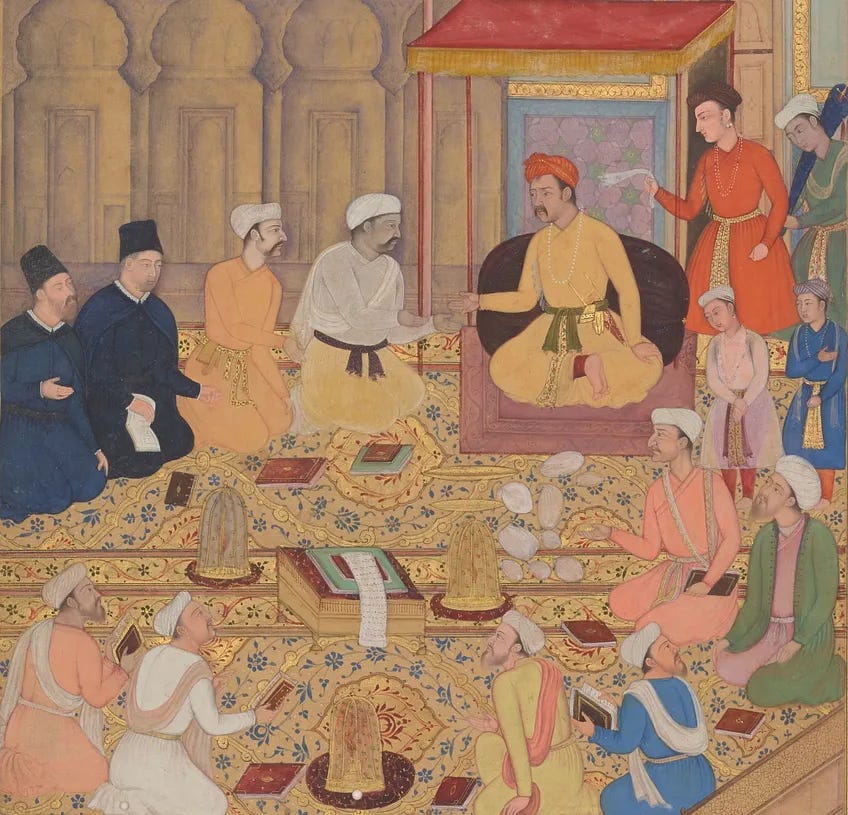
The caliph of 833 wished to seize authority over faith in order to impose a doctrine. Seven and a half centuries later, in Mughal India, a Muslim emperor seizes the same authority for the opposite reason: to protect the plurality of beliefs rather than to impose one of them. He sheds light on the Mihna as in a mirror, and from within Islam itself.
Abolishing the poll tax, opening the House of Worship
Akbar, third emperor of the Mughal dynasty, reigns from 1556 to 1605 over an empire in which Muslims are a minority within a population that is overwhelmingly Hindu. Around 1564, he abolishes the jizya, the poll tax that non-Muslims had paid since the beginnings of Islam, as well as the taxes that Hindus paid to go on pilgrimage; Richard Eaton places these measures between 1562 and 1564. He brings Hindu officers into his service, in particular Rajput princes, alongside the Muslims, and he marries Hindu princesses without requiring their conversion. What the dhimma had been, paying to remain other, ceases in part to hold good in his empire.
In 1575, in the new city he is having built at Fatehpur Sikri, near Agra, Akbar has a hall of debate constructed, the Ibadat Khana, the ‘House of Worship’. There, on Thursday evenings, he gathers Sunni Muslim scholars, then Shi’ites and Sufis, and soon Brahmins, Jains, Zoroastrians and Jesuits come from Goa, and he listens to them dispute before him. The debates among the Muslim scholars sometimes turn to insult, and the emperor draws from them, according to his chroniclers, a certain contempt for their quarrels. We know these sessions through two witnesses who do not agree: the official historiographer Abu’l-Fazl, friend and admirer of Akbar, and the chronicler ‘Abd al-Qadir Badauni, who also attended them and left a secret history of them, very hostile, in which he accuses the emperor of having abandoned Islam.
A Mihna in reverse
In 1579, the principal jurists of the court sign a deed, the Mahzar, which recognises Akbar’s right to choose between their opinions when they diverge on a question of religion, and to have applied the one he judges most in keeping with the interest of the empire. Several sign reluctantly, according to Eaton. One thinks at once of 833: like al-Ma’mun, Akbar seizes the doctrinal authority that the scholars held, and like him he obtains it by their signature. But he does not use it to impose a doctrine. He uses it to impose a policy of ‘peace with all’, the sulh-i kull, which the historian Rajeev Kinra has studied, and which consists in the state taking the side of no religion and guaranteeing to all their free exercise. The result nevertheless has its irony: the debates of the Ibadat Khana decline after the Mahzar. The sovereign’s arbitration made discussion less necessary.
Akbar’s work depends on the man who carries it. His great-grandson Dara Shukoh, eldest son of the emperor Shah Jahan, is its spiritual heir: a lettered prince and a disciple of Sufi masters, he has Upanishads translated into Persian and composes in 1655 The Mingling of the Two Oceans, Majma’ al-Bahrayn, in which he shows the deep accord between Sufism and Vedanta. In the war of succession that follows Shah Jahan’s illness, he is defeated by his brother Aurangzeb, who has him declared an apostate by an assembly of nobles and jurists, then executed on 30 August 1659. On 2 April 1679, Aurangzeb restores the jizya.
A plurality protected from above depends on the one who protects it. Akbar did what al-Ma’mun had not wished to do: he put the power of the state at the service of coexistence rather than of uniformity. But in placing the sovereign above the clerics, he made this coexistence a grace of the prince, which the next prince could withdraw. The previous article met the same fragility with the Peace of God, and one would find it again elsewhere, in the Pennsylvania of the Quakers for example: what rests on one man or on one generation survives succession poorly.
What my grid of analysis brings to light
I now take up this journey once more, from Medina to Cordoba, together with its Mughal mirror, with the tools of the first article, to which I added in the second four questions drawn from your replies: where the impulse comes from, on what scale it is exercised, whether there exists a place where one may doubt without being excluded, and what doubt costs, and to whom.
In both directions
In the first direction, from the person towards society, one sees the Prophet carry a revelation and inscribe it, at Medina, in a pact that organises common life; scholars refuse, in the name of what they hand down, what the caliph demands, from Abu Hanifa and Malik to Ibn Hanbal; Eulogius and the martyrs of Cordoba set their faith against a society that asked of them only that they keep silent; Akbar, finally, makes of his personal conviction an imperial policy. This direction is more alive here than in the previous article, because religious authority remains dispersed: there is no institution strong enough to silence the scholars who resist, and the margin where Ibn Hanbal stands ends by becoming the centre.
The second direction, from organisation towards the inner life, is nevertheless everywhere. The dhimma makes otherness pay, and the communities learn to live in self-effacement. Conversion follows interest and belonging as much as conviction, and whole peoples change religion in three centuries without anyone having compelled them to. The Mihna teaches dissimulation to those who give way. Slow assimilation, without violence, drives a minority of the Christians of Cordoba to seek death. And persecution teaches the Shi’ites to keep silent in order to survive.
The two directions cross, here as elsewhere. The revelation of Medina, an impulse of the first direction, becomes within two generations a political order in which faith and allegiance are one and the same; the resistance of Ibn Hanbal, likewise carried by a man alone, becomes an orthodoxy that excludes al-Muhasibi and that a caliph will enforce nearly two centuries later.
The four quadrants
Wilber’s map crosses the individual and the collective, the interior and the exterior, and I go through it in four moments.
At Medina, between 622 and 632, the individual interior is made up of a faith received from the very mouth of the Prophet and, for the Jews of the oasis, of a fidelity to their own Law that the pact recognises; the individual exterior, of prayers, alms and battles; the collective interior, of a new community, the umma, which thinks of itself as the people of a single G-d; the collective exterior, of a writing that regulates blood-money and common defence, then of sieges and expulsions.
From 632 to 750, from the wars of the ridda to the fall of the Umayyads, the individual interior is divided between the Kharijites’ demand for purity and the suspension of judgement of those who leave the sinner’s fate to G-d; the individual exterior is made up of taxes, paid or refused, and of conversions, accepted or held back; the collective interior sees the birth of the figure of the apostate, which confounds lost faith with broken allegiance, and, with Karbala, the memory of a martyrdom that founds Shi’ite piety; the collective exterior fills up with treaties of surrender, with army registers, the diwan, in which those entitled are inscribed, and with a fiscal system that distinguishes believers from the others.
From 833 to 859, from the Mihna to the martyrs of Cordoba, the individual interior is made up of Ibn Hanbal’s conviction, of the taqiyya of those who give way and of the desire for martyrdom at Cordoba; the individual exterior, of interrogations, chains, the lash and beheadings; the collective interior, of a word held to be eternal and of the memory of a trial that would become foundational; the collective exterior, of caliphal letters, courts and registers of answers, and, on the other side, of a crowd that gathers before the palace.
At Akbar’s court, finally, in the sixteenth century, the individual interior is made up of the curiosity of an emperor and the reluctance of the jurists who sign; the individual exterior, of debates attended on Thursday evenings; the collective interior, of a ‘peace with all’; the collective exterior, of an abolished poll tax and of a deed by which jurists hand over their authority to the prince.
The shift does not go, this time, in a single direction. Authority over faith passes from the Prophet to the caliph, then escapes the caliph to return to the scholars, before a caliph borrows it from them to impose their own orthodoxy.
The five-dimension profile
Self-transcendence remains strong and constant from one end to the other, among persecutors as among persecuted: al-Ma’mun doubts G-d no more than Ibn Hanbal does, nor Eulogius any more than the emir who has him beheaded. Self-transformation is carried by the scholars, by the first mystics, of whom al-Muhasibi is one of the masters, and by figures of piety such as ‘Umar II; it is kept under watch as soon as it takes a form that disturbs, and al-Hallaj dies of it. Concern for others is inscribed in the law, with the legal alms that are one of the pillars of Islam, but it is bounded by the status of the other, who pays to remain what he is. Rite and belonging become the gateway of conversions, since it is through belonging that whole peoples embrace Islam, and, with the ridda, the frontier of loyalty, since he who leaves it is treated as a rebel. The breadth of responsibility is in principle very wide, Islam addressing itself to the whole of humanity, but it is ordered towards a political domination, that of the domain of Islam over the peoples it subjects.
The seven questions, and the four additions
Who carries the impulse? The Prophet first, then his successors, the caliphs, then the scholars who hand down his word and become, after the Mihna, those who state doctrine; on the margins, groups that call for purity, like the Kharijites, or for equality, like the followers of al-Harith ibn Surayj. Where does it come from? At Medina, it is received, in the form of a revelation; in 833, it is decided by a sovereign; at Akbar’s court, it arises from the curiosity of an emperor and from the needs of an empire in which Muslims are a minority. Through what is it inscribed? Through a written pact, then through treaties of surrender, then through caliphal letters and registers of interrogation, and with Akbar through a signed deed. How is it applied? Through tax above all, which makes people pay for their difference without demanding conversion; through war against those who leave the allegiance; and, for sixteen years, through interrogation, prison and the lash.
What becomes of the group on the death of the one who carried the impulse? The question arises as early as 632, and the answer is threefold: on the death of the Prophet, tribes hold their pact to have lapsed and are fought; the Companions designate a successor whose religious authority would remain disputed for two centuries, until the Mihna settles the matter against him; and part of the community rejects this choice, holds ‘Ali to be the designated heir and seeks among his descendants the one who knows how to read the Book. With Akbar, the answer is brutal: the work does not survive the succession. Who opposes it? The tribes of the ridda, the Kharijites, the partisans of ‘Ali and his descendants, the rebellious Medinans whom Malik encourages, the scholars who refuse the Mihna, the martyrs of Cordoba; and, within the victorious orthodoxy itself, al-Muhasibi, placed under a ban, and al-Hallaj, who pays for his difference with his life. Who decides, and at what distance? A caliph on campaign on the Byzantine frontier, who writes to Baghdad from Raqqa and summons the scholars to Tarsus; an emir at Cordoba; an emperor who, at Fatehpur Sikri, has the jurists sign that he will decide in their place. What does the organisation do to the inner life of those who take part in it? It teaches some to dissimulate, others to resist, many to belong without asking themselves questions.
The four additions sharpen the picture. The scale passes from an oasis to an empire stretching from Spain to the Indus, and the pact of Medina, made for a few thousand people who knew one another, does not carry over to that scale: the dhimma replaces it, settling the fate of whole peoples by a status and no longer by an alliance. The place of doubt exists, and it is wider than is often said: the clause that recognises the Jews’ religion, the suspension of judgement on the sinner, disagreement among the schools of law held to be legitimate, Timothy’s discussion before al-Mahdi. It also closes, after the Mihna, and against those who had most need of it. The price of doubt, finally, varies according to who doubts. For the dhimmis, it is tax and self-effacement; at Khaybar, death for some, half the harvest for the survivors, then exile; for the scholars during the Mihna, the loss of their social standing and the flogged body; for the apostate, his life.
Arendt before the judges of Baghdad
In the previous article, I took up Hannah Arendt’s thesis that an adult who obeys in reality supports. The Mihna puts it to the test in a way Arendt had not envisaged. Most of the judges of Baghdad called the Qur’an created in order to keep their office, and many did not believe it. Their signature nevertheless made the Mihna work: it was because almost all gave way that the caliph could treat as rebels the few who refused, and send them in chains to Tarsus. Does he who speaks without believing support? Taqiyya answers that he does not, since the heart remains faithful; Arendt would doubtless answer that he does, since the regime needs only the word. The emir of Cordoba asked the same thing of Eulogius, a single word, and Eulogius, like Ibn Hanbal, understood that it would not be merely a word. The question Arendt leaves us, ‘could I go on living with myself after having done this?’, received different answers in Baghdad, and I do not believe that we can condemn all those who answered otherwise than Ibn Hanbal.
The three forces put to the test
The previous article, The bishop and the sword, concluded with three forces whose meeting makes persecution possible: an institution that wants to endure, a certainty that believes it saves, a power that goes all the way. It added that these three forces come together when the place where one may doubt without being excluded disappears. The Mihna allows this hypothesis to be put to the test. The certainty was there, that of a rational theology sure of itself, and so was the power, that of a caliph who had the army, the judges and the prisons at his disposal. The third force was missing: the caliph was alone with his theologians, facing scholars who did not depend on him, and no body could take up his cause after him. The persecution died out with the caliphs who carried it.
The hypothesis is thereby confirmed, but also refined. The will to endure does not suffice when it belongs to the sovereign alone: the institution that persecution needs must be distinct from him, in order to survive him and to give his decisions the authority of a received doctrine. The Latin Church of the thirteenth century was such an institution, with its bishops, its councils and its inquisitors; a caliph, by himself, could not be one. But the absence of such an institution does not guarantee freedom. The scholars who had stood up to the caliph closed the debate of their own accord: the doctrine they had defended became a frontier between orthodoxy and heresy, and it took only one caliph, al-Qadir, to make it law. The place of doubt therefore has two enemies, and not one: the power that decides, and the community that holds itself to be pure.
What this study does not prove
This journey lends itself to two opposite uses, and I prefer to set both aside. It does not prove that Islam is by essence tolerant, nor that it is by essence conquering, and what Islamist movements make of it today does not say what it was during these two centuries. The dhimma was not an equality, and one would be wrong to present it as a model of happy coexistence; nor was it a persecution, and one would be wrong to see in it the equivalent of the Inquisition. Conversion was not always free. The Fatimid caliph al-Hakim, in Cairo, persecutes Christians and Jews at the beginning of the eleventh century, forces many of them to convert and has the church of the Holy Sepulchre in Jerusalem destroyed in 1009; his successor then allows those converted by force to return to their religion. In the middle of the twelfth century, in al-Andalus and in the Maghreb, the Almohads leave Jews and Christians only conversion or exile, and it is before them that the family of the young Maimonides leaves Cordoba. These episodes are exceptions, but they took place.
The Mihna was not an Inquisition. John Nawas stresses that it had neither a comparable apparatus nor permanent tribunals, and that it lasted only sixteen years, against several centuries for the Inquisition. The Sahifa of Medina was not a constitution in the modern sense. Fred Donner’s thesis on ‘believers’ of several confessions is not established, and Bulliet’s curve is not exact in its detail. The ‘Pact of ‘Umar’ does not go back to ‘Umar. Ibn Hanbal’s resistance does not make him a defender of freedom of conscience: it protected tradition against the caliph, not the right of each person to think otherwise. The martyrs of Cordoba do not represent the Christians of al-Andalus, most of whom disapproved of them. Akbar was not a secular sovereign before his time, since his policy of peace with all rested on a religious authority he had had recognised in himself.
What I believe I can draw from this journey is more limited. The Muslim conquest demanded of the vanquished peoples a political submission and a tax, and it made them pay for remaining other, but it did not, on the whole, demand that they change their faith. The coercion of consciences appeared when power sought to fix the doctrine of Muslims themselves, and it failed, because no one could carry it in power’s stead. This failure left the scholars a dispersed authority, which protected disagreement among them, until they too closed it, upon an orthodoxy that a single caliph would suffice to make obligatory.
Next time: the absent king
The first three articles of this series have followed societies in which someone, bishop, emperor, caliph or emir, claimed to decide.
The next, planned for Sunday 6 December, opens in a place where no one could. In 930, on a lava plain in the south-west of Iceland, at Þingvellir, the settlers who had come from Norway gather for the first session of the Althing, an assembly without a king, where the law is recited from memory and conflicts are settled by speech, then by the duel when speech no longer suffices. The article will then go back to the judges of Israel, before the monarchy, and come down to the Barcelona of 1936 and the Rojava of our own century: societies that sought to organise themselves without a sovereign, and what became of them.
Before we meet again, I put to you three questions, which you may answer in the comments or by return email.
Have you known a community in which one could keep one’s conviction on condition of keeping it to oneself, and did that silence seem to you a protection or a submission?
Does an authority that protects plurality by its own force, as Akbar did, still seem to you a form of constraint?
What best guards the place of doubt, in your view: an authority dispersed among many scholars, or an institution able to decide and to answer for its decisions?
I shall read everything, and I shall take it into account in the following articles.
Until soon!
Jérôme Nathanaël
Main sources
The Mihna
Janine and Dominique Sourdel, Dictionnaire historique de l’islam, PUF, 1996, repr. ‘Quadrige’, 2004 (no English translation).
Tabari, The History of al-Tabari, SUNY Press, vol. 31, The War between Brothers, trans. Michael Fishbein, 1992, and vol. 32, The Reunification of the ‘Abbasid Caliphate, trans. C. E. Bosworth, 1987 (letters of al-Ma’mun).
Ibn al-Jawzi, Virtues of the Imam Ahmad ibn Hanbal, ed. and trans. Michael Cooperson, New York University Press, ‘Library of Arabic Literature’, 2 vols, 2013–2015.
Michael Cooperson, ‘Two Abbasid Trials: Ahmad ibn Hanbal and Hunayn b. Ishaq’, Al-Qantara, 22/2, 2001.
John A. Nawas, Al-Ma’mun, the Inquisition, and the Quest for Caliphal Authority, Lockwood Press, 2015.
Jacob Neusner and Tamara Sonn, Comparing Religions through Law: Judaism and Islam, Routledge, 1999 (the authority of scholars and religious law).
Patricia Crone and Martin Hinds, God’s Caliph: Religious Authority in the First Centuries of Islam, Cambridge University Press, 1986.
Christopher Melchert, ‘The Inquisition outside Baghdad’, Journal of the American Oriental Society, 141/1, 2021, pp. 201–210.
John P. Turner, Inquisition in Early Islam, I. B. Tauris, 2013.
David Bertaina, ‘Melkites, Mutakallimūn and al-Ma’mūn’, Comparative Islamic Studies, 4, 2008 (Abu Qurra’s debate).
Josef van Ess, ‘al-Muḥāsibī’, Encyclopaedia of Islam, 2nd ed., Leiden, Brill.
George Makdisi, Ibn ‘Aqil: Religion and Culture in Classical Islam, Edinburgh University Press, 1997, section ‘The Retraction and the Qadiri Creed’.
Wael B. Hallaq, ‘Was the Gate of Ijtihad Closed?’, International Journal of Middle East Studies, 16/1, 1984, pp. 3–41.
‘Ma’mun’, Encyclopaedia Iranica (the succession of 817).
David Cook, Studies in Muslim Apocalyptic, Darwin Press, 2002 (traditions of the black banners).
Etan Kohlberg, ‘Some Imami-Shi’i Views on Taqiyya’, Journal of the American Oriental Society, 95, 1975; ‘Taqiya’, Encyclopaedia Iranica; al-Bukhari, Sahih, book of jihad (hadith ‘war is deceit’), cited in the French translation by Octave Houdas and William Marçais, Les Traditions islamiques, Paris, Imprimerie nationale and E. Leroux, 4 vols, 1903–1914.
Medina and the first generations
Michael Lecker, The ‘Constitution of Medina’: Muhammad’s First Legal Document, Darwin Press, 2004.
Moshe Gil, ‘The Constitution of Medina: A Reconsideration’, Israel Oriental Studies, 4, 1974.
Uri Rubin, ‘The “Constitution of Medina”: Some Notes’, Studia Islamica, 62, 1985.
Saïd Amir Arjomand, ‘The Constitution of Medina’, International Journal of Middle East Studies, 41, 2009.
R. B. Serjeant, ‘The Sunnah Jami’ah, Pacts with the Yathrib Jews, and the Tahrim of Yathrib’, Bulletin of the School of Oriental and African Studies, 41, 1978.
W. N. Arafat, ‘New Light on the Story of Banu Qurayza and the Jews of Medina’, Journal of the Royal Asiatic Society, 1976.
Suleiman A. Mourad, ‘Ibn Qayyim al-Ǧawziyya on the Question of Permanent Truce’, Transmediterranean History, 8/1, 2026.
Ibn Ishaq, The Life of Muhammad: A Translation of Ishaq’s Sirat Rasul Allah, recension of Ibn Hisham, trans. A. Guillaume, Oxford University Press, 1955.
Mohammad Ali Amir-Moezzi and Christian Jambet, What is Shi’i Islam? An Introduction, trans. Kenneth Casler and Eric Ormsby, Routledge, 2018.
Nahj al-Balagha (The Peak of Eloquence), bilingual edition, Beirut, Dar al-Kitab al-Lubnani, 2nd ed., 1989 (sermon 125, on the arbitration).
The conquest, conversion and the dhimma
Robert G. Hoyland, Seeing Islam as Others Saw It, Darwin Press, 1997.
Bernard Lewis, ‘An Apocalyptic Vision of Islamic History’, BSOAS, 13, 1950.
John of Nikiu, The Chronicle of John, Bishop of Nikiu, trans. R. H. Charles, Text and Translation Society, 1916 (the conquest of Egypt and the patriarch Cyrus).
Daniel C. Dennett, Conversion and the Poll Tax in Early Islam, Harvard University Press, 1950.
Richard W. Bulliet, Conversion to Islam in the Medieval Period, Harvard University Press, 1979.
Fred M. Donner, Muhammad and the Believers, Harvard University Press, 2010.
Milka Levy-Rubin, Non-Muslims in the Early Islamic Empire, Cambridge University Press, 2011.
Mark R. Cohen, Under Crescent and Cross: The Jews in the Middle Ages, Princeton University Press, 1994.
The New Cambridge History of Islam, vol. 1, Cambridge University Press, 2010, chapter ‘Conversion and the ahl al-dhimma’.
Patricia Crone, ‘No compulsion in religion: Q. 2:256 in mediaeval and modern interpretation’, in Le Shi’isme imamite quarante ans après, Brepols, 2009, pp. 131–178.
Paul Alvarus, Vita Eulogii (the arrest and death of Eulogius, Leocritia).
Kati Ihnat, ‘The Martyrs of Córdoba’, History Compass, 2020; Kenneth Baxter Wolf, The Eulogius Corpus, Liverpool University Press, 2019.
Hans Putman, L’Église et l’islam sous Timothée I (780-823), Beirut, Dar el-Machreq, 1975 (Arabic version of the dialogue; no English translation); Alphonse Mingana, ‘The Apology of Timothy the Patriarch before the Caliph Mahdi’, Woodbrooke Studies, 2, 1928 (Syriac text and English translation).
John Tolan, Saint Francis and the Sultan: The Curious History of a Christian-Muslim Encounter, Oxford University Press, 2009 (Damietta, 1219).
Akbar
Richard M. Eaton, India in the Persianate Age, 1000–1765, Allen Lane, 2019.
Rajeev Kinra, ‘Revisiting the History and Historiography of Mughal Pluralism’, ReOrient, 5/2, 2020, pp. 137–182.
‘Akbar’ and ‘Abu’l-Fazl’, Encyclopaedia Iranica.
Daryush Shayegan, Hindouisme et soufisme. Une lecture du « Confluent des deux océans », Albin Michel, 1997 (with a French translation of Dara Shukoh’s text; no English translation).
Contemporary extensions
Frères musulmans et islamisme politique en France (The Muslim Brotherhood and political Islamism in France), report submitted to the French government, May 2025.
Washington Institute for Near East Policy, ‘Between Hudna and Crackdown: Assessing the Record of Hamas Ceasefires’ (Ahmed Yassin’s truce proposals).
Khalid Sheikh Mohammed et al., ‘The Islamic Response to the Government’s Nine Accusations’, exhibit D-101, military commission at Guantánamo, March 2009.
© 2026 – Dialogues of the New World — Jérôme Nathanaël


The Waymakers’ space
This space below is reserved for free or paid subscribers to the publication. It is not visible to non-subscribers.
... ... ... ... ... ...
Join us
Are you discovering this publication and do you feel drawn to its approach? I invite you to read the Opening page, which presents the author and the project, then to subscribe, free or paid. You will thus gain access to The Waymakers community: direct communication between subscribers through the Chat and its thematic forums, as well as the possibility of exchanging with the author by email or video.
