

Article disponible en français
The World We Cross · New World · 72 min
To open up perspectives, test out possibilities, seek forms of life more fit to be inhabited.

Series ‘Spirituality and the organisation of societies’ · Article 2 of 6
What the inner life does to societies, what societies do to the inner life.
If this article is your first encounter with the series. The first article poses the question that carries all six: what link is there between the spiritual development of persons and the way a society organises itself, and does this link run in both directions, from the person towards society as from society towards the inner life? It formulates two hypotheses that I seek to test rather than to demonstrate, defines what I mean by spirituality (a threshold, the quest for meaning, then five dimensions), and sets out the method applied to each case: Ken Wilber’s four quadrants and seven questions. I refer back to these passages whenever the argument assumes them to be known, and each of them can be read in a few minutes.
In this article:
A man in chains writes to the Churches
After the persecutions, the lapsed and the pure
When the emperor enters the Church
Augustine, or constraint become charity
The blessed sword, from the Peace of God to Clermont
From the ‘good men’ to the Inquisition
Francis of Assisi, the other way
What my grid of analysis brings to light
‘Follow the bishop, all of you, as Jesus Christ follows his Father, and the presbytery as the apostles. [...] Wherever the bishop appears, there let the community be, just as wherever Christ Jesus is, there is the Catholic Church.’
Ignatius of Antioch, Letter to the Smyrnaeans, 8
A man in chains writes to the Churches
Seven letters from a condemned man
At the beginning of the second century, according to the tradition that places this episode in the reign of Trajan, a bishop of Antioch named Ignatius crosses Asia Minor under military escort, condemned to die in the arena at Rome. He is chained to ‘ten leopards’, as he will soon write, that is, to a detachment of soldiers who grow worse the better they are treated. At Smyrna, where the convoy halts, his guards allow the bishop of the city, Polycarp, to come to him, together with the delegates whom several neighbouring communities have sent to meet the prisoner, among them the bishops of Ephesus, Magnesia and Tralles. He entrusts them with letters for their Churches, then writes another to the Christians of Rome, the only one to bear a date, a 24 August (the ninth day before the calends of September) whose year is not given. Further on, at Troas, before taking ship, he writes again to the communities of Philadelphia and of Smyrna, and to Polycarp himself. Seven letters in all, written by a man who is going to die and knows it, who even desires it, since he begs his brethren in Rome to attempt nothing to save him.
‘Do nothing without the bishop’
These letters all say the same thing, with an insistence that strikes the reader of today: do nothing without the bishop. One must follow the bishop as Jesus Christ follows his Father, respect the presbyters as though they were the council of the apostles, and revere the deacons as one reveres the commandment of G-d. The presbyters, from the Greek presbyteroi, ‘the elders’, whence our word ‘priest’, form around the bishop a college of those responsible for the community; the deacons, from the Greek diakonoi, ‘the servants’, assist him in worship and in the care of the poor. Ignatius thus requires that no eucharist, no baptism and no fraternal meal ever be celebrated without the bishop or without the one to whom the bishop has entrusted the task; and he who does anything without his knowledge, adds the letter to the Smyrnaeans, is rendering worship to the devil.
The reason Ignatius gives for this requirement is to avoid division, ‘the beginning of evils’, and the adversary he names is a group of Christians who would later be called the Docetists, for whom Christ had only the appearance of a body and therefore neither suffered nor truly rose again. For Ignatius, this doctrine ruins the meaning of the torment that awaits him in Rome: if Christ suffered only in appearance, he writes, then it is also in appearance that he himself is in chains, and this martyrdom, which he desires as an imitation of the Passion, no longer means anything; he reproaches these Christians, moreover, with abstaining from the eucharist and from prayer, because they do not recognise in it the flesh of the Saviour.
A word received from on high
What gives me pause in these letters is less this demand for unity, understandable in a man who feels himself threatened and fears for his Church, than the manner in which Ignatius grounds it. We already stand before a doctrinal rejection; but the graver matter is that he claims to ground this rejection, and above all a hierarchy, on a word that the Spirit is supposed to have dictated to him. In his letter to the Philadelphians, he relates that during his visit he cried out in the midst of the assembly, ‘with the voice of G-d.’: ‘Hold fast to the bishop, to the college of presbyters and to the deacons.’ Some suspected him of having spoken thus because he knew in advance of the divisions in the community; he replies that he did not learn it ‘from the flesh of any man’, and that it was the Spirit who proclaimed: ‘Do nothing without the bishop.’ Obedience to the bishop thus presents itself, in his writing, not as a rule of organisation that the community might have decided upon, but as a word received, which places it beyond the reach of discussion.
Ignatius has no power of constraint at his disposal: he asks only that the Docetists not be received, that prayers be offered for their return, and that their very names not be remembered until they repent; but the logic that will later make the Inquisition is already in place: a supernatural validation that is not open to discussion, and that leaves disagreement no outlet but repentance and submission. A reader of the first article had pointed out to me that my definition of spirituality did not leave enough room for the irruption of the supernatural, for a word that comes without having been sought; we find here, from the first Christian generations onwards, the example of a word presented as received, but used to ground a hierarchy and to exact obedience.
Those who asked: ‘Where is it written?’
The same letter to the Philadelphians preserves the trace of those who resisted. Some, Ignatius reports, said: ‘If I do not find it in the original documents (in Greek archeia, the ancient records that are authoritative, of the same family as archè, “beginning” and “authority”), I do not believe it in the Gospel’, and when he countered with ‘It is written’, they answered him: ‘That is precisely the question.’ They were not merely demanding a verification, they were contesting a reading: what do these documents say, doubtless the Scriptures of Israel, and who is qualified to say it? Ignatius does not answer on that ground. He declares: ‘My original documents are Jesus Christ; my inviolable documents are his cross, his death, his resurrection and the faith that comes through him.’ The meaning of Scripture is henceforth borne by a person, and in the logic of these letters it is the bishop who guarantees its right reading: the question ‘where is it written?’ becomes superfluous.
The Jewish masters kept the minority opinion
The measure of this shift can be taken by looking at what the Jewish masters were doing at the same moment, provided one does not go too fast. The Judaism of the end of the first and the beginning of the second century was not a monolith, and what we know of its debates comes to us from later texts: the Mishnah, set down in writing around 200, and the two Talmuds, of the fourth to sixth centuries. They report controversies of earlier generations, among them those of masters contemporary with Ignatius, such as Eliezer ben Hyrcanus, Joshua ben Hananiah or Gamaliel II, gathered at Yavneh after the destruction of the Temple in 70 and the repression of the first revolt against Rome. These texts show a constant practice: controversy is recorded in them, the names of those who disagree are preserved, and the minority opinion is handed down together with that of the majority, the Mishnah (Eduyot 1:5) explaining that this is so that a later court, should it see fit, may rely upon it. The common rule is decided by the majority, and disagreement remains inscribed in the tradition.
The story of the oven of Akhnai (Bava Metzia 59b) offers the illustration closest to the scene at Philadelphia: Rabbi Eliezer, left alone in upholding his opinion against the majority, calls forth wonders, then a heavenly voice that declares him right. But Rabbi Joshua ben Hananiah answers him with Deuteronomy (30:12), ‘It is not in heaven’, that is to say that the Torah, once given, belongs to the interpretation of men, and that the heavenly voice has no business deciding. The text adds that G-d is said to have smiled: ‘My sons have defeated me.’ Ignatius, for his part, answers those who say ‘that is the question’ that his documents are Christ himself, having authorised himself, a few lines earlier in the same letter, by a word that the Spirit is supposed to have dictated to him. The sages of the story, on the contrary, deny the voice from heaven the right to decide in place of the majority.
It would be wrong to idealise, and the story itself does not allow it. It ends with the excommunication of Eliezer, not for his opinion, which continues to be handed down (the Mishnah and the Talmud record many of his views), but for having refused to bow before the decision of the majority. Rabban Gamaliel, who pronounces it in the name of the assembly of sages, says that he did so ‘so that disputes may not multiply in Israel’. The same story nevertheless shows what this sanction costs: Eliezer’s tears are enough to reach the world, a third of whose olives, wheat and barley are spoiled, and Gamaliel himself dies soon afterwards, for, says the tradition that Eliezer’s wife, Gamaliel’s sister, reports from her family, the gates of heaven always remain open to the prayer of the one who has been wronged.
The first Christian assemblies, too, knew how to deliberate. The Acts of the Apostles (chapter 15) report, around the year 49, a meeting in Jerusalem at which Paul and Barnabas confront those who demand the circumcision of non-Jewish converts. After a heated discussion, Peter and then James, whom Paul calls ‘the brother of the Lord’ (Galatians 1:19) and who was then leading the Church of the city, secure the adoption of a common solution. Luke doubtless idealises the scene, of which Paul gives a more strained version in his letter to the Galatians, but it shows a group that settles matters by deliberating. The comparison therefore traces a slope, not a fatality: each time an institution settles a disagreement by power rather than by discussion, the space for doubt narrows, from the exclusions of the early days to the Inquisition.
Two excommunications, Jewish and Christian
It remains to measure what the same word, excommunication, covers in the two worlds, Jewish and Christian. As the rabbinic texts, which are later, describe it, Jewish excommunication, the niddui, is a court procedure: the person is summoned, warned several times, kept at a distance for at least thirty days, and a harsher sanction, the herem, comes only after two months of obstinacy; it is lifted as soon as the person concerned mends his ways (Moed Katan 16a). Its grounds almost all have to do with obedience to the court and the respect owed to the masters, which is what the tradition reported concerning Eliezer says: ‘because he had not accepted the decision of the majority’, they ended by ‘blessing’ him, a euphemism for excommunicating him (Berakhot 19a). But what must above all be noticed is that it does not take away belonging: even when Israel has sinned, it remains Israel (Sanhedrin 44a).
Christian excommunication also aims, first of all, at the return of the offender, but its reach is of another order. It bars him from the eucharist, and therefore from what makes the Church and belonging to the community, and Cyprian of Carthage would write in the middle of the third century that outside the Church there is no salvation. It attaches itself more and more to belief itself: from the middle of the first century, Paul pronounces anathema on whoever should preach another gospel (Galatians 1:8–9), and a letter placed under his name, perhaps contemporary with Ignatius, asks that the ‘factious man’, the hairetikos, from which the word ‘heretic’ will come, be set aside after two warnings (Titus 3:10).
This difference is in no way a law of nature: the Jewish world, too, would later know exclusions for opinions. But from the time of Ignatius, it separates an exclusion that sanctions the breach of a common rule from an exclusion that is beginning to sanction what one believes. The latter as yet has no weapon but refused communion; in the fourth century it will find support in public power, and that is what the rest of the story tells.
A reservation about the date of these letters
A reservation about dates is needed to close this episode. The traditional date of Ignatius’s letters, around 110, rests on Eusebius of Caesarea, who was writing two centuries later, and the historian Timothy Barnes argued in 2008 that they were written rather in the 140s. Barnes does not contest their authenticity, which the majority of scholars accept for the seven letters of the so-called middle recension, and which only a minority doubts. One fact remains, whatever date is adopted: the letter to the Romans is the only one in which Ignatius mentions no bishop and does not urge obedience to one. What he was asking for was doubtless not yet the rule everywhere.
Before the bishop, assemblies
Houses, meals, the poor
To measure what Ignatius is asking, one must look at what these communities were a few decades earlier, and on this point we have an unexpected witness, a Roman governor. Around 112, Pliny the Younger, governor of Bithynia, on the southern shore of the Black Sea, writes to the emperor Trajan to ask him how to deal with the Christians denounced to him. Those he has questioned have explained to him that they met on a fixed day, before dawn, to sing in alternation a hymn to Christ ‘as to a god’, and bound themselves by oath, not to commit some crime, but to abstain from theft, robbery, adultery and breach of trust; they would then part, and meet again for an ordinary and harmless meal, which they had ceased to take after the governor’s edict forbidding associations. To learn how matters really stood, Pliny had had ‘two maidservants who were called ministrae’ tortured, the Latin word that renders the Greek diakonoi, and had found, he writes, nothing but an unreasonable and immoderate superstition.
This police report says in a few lines what Christian texts confirm elsewhere: groups small enough to fit in a house, mixing slaves and free men, men and women, and in which women, here slaves, exercise a recognised ministry, like Phoebe, whom Paul, fifty years earlier, had commended to the Romans, calling her diakonos of the Church at Cenchreae. The Acts of the Apostles describe the first community of Jerusalem holding its goods in common; the author, Luke, presents this picture as an ideal, and we do not know how far it was practised, nor for how long.
The care of widows, orphans and the poor, on the other hand, is attested everywhere and very early. Acts, in chapter 6, tells of the quarrel that arose over the daily distribution to widows; Justin describes, around 155, a collection whose proceeds go to orphans, widows, the sick, prisoners and strangers passing through; Tertullian, at the end of the second century, speaks of a common chest fed by voluntary gifts, which serves to feed and bury the poor and to support orphans and the old. Hostile witnesses confirm it, ironically: Lucian of Samosata, around 165, mocks the Christians who surround their imprisoned leader with care and let themselves be taken in, he says, by the first charlatan who comes along. This trait would strike, finally, two and a half centuries after Pliny’s letter, the most determined adversary of Christianity, the emperor Julian, whose letter we shall come upon further on.
Electing one’s leaders, and deposing them
Let us take a step back, by a generation or two before Ignatius. At that time, communities appointed their own leaders. The Didache, a manual of Christian life that most scholars date to the end of the first or the beginning of the second century, says so plainly: ‘Elect for yourselves bishops and deacons worthy of the Lord, men who are gentle, free from the love of money, truthful and proven.’ The word episkopos, whence ‘bishop’, still designates an overseer, one of those responsible for a community, and not the sole head of a city.
Around 96, according to the most common dating, that is, some fifteen years before the letters of Ignatius if one keeps to their traditional date, the Church of Rome writes to that of Corinth, a great port city of Greece where Paul had founded a community more than forty years earlier, and whose divisions he had already had to calm in his first letter (1 Corinthians 1:10–12). The text bears no author’s name: tradition attributes it to Clement, whom later lists count among the first bishops of Rome, but who speaks here in the name of the whole Church and not in his own. Part of the Corinthians have deposed their presbyters, and Rome asks that they be reinstated. The letter explains that the apostles instituted leaders and provided for their succession, and that those appointed by them, or afterwards by other eminent men, ‘with the consent of the whole Church’, and who have served blamelessly, cannot be driven from their ministry. Two details matter here. Clement uses ‘bishops’ and ‘presbyters’ interchangeably, and he names no single bishop, either at Corinth or at Rome. And he reduces the event to the ‘sedition’ of ‘one or two persons’, whereas it must have taken a considerable part of the community to depose its elders. What we are reading, then, is the version of the Church that condemns; the Corinthians’ version is lost.
This letter seems to me to mark a threshold. The consent of the whole Church remains the condition of an appointment, but it no longer suffices for a removal: once established, a blameless leader can no longer be deposed by the assembly, and another Church, that of Rome, intervenes to say so. Order comes before choice.
An intermittent persecution, always possible
Let us return to Pliny’s letter, from which we read above what it teaches us about these communities. If he asks Trajan’s advice, it is because he had never, he says, attended a trial of Christians, and did not know whether the mere name of Christian should be punished or the crimes attached to it. For want of a rule, he followed his own practice: he asks the accused, three times, whether he is a Christian, threatening him with punishment, and has those who persist executed, Roman citizens being sent to Rome to be tried there. The names come to him first from an anonymous writing, then from people who say they had been Christians and are so no longer, and who, to prove it, invoke the gods, offer incense and wine before the emperor’s image and curse Christ. Trajan replies that Christians are not to be sought out, but that those who are denounced and refuse to sacrifice to the gods are to be punished; he also rejects anonymous denunciations, as setting, he says, a detestable example and no longer belonging to our age.
Persecution is therefore intermittent and local, but always possible, and it depends to a great extent on what neighbours and former members are willing to say. In these conditions, an internal disagreement can become deadly: an angry dissident can denounce, a division can betray the community to the authorities. Clement, some fifteen years earlier, opened his letter to the Corinthians by apologising for his delay on account of ‘sudden and repeated’ events, which are often connected with a persecution under Domitian, though without certainty. Ignatius, for his part, writes in chains, and his fear of division has something vital about it. This is the second direction of our question, the one that goes from society to the inner life, which I described in the first article: the external threat drives the group to close ranks, and unity becomes a spiritual value.
After the persecutions, the lapsed and the pure
Decius, the lapsed and Novatian
The letters of Ignatius and that of Clement show a Church that demands unity without possessing any means of enforcing it: its only weapons are the word, refused communion and the fear of G-d. Nearly two centuries go by before it meets a secular power able to lend its force to its sentences, and these are two centuries of persecutions, sometimes local, like the one Pliny evokes, sometimes extended to the whole Empire, like those of Decius in 250 and of Valerian in 257, the latter aimed above all at bishops and assemblies.
In 250, the edict of Decius orders all the inhabitants to sacrifice to the Roman gods for the welfare of the emperor and to obtain a certificate of it from local commissions: this is to take up on a grand scale the test that Pliny already imposed, and for a Christian, to offer incense or to taste meat sacrificed to idols is to deny Christ. Many give way, from fear of torture or confiscation, and a few buy a certificate without having sacrificed; they are called the lapsi, ‘the fallen’, or the lapsed. Others continue to confess their faith in Christ before the magistrates, at the cost of prison, torture or exile, and survive: these are the confessors, whom their brethren venerate almost on a par with the martyrs.
When calm returns, in 251, it must be decided whether the lapsed may come back to the eucharist, after what penance, and who is to judge. The confessors, strong in their prestige, issue letters of peace that count as pardon. Cyprian, bishop of Carthage, accepts that the lapsed be reconciled after penance, but he insists that it be the bishops, gathered in council, who decide, and not the confessors, who in his view are arrogating to themselves a power that is not theirs.
In Rome, Bishop Fabian died a martyr in January 250, and the see remained vacant for more than a year; during that time a learned priest, Novatian, drafts the letters that the Roman clergy address to the other Churches. When Cornelius is elected, in the spring of 251, Novatian contests the election and has himself consecrated in turn by three bishops of Italy. His position is rigorist: the lapsed may do penance all their lives and commit themselves to the judgement of G-d, but the Church, which must remain holy, has no power to restore communion to them. Cornelius gathers a synod of some sixty bishops, which opens the way of penance to the lapsed and excommunicates Novatian, and the schism is consummated. His followers will form for several centuries a distinct Church, whose members called themselves ‘the pure’, katharoi in Greek, with no link but the name to the Cathars whom we shall meet further on.
Those who had handed over the Scriptures
The question would return in another form after the persecution of Diocletian, the last and the most violent. The emperor’s first edict, in February 303, orders the churches to be destroyed and the holy books to be handed over to the magistrates to be burnt, and some bishops and clergy obey; they will be called traditores, from the Latin tradere, ‘to hand over’, whence our word ‘traitor’. Now these books are, for Christians, the very word of G-d, and to hand them over is a betrayal that many equate with the denial of the lapsed. Can such men be forgiven, and can they still consecrate other bishops? In North Africa, this question sets off a crisis so grave that one of the parties will end by appealing to the arbitration of the emperor.
In 311 or 312, on the death of Mensurius, bishop of Carthage, his archdeacon Caecilian is elected to succeed him. Part of the city’s Christians, supported by the bishops of Numidia, refuse to recognise him, on the grounds that one of those who consecrated him is said to have been a traditor. For these opponents, the Church must be a community of saints, and the sacraments given by an unworthy bishop are without value: they therefore elect another bishop, Majorinus, who is soon succeeded by Donatus, who will lead the rival Church of Carthage for more than thirty years and give the movement his name. The Donatists, as they will be called, will likewise regard themselves as the pure Church, the Church of the martyrs, rebaptising those who join them from the other communion, and will form in North Africa a powerful Church facing the one that remains in communion with Rome and the rest of the Empire, which is called Catholic.
When the emperor enters the Church
Constantine called in as arbiter, in 312
In October 312, Constantine enters Rome after his victory at the Milvian Bridge, and at once favours the Church, to which he has its property restored; at the beginning of 313, he comes to an agreement at Milan with Licinius, his colleague in the East, to guarantee Christians freedom of worship. It is the Donatists who, in April 313, turn to him to ask him for judges. The emperor refers the matter to a synod of bishops gathered in Rome in October 313, which finds for Caecilian; the opponents appeal, and a broader council, meeting at Arles in August 314, finds against them once more; they appeal again to the emperor, who decides the matter himself in November 316. A law, now lost, then orders them to hand over their churches to the Catholics, and the coercion lasts from 317 to 321, until Constantine, absorbed by his rivalry with Licinius and faced with the failure of the repression, orders the Donatists to be left in peace.
What is usually remembered of this episode is that it was the emperor who meddled in the affairs of the Church. What is forgotten is that it was the divided Church that went to fetch him. The disagreement that Christians could no longer settle among themselves was brought before public power, and public power, once seized of the matter, settled it in its own fashion.
Arius, Nicaea, and the emperor who decides
In the next affair, no one calls on him. At Alexandria, the priest Arius teaches that the Son is a creature of the Father, and therefore inferior to him; his bishop has had him condemned, the quarrel spreads across the whole East, and Constantine, who in 324 has just defeated Licinius and reunited the Empire under his sole authority, himself convenes a council of bishops at Nicaea, in 325. The council condemns Arius and defines the faith that will be called Nicene, that of a Son ‘of one substance’ with the Father, which remains at the heart of the creed of most Christian Churches; the emperor doubles this religious sanction with political penalties: he exiles Arius, and orders by letter that his writings be burnt, the penalty of death threatening anyone who should hide a copy. In the Donatist affair, he had been solicited and the dispute concerned the legitimacy of a bishop; here, he takes the initiative, and the disagreement concerns what one must believe about Christ.
‘What has the emperor to do with the Church?’
A generation later, the emperor Constans, son of Constantine, who then reigns over the West, attempts in his turn to restore unity in Africa. Around 347, he sends two commissioners there, Paul and Macarius, charged with distributing alms to the Churches and to the poor in order to win the Donatists over to reconciliation. Donatus receives them with a question reported by Optatus of Milevis, the Catholic bishop who would write against his party: ‘What has the emperor to do with the Church?’ He refuses the gifts, and forbids his followers to accept them. The mission turns into repression: at Bagai, in Numidia, the soldiers of Macarius massacre the Donatists gathered around their bishop, the leaders of the party are exiled, and Donatus himself will die in exile a few years later. The Donatists will keep from this ‘time of Macarius’ the memory of a new persecution, carried out this time by Christians.
Donatus’s question is a just one, and it is indeed the question this whole article asks: by what right should public power decide what one must believe, or who is worthy to be a bishop? But it came late. Thirty years earlier, it was his own party that had asked Constantine for judges, then appealed to him against the sentence of the bishops. Those who had brought the emperor into the quarrel challenged his competence only from the moment he found against them, and a competence one has oneself acknowledged cannot be taken back at will. They would show this again, moreover, in 362, when they solicited from Julian, the emperor who had renounced Christianity, the return of their exiles and the restitution of their churches, something Augustine would not fail to reproach them with. It must be added, in fairness, that their adversaries never asked the question: they had the emperor on their side, and they would keep him there, right up to the edicts of Honorius that Augustine would end by justifying.
A state faith, and Martin at Trier
In 380, by the edict of Thessalonica, the emperor Theodosius makes the faith defined at Nicaea the religion of the Empire, and the other Christian confessions become heresies in the eyes of the law. Some five years later, at Trier, a Spanish ascetic named Priscillian, who had become bishop of Ávila and been accused by other bishops of suspect teachings, is tried by the court of the emperor Maximus, condemned for sorcery and beheaded together with several of his companions. He is held to be the first Christian put to death by Christians for heresy. Legislation would thereafter never cease to grow: the Theodosian Code, promulgated in 438, which gathers the imperial laws since Constantine, devotes several dozen texts to heretics, and some of them provide for the confiscation of their property.
There were protests, and they must be looked at closely. Martin, bishop of Tours, was at Trier during the proceedings and had obtained from the emperor the promise that no blood would be shed; the promise was broken after his departure. Ambrose of Milan refused communion to Ithacius, the accusing bishop, and Pope Siricius rebuked the emperor. But these protests bore above all on competence: a secular court had no business judging a cause of the Church, nor had blood any business being shed over a question of faith. They did not defend Priscillian’s right to think otherwise. Martin himself, in order to obtain pardon for other condemned men and an end to the prosecutions in Spain, ended by resuming communion with the bishops responsible, and his biographer Sulpicius Severus reports that he thereafter avoided every assembly of bishops. The place of doubt therefore still exists, but within the institution, in the conscience of a few, and it gives way before power.
Augustine, or constraint become charity
From persuasion to constraint
The most illuminating case remains that of Augustine, bishop of Hippo, on the coast of present-day Algeria, who confronted the Donatists for more than twenty years. He told it himself. In 408, in a long letter to Vincent, bishop of a small dissident community, he acknowledges that he had at first thought that no one should be compelled to the unity of Christ, that one should act by the word, fight by discussion and conquer by reason, for fear of filling the Church with false converts. The emperor Honorius had issued in 405 an edict of unity against the Donatists, which the Catholic bishops, Augustine included, had not asked for in that form. But Augustine saw whole towns return to the Catholic Church out of fear of the imperial laws, and converts tell him of their gratitude at having been driven to it; it is these facts, he writes, that made him change his mind.
He draws a doctrine from it. The master of the house in the parable, he recalls, says to his servants: ‘Compel them to come in’ (Luke 14:23), and what must be considered when one compels someone is not the fact of compulsion, but the nature of what one compels him to, whether good or evil. After the conference of Carthage in 411, at which the Donatists are condemned, an edict of January 412 outlaws them, confiscates their property and exiles their leaders.
I return here to Max Weber, whose lecture of 1919 opened the first article. Weber set against the ethic of conviction, which judges the act by the purity of the intention, the ethic of responsibility, which answers for the consequences. Augustine changes his mind in the light of the consequences, and his doctrine of constraint has every appearance of an ethic of responsibility: he judges constraint by its fruits. But the responsibility he takes upon himself concerns the salvation of others, and it is this shift that makes it formidable. He who holds himself responsible for his neighbour’s soul may impose anything on him, since the stakes exceed his life. Augustine himself nevertheless stops at the threshold of blood: he never wanted the death of the Donatists. In 412, when bands of their party had killed one Catholic priest and mutilated another, he begs the imperial commissioner Marcellinus not to apply the death penalty to the guilty. But the argument outlives the moderation of the man who formulated it.
From Gratian to the morality police
The reasoning, for its part, enters the law. Around 1140, the monk Gratian composes the Decretum, which would serve as the basis of the law of the Church for centuries, and takes up in it at length Augustine’s letters on the coercion of heretics; the jurists of the Inquisition would draw on them in their turn. In 1685, the year in which Louis XIV revokes the Edict of Nantes, Philippe Goibaut du Bois, translator of Augustine’s letters, publishes in Paris two of them, accompanied by his commentary, under a title that says by itself the use then made of the bishop of Hippo: Conformité de la conduite de l’Église de France pour ramener les protestants, avec celle de l’Église d’Afrique pour ramener les donatistes à l’Église catholique (The conformity of the conduct of the Church of France in bringing back the Protestants with that of the Church of Africa in bringing back the Donatists to the Catholic Church). The following year, the Protestant Pierre Bayle, a refugee in Rotterdam, replies with a Philosophical Commentary on these words of Jesus Christ: ‘Compel them to come in’, one of the first modern pleas for freedom of conscience.
Reduced to its essentials, the argument fits into a few words: I possess the truth, your true good is to adhere to it, the constraint I impose on you is therefore a charity, and you will thank me for it later, as those converts thanked Augustine. One finds it again without G-d in Rousseau, for whom whoever refuses to obey the general will shall be compelled to do so by the whole body, ‘which means nothing other than that he will be forced to be free’, then in the regimes of the twentieth century that re-educated their opponents for their own good. One finds it again with G-d in Iran, where the Islamic Republic has charged a morality police with enforcing the veil in the name of the religious duty of commanding good and forbidding evil, and where Mahsa Amini died in September 2022, three days after her arrest for a veil judged to be improperly worn. One finds it again, more broadly, wherever, in political Islam as elsewhere, the state makes itself the guardian of faith.
I do not claim that Augustine engendered these regimes: they have their own sources, and the Iranian doctrine draws on the Islamic tradition, not on a Latin bishop. I observe that he gave this argument, in our history, its most finished form, and that the Church, by holding him to be a saint and a doctor, handed it down with the authority of sanctity. Everything turns on the question of who decides the good of the other: as soon as it is no longer the other himself, doubt becomes a fault, and he who doubts a sick man to be cured.
What the emperor Julian envied the Christians
In 362, almost half a century before Augustine’s letter to Vincent, the same Julian whom the Donatists solicited that very year writes to the high priest of Galatia, Arsacius, to ask him to open hostels in every city and to distribute grain to strangers and beggars. For it is shameful, he writes, that no Jew should beg, and that ‘the impious Galileans feed not only their own poor but ours as well’. At the very moment when the Church is learning to use the law against its dissidents, its greatest adversary envies the charity of its faithful. The two things are true together, and neither cancels the other.
The blessed sword, from the Peace of God to Clermont
The Peace of God, or restraining the warriors
Six centuries later, the Western Roman Empire has disappeared, and power has been scattered among lords who hold castles and men-at-arms. In 989, at Charroux, in Poitou, a council of bishops gathered around the archbishop of Bordeaux strikes with anathema those who plunder churches, rob peasants or strike unarmed clerics. This is the beginning of what would be called the Peace of God, then the Truce of God, which forbids fighting on certain days. The Church attempts to restrain the violence of the warriors through religious demand, which belongs to the first direction of our question, from spiritual demand towards social organisation; but it does so less through education and example than through condemnation, while waiting to take up arms.
Historians do not agree on what this movement was. For Georges Duby and the school of the ‘mutation of the year 1000’, it was a response to a collapse of public order; for Dominique Barthélemy, this reading stems from a ‘source effect’, the monastic chronicles dramatising a disorder that was above all the continuity of a society of lords. I am in no position to settle the matter, and I retain only that a bishop of that time, Adalbero of Laon, describes around 1030 a society divided into three orders, those who pray, those who fight and those who work, each in his place and each necessary to the others. The social order now becomes an order willed by G-d, and it will be upheld by those who arrogate to themselves the right to speak in his name.
The word anathema then carried a weight that we have lost. The most solemn form of excommunication, pronounced by the assembled bishops, it cuts the guilty man off from the community of the faithful. He may no longer receive the sacraments or enter the church, Christians must avoid eating with him or greeting him, and if he dies in that state, he will not be buried in consecrated ground. The formulas of that time consign him to hell, but they almost always set a condition, and the canons of Charroux repeat: unless he comes to make amends. Rather than a damnation, which G-d alone could pronounce, the anathema is a threat, which is lifted as soon as the lord restores what he has taken, does penance and swears the peace, often on the relics that the monks have carried in procession to the place of the council.
The Church has a heavier weapon still, which strikes no longer a person but a territory, and which would later be called the interdict. In 1031, according to the account of the monk Adhemar of Chabannes, whose reliability is disputed, a council gathered at Limoges threatens the whole Limousin with a ‘general excommunication’ if its knights do not swear the peace: no more Mass, no more bells, no more Christian burial. The bishops throw their lighted candles to the ground, and the congregation cries out: may G-d likewise extinguish the joy of those who refuse justice and peace. To reach the lord, the sanction is made to weigh on those he governs. The Gregorian reform would go further and reach fealty itself. In 1075, Gregory VII sets down among the prerogatives of the pope that of absolving subjects from their fealty to the unjust; the following year, he excommunicates King Henry IV, the future emperor, and releases from their oath all those who have sworn fealty to him, so that Henry must come, in January 1077, and stand for three days barefoot, in a penitent’s habit, before the castle of Canossa, to obtain the lifting of a sentence that deprived him of his kingdom as much as of communion.
Passed through the grid of this series, the Peace of God is nevertheless surprising. It protects the unarmed, and the anathema in it sanctions acts, theft or blows, not beliefs; it resembles more closely the Jewish exclusion I described above, which sanctions the breach of a common rule, than the one that will strike, in the following century, the dissidents of Languedoc whom their faithful called the ‘good men’. What is demanded of the knight is that he cease to do harm, not that he think otherwise. But the question I added to the grid, what doubt costs in this group and who pays the price, brings out the limit of the instrument. The anathema has a hold only on the man who fears hell and on a society that defers to the judgement of the bishops; and when it does not suffice, the general excommunication makes the peasants pay for the fault of their lord, that is, the very people the peace was meant to protect.
This limit appears as early as 1038. At Bourges, Archbishop Aimon makes all the men of the diocese aged fifteen and over swear not only to respect the peace, but to march against those who violate it, and thus forms a militia of clerics and peasants led by the priests. It at first prevails over several recalcitrant lords, then runs up against Odo of Déols, on the banks of the Cher, where it is routed and where many perish by drowning. The monk Andrew of Fleury, who reports the episode a few years later, sees in it the punishment of a league that ambition had corrupted. The Church had come to arm the faithful fifty-seven years before the appeal of Clermont.
Clermont, 1095, and the Jews of the Rhine
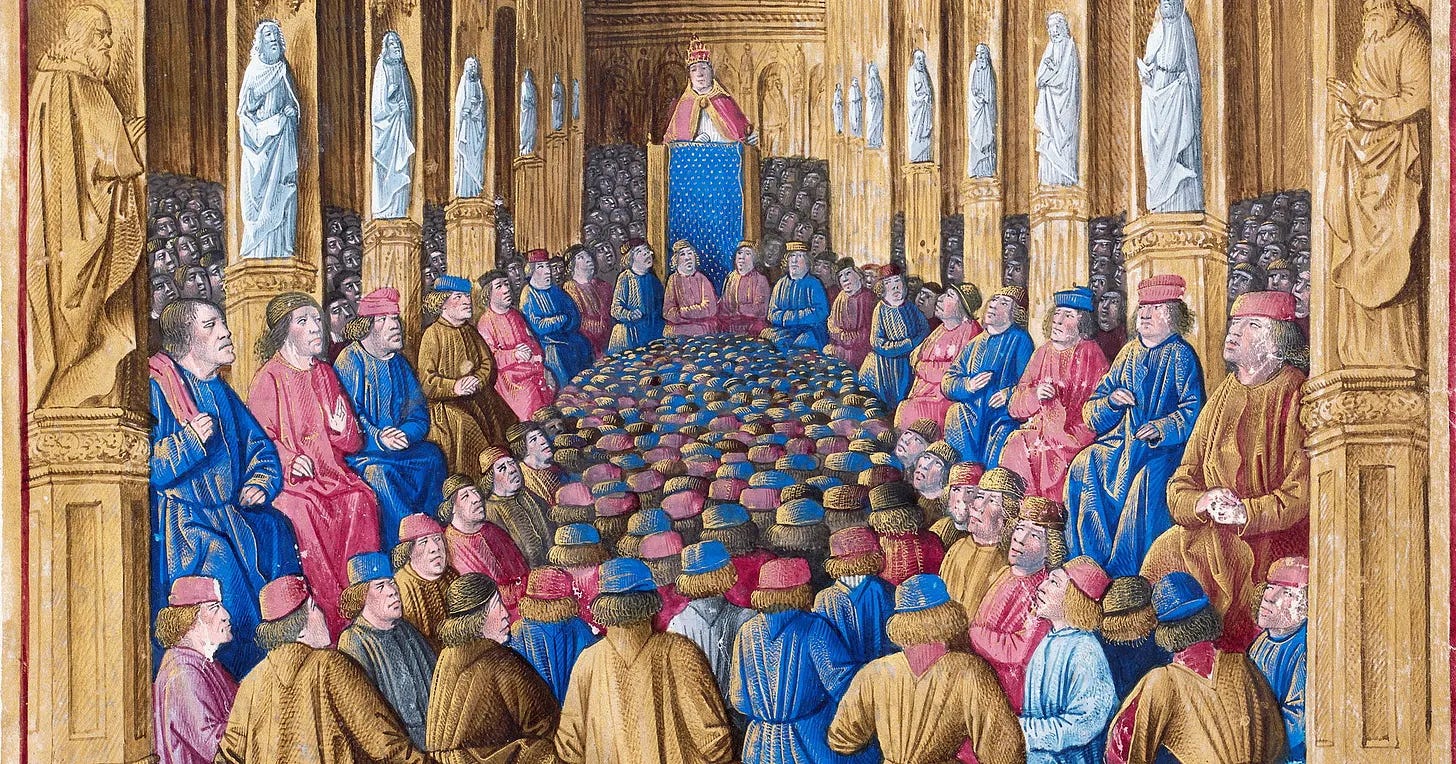
On 27 November 1095, at the close of the council he has convened at Clermont, in Auvergne, Pope Urban II renews the Truce of God under pain of anathema, then addresses the crowd gathered outside the town. A few months earlier, at the council of Piacenza, envoys of the Byzantine emperor Alexios Komnenos had come to ask for help against the Seljuk Turks, who had taken almost the whole of Asia Minor from him. The pope calls upon the knights of the West to succour the Christians of the East and to deliver Jerusalem, and promises to those who die on the way or in battle the remission of their sins. We know his speech only through chroniclers who wrote it up after the event, each in his own way, but the version of Fulcher of Chartres, who was probably present, preserves its logic: ‘Let those who were long brigands now become soldiers of Christ; let those who fought against their brothers and kinsmen now rightly fight the barbarians.’
This sequence has often been read as a displacement: the violence that could not be contained within Christendom would be directed outwards and sanctified. This reading is disputed, and I offer it as a hypothesis. But the gesture is clear: the same authority that forbids fighting one’s neighbours blesses those who set out to fight far away. And a new figure then appears at the frontiers of Christendom. The Donatist, like the plundering lord, was a Christian whom one wished to bring back to unity or to peace; the infidel, defined by his faith alone, is an other whom one no longer seeks to bring back, but to defeat.
This other, some crusaders find before they have even left Europe. At Rouen, relates the abbot Guibert of Nogent, men who have taken the cross say to one another: ‘We wish to go and attack the enemies of G-d in the East, at the cost of an immense journey, when we have before our eyes the Jews, of all peoples the most hostile to G-d.’ In the spring of 1096, in the Rhine valley, the bands of Count Emicho of Flonheim attack the Jewish communities: eleven dead at Speyer, where the bishop protects the others; some eight hundred at Worms, where the episcopal palace that sheltered them is forced; more than a thousand at Mainz, on 27 May, whose archbishop ends by taking flight; and the violence then spreads to other towns, from Cologne to Regensburg. Everywhere, the choice offered is the same: baptism or death. The Hebrew chronicles, that of Solomon bar Samson above all, report that many, at Mainz in particular, took their own lives and those of their children rather than receive baptism: this is kiddush ha-Shem, the sanctification of the Name.
Neither the pope nor the bishops had called for these massacres; several bishops tried to shelter the Jews, and the emperor Henry IV afterwards allowed those baptised by force to return to Judaism. But the logic that makes them possible is the very one we have been following since Ignatius: when belonging is defined by what one believes, he who believes otherwise becomes an enemy, and nothing any longer indicates where the frontier stops. The Jews of Mainz, who prefer to die rather than deny their faith, find themselves in the situation of the Christians who refused to sacrifice under Decius, with this difference, that it is now Christians who demand the denial.
Three years later, on 15 July 1099, the crusaders take Jerusalem. The Latin chroniclers describe with complacency the massacre of the Muslims who had taken refuge within the precinct of the Temple, and the Damascene chronicler Ibn al-Qalanisi reports that the Franks burnt the synagogue in which the Jews had gathered. The figures given by the sources are doubtless inflated, and letters found in the Cairo Genizah show that some Jews were ransomed as captives; the massacre itself is not in doubt. A century later, the crusade would turn against Christians, in Languedoc.
From the ‘good men’ to the Inquisition
‘The good men’
In the twelfth century, in Languedoc and in northern Italy, preachers appear who live in poverty, work with their hands, refuse the oath and the lie, and whom their faithful call the ‘good men’ and the ‘good women’. Their adversaries call them heretics, then Cathars and Albigensians. Their demand is strikingly like that of the first Christian communities, and it arises, outside the institution, from the conduct of persons who attract by their way of life: again the first direction of our question, from spiritual demand towards social organisation, but this time against the established Church. The Church responds at first by preaching: in 1203, Pope Innocent III sends Cistercian monks, who are joined by their abbot general, Arnaud Amalric; their failure leads the bishop of Osma, Diego, and his companion Dominic, the future founder of the Dominicans, to preach in their turn barefoot and without money, in order to set against the poverty of the ‘good men’ a Catholic poverty.
A reservation is needed here more than anywhere else, since almost everything we know about these dissidents comes to us from those who fought them, preachers, chroniclers of the crusade and inquisitors. Since the collection edited in 1998 by Monique Zerner, Inventer l’hérésie ? (Inventing heresy?), a number of historians, among them Robert I. Moore and Mark Pegg, have maintained that the organised and dualist ‘Cathar Church’ is in large part a construction of its persecutors; others, such as Peter Biller, hold that it existed. The debate is not closed. I shall therefore speak of dissidents, and I retain what is not in dispute: an evangelical demand for poverty that attracted, and an institution that named it heresy. To this I add a hypothesis, which I hold to be the most probable: if the Church named it so, it was first of all because this demand escaped its control.
Béziers, 22 July 1209
In January 1208, the papal legate Peter of Castelnau is assassinated near Saint-Gilles, shortly after a stormy interview with the count of Toulouse, Raymond VI, whom he had excommunicated the previous year for the protection he was granting to heretics. Innocent III, who holds the count responsible for the murder, then calls for a crusade against the heretics of Languedoc and against the lords who protect them, promising the crusaders the conquered lands. The army gathers at Lyon at the beginning of the summer of 1209 and arrives before Béziers on 21 July. The next day, while the departure of the Catholics from the town is still being negotiated, the ribauds of the army, without waiting for the order of the leaders, cross the ditches and the walls, and the town is taken in a few hours.
The two legates, Arnaud Amalric and Milo, write to the pope in August: ‘Our men, sparing neither rank, nor sex, nor age, put to the sword nearly twenty thousand people.’ The figure is doubtless exaggerated, but it is given as a victory. The sentence everyone knows, ‘Kill them all; God will know his own’, does not appear in this letter; it is reported by Caesarius of Heisterbach, a German Cistercian monk, in a collection of edifying tales written between 1219 and 1223, and it echoes a verse of the second letter to Timothy: ‘The Lord knows those who are his.’ Its authenticity is doubtful, but Caesarius reports it to the glory of the legate, which says enough about what a monk of that time could admire.
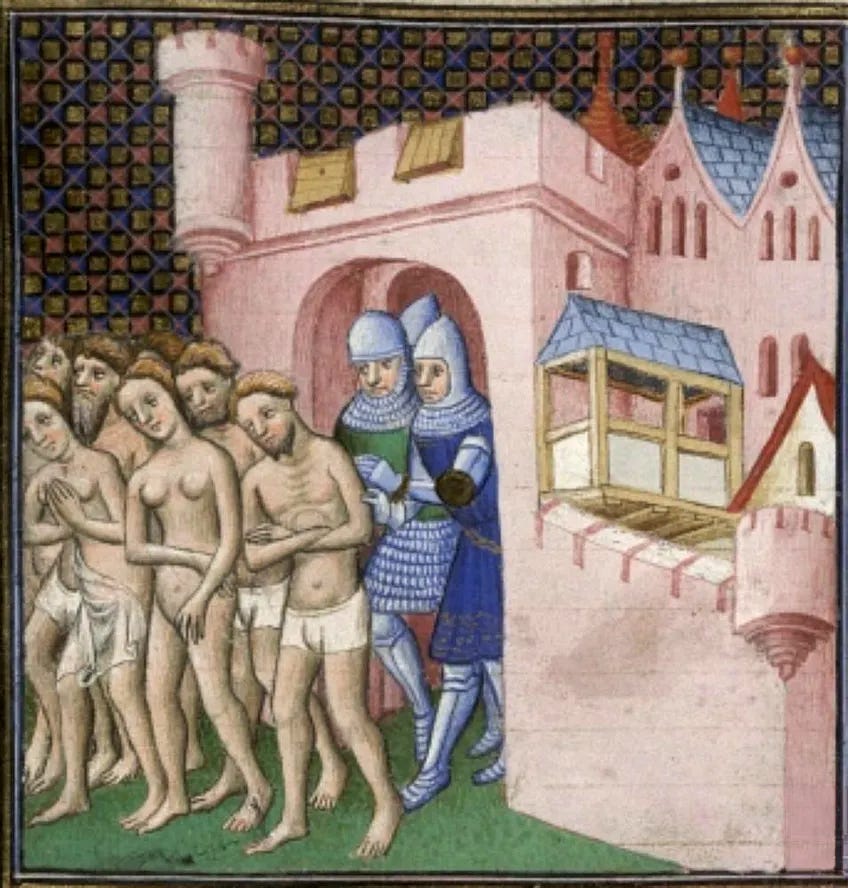
Three weeks later, the army lays siege to Carcassonne, which is better defended; deprived of water, the city surrenders on 15 August. Its inhabitants are spared, but must leave, according to the chronicler William of Tudela, ‘in their shirts and breeches’, abandoning all their goods to the crusaders: this is the scene shown in the illumination from the Grandes Chroniques de France reproduced above. The viscount Raymond-Roger Trencavel, who had come to negotiate under safe conduct, is held prisoner and dies in November in his own city; his lands pass to Simon de Montfort, who takes command of the crusade.
Lateran, 1215: judging the heretic, confessing everyone
In November 1215, Innocent III gathers more than four hundred bishops at the Lateran. The third canon of the council regulates the procedure against heretics: the secular authorities must swear to drive from their lands those whom the Church designates, the Latin verb exterminare meaning first of all ‘to banish beyond the borders’, and those who take the cross against them receive the same indulgences as the crusaders of the Holy Land. The twenty-first canon, known by its opening words, Omnis utriusque sexus, requires every member of the faithful of either sex, having reached the age of reason, to confess all his sins at least once a year to his own priest. It confirms a custom more than it invents one, but it makes of it a universal law, and the priest, as Thomas Aquinas later noted, thereby learns to know his flock, ‘lest a wolf be hiding in it’.
The council thus organises at one and the same time the struggle against those who think otherwise and the examination of each conscience by a priest. The second direction of our question, the one that goes from the organisation of society towards the inner life, here crosses a threshold: the structure is no longer content to regulate conduct, it enters the intimacy of each person to impose its rule on him.
The tribunal of consciences
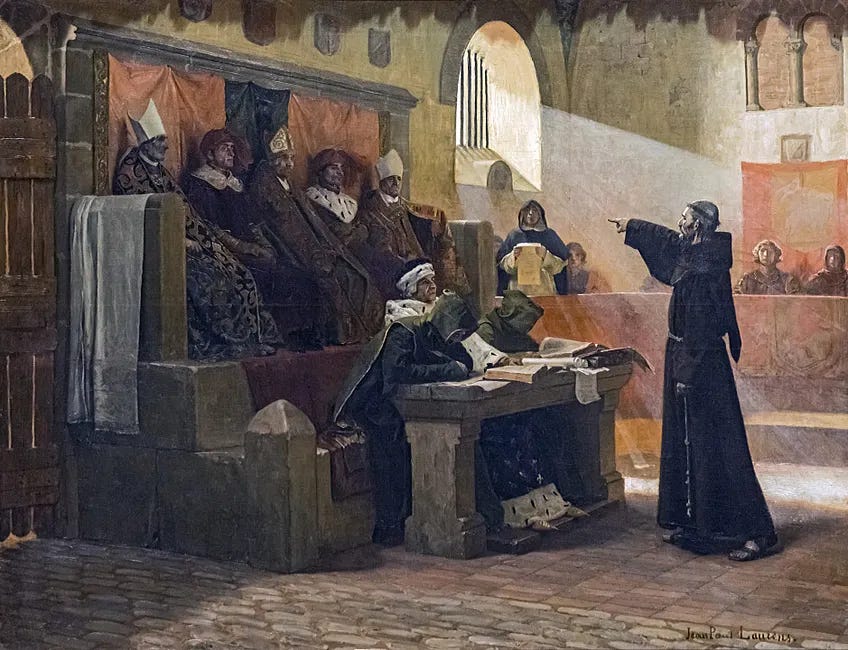
The tribunal is born in these same years. In 1231, by the constitution Excommunicamus, Gregory IX fixes the penalties against heretics, and in 1233 he entrusts the search for them, in the kingdom of France and in Languedoc, to the Friars Preachers, the order founded by that same Dominic whom we saw preaching barefoot against the ‘good men’. These inquisitors are delegated by the pope and answer to him alone: the decision henceforth escapes the bishops themselves. Their procedure is new. Having arrived in a town, the inquisitor preaches, then opens a ‘time of grace’ during which anyone may come forward to accuse himself and to denounce others; the inquiry then begins, the inhabitants are summoned and questioned, the names of the witnesses remain secret, and the accused has neither advocate nor appeal. In 1252, the bull Ad extirpanda of Innocent IV authorises torture. The penalties range from yellow crosses sewn on to clothing to prison, which is called ‘the wall’; those who refuse to abjure, and the relapsed, who fall back into heresy after having abjured it, are ‘abandoned to the secular arm’, which burns them, since the Church does not itself shed blood.
On 16 March 1244, at the foot of Montségur, more than two hundred ‘good men’ and ‘good women’ who refuse to abjure are burnt together, and the last known ‘good man’ of Languedoc, Guillaume Bélibaste, dies at the stake in 1321. In these same years, from 1318 to 1325, the bishop of Pamiers, Jacques Fournier, the future Pope Benedict XII, questions the inhabitants of Montaillou, a village of the upper Ariège, and his register has enabled Emmanuel Le Roy Ladurie to reconstruct its daily life. The only voices of the dissidents that remain to us were thus gathered by their judges, which gives its full weight to the reservation I stated above.
Measured against what precedes, the novelty is twofold. Trajan refused anonymous denunciations, ‘a detestable example’; the Inquisition accepts that the accused should not know the names of his accusers, and it obliges everyone to speak. It also completes what confession had begun: the priest examines each conscience once a year, the inquisitor questions each village, and what was said at the hearth may henceforth serve as evidence. The place of doubt disappears, since even silence becomes suspect, and the price of doubt falls upon all, upon the neighbours who denounce so as not to be denounced, and even upon the dead, who are exhumed so that their bones may be burnt.
The institution would long outlive those it had been born to fight. The medieval Inquisition fades in the fourteenth and fifteenth centuries, but in 1478 the pope authorises the Catholic Monarchs to found the Spanish Inquisition, which would last until 1834 and would still, in 1826, at Valencia, have a schoolmaster accused of deism executed; the Portuguese Inquisition, established in 1536, is abolished in 1821. In 1542, Paul III creates in Rome the Congregation of the Roman and Universal Inquisition, the Holy Office, which has Giordano Bruno burnt in 1600 and condemns Galileo in 1633; the Index of Forbidden Books, created in 1559, loses its force of law only in 1966. The Holy Office becomes in 1965 the Congregation for the Doctrine of the Faith, then in 2022 a dicastery, with no power of constraint whatsoever. On 12 March 2000, John Paul II asked forgiveness for the methods ‘not in keeping with the Gospel’ used in the service of truth, in a prayer which affirms that truth imposes itself only by the strength of truth itself. It was, sixteen centuries later, the position Augustine had first held, before abandoning it.
Francis of Assisi, the other way
Before the sultan, at Damietta
One scene, however, unsettles this account. In September 1219, during the Fifth Crusade, before Damietta, in Egypt, Francis of Assisi crosses the lines and presents himself at the camp of the sultan al-Kamil, who listens to him for several days and has him escorted back safe and sound. The principal witness, Jacques de Vitry, bishop of Acre, was himself a supporter of the crusade, and the historian John Tolan has shown that Francis was seeking the sultan’s conversion or martyrdom, not peace as we understand it. The scene therefore does not prove that Francis condemned the crusade. It shows only that at the very heart of the age in which the Church takes up the sword, one man chose to go towards the enemy unarmed, and that another way of bearing the demand remained possible.
What the order made of Francis
The rest of Franciscan history nevertheless shows how hard this other way was to hand on. Francis never wished to stand outside the Church: he asked his brothers for obedience to the pope, and his Rule had been approved by Honorius III in 1223. But he wanted it to be lived to the letter, and in the Testament he dictated before his death, in October 1226, he forbids his brothers to add glosses to it and to say ‘it must be understood thus’, asking them to understand it ‘simply and without gloss’. Four years later, on 28 September 1230, the bull Quo elongati of Gregory IX, the former Cardinal Hugolino who had been his protector before canonising him, declares, at the request of the brothers themselves, that this Testament does not bind them. In 1245, Innocent IV settles the question of property by declaring that it belongs to the pope, the brothers having only its use: the order can thus build friaries and libraries without owning anything in law.
The Franciscans also enter the Inquisition. Gregory IX associates them with it from the 1230s, and in 1254 Innocent IV entrusts them with the prosecution of heresy throughout central Italy; in France, Provence becomes the only inquisitorial district that falls to them. Within the order itself, those called the ‘Spirituals’, who wish to keep the poverty of Francis, are opposed to the majority, the ‘Conventuals’, who come to terms with friaries and property. Pope John XXII decides against the former. In 1317, he summons the Spirituals of Narbonne and Béziers to Avignon; twenty-five refuse to submit and are handed over to the Franciscan inquisitor of Provence, Michel Lemoine; twenty-one recant, and on 7 May 1318, at Marseilles, the four others, all brothers of the friary of Narbonne, are burnt. Brothers of Francis had brothers of Francis burnt because they wanted to live as he had. In 1323, John XXII declares heretical the assertion that Christ and the apostles owned nothing.
Bernard Délicieux against the inquisitors
Another Franciscan had tried to make something else heard. Bernard Délicieux, lector at the friary of Carcassonne, leads from 1299 to 1304 a movement against the Dominican inquisitors of Languedoc, goes to plead the cause of the towns before Philip the Fair, and obtains for a time the transfer of the prisoners of the ‘wall’ of Carcassonne to the king’s prisons. Having come to Avignon in 1317 with the Spirituals of Narbonne and Béziers, he is arrested, tortured, then tried at Carcassonne by two bishops commissioned by the pope, among them Jacques Fournier, and condemned on 8 December 1319 to perpetual imprisonment; the judges had spared him irons on account of his age and the tortures he had undergone, and John XXII revokes this mitigation. He dies at the beginning of 1320. Like Martin at Trier, he had sought a space for disagreement within the institution; unlike Martin, he died of it.
Weber gave a name to this process: the routinisation of charisma, by which the impetus of a founder becomes, after him, an organisation that endures. It is not pure betrayal, for without friaries and without the support of the popes, the order would doubtless not have survived its founder, nor carried preaching and the care of the poor so far. The price was paid by those who, within, wished to keep the impetus intact.
What my grid of analysis brings to light
I now take up this journey of twelve centuries, from Ignatius to Bernard Délicieux, with the tools I presented in the first article, to see what they allow us to distinguish.
What your replies have changed
Two readers replied at length to the questions I asked at the end of the first article, and I thank them for it. One pointed out to me that my definition of spirituality said nothing of the irruption of the supernatural nor of the size of organisations, and that too few landmarks could cause as much anguish as too many constraints; the other, that one can live through a sincere transformation without understanding what is transforming us, and that a community can transmit a fidelity without transmitting the capacity to question it. This second reader then observed to me that a right to doubt is not enough: one may have the right to contest a common conviction and yet remain unable to do so without risking one’s place, one’s relationships or a part of one’s identity, because we hold to our convictions through the bonds, the hopes and the fears that accompany them as much as through our reasons.
I am not, for all that, adding a sixth dimension, but four refinements to the grid of reading. I shall henceforth ask where the impulse comes from, whether it is decided, sought or received; on what scale it is exercised; whether there exists a place where the conviction may be called into doubt without the one who doubts being excluded; and what doubt costs in this group, and who pays the price. The other remarks of these two readers did not call for a new question, but they illuminate this case better than I would have done alone, and I take them up further on. Hamza Abid, with whom I am preparing a Two Quills dialogue, reminded me, finally, of a distinction that this whole journey bears out: the depth of a conviction must not be confused with the validity of its consequences.
In both directions
In the first direction, from the person towards society, one sees individuals and small groups carrying a demand and bringing it into common life: the communities that care for their poor to the point that Julian envies them, the confessors who refuse to sacrifice to the pagan gods under Decius, the bishops of the Peace of God who wish to protect the unarmed, the ‘good men’ whose poverty attracts, Francis going towards the enemy. This direction is not confined to Christianity, since the Jews of Mainz, in choosing death rather than baptism, likewise set an inner demand against the society that seeks to convert them. But as the account advances, it becomes rarer and passes more and more through the margins: through Martin at Trier, who ends by falling silent, through Bernard Délicieux at Carcassonne and through the Spirituals of Narbonne, whom the institution silences.
The second direction, from organisation towards the inner life, gains ground, on the contrary. The threat of persecution makes unity a spiritual value; the Christian Empire transforms faith into civic belonging; the sermon of Clermont, which calls for the crusade, gives rise in whole crowds to a new piety, in which the remission of sins is won by fighting, and the massacres of 1096 issue from it without anyone having ordered them; annual confession brings the gaze of the institution into every conscience; the Inquisition, finally, with its ‘time of grace’ that invites each person to accuse himself and to denounce others, makes surveillance an inner affair, to the point that the fear of heresy renders suspect the very question of Philadelphia, ‘where is it written?’.
The two directions cross ceaselessly, and the case shows how. An impulse of the first kind, once it has become an institution, begins to act in the second: the Peace of God, born of concern for the unarmed, passes through the anathema, then through the excommunication of a whole territory, and finally through the militia of Bourges; the order of Francis, born of a chosen poverty, ends by supplying inquisitors and by burning those who wished to keep that poverty. The reversal has less to do with the demand itself than with the institution that bears it: once sure of enduring, the institution turns its force against those who take it at its word.
The four quadrants
Wilber’s map crosses the individual and the collective, the interior and the exterior, and I go through it in four moments.
In the second century, the individual interior is made up of the desire for martyrdom and the fear of division; the individual exterior, of meals, hymns and oaths; the collective interior, of a brotherhood that thinks of itself as the body of Christ; the collective exterior, of houses, elected leaders and a Roman law that can kill, but that still refuses anonymous denunciations.
From the middle of the third to the beginning of the fifth century, the individual interior is divided between the shame of the lapsed and the prestige of the confessors; the collective interior hardens around Cyprian of Carthage’s formula, ‘outside the Church, no salvation’, and around a question that will never leave it again, that of purity; the collective exterior fills up with councils, imperial laws and courts, and an emperor now decides what must be believed about Christ.
In the eleventh century, the individual interior is made up of the fear of hell, which the anathema turns into a weapon, and of the hope of a remission of sins that can be won with weapons in hand; the individual exterior, of oaths sworn on relics and of cloth crosses sewn on to the shoulders of the crusaders; the collective interior sees the appearance of a new figure, the enemy defined by his faith alone, infidel far away and Jew close at hand; the collective exterior counts councils of peace, diocesan militias and soon armies.
In the thirteenth and fourteenth centuries, the collective exterior brings together legates, armies, conciliar canons and permanent tribunals, and it relies on an instrument that is often forgotten, writing. Bulls, registers and lists of witnesses no longer serve to transmit a word, like the letters of Ignatius, but to control consciences, and the register of Jacques Fournier, an instrument of that control, is also the only trace left to us of those it controlled. The individual interior is reached by annual confession and by interrogation, which teach each person to watch over himself and to watch his neighbour.
The shift fits into one sentence: what at first rested on the conviction of each person rests in the end on an institution that controls convictions.
The five-dimension profile
In the first article I defined five dimensions which I describe as a profile and not as a score. Self-transcendence remains strong from beginning to end, and that is what makes the journey disquieting: neither Mainz nor Béziers can be explained by a loss of faith. Self-transformation is demanding in the first communities and never disappears, since it animates the confessors, the ascetics, Martin, the ‘good men’, Francis and his Spirituals; but it ceases to be the condition of belonging when whole populations enter the Church along with the law of the Empire, and when it is reborn with the mendicant orders, the institution brings it under control within a few years, as the bull of 1230 releasing the brothers from the Testament of Francis shows.
Concern for others endures towards the brother and the poor, and the Peace of God extends it to the unarmed, as Julian himself acknowledged. But it withdraws from the heretic, then from the infidel, then from the Jewish neighbour, and this circle tightens as the frontier of the enemy widens. Rite and belonging grow until they become the whole, which is what I feared when I wrote that this was the most visible dimension, and therefore the easiest to mistake for the whole; its extreme case is the spring of 1096, when belonging becomes the very condition of life, since the Jews of the Rhine are offered baptism or death. The breadth of responsibility, finally, widens from the house to the Empire and to Christendom, but it widens into domination: one holds oneself responsible for the salvation of whole peoples, which permits them to be coerced, and Augustine provided the justification that the Inquisition would put into practice.
The seven questions, and the four additions
Who carries the impulse? Martyrs and communities first, then bishops, emperors and popes, crowds gathered around relics, a pope who preaches the crusade, and at the end professionals whose trade it is, the inquisitors; on the margins, dissidents. Where does it come from? Ignatius says he received it from the Spirit, the crowd at Clermont proclaims it willed by G-d, Augustine says he drew it from the facts; in every case, what grounds authority escapes the debate of the community. Through what is it inscribed? Through letters, then through the canons of councils and imperial laws, finally through bulls, registers and an annual obligation of confession: writing, which served to transmit, now serves to control. How is it applied? Through the consent of small groups, then through a gradation of constraints that the account allows us to follow step by step, from refused communion to exile and confiscation, then to the anathema, to the excommunication of a whole territory, to the militia, to the crusade and to the permanent tribunal; and always the constraint is justified in the name of the good of the one who is constrained.
What becomes of the group on the death of the one who carried the impulse? The answer of the first centuries is succession: the apostles instituted leaders and provided for their replacement, says Clement, and this succession becomes the guarantee of truth. Among the Franciscans, a century after Francis, the same logic of succession made it possible to condemn those who wished to live as he had. Who opposes it? The Corinthians who depose their presbyters, the Philadelphians who wish to check in the Scriptures, Novatian, the Donatists, Martin at Trier, the ‘good men’, the Spirituals, Bernard Délicieux; at each stage, the opposition is at first a question asked from within, and it ends by being treated as a threat from without.
This list brings out a paradox I did not expect. Almost all these opponents are rigorists, who call for more purity or more poverty than the institution demands: Novatian refuses to readmit the lapsed, the Donatists to recognise the sacraments given by traitors, the ‘good men’ and the Spirituals to possess anything at all. Faced with them, the Church often chose mercy, with Cyprian and Cornelius reopening communion to the lapsed, and Augustine gave this choice its theological form, that of a Church in which the righteous and sinners remain mingled until the judgement. But this choice of a body open to all also justified the coercion of those who wished to separate from it in order to remain pure: the same decision that opens the Church to the weak makes it shut the door on those who wish to leave.
Who decides, and at what distance? The assembly, then the bishop, then the council and the emperor, then the pope and his legates, and finally inquisitors who answer only to the pope and escape even the bishops, hundreds of leagues away from those who will undergo their sentences. What does the organisation do to the inner life of those who take part in it? It asks them less and less to seek and more and more to adhere, then it teaches them to mistrust their neighbour, to accuse themselves during the time of grace granted by the inquisitors, and to keep silent.
The four additions give the same picture. The scale passes from a house of a few dozen people to an Empire, then to the whole of Latin Christendom, able to raise armies, and at each change of scale the decision moves further away. The place of doubt shrinks: one could ask at Philadelphia ‘where is it written?’, one could still protest at Trier against the shedding of blood, Bernard Délicieux sought this place within his order and died of it, and at Montaillou silence itself became suspect. This shrinking has, moreover, a precise juridical form. Trajan, a pagan emperor, refused anonymous denunciations as unworthy of his age; the Inquisition accepts that the accused should not know the names of his accusers. A guarantee that Roman law still granted to persecuted Christians, the Church no longer grants to those it prosecutes.
The price of doubt rises at the same time. The Corinthians who depose their presbyters are treated as seditious, Martin resumes communion with the bishops of Trier to obtain pardons and thereafter keeps silent, the Donatists lose their churches, then their property and their leaders, the peasants struck by general excommunication pay for their lord, the Jewish communities of the Rhine for a faith that is not that of their neighbours, four brothers of Narbonne for the poverty of Francis, and the dead themselves, exhumed so that their bones may be burnt, are not quit of it. The Greek word hairesis, whence ‘heresy’, first meant ‘choice’: the journey I am describing is the one by which choice became a crime.
Three remarks that illuminate the case
The remarks of my readers that I did not turn into questions shed light on three further points, and the first obliges me to be fairer to Ignatius and Clement. Too few landmarks, a reader wrote to me, can cause as much anguish as too many constraints, and scattered, threatened communities, which did not always know who had authority over them, doubtless needed a stable landmark: the demand for unity answered a real need before becoming an instrument. The dissidents, from Novatian to the ‘good men’, also offered strong landmarks, a clear rule of life and the image of a pure Church, and it is partly for that reason that they attracted. The question then concerns those who fix the landmarks, and the possibility of discussing them once they are fixed.
The second reader wrote to me that one can live through a sincere transformation without understanding what is transforming us. That is exactly the case of the converts who thanked Augustine for having been driven towards unity: their gratitude was doubtless sincere, but what had transformed them was fear of the imperial laws, and their gratitude became the very argument for constraint. The crowd at Clermont that acclaimed the pope was likewise living through a sincere impulse, and did not see what would be made of its violence.
He added that a community can transmit a fidelity without transmitting the capacity to question it, and Franciscan history offers the clearest illustration of this. Four years after the death of Francis, fidelity to the order prevailed over fidelity to what he had asked, and those who wished to question it by returning to his Testament ended at the stake. Succession, which Clement held to be the guarantee of truth, hands down obedience just as well as forgetfulness of what had given rise to it.
Hamza Abid’s distinction, finally, runs through the whole journey. No one, from Clermont to Béziers, lacked conviction, and that is what forbids us to judge a spiritual demand by its depth alone: Urban II and Francis, Arnaud Amalric and Bernard Délicieux were equally convinced, and it is by their consequences that they can be told apart.
Arendt and the secular arm
In the first article, I presented Hannah Arendt’s thesis on cogs: before a court of law, there are no more cogs, only responsible human beings. In a text of 1964, ‘Personal Responsibility under Dictatorship’, she goes further and refuses the word obedience in political and moral matters: a child obeys, she writes, an adult consents, and when an adult is said to obey, in reality he supports. The ribauds of Béziers, the lords who swore to drive the heretics from their lands, the faithful who denounced their neighbours did not obey an authority that was beyond them: they supported an undertaking. The Inquisition had even organised this support in such a way that no one need feel responsible for the blood shed: the inquisitor judged, the secular arm burnt, and the Church could say that it did not shed blood. This division of labour is precisely what Arendt refuses to accept as an excuse, since it allows each person to regard himself as a mere cog. The question she leaves us is the one the Church of the thirteenth century had ceased to ask its members: ‘could I go on living with myself after having done this?’
Why the impetus meets power
It remains to say why. The journey that the grid has just broken down comes to a few features: a demand born of the inner life, carried by small communities, becomes an institution; this institution, under threat, makes unity a spiritual value; sure of itself and allied with public power, it passes from exclusion to constraint, then from the constraint of acts to the surveillance of consciences; and at each stage, the place where one could doubt narrows while the price of doubt rises. Why did a demand born of the Sermon on the Mount follow this path? I do not believe a single cause suffices, and the explanations several thinkers have proposed complement one another more than they exclude one another.
The institution that wants to endure
The first has to do with duration. Max Weber showed that an impetus carried by a person survives its founder only by becoming an organisation, what he called the routinisation of charisma. His friend Ernst Troeltsch, in his great study of 1912 on the social teaching of the Christian Churches and groups, distinguished the Church, which welcomes all the baptised, compromises with the world and allies itself with power, from the sect, which gathers only volunteers and demands purity of them. Novatian, the Donatists, the ‘good men’ and the Spirituals are sects in Troeltsch’s sense, and the Church that fights them follows its own slope. The sociologist Robert Michels had formulated the previous year what he called the ‘iron law of oligarchy’: every organisation, even one animated by the loftiest ideals, ends by giving itself an elite whose first concern is to maintain itself. Within this framework, disagreement ceases to be a question and becomes a threat to the very existence of the group.
The certainty that believes it saves
The second has to do with certainty. When truth is held to be absolute, and the stakes exceed life since salvation is at issue, constraint becomes a charity, and that is Augustine’s argument. Dostoevsky turned it against the Church itself in ‘The Legend of the Grand Inquisitor’, which he inserted in 1880 into The Brothers Karamazov: the old inquisitor of Seville reproaches Christ, returned to earth, with having left men a freedom too heavy for them, and prides himself on having taken it from them in the name of miracle, mystery and authority. Erich Fromm, in The Fear of Freedom, in 1941, showed how the anguish that this freedom arouses drives men to submit, which joins my first reader’s remark on the anguish of a lack of landmarks. Constraint does not only come down from above: it also answers a demand.
The power that goes all the way
The third has to do with power itself. Simone Weil copied out this sentence of Thucydides, ‘every being exercises all the power at its disposal’, and added that the soul, like a gas, tends to fill all the space granted to it. In 1887, Lord Acton wrote to the historian Mandell Creighton, about the popes of the thirteenth and fourteenth centuries, from Innocent III to the time when Jan Hus was burnt as a heretic, in 1415, that power tends to corrupt and absolute power corrupts absolutely, and he added that ‘there is no worse heresy than that the office sanctifies the holder of it’. The medievalist Robert I. Moore showed, in The Formation of a Persecuting Society, published in 1987, that the persecution of heretics, Jews and lepers arose less from a real threat than from the construction of the power of clerics and princes: to persecute was a way of governing. Simone Weil, finally, saw in the social collectivity, and in the Church as a collectivity, Plato’s ‘great beast’, which has itself worshipped in the place of G-d, and she devoted to the crushing of Occitan civilisation by the crusade a text published in 1943, ‘L’agonie d’une civilisation vue à travers un poème épique’, which Richard Rees translated as ‘A Medieval Epic Poem’.
The scapegoat
René Girard offers a fourth explanation, which illuminates moments of crisis. In The Scapegoat, published in French in 1982, he describes how a threatened group recovers its unity by turning as one against a victim, and he maintains that the Gospels unveiled this mechanism by taking the side of the innocent victim. It is all the more troubling to see Christendom reproduce it, at Mainz in 1096 as against the heretics.
When the place of doubt closes
None of these explanations suffices alone, and it is their meeting that seems to me decisive. Persecution requires an institution anxious to endure, a certainty that makes constraint a duty, and a power that supplies the means for it and finds its interest there. Each exists without the others: the first communities had certainty without power, and the pagan Empire power without concern for the salvation of others. It is when they come together, under Theodosius, under Honorius, then under Innocent III, that persecution becomes possible, then ordinary.
My grid nevertheless brings out what allows these three forces to come together: the disappearance of the place of doubt. As long as such a place exists, certainty remains open to discussion and power meets a limit; when it closes, nothing restrains them any longer. The comparison with the Jewish masters gives the measure of this. The rabbinic world, too, knew exclusion, certainty and the authority of the majority; but it preserved minority opinions in its texts, and it had no sword of state at its disposal. Thirteenth-century Christendom lost both at once. Hannah Arendt, in On Violence, an essay published in 1970 and later gathered in Crises of the Republic, distinguished power, which arises from consent and common action, from violence, which appears where that power is lost. That is what this historical journey shows: violence takes the place of speech when speech no longer suffices, and speech ceases to suffice as soon as the institution no longer accepts being contradicted from within.
This case thus obliges me to correct one of my hypotheses. I wrote that when cohesion unravels, fear, scarcity and distrust divert the spiritual impetus towards defence, identity and the designated enemy. The threat did indeed play this role, but otherwise than I had foreseen. Under Decius and under Diocletian, for want of means, fear did not produce constraint: it produced the demand for purity, the refusal of the lapsed and of the traditores, the idea of a Church of saints. Constraint came afterwards, when the Church was secure and had public power at its disposal, under Constantine, Theodosius and Honorius, then under Innocent III, at the summit of its authority. And persecution was born when the demand for purity, having passed from life into doctrine, found that power: the Donatists, children of persecution, were the first to go and fetch the emperor, and the Church of Innocent III, sure of its orthodoxy, had every sword at its disposal. My hypothesis was therefore not false, but incomplete: security and power divert the spiritual impetus as much as fear does, and it is the closing of the place of doubt that links the one to the other.
A spiritual community can endure, believe with certainty and even possess a certain power without persecuting, on condition that it keeps a place where it can be contested without one’s being excluded from it. It remains to be seen on what conditions such a place can survive power, and that is the question I should like to carry into the following articles.
What this study does not prove
Several readings that this journey might seem to support do not hold, and I prefer to set them aside myself. The first Christians were not absolute pacifists. The strictest text on military service, the Apostolic Tradition, long attributed to Hippolytus of Rome at the beginning of the third century, forbids the baptised soldier to kill and turns away the catechumen who would enlist, but its date and its author are now disputed; Tertullian and Origen also condemn the profession of arms, and yet Tertullian himself attests, around 197, that Christians serve in the emperor’s armies, which is further confirmed by the acts of the centurion Marcellus, executed in 298 for having thrown down his belt. The holding of goods in common at Jerusalem belongs, in Luke, the author of Acts, to the ideal as much as to practice. The Peace of God was perhaps not born of a general collapse, since Dominique Barthélemy disputes it. As for the dissidents of Languedoc, nothing assures us that they formed the organised Church their persecutors describe, and the crusade launched against them owed a great deal to geopolitics and to the ambitions of Innocent III, as Monique Zerner and Jean-Louis Biget have stressed.
The medieval Inquisition, for its part, was not primarily a machine for burnings. Of the 636 persons Bernard Gui condemned at Toulouse between 1308 and 1323, some forty were handed over to the secular arm, less than 7 per cent, and more than half were sent to prison; sixty-seven sentences ordered, in addition, that the bones of the dead be exhumed and burnt. Annette Pales-Gobilliard, who edited this register, and Julien Théry, who presented it to the general public, stress that the institution sought conversion first, and that its strength lay less in its severity than in the rigour of its inquiries and the control it exercised over populations. Far from weakening my reading, these figures sharpen it, since what counts here is the surveillance of consciences more than death. Nor shall I say that the crusade was conceived as a rehearsal against the Jews before it took aim at the Muslims: neither the pope nor the bishops had called for the massacres of 1096, and several bishops tried to prevent them. Franciscan history, finally, cannot be reduced to a betrayal, for the institution that condemned the Spirituals also allowed the order to endure, to preach and to serve the poor.
Above all, nothing in this journey establishes that the demand born of the Sermon on the Mount leads by its nature to the crusade. Martin at Trier, the ‘good men’, Francis at Damietta, Bernard Délicieux at Carcassonne show that it continued to produce something else. What I believe I can draw from it is more limited: each time an internal disagreement could not be settled by speech, a power was sought out to settle it, and each time that power reduced the space for disagreement.
Next time: conquest and conscience
The next article, planned for Sunday 22 November, opens in the spring of 833, when the caliph al-Ma’mun orders his governor in Baghdad to question the judges and the scholars, and to dismiss those who refuse to admit that the Qur’an was created, and is therefore not, as most of them held, the eternal word of G-d. It will then go back to the Charter of Medina, drawn up in the time of the Prophet, to ask what the Muslim conquest required of the consciences of subject peoples, and whether it compelled them to convert.
Before we meet again for the next article, I put to you three questions, which you may answer in the comments or by return email.
Do you know of a community, religious or not, that has kept, even while becoming powerful, a place where it can be contested without one’s being excluded from it, and how has it preserved that place?
Does the idea that fear engenders the demand for purity, and that power turns it into constraint, seem right to you, and do you see counter-examples?
In your own journey, has a word received as coming from on high ever set you free, or on the contrary prevented you from asking questions?
I shall read everything, and I shall take it into account in the following articles.
Until soon!
Jérôme Nathanaël
Main sources
The first centuries
Ignatius of Antioch, Clement of Rome and the Didache: Michael W. Holmes (ed. and trans.), The Apostolic Fathers. Greek Texts and English Translations, 3rd ed., Grand Rapids, Baker Academic, 2007; Bart D. Ehrman (ed. and trans.), The Apostolic Fathers, vol. I, Loeb Classical Library 24, Cambridge, Mass., Harvard University Press, 2003. Timothy D. Barnes, ‘The Date of Ignatius’, The Expository Times, 120/3, 2008.
Pliny the Younger, Letters, book X, 96–97, in Letters and Panegyricus, trans. Betty Radice, Loeb Classical Library 55 and 59, Cambridge, Mass., Harvard University Press, 1969.
Justin, First Apology, 67; Tertullian, Apology, 39 and 42, On Idolatry, 19, and The Crown, 11; Lucian of Samosata, The Passing of Peregrinus, 12–13; Origen, Against Celsus, VIII, 73; Acts of the centurion Marcellus (298).
The Apostolic Tradition, 16; Paul F. Bradshaw, Maxwell E. Johnson and L. Edward Phillips, The Apostolic Tradition. A Commentary, Minneapolis, Fortress Press, 2002.
New Testament: Acts 6 and 15; Romans 16:1; 1 Corinthians 1:10–12; Galatians 1–2; Titus 3:10; Luke 14:23.
Mishnah, Eduyot 1:5; Babylonian Talmud, Bava Metzia 59b, Berakhot 19a, Moed Katan 16a, Sanhedrin 44a, Gittin 56b, English text of the William Davidson Edition on Sefaria; Rashi on Bava Metzia 59b. Translations my own.
Cyprian of Carthage, On the Lapsed and Letter 73, 21; Eusebius of Caesarea, Ecclesiastical History, VI, 43 (letter of Cornelius on Novatian), VIII, 2 (edict of 303) and X, 5; Lactantius, On the Deaths of the Persecutors, 12.
The Christian Empire
Optatus of Milevis, Against the Donatists, trans. and ed. Mark Edwards, Translated Texts for Historians 27, Liverpool, Liverpool University Press, 1997.
Socrates Scholasticus, Ecclesiastical History, I, 8–9 (exile of Arius and Constantine’s letter ordering his writings to be burnt), in Nicene and Post-Nicene Fathers, second series, vol. II, ed. Philip Schaff and Henry Wace, 1890.
The Theodosian Code and Novels and the Sirmondian Constitutions, trans. Clyde Pharr, with Theresa Sherrer Davidson and Mary Brown Pharr, Princeton, Princeton University Press, 1952, book XVI: the edict of Thessalonica (XVI, 1, 2) and, for the confiscation of heretics’ property, XVI, 5, 40 (407) and XVI, 5, 54 (414, against the Donatists).
Sulpicius Severus, Chronicles, II, 46–51, and Dialogues, III, 11–13, trans. Alexander Roberts, in Nicene and Post-Nicene Fathers, second series, vol. XI, ed. Philip Schaff and Henry Wace, 1894.
Augustine, Letter 93 to Vincent (408) and Letter 133 to Marcellinus (412), in The Works of Saint Augustine. A Translation for the 21st Century, II/1, Letters 1–99 (2001), and II/2, Letters 100–155 (2003), trans. Roland Teske, Hyde Park, New York, New City Press.
Julian, Letter 22 to Arsacius (362), in The Works of the Emperor Julian, vol. III, trans. Wilmer Cave Wright, Loeb Classical Library 157, London, Heinemann, 1923.
Gratian, Decretum (c. 1140), second part, Causa 23, in particular questions 6 (‘must the wicked be compelled to the good?’) and 7 (the confiscation of heretics’ property), ed. Emil Friedberg, Corpus iuris canonici, I, Leipzig, 1879, Latin text online; Philippe Goibaut du Bois, Conformité de la conduite de l’Église de France pour ramener les protestants, avec celle de l’Église d’Afrique pour ramener les donatistes à l’Église catholique, Paris, Jean-Baptiste Coignard, 1685 (no English translation); Pierre Bayle, A Philosophical Commentary on These Words of the Gospel, Luke 14.23, ‘Compel Them to Come In, That My House May Be Full’, ed. John Kilcullen and Chandran Kukathas, Indianapolis, Liberty Fund, 2005 (first published anonymously in 1686–1688, presented as translated from the English; the third part, of 1687, is devoted to refuting ‘the apology St Augustine made for persecutions’); Jean-Jacques Rousseau, The Social Contract, 1762, book I, chapter 7, ‘The sovereign’.
The Peace of God and the crusade
Canons of the council of Charroux (989), in the Fordham Medieval Sourcebook; Adhemar of Chabannes, account of the council of Limoges (1031); Andrew of Fleury, Miracles of St Benedict, V, 1–4, ed. Eugène de Certain, 1858; Thomas Head and Richard Landes (eds), The Peace of God. Social Violence and Religious Response in France around the Year 1000, Ithaca, Cornell University Press, 1992.
Gregory VII, Register, III, 10a and IV, 12, and Dictatus papae, in the Avalon Project.
Dominique Barthélemy, L’an mil et la paix de Dieu. La France chrétienne et féodale, 980-1060, Paris, Fayard, 1999 (no English translation); Georges Duby, The Three Orders. Feudal Society Imagined, trans. Arthur Goldhammer, Chicago, University of Chicago Press, 1980.
Fulcher of Chartres, Robert the Monk and Guibert of Nogent, versions of the Clermont speech, in the Fordham Medieval Sourcebook; Guibert of Nogent, A Monk’s Confession. The Memoirs of Guibert of Nogent, trans. Paul J. Archambault, University Park, Pennsylvania State University Press, 1996, II, 5 (Rouen).
Shlomo Eidelberg (ed. and trans.), The Jews and the Crusaders. The Hebrew Chronicles of the First and Second Crusades, Madison, University of Wisconsin Press, 1977; H. A. R. Gibb (trans.), The Damascus Chronicle of the Crusades, Extracted and Translated from the Chronicle of Ibn al-Qalanisi, London, Luzac, 1932; S. D. Goitein, ‘Contemporary Letters on the Capture of Jerusalem by the Crusaders’, Journal of Jewish Studies, 3, 1952; Benjamin Z. Kedar, ‘The Jerusalem Massacre of July 1099 in the Western Historiography of the Crusades’, Crusades, 3, 2004.
The Albigensians and the Inquisition
Letter of the legates Arnaud Amalric and Milo to Innocent III (August 1209); William of Tudela, The Song of the Cathar Wars. A History of the Albigensian Crusade, trans. Janet Shirley, Aldershot, Ashgate, 1996; Caesarius of Heisterbach, Dialogus miraculorum, V, 21; Jacques Berlioz, « Tuez-les tous, Dieu reconnaîtra les siens ». La croisade contre les Albigeois vue par Césaire de Heisterbach, Portet-sur-Garonne, Loubatières, 1994 (no English translation).
Monique Zerner (ed.), Inventer l’hérésie ? Discours polémiques et pouvoirs avant l’Inquisition, Nice, 1998, and Jean-Louis Biget, Hérésie et inquisition dans le Midi de la France, Paris, Picard, 2007 (neither translated into English); R. I. Moore, The War on Heresy, London, Profile Books, 2012; Antonio Sennis (ed.), Cathars in Question, York, York Medieval Press, 2016.
Fourth Lateran Council (1215), canons 3 and 21, English text; Gregory IX, Excommunicamus (1231); Innocent IV, Ad extirpanda (1252).
Le Livre des sentences de l’inquisiteur Bernard Gui (1308-1323), ed. and French trans. Annette Pales-Gobilliard, Paris, CNRS Éditions, 2002, and selected extracts, translated and presented by Julien Théry, CNRS Éditions, 2010, repr. 2018 (no English translation); Henry Charles Lea, A History of the Inquisition of the Middle Ages, 3 vols, New York, 1888.
Le Registre d’inquisition de Jacques Fournier, évêque de Pamiers (1318-1325), French trans. Jean Duvernoy, Paris, Mouton, 1978, 3 vols (no complete English translation; selected depositions translated by Nancy P. Stork, San José State University); Emmanuel Le Roy Ladurie, Montaillou. Cathars and Catholics in a French Village, 1294–1324, trans. Barbara Bray, London, Scolar Press, 1978.
For the later history of the Inquisition: Dicastery for the Doctrine of the Faith, historical notes; John Paul II, prayer of 12 March 2000 and letter to Cardinal Etchegaray of 15 June 2004.
Francis and the Franciscans
Jacques de Vitry, Lettres, ed. R. B. C. Huygens, Leiden, Brill, 1960; John Tolan, Saint Francis and the Sultan. The Curious History of a Christian–Muslim Encounter, Oxford, Oxford University Press, 2009.
Francis of Assisi, Testament (1226); Gregory IX, Quo elongati (1230); Innocent IV, Ordinem vestrum (1245); John XXII, Cum inter nonnullos (1323).
Sylvain Piron, ‘Michael Monachus. Inquisitoris sententia contra combustos in Massilia’, Oliviana, 2, 2006; David Burr, The Spiritual Franciscans. From Protest to Persecution in the Century after Saint Francis, University Park, Pennsylvania State University Press, 2001; Alan Friedlander, The Hammer of the Inquisitors. Brother Bernard Délicieux and the Struggle against the Inquisition in Fourteenth-Century France, Leiden, Brill, 2000.
The thinkers
Max Weber, The Vocation Lectures. ‘Science as a Vocation’, ‘Politics as a Vocation’, ed. David Owen and Tracy B. Strong, trans. Rodney Livingstone, Indianapolis, Hackett, 2004, and Economy and Society, ed. Guenther Roth and Claus Wittich, Berkeley, University of California Press, 1978 (on charisma and its routinisation); Ernst Troeltsch, The Social Teaching of the Christian Churches, trans. Olive Wyon, London, Allen & Unwin, 1931; Robert Michels, Political Parties. A Sociological Study of the Oligarchical Tendencies of Modern Democracy, trans. Eden and Cedar Paul, New York, Hearst’s International Library, 1915.
Fyodor Dostoevsky, The Brothers Karamazov, book V, chapter 5, ‘The Grand Inquisitor’; Erich Fromm, The Fear of Freedom, London, Kegan Paul, 1942 (published in the United States as Escape from Freedom, 1941).
Lord Acton, letter to Mandell Creighton of 5 April 1887; R. I. Moore, The Formation of a Persecuting Society, Oxford, Blackwell, 1987; 2nd ed., The Formation of a Persecuting Society. Authority and Deviance in Western Europe 950–1250, 2007.
Simone Weil, Gravity and Grace, London, Routledge & Kegan Paul, 1952 (Routledge Classics, 2002), chapter ‘The Great Beast’, and ‘A Medieval Epic Poem’ (‘L’agonie d’une civilisation vue à travers un poème épique’, Cahiers du Sud, 1943), in Selected Essays 1934–1943, trans. Richard Rees, London, Oxford University Press, 1962; René Girard, The Scapegoat, trans. Yvonne Freccero, Baltimore, Johns Hopkins University Press, 1986.
Hannah Arendt, ‘Personal Responsibility under Dictatorship’, in Responsibility and Judgment, ed. Jerome Kohn, New York, Schocken Books, 2003, and ‘On Violence’, in Crises of the Republic, New York, Harcourt Brace Jovanovich, 1972.
© 2026 - Dialogues of the New World — Jérôme Nathanaël


The Waymakers space
The space below is reserved for free and paid subscribers of the publication. It is not visible to non-subscribers.
… … … … … …
Join us
Are you discovering this publication, and does its approach speak to you? I invite you to read the Opening page, which presents the author and the project, and then to subscribe, in the free or the paid version. You will thus gain access to The Waymakers community: direct communication between subscribers through the Chat and its thematic forums, as well as the possibility of exchanging with the author by email or video.
