
Article disponible en français
The World We Cross · The age under strain · 6 min
Reading what our age puts to the test — in us and in our civilisations.

Series: Israel-Palestine: beyond the war of narratives | Article 4 — The night of the Jabbok: seeing in the enemy’s face the face of G-d
In this article:
Beyond the maps: why this article will be unlike the others
The four stations of Jacob: anatomy of a journey
Torah and Quran in dialogue: two shores, one water
‘All Israel limps’: Meiri and al-Ghazali, or the recognition of the oth
The process: helping two peoples cross the Jabbok

‘The stranger who sojourns among you shall be to you as the native among you; you shall love him as yourself, for you were strangers in the land of Egypt.’ — Leviticus 19:34
‘O mankind! We have created you from a male and a female, and constituted you as peoples and tribes so that you might come to know one another.’ — Quran, sura Al-Hujurat, 49:13

Beyond the maps: why this article will be unlike the others
The preceding article ended on a conclusion that one hundred and fifty years of history impose without mercy: peace was possible on several occasions between Israelis and Palestinians, and it was destroyed — by strategic calculation, by ideology, or by the refusal to assume before one’s own population the cost of a painful compromise. This conclusion opened onto a question which the three preceding texts in this series had prepared without resolving: if political solutions alone, the maps, the treaties and the roadmaps, have systematically failed whenever they were not accompanied by a more profound transformation, what remains to be sought beyond the maps?
Where conflicts deemed insoluble have ultimately yielded — South Africa emerging from apartheid through its Truth and Reconciliation Commission, Northern Ireland pacified by the Good Friday Agreement, France and Germany become partners after centuries of enmity — the solution never came solely from a document signed under duress. It required, each time, something more: that the national narratives be transformed, that each camp recognise the other’s wound, that an interior displacement occur, the very one which no diplomatic protocol knows how to manufacture, because it is not of the same nature as diplomacy.
It is precisely here that politics finds its limits, and the question changes register. This article therefore descends beneath politics, towards the layer where what politics alone cannot produce is at stake. And I must name from the outset what this descent may have of paradoxical, even of provocative, for anyone who has read the first three texts. To seek resources for reconciliation in the Torah and the Quran, when it is these very two bodies of scripture that the fanatics on both sides have transformed into weapons — the promised land turned into an inalienable land register, Palestine turned into a waqf consecrated until the Day of Judgement — may seem a strange imprudence. Is it not religion that sacralises the abyss which Ben-Gurion, as early as 1919, declared he did not know how to cross? Is it not religion that transforms a territorial dispute into a holy war, and a compromise into sacrilege?
This objection must be answered without circumlocution, for it governs everything that follows. The whole series has shown that extremism, on both sides, never proceeds from the depth of a tradition but from its amputation. Rav Abraham Isaac Kook was a universal mystic for whom the redemption of Israel was only the first light of a redemption of all humanity; it was his son, Zvi Yehuda, who closed this prophetic opening upon an absolute territorial particularism. On the Islamic side, the mechanics of betrayal are of the same nature, but they require a precision that polemic always evades. Classical Islam was never a religion without political ambition: the caliphates were conquering empires, and the articulation of the religious with the political has existed within it since the seventh century.
What the Muslim Brotherhood, of which Hamas is the Palestinian armed branch, invented was therefore not the union of faith and power, which is ancient, but its transformation into a totalising modern-type ideology, modelled on the fascisms and communisms of the twentieth century, one that claims to furnish a complete and definitive answer to all questions of existence, and to punish those who refuse to submit. In doing so, they smothered what Islamic civilisation had carried that was deepest and most fertile: the plurality of the great legal schools, the ijtihad, that effort of interpretation which adapted the law to circumstances, and above all contemplative Sufism, that admirable spiritual tradition for which the decisive struggle is not the conquest of the world but the transformation of the soul. The error does not lie in believing that Islam is innocent of power; it lies in forgetting that, within it, power has never entirely devoured its depth, and that it is this depth which the Brotherhood ideology has sacrificed.
The mechanics of betrayal are thus identical on both sides: to take authentic concepts, tear them from their living context, and make of them instruments of exclusion. What this article undertakes is, in every respect, the inverse gesture. It does not go towards religion as the extremists have confiscated it; it moves back towards the sources, against those who have seized them. For these same texts, which the fanatics have turned into titles of ownership, contain, for those who will read them in their prophetic and mystical depth, the very resources for the reconciliation they are bent on making impossible. Leviticus, which declares that ‘the land vomits out those who defile it’, prescribes thirty-six times the love of the stranger; the Quran, which may be read as a theology of conquest, also affirms that ‘there is no compulsion in religion’. The question is therefore not whether these resources exist — they exist, manifestly, abundantly — but why they have never governed politics, and what it would take for them to do so one day.
To understand this, one must begin with the narrative which, from the first article onward, has served as the guiding thread of this entire series. Not to impose it upon current events as a convenient moral lesson, but because a text which millions have read and reread for three thousand years has retained, regarding how two enemy brothers cease to be so, what neither diplomacy nor political analysis has been able to put into words.

The four stations of Jacob: anatomy of a journey
This text is the story of Jacob and Esau, twin brothers, grandsons of Abraham, whom the betrayal of a stolen inheritance and twenty years of exile had turned into mortal enemies. Jacob — Yaakov, literally ‘he who grasps the heel’ — had come into the world after Esau, seizing him by the heel, but had later stolen through cunning the paternal blessing that belonged to the firstborn. He had fled from Esau’s fury, and now, after two decades, he returns towards the land of his fathers, knowing that his brother awaits him with four hundred men. The entire narrative, in chapters 31 to 33 of Genesis, is tensed towards this dreaded encounter. And the structure which the text imposes between this announcement and its resolution is not a succession of episodes: it is the precise anatomy of a path whose every stage is the condition for the next, such that none may be skipped. (Read these chapters of Genesis online.)

Laban: closing the past one has endured
We often forget that the road towards Esau does not begin with the night of struggle at the ford of the Jabbok, but much earlier, with another figure: Laban, the uncle with whom Jacob had fled and spent twenty years. And those twenty years were not spent at a generous host’s table. Laban deceived Jacob as Jacob had deceived his brother Esau: he substituted Leah for Rachel on the morning of the wedding, he altered Jacob’s wages ten times, he sought to hold him captive in the service of his wealth. Jacob, the deceiver, was thus himself deceived in turn, and more greatly still. He too, then, is one to whom wrong was done. When he finally decides to leave, he does so in secret; Laban pursues him, overtakes him, and from this confrontation there arises not a warm reconciliation but a pact: a boundary set, a stone raised as a stele, a shared meal, and an oath not to cross this limit to harm one another. It is a cold, contractual peace, founded on separation rather than on transformation. But something, behind Jacob, closes.
This first station says something that all that follows presupposes: one cannot go towards the one to whom one has done wrong without first having settled one’s relation to what one has oneself endured. Jacob sets out towards Esau only after having closed the Laban chapter, painfully, imperfectly, but in fact. He has refused to remain indefinitely in the bitterness of the despoiled, just as he will later refuse to remain in the fear of the guilty. He who remains entirely defined by the wrong done to him does not yet have his hands free to open his arms. This is the most discreet station in the narrative, and perhaps the most difficult to transpose — as will be seen — to the scale of two peoples who have, neither of them, yet finished closing their own Laban chapter.

Mahanaim: the first step before one is ready
Scarcely has this chapter closed when the text inserts a scene of disconcerting brevity: ‘Jacob continued on his way, and angels of G-d met him. When he saw them, Jacob said: “This is G-d’s camp”, and he called that place Mahanaim’, which means the two camps. Two verses, no description of the envoys, no message delivered. Jacob sees them, names them, and continues. Why so elliptical a narrative, planted there between the departure from Laban and the night of the Jabbok?
Precisely because the essential lies not in the content of the vision, but in what it reveals of Jacob’s inner disposition at that instant. He has just closed the past; he sets himself in motion towards his brother with no guarantee whatsoever that the encounter will not be a massacre — fear is explicitly named in the text, it does not disappear. And it is in this very movement, this first step taken before one is ready, that the angels become visible. As though the direction chosen opened a space of presence inaccessible so long as one remained motionless in fear or resentment. Mahanaim teaches this, which contemporary psychology has rediscovered by other paths: one does not wait until one has inwardly resolved a wounded relationship before beginning to move towards the other; it is often the movement itself, the first fragile and fearful gesture, that unties what rumination alone cannot unknot. Action precedes and begins the transformation one believed should precede it. Jacob is not yet reconciled — he sets out. And it is this setting out, and it alone, that makes possible the night which is to follow.

The Jabbok: the night that breaks and refounds
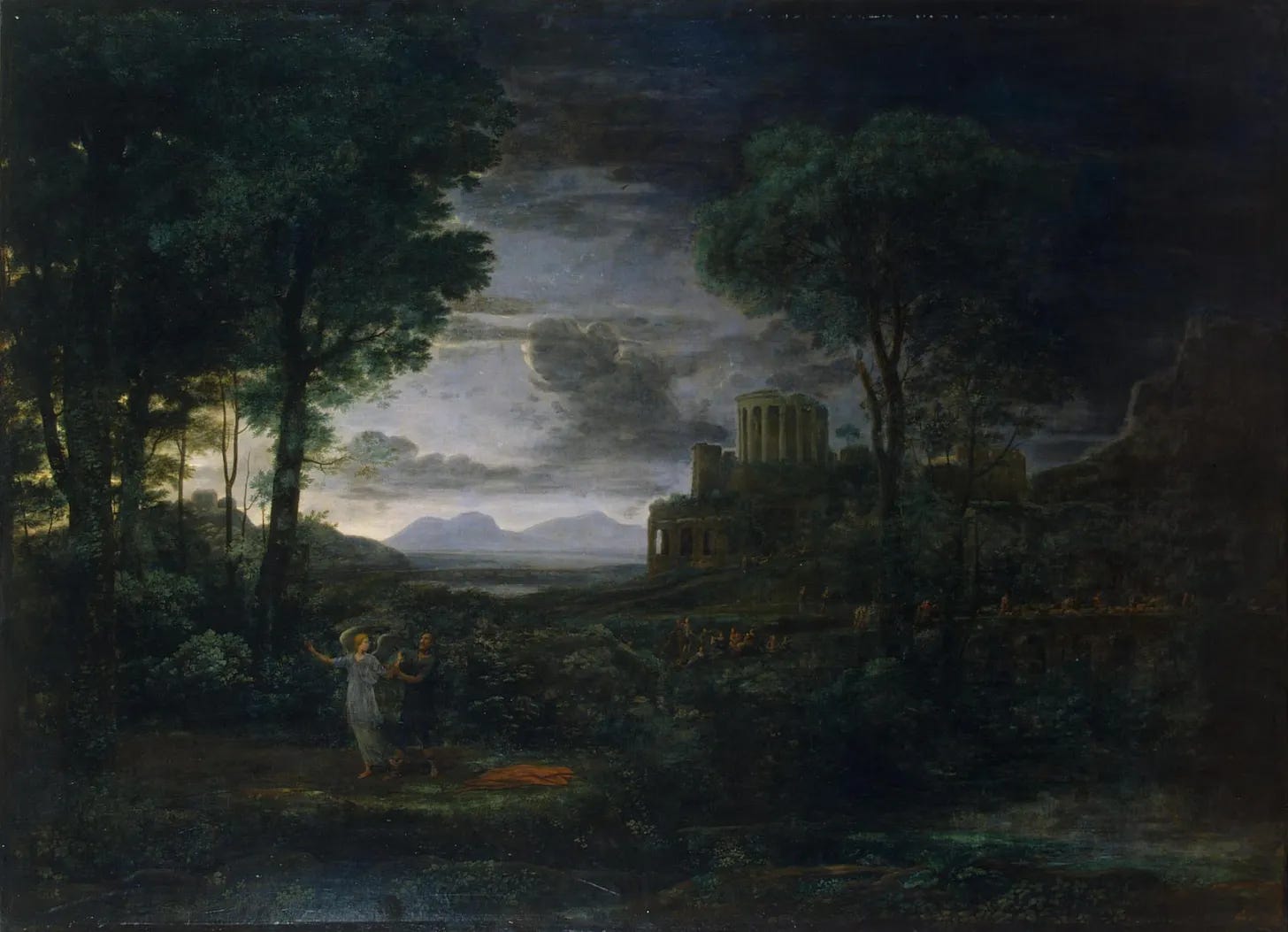
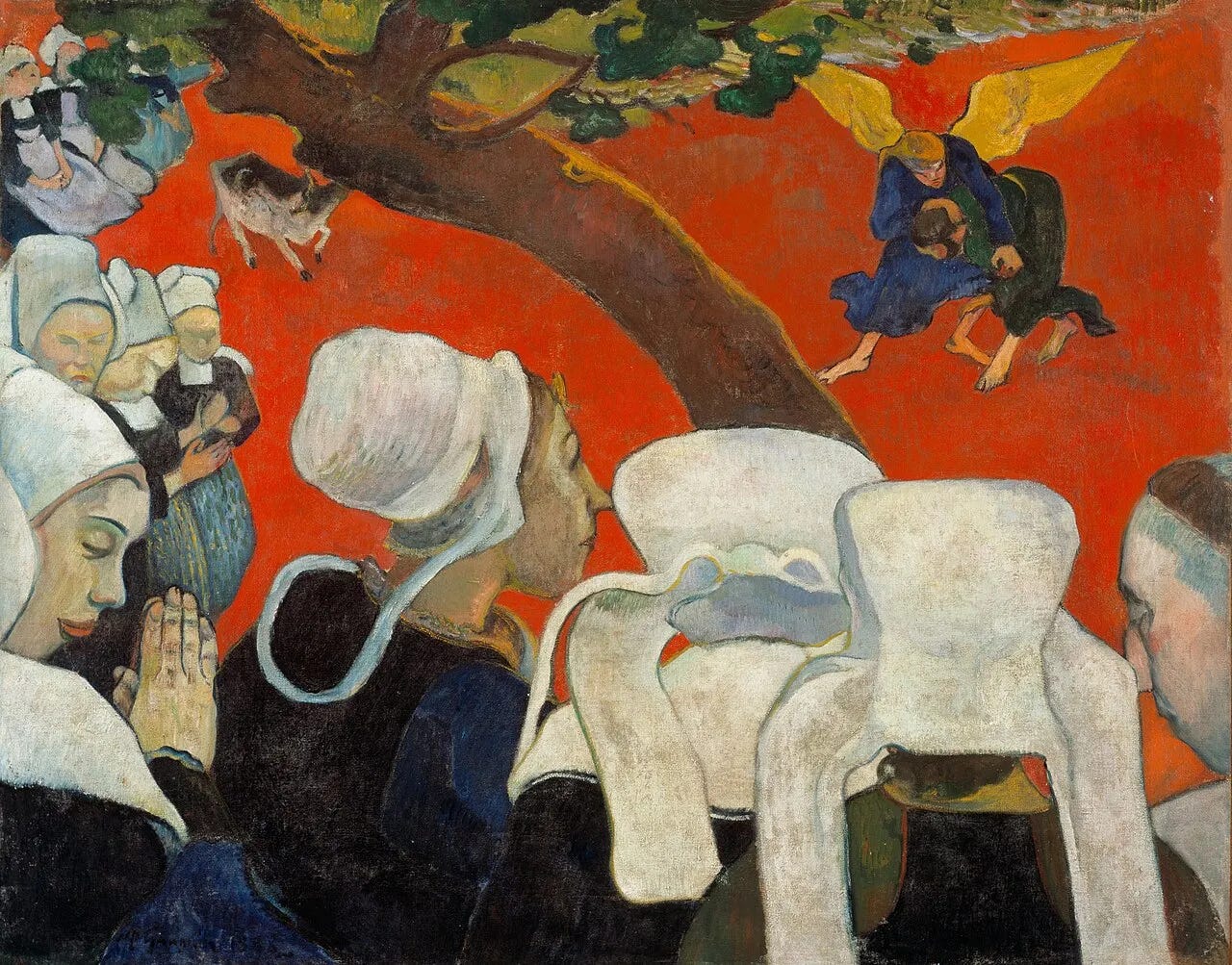
Then comes the heart of the narrative. Jacob makes his wives, his children and his flocks cross the ford of the Jabbok. He remains alone. And in the darkness, a man — ish, says the text, with deliberate opacity — wrestles with him until the break of dawn. The narrative never states clearly who this adversary is; one learns only afterwards that he may have been of divine character, for Jacob then declares: ‘I have seen G-d face to face.’ This opacity is not an accident of composition. It is constitutive of the meaning: the struggle with the Mystery takes place in the night, at the edge of a ford, between two worlds, and one emerges from it not with a clear answer but with a transformation.
Two things happen at dawn. Jacob receives a new name: ‘You shall no longer be called Jacob, but Israel, for you have struggled with G-d and with men, and you have prevailed.’ And he emerges from the struggle limping, his hip wrenched by his adversary. These two events are inseparable, and therein lies all the depth of the scene. The old identity — Yaakov, the supplanter, he who defined himself by what he seized, took, stole from the other — breaks and reconstitutes itself as Israel, an identity no longer founded on subtraction from his brother but on direct confrontation with what surpasses him. Jacob ceases to be defined by what he took from Esau, and becomes defined by what he traversed in the night. But this refounding bears a price inscribed in the flesh: the limp. Israel does not emerge from the struggle intact, glorious, purified. He emerges wounded and upright. And this detail is decisive, for it forestalls any triumphalist reading: the name Israel does not designate he who has conquered the Mystery, still less he who possesses it, but he who has held fast despite the wound. All authentic Israel limps. A thought, a tradition, a people that presented itself as having dissolved the question, eliminated the mystery, resolved without remainder the human condition, would thereby have betrayed this emblematic figure of an authentic spirituality.

Esau’s morning: recognition without fusion
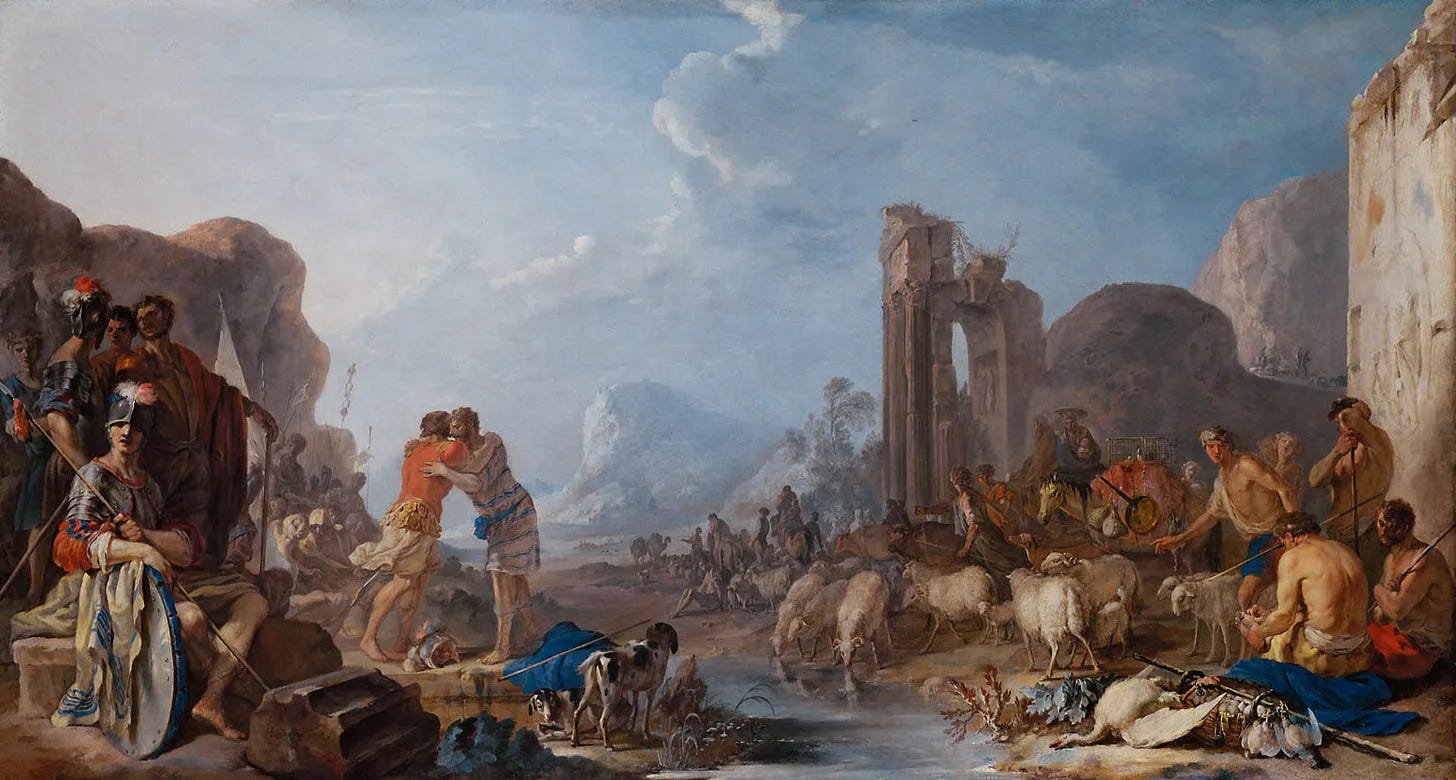
In the morning, ‘Jacob lifted his eyes — wayyissa Yaakov einav — and saw Esau coming with his four hundred men.’ He advances, and, against all the accumulated fear, no longer hides behind his flocks: he goes before his own people, he walks, he limps, but he walks. He bows to the ground seven times before his brother. And against all expectation, the encounter is not a carnage but an embrace: Esau runs towards him, falls upon his neck, kisses him, and both men weep. Jacob then says a phrase that sums up everything this series has sought to document: ‘To see your face is like seeing the face of G-d.’
The symmetry is too precise to be coincidental. The face of G-d encountered in the night makes possible the re-cognition of the other’s face in the day. The struggle with the Mystery has opened in Jacob a capacity to see, to be truly face to face with one he could not previously face. And there is more: Jacob comes towards his enemy limping. He does not arrive transfigured, in a position of strength. His visible wound says to the other: I am not intact, I have been through something, I do not come to dominate you. Vulnerability equalises. It creates the conditions for a mutual recognition that is perhaps the only solid foundation for a real peace.
But the narrative refuses easy consolation to the end, and it is this that saves it from naivety. Jacob and Esau, after the embrace, do not fuse. They do not become one people, do not share one encampment. Esau offers to journey together; Jacob declines with courtesy, and each departs on his own way, towards his own destiny. Reconciliation does not efface difference; it only makes it possible for difference to cease to be a threat. Two brothers, two peoples, two trajectories, now coexisting without the existence of the one being the negation of the other. It is this model, and this alone — not that of an improbable fusion, nor that of one party’s victory over the other — that will need to be transposed.
But before this transposition, a question arises that is by no means obvious: can this narrative, born of the memory of only one of the two peoples, speak to the other as well? And above all, who here is Jacob, and who is Esau? One will see that the answer is not the one expected, for neither camp occupies a fixed place when we transpose this narrative: each is in turn the brother who has wronged and the brother who is feared. It is here that the two traditions must enter into dialogue.

Torah and Quran in dialogue: two shores, one water
We must begin by dispelling a misunderstanding that the war of narratives has installed as a self-evident truth: the idea that the Torah and the Quran are two alien universes, two rival legitimacies disputing the same land from worlds with no convergence whatsoever. This is false, and a falsehood verifiable by reading the texts themselves. The two traditions are not foreign to one another; they are interwoven at the root. And the best way to demonstrate this is not to place them side by side in two separate expositions, but to set them in dialogue — as the peoples who claim them would, if they permitted themselves to do so.

The shared family: a genealogy of reconciliations
The first interweaving is genealogical, and it bears directly on the narrative we have just traversed. Let us ascend two generations before Jacob, to his ancestor Abraham. He had two sons: Ishmael, the elder, born of his servant Hagar, and Isaac, born of Sarah, the child of the promise who would be the father of Jacob. Genesis recounts the sending away of Hagar and Ishmael into the desert, the separation, the wound of the rejected son on account of Sarah’s jealousy. One might expect this rupture to be the final word. It is not. For when Abraham dies, the text notes a detail that hurried readers pass over without heeding: ‘And Isaac and Ishmael, his sons, buried him in the cave of Machpelah’ (Genesis 25:9). The two separated brothers, the rejected and the chosen, come together side by side before their father’s body. The first broken Abrahamic fraternity closes, in silence, over a shared tomb.
Yet this genealogy belongs not only to the Torah. Abraham — Ibrahim — is one of the pillars of the Quran: the hanif, the pure believer prior to all confessional division, ‘the friend of G-d’, model of confident submission to the divine. And Ishmael — Ismâ’îl — is honoured there as a prophet, son of Abraham and, according to tradition, co-builder of the Kaaba with his father; he is also considered the ancestor of the Arabs, the lineage through which, centuries later, the Prophet who would receive the Quran would come. The two peoples are therefore not simply disputing a land: they descend from the same man, through his two sons.
But one must guard here against an easy conclusion, for the two traditions do not say the same thing about these two sons, and their disagreement is more instructive than any accord would be. In the Torah, the covenant with G-d, the brit, passes through Isaac; to Ishmael the divine promise is of another tenor, not the covenant but an express blessing and a great nation descended from him (’I will bless him, make him fruitful, and multiply him exceedingly’, Genesis 17:20). The Quran performs precisely the inverse movement: the decisive lineage passes through Ishmael, for it is Abraham and Ishmael together who raise the foundations of the Holy House in Mecca and pray to G-d to raise up from their descendants a messenger who shall teach the Book (Quran 2:127-129) — a prayer which tradition reads as the announcement of Muhammad. Each revelation therefore places the centre of gravity with ‘its’ son: the Torah with Isaac, the Quran with Ishmael. (To read the Quran online)
One might see in this the very heart of the conflict, and that would not be altogether wrong: each tradition believes itself to hold the true promise, and holds the other lineage to be secondary. But two things forbid making of this a war of heirs. The first is that neither text transforms this preference into a curse upon the rejected one: the Torah has Ishmael blessed and brings him back to bury his father; the Quran honours Isaac as a truthful prophet and professes that ‘no distinction is made between the messengers’ (Quran 2:136). On both sides, the other son is blessed, recognised, never cursed. The second is that this double, inverted promise is precisely what the gesture of Meiri of Perpignan, of which we shall speak further on, makes it possible to think without contradiction: each reads, from his own shore, a promise as real for him as mine is for me, and to recognise that the other knows himself to bear a promise does not oblige me to renounce my own. It is this asymmetrical fraternity, where each is the elder in his own narrative — not an abstract equality — that founds common ground. It exists prior to all dialogue; it is inscribed in the very blood of the narratives themselves.
And what strikes one, as soon as one holds the two bodies of scripture together, is that reconciliation within them is less a theme than a law of the lineage, repeated from generation to generation. Isaac and Ishmael come together before the dead Abraham. Jacob and Esau embrace at the ford of the Jabbok. Joseph, as we shall see, forgives the brothers who had sold him. Three generations, three broken fraternities, three reconciliations. The family from which the two peoples in conflict are descended is, in its very founding texts, a long school of forgiveness between brothers. When a Muslim reads the story of Jacob, he does not read the myth of a foreign people: he reads the story of Ya’qub, a prophet honoured in the Quran, father of Yusuf. The narrative thread is shared; it is the heirs who have forgotten it.

The stranger one must recognise
To the most repeated commandment in all of the Torah — ‘you shall not oppress the stranger; you know the heart of the stranger, for you were strangers in Egypt’, a formulation that recurs thirty-six times, more than any other precept — the Quran responds with one of its most universalist verses, placed in the epigraph of this article: ‘We have constituted you as peoples and tribes so that you might come to know one another’ (Quran 49:13). The decisive word is ta’âruf, this mutual knowing: the diversity of peoples is not there a defect to be abolished nor an obstacle to overcome, but the very purpose of creation, an invitation to know one another rather than to dominate one another. And the Quran pushes even further this theology of plurality, to a vertiginous point that fundamentalist readings hasten to forget: ‘Had G-d willed, He would have made you one community’ (Quran 5:48). The diversity of paths is not a concession to human weakness; it is willed, deliberate, divine. What the Torah formulates as an ethical obligation towards the other, the Quran formulates as a theological intention: otherness is not an accident of history that truth will eventually dissolve, but the very condition which G-d has chosen to bestow upon mankind. To which it adds, in a phrase that should suffice to disarm all conquest in the name of faith: ‘There is no compulsion in religion’ (Quran 2:256).

When the Quran cites the Mishnah: the inviolable life
There is even a place in the Quran where the two traditions do not merely answer one another: one explicitly cites the other, and says so. Sura Al-Ma’ida states: ‘We decreed for the Children of Israel that whosoever kills a person, unless it be for a killing or for corruption in the land, it is as if he had killed all mankind; and whosoever saves a life, it is as if he had saved all mankind’ (Quran 5:32). This verse echoes, almost word for word, an older teaching of the Mishnah, in the tractate Sanhedrin: ‘Whosoever destroys a single soul, Scripture accounts it as if he had destroyed an entire world; and whosoever saves a single soul, Scripture accounts it as if he had saved an entire world’ (Talmud, Sanhedrin 37a).
The Quran does not merely converge with the Jewish tradition on the absolutely inviolable character of a human life; it explicitly attributes this teaching to the Children of Israel, thereby recognising its source. The interweaving of the two bodies of scripture is therefore not an analogy invented by a well-meaning commentator; it is textual, assumed, engraved in the Quran itself. This is what both extremisms had to cover over in order to kill: a sacred text of one citing a sacred text of the other to say that to kill one man is to kill all of humanity.

The great struggle: Islam’s Jabbok
The night of Jacob, that solitary, nocturnal confrontation with what surpasses him, from which he emerges transformed and wounded, finds on the other shore a structural echo of striking precision. The Islamic tradition distinguishes two forms of jihad, a word whose primary meaning is not ‘holy war’ but ‘effort’. According to a saying attributed to the Prophet — the transmission chain of which hadith scholars debate, but which has become central to the entire spiritual and Sufi tradition — Muhammad, returning from a military expedition, is said to have declared: ‘We have now returned from the lesser jihad to the greater jihad‘; the greater being the struggle against oneself, against the nafs, the carnal soul, the passions that enslave.
All of contemplative Sufism, the very form of Islam that the Brotherhood has marginalised in order to make it an ideology of external combat, has placed this jihad al-akbar, this great interior struggle, at the heart of the spiritual life. And this is the very structure of the night of the Jabbok: the decisive combat is not the one waged against the other, but the one waged against oneself, in solitude and darkness, from which one emerges not unscathed. Both traditions know, each in its own language, that the transformation which makes peace with the other possible passes first through a struggle with oneself that no one else can conduct in one’s place.

The betrayed brother and forgiveness: the sura of Yusuf
But the deepest mirror between the two traditions is not a concept: it is a narrative, and it is the direct continuation of the story of Jacob. The Quran devotes an entire sura, the twelfth, to Yusuf, Joseph, Jacob’s son, and introduces it with a formula unique in the whole Quranic text: ahsan al-qasas, ‘the finest of narratives’. Yet this story is not a Quranic invention: it is, almost detail for detail, the one that the Torah recounts in chapters 37 to 50 of Genesis. Joseph thrown into a pit by his jealous brothers, then sold and taken into slavery in Egypt, raised to the summit of power by his gift for interpreting dreams — and who, when these same brothers come to him during the famine without recognising him, chooses not vengeance but forgiveness. Genesis places in his mouth: ‘It was not you who sent me here, but G-d’ (Genesis 45:8); the Quran has him say: ‘No reproach upon you this day; may G-d forgive you, for He is the most merciful of the merciful’ (Quran 12:92). Two Books separated by a thousand years and by a schism, recounting the same reconciliation between the same brothers, in the same words or nearly so.
And the differences between the two versions, far from weakening this parallel, make it more eloquent still, for each illuminates one face of the same movement. The narrative of Genesis is long, choral, encumbered with an entire family: Judah who stands surety for Benjamin, Joseph’s successive ruses, hiding the cup in his brother’s sack, testing his kin, delaying the revelation, weeping in secret before revealing himself. It is the narrative of a process: reconciliation there ripens slowly, in stages, exactly as the night of the Jabbok ripened through Laban and Mahanaim. The Torah shows the path in its full duration and full difficulty. The Quran, for its part, tightens the narrative around Joseph alone, presents him immediately as a prophet receiving a revelation, and lays the emphasis on two virtues it holds up as a model: sabr, patience in ordeal, and forgiveness as the summit of spiritual life. Where Genesis unfolds the process, the Quran draws from it the lesson. One narrates at length how one makes the journey; the other goes straight to what the journey teaches. That both versions are needed to hold the whole story is perhaps the most just of symbols: the two peoples each hold a part of the same wisdom, and would possess it whole only by consenting to read it together.
That this shared narrative is, for the Quran, the finest of all, and that it extends directly from that of Jacob and Esau, the generation after, the same blood, the same Abrahamic family — this is no coincidence. The two traditions agree not only, in theory, on the value of reconciliation: they share the very narrative in which this reconciliation takes place and is transmitted, from Isaac and Ishmael before the tomb of Abraham to Jacob reconciled with Esau, then to Joseph reconciled with his brothers. Fraternal forgiveness is not a theme borrowed from outside; it runs in the veins of both founding narratives, and it is the same blood that circulates in them.
There is, moreover, a word in the Arab-Muslim tradition to name what Joseph accomplishes towards his brothers: sulh. Far from designating a vague goodwill, it is a precise institution for the resolution of conflicts, one that does not seek first to establish who is guilty but to restore the severed bond, and which is sealed through a public reconciliation and a shared meal. The Quran summarises it in a lapidary formula: ‘reconciliation is a good’ (wa-l-sulhu khayr) (Quran 4:128). And the final scene of Joseph is its archetype: not a court of judgement, but the wronged brother who pardons, the bond remade, the family reconstituted around a table in Egypt. The Torah had already given the form of this gesture a generation earlier, when Jacob and Laban, at the end of their dispute, raised a stone and shared a meal to seal their pact (Genesis 31:54). From one end of Abraham’s family to the other, reconciliation takes the same concrete form: an outstretched hand, a table, a meal taken together.

Mystics and philosophers, from shore to shore
What the prophetic texts lay down, the mystics of both traditions have carried to incandescence, and they have done so, from opposing shores, in strikingly convergent terms. Ibn Arabi, the greatest of the Sufi masters, wrote in the thirteenth century in his work The Interpreter of Desires, Turjuman al-Ashwaq: ‘My heart has become capable of every form: it is a pasture for gazelles, a cloister for monks, a temple for idols, the Kaaba of the pilgrim, the tablets of the Torah, the book of the Quran. I am the religion of love, whichever direction its mounts may take.’ Shortly before him, al-Ghazali — who is no marginal figure but one of the greatest Sunni theologians, he whom the tradition has surnamed the ‘Proof of Islam’ — had made interior purification, the struggle against the passions of the soul, the very heart of the lived faith; he had reconciled in a single work the rigour of the law and the depth of Sufism. And Rumi, a century later, sang in a verse that has become proverbial: ‘Beyond ideas of right-doing and wrong-doing, there is a field. I will meet you there.’ From these three voices rises the same water: the authentic spiritual life of Islam was never the conquest of the other, but the welcoming of what the divine has deposited within him.
On the other shore, Jewish mysticism had sensed the same thing in its own language. The Kabbalists made Jacob-Israel a sefirah, Tiferet, Beauty, the heart of the sefirotic Tree, the principle that harmonises and reconciles the two opposing divine forces, the overflowing mercy of Hesed and the cutting rigour of Gevurah. Israel thus became, in Jewish mysticism itself, no longer merely a people but a structure of being: the figure of the middle that holds together what opposes, the cosmic reconciler. And Rav Kook, heir to this Lurianic Kabbalah, wrote in For the Perplexed of the Generation — Le’Nevuchei Ha’Dor that ‘in every religion there is a divine spark of morality that sustains it’, through which ‘humanity may progressively advance towards belief in divine unity’.
That these two mysticisms answer one another is, moreover, no surface coincidence: they truly crossed paths, and fertilised each other. The Kabbalah was born and matured precisely where Judaism lived in closest contact with Islam, in Andalusian Spain and the Provence of the twelfth and thirteenth centuries, those same lands where Meiri would write at Perpignan. Historians of mysticism have long shown what the Kabbalistic theory of the divine attributes, like the spiritual poetry of a Judah Halevi, owed to Sufism and to Arabic philosophy; Maimonides himself thought in part in the language and with the tools of the Muslim philosophers. In other words, the convergence of the two traditions on the welcoming of the other is not simply an analogy that a well-disposed reader imposes after the fact: it is a historical kinship, woven across the centuries when Jews and Muslims inhabited the same cities and read the same books. This fertile coexistence truly existed; it is not, therefore, in principle beyond reach.
This mystical intuition, two twentieth-century Jewish thinkers translated into philosophy, and their translation touches the very heart of this article. Martin Buber, who was also, as we saw in the second article, one of the voices of the ethical Zionism of Brit Shalom, opposed two fundamental ways of existing in the world: the I-It relation, where the other is merely an object to be used, classified, dominated, and the I-Thou relation, where the other is encountered as an irreducible presence, a genuine interlocutor. The whole mechanics of extremism described in this series is, at bottom, nothing but a gigantic reduction of the other to an It — a threat, an obstacle, an invisible labour force. Buber, who from the 1920s defended a Judeo-Arab understanding and a homeland common to both peoples, had drawn from this a direct political consequence: peace would not be built upon the domination of one people by the other, but upon the genuine encounter of two presences that recognise each other.
And Emmanuel Levinas, marked in his own flesh by the Shoah, made the face of the other the foundation of all ethics: the face of the other man, in its nakedness and fragility, addresses me with a silent injunction that precedes all words and all calculation — ‘thou shalt not kill’ (Exodus 20:13). The face, in Levinas, is precisely what forbids murder. One measures then the depth of Jacob’s phrase, ‘to see your face is to see the face of G-d’: it says, twenty-five centuries before Levinas, that to recognise the enemy’s face as a face is to render oneself incapable of killing him. From shore to shore, from century to century, the same intuition surfaces and is transmitted: the other is not the enemy of my faith nor the object of my power, but one of the forms the divine has chosen to take, and his face looks upon me.

The limit that must be named
It would be dishonest, and contrary to the rigour this series has claimed from one end to the other, to stop at this harmony. For this dialogue of texts, as real and documented as it is, has never governed politics. The same scriptures that cite and answer one another have been changed into land registers and waqf, into titles of divine ownership withdrawn from all human compromise. The convergence of prophets and mystics has prevented neither the wars, nor the seventh of October, nor the destruction of Gaza. The question, then, is not whether resources for reconciliation exist in both traditions — they exist, as we have just verified, abundantly and interwoven. The question is to understand why they have remained without effect, and what prevents them from being mobilised. And the answer, at bottom, comes down to a single obstacle, formidable precisely because it hides at the very heart of what makes a tradition strong: the temptation to believe that recognising the truth of the other is to betray one’s own. It is this obstacle which a single man, in Perpignan, in the thirteenth century, knew how to remove — and it is he of whom we must now speak.

‘All Israel limps’: Meiri and al-Ghazali, or the recognition of the other
Meiri’s gesture: recognising without absorbing
Menahem ben Solomon Meiri (1249-1316), born and died in Perpignan, is the author of the Beit HaBechirah, ‘the House of Choice’, an encyclopaedic commentary on almost the entire Talmud. Heir to the Provençal school, to the rationalism of Maimonides and to daily contact with the Christians and Muslims of the towns of Languedoc and Catalonia, he accomplished a gesture which the Jewish tradition largely forgot for centuries — it was rediscovered above all in the twentieth century, notably by the historian Jacob Katz, precisely because it was troubling. Where the halakhah drew a juridical distinction between the Jew and the non-Jew, the goy, Meiri introduced a third category that overturns this binary: the umot ha-gedurot be-darkhei ha-datot, ‘the nations bounded by the ways of religions’. Any people, any community that lives under the governance of a moral law, a religious discipline, an ethic of responsibility — whether Christian, Muslim, or other — deserves, he argues, to be treated with the same ethical consideration as an Israelite, in the very domains where the halakhah had previously distinguished.
What Meiri accomplishes is not a relativism; he does not say that ‘everyone is Jewish’ or that ‘everything is equivalent’. He says something far more nuanced, and far more powerful: the determining category is not ethnic or confessional affiliation, but the moral structure of existence. He thus performs what contemporary philosophy would call a universalisation by recognition, the exact opposite of the universalisation by substitution practised by historical Christianity in proclaiming ‘the true Israel is us’. In substitution, the universal cancels the particular: it claims to replace the original. In Meiri’s recognition, the particular remains the hearth from which the universal is glimpsed — Meiri speaks from Israel, never in place of Israel — and he recognises a common form through irreducibly diverse expressions, without dissolving any of them. This is, in more recent language, a concrete universal: a universal that is valid only because it is inhabited by an irreplaceable particularity, and that radiates from it without erasing it.

Al-Ghazali: the same recognition, seen from within
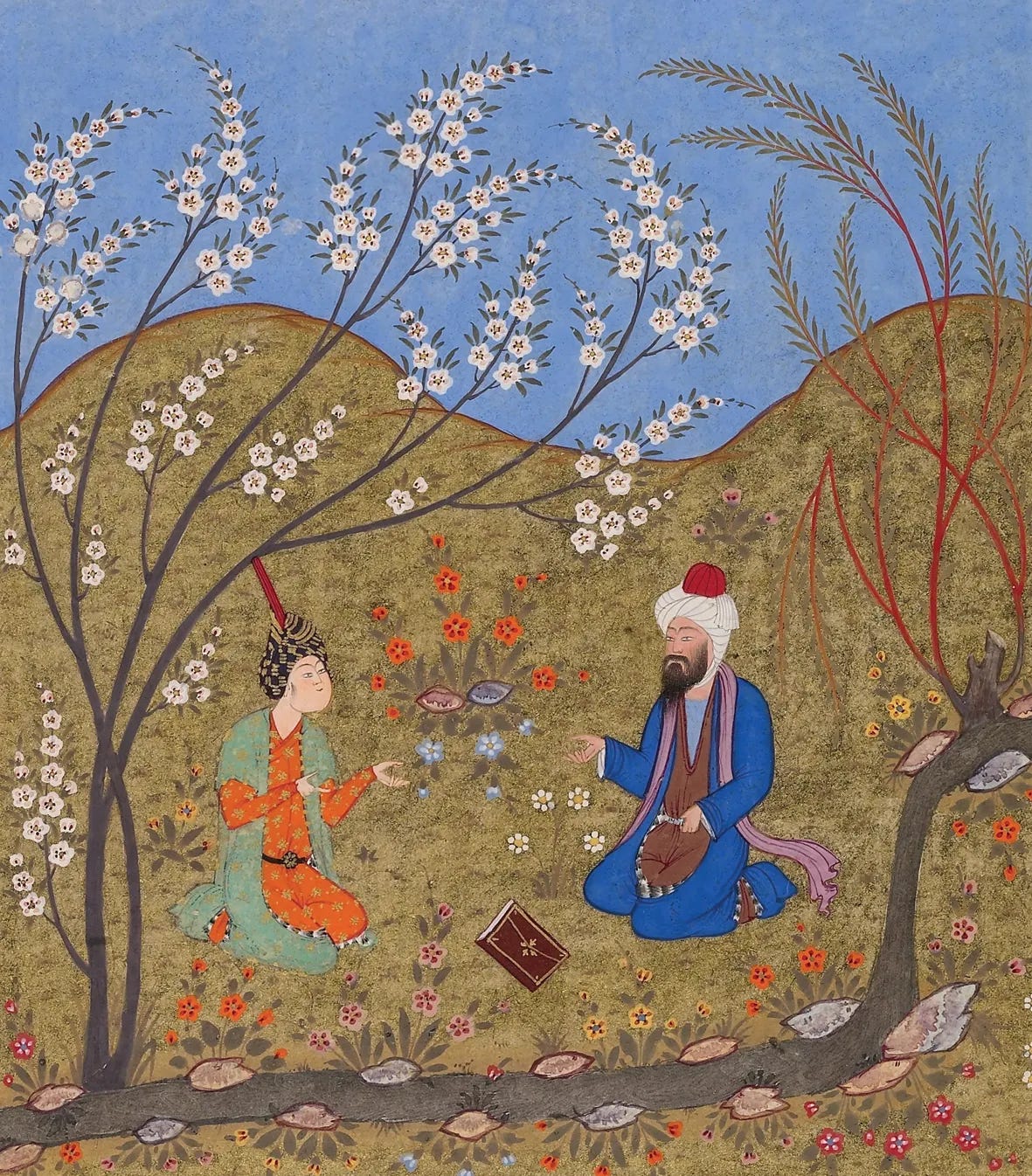
And this gesture is not a Jewish singularity, isolated on its shore: it has, on the other, an almost exact counterpart. Each tradition therefore bears within itself, from the inside, the principle that makes it possible to recognise the other — and that, at bottom, is what this entire article seeks to show. Al-Ghazali, already encountered for his knowledge of the interior struggle, sustained in his treatise on the Decisive Criterion a thesis of quiet audacity: salvation is measured not first by the confessional affiliation declared, but by the sincerity of the quest for truth and the uprightness of the heart. Many of those who have never received the message in its authentic form, or have known only a distorted image of it, belong, in his view, to divine mercy, because G-d judges what lies at the depths of beings and not the label they wear.
The parallel with Meiri is striking, and the difference between the two gestures is what gives it its full value. Meiri, a jurist, shifts the criterion from outside: what renders a nation worthy of consideration is its visible moral discipline, its orderly manner of inhabiting the world. Al-Ghazali, a mystic, shifts the same criterion towards the inside: what saves a being is the interior quality of his search, invisible to all but G-d. One recognises the other by his conduct, the other by his heart; but both refuse to let the frontier of belonging be the frontier of humanity. That this refusal was formulated separately, at the very heart of Judaism and at the very heart of Islam, by two of their greatest minds, says clearly enough that the recognition of the other is not an import from modernity: it lay dormant in both traditions, waiting to be awakened.

Defusing the war of promises
This is what defuses the war of promises evoked above. As we have seen, each tradition places with ‘its’ son — Isaac for the Torah, Ishmael for the Quran — the decisive promise, and is inclined to hold the other lineage to be secondary. As long as one reasons by substitution, these two claims are mutually exclusive: if my promise is the true one, yours is usurped, and one is brought back to the logic of the two extremisms for which one people’s land can only be the denial of the other’s. Meiri’s gesture opens another path: I may hold my promise as mine, fully, irreducibly, and recognise at the same time that you know yourself, from your shore, to bear a promise as real for you; without your certainty annulling mine, nor mine yours. To recognise the other’s promise is not to renounce one’s own; it is to cease demanding that the other have none.

Israel, proper name and common noun
Let us apply this key to the very name of Israel, and the whole tension unravels. Israel designates, in its primary and irreducible sense, a particular people, bound to a singular history, to a revelation, to a wound inscribed in the flesh through circumcision and in time through the Sabbath. This cannot be diluted, transferred, or claimed by anyone else. But the existential structure which this people embodies — the struggle with the Mystery of the Living without capitulation or evasion, the wound accepted, the transmission of this experience as a path for standing upright — can be recognised as active, differently and partially but genuinely, in any human being or any tradition that lives under this same exigency. Israel, in this figurative and secondary sense, is whoever refuses to evade the Mystery, enters into struggle with it without seeking to annihilate it nor to submit to it passively, emerges transformed and wounded, and attempts to transmit this experience as a possible way of assuming the human condition. This excludes from this figure the militant atheism that denies the Mystery, the fundamentalism that claims to possess it without remainder, the nihilism that renounces the struggle, and the gnosticism that believes it can stride over this Mystery through knowledge, and emerge intact. And it includes, as the whole history of the just on both sides has shown, all those who have faced the night without averting their eyes.

Esau too is a wrestler
The decisive reversal is then this. The other, in this conflict, is always a son of Abraham. According to the tradition that makes him the ancestor of the lineage which would receive the Quran, the Arabs descend from Ishmael, the first son, the desert castaway who returned nonetheless to bury his father at Isaac’s side, the second son, progenitor of the tribes of Israel. Yet in the narrative of the Jabbok, both can also take the figure of Esau, the twin brother turned enemy and reconciled at the ford. These two aspects are not interchangeable, and it would be inaccurate to confuse them: Ishmael is the other by blood, Esau the other through the history of a fraternal betrayal. Yet together they speak the same truth, and with a force that neither would have alone. For in this night that each must traverse, it is indeed the other who holds the role of Esau, the brother one has feared, whom one may have wronged, and of whom one does not know whether he comes to embrace or to slaughter: the Israeli is the feared Esau of the Palestinian as much as the Palestinian is the feared Esau of the Israeli. The reconciliation to which this conflict calls is therefore not that of an elect with one who is rejected, of a people bearing the truth with a people deprived of it. It is the reconciliation of two brothers who each have their Jabbok to cross, and who are, for each other, in turn the wrestler and the feared enemy.
To see in the enemy’s face the face of G-d is not an edifying formula: it is to recognise that the other, too, is Israel in the sense that Jacob became it that night, a being who wrestles with the Mystery and bears its mark. And Meiri’s gesture has this liberating quality: that this recognition takes nothing from the proper name of the Jewish people. To recognise that the other too wrestles is not to renounce what one is; it is, on the contrary, to fulfil it. For ‘all Israel limps’ — and he who, on the opposite side, limps as well is not the enemy of my Israel: he is its unrecognised brother.

The process: helping two peoples cross the Jabbok
There remains the most difficult test: to transpose this individual path — four stations traversed by a man alone, in one particular night, at the edge of a ford whose name we still know — to two entire peoples, each laden with millions of dead, with irreconcilable memories, with national narratives soldered to suffering. This transposition will never be an equivalence: the two memories do not weigh the same at the same moments, and the whole series has refused the false balance that settles responsibilities in equal shares. But the structure of the path holds good for both, for neither can do without a single one of its stations.

Laban, or free hands
Before being able to open their arms towards the other, each people must settle its relation to what it has itself endured. For the Jewish people, this is the wound of two millennia of persecutions, expulsions and pogroms, of which the Shoah is the abyss: that matricial wound which, in Paris in 1895, before Captain Dreyfus degraded beneath cries of ‘death to the Jews’ in the courtyard of the École Militaire, founded in the Viennese journalist Theodor Herzl the conviction that a refuge-state was needed, and which today renders any questioning of Israel’s security literally unbearable. For the Palestinian people, it is the Nakba, the dispossession, the exile, and those refugee camps maintained across several generations as a wound that no one wished to let heal: not Israel, which refused return; not the Arab regimes, which often preferred to perpetuate refugee status rather than integrate those they claimed to defend; not an international community that funded survival without ever imposing a solution. The wound is real; its guardians are more numerous than is ordinarily said.
This is not a matter of placing these two wounds on the two pans of a balance; that would be to fall back into false symmetry. It is a matter of noting that each must be worked through by those who bear it, because a people that remains entirely defined by its victimhood, whatever that may be, has not yet closed its Laban chapter, and keeps its hands bound by its own past. Charles Rojzman, the inventor of social therapy, who spent his life leading groups in conflict towards reconciliation, formulated this in clinical terms when he cited Yeshayahu Leibowitz, who featured in the second article: ‘nothing is more comfortable than to define oneself by what others have done to us, for it spares us the question “who are we?” and the need for any examination of conscience.’ The remark was aimed at Israelis, but Rojzman observed that it applies just as much, almost identically, to Palestinians: two peoples each enclosed within the circle of their own wounds, and each systematically underestimating the fear and suffering of the other. This is the station that both have, until now, most obstinately refused: each remains in the camp of the despoiled, and from there one does not open one’s arms; one clenches one’s fists.

Mahanaim, or the craftsmen of the first gesture
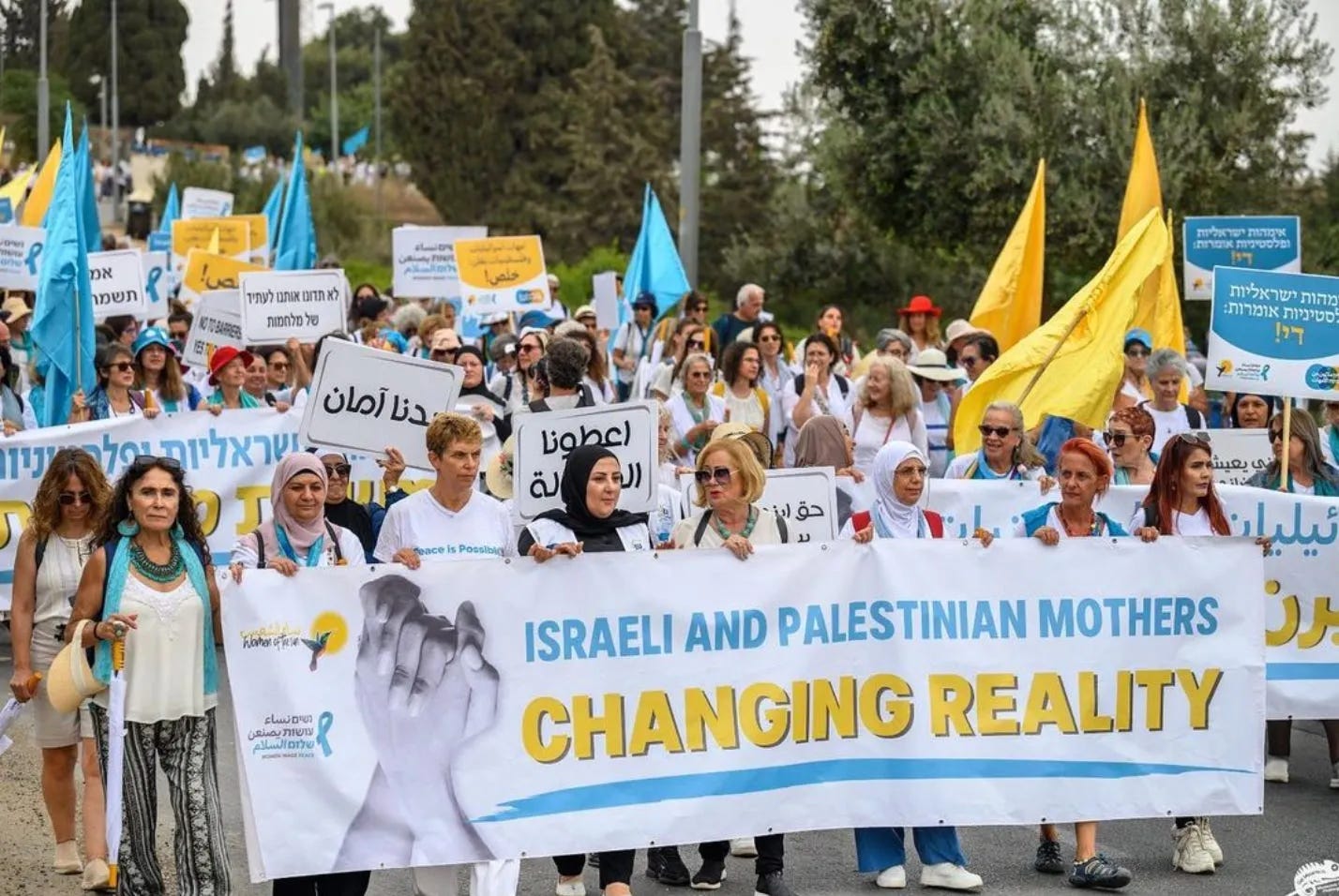
It is here that the lucid voices whose history the second article of this series recounted return, no longer to be enumerated but to be named at last by their proper name: they are those who took the first step before being ready, in fear, without guarantee, and who saw for this reason the angels on their path. The mothers of Women Wage Peace and Women of the Sun who marched together in Jerusalem on 4 October 2023, three days before the worst, signing a Mothers’ Appeal against the cycle of bloodshed. The Combatants for Peace, former Israeli soldiers and former Palestinian fighters who laid down their arms together. The forum of bereaved families from both camps. Standing Together, which secured humanitarian convoys in the midst of war. All wagered that action precedes transformation, that one sets out towards the other without waiting to have resolved one’s own night.
And what they practise intuitively, half a century of fieldwork has distilled into method. Rojzman, again, tested his own in the French banlieues, in Rwanda after the genocide, wherever groups separated by fear and hatred must relearn to live together. His postulate runs counter to the usual diplomatic intuition: it is not the conflict that must be eradicated, but the violence. Conflict, when conducted within a framework that maintains mutual recognition, is not the enemy of peace; it is its necessary passage, for it obliges adversaries to say face to face what polite dialogue conceals. Violence, by contrast, dehumanises the other and excludes him from the human race; conflict accepted and faced, on the contrary, maintains him as an interlocutor. This is, transposed into the language of fieldwork, the night of the Jabbok itself: not the avoidance of the confrontation, but its traversal, from which one emerges changed.
Rojzman added a fundamental requirement for reconciliation to become possible: it would be necessary to teach, in schools, the affective history of the other — not the history of events, always disputed, but that of his emotions, his pride and his anxieties, received without judgement, as a recognition of the other’s heart. To hear the adversary’s pain without judging it is already to see in his face something other than a threat. This is what the mothers of Women Wage Peace and Women of the Sun do, without always theorising it, when they sit together: not to negotiate positions, but to hear the other’s fear as one would wish one’s own to be heard. And all have paid the price of Mahanaim: the seventh of October struck first at the peacebuilders, the kibbutzim of the pacifist left, Vivian Silver murdered at Be’eri. The first step is not reconciliation; it is only the putting in motion, and it exacts a price. But without it, nothing of what follows is possible.

The Jabbok, or the transformation that cannot be passed on
Then comes the struggle which no one can conduct in the other’s place, and it is here that the transposition becomes most demanding, for the night does not have the same content for each. For Israel, to cross the Jabbok would be to confront the temptation of mastery — not the legitimacy of its existence, which is not in question, but the risk that the vital quest for security stiffens into a will to domination, that attachment to the land solidifies into a sacred land register, that the national impulse closes in upon the exclusivity which Kook the son substituted for his father’s prophetic universalism. Israel’s night would be to allow the name Israel once again to signify first the wrestler-with-the-Mystery, and not the master-of-the-territory. For the Palestinians, to cross the Jabbok would be to confront the identity built upon refusal and resentment, that theological line of the rejection of all Jewish presence which al-Husseini inoculated, that prison of martyrdom which Hamas has erected. The Palestinian night would be to recover the Quranic ta’âruf and the spirit of sulh against the waqf turned into a weapon, and to transform the combat into a jihad al-akbar against its own hatred rather than a lesser jihad against the other.
Neither can cross this night for the other, nor claim to have crossed it so long as the other has not crossed it also. And each, if it does cross it, will emerge limping: this must be named without circumlocution, for any reconciliation that presented itself as intact, triumphant, without scar or renunciation, would be a lie. Both peoples will emerge wounded from their night, or they will not emerge from it at all.

The morning, or the other’s legitimacy
At the end of the process, there is not one single people, not a fusion, not the erasure of differences. Jacob and Esau embrace, then each departs his own way, towards his own destiny. Two peoples, two national legitimacies, two memories, coexisting without the existence of the one being the negation of the other. The political translation of ‘to see your face is to see the face of G-d’ is not a treaty clause: it is to recognise the other’s national existence as legitimate, his wound as real, his face as a face and not as a threat. It is precisely this which has been absent from every agreement signed and subsequently betrayed over the last century: not one more article, not one more security guarantee, but this recognition, which no protocol contains and which only a night of the Mystery traversed by both peoples can produce.

A possible dream: the federation of two brothers
The morning of Jacob and Esau does not merely sketch an interior attitude; it sketches, if one listens to it to the end, a political form. Two brothers who embrace and then camp separately, on a land they can neither divide by ignoring one another nor inhabit by fusing: this is almost a definition of what could one day be a federation. One may dream of it, and to name that dream is not to yield to the naivety this series has combatted from one end to the other; it is to refuse that the absence of a horizon itself become a destiny. To dream, then, of two sovereign states, each endowed with its own institutions, its flag, its memory, its assumed national narrative, but linked by shared institutions where separation is impossible: to manage together Jerusalem, which neither can possess alone without denying the other; to guarantee free movement on a land too narrow for two walls; to watch over the balance of two forms of development which, instead of each proceeding against the other, would discover themselves to be complementary.
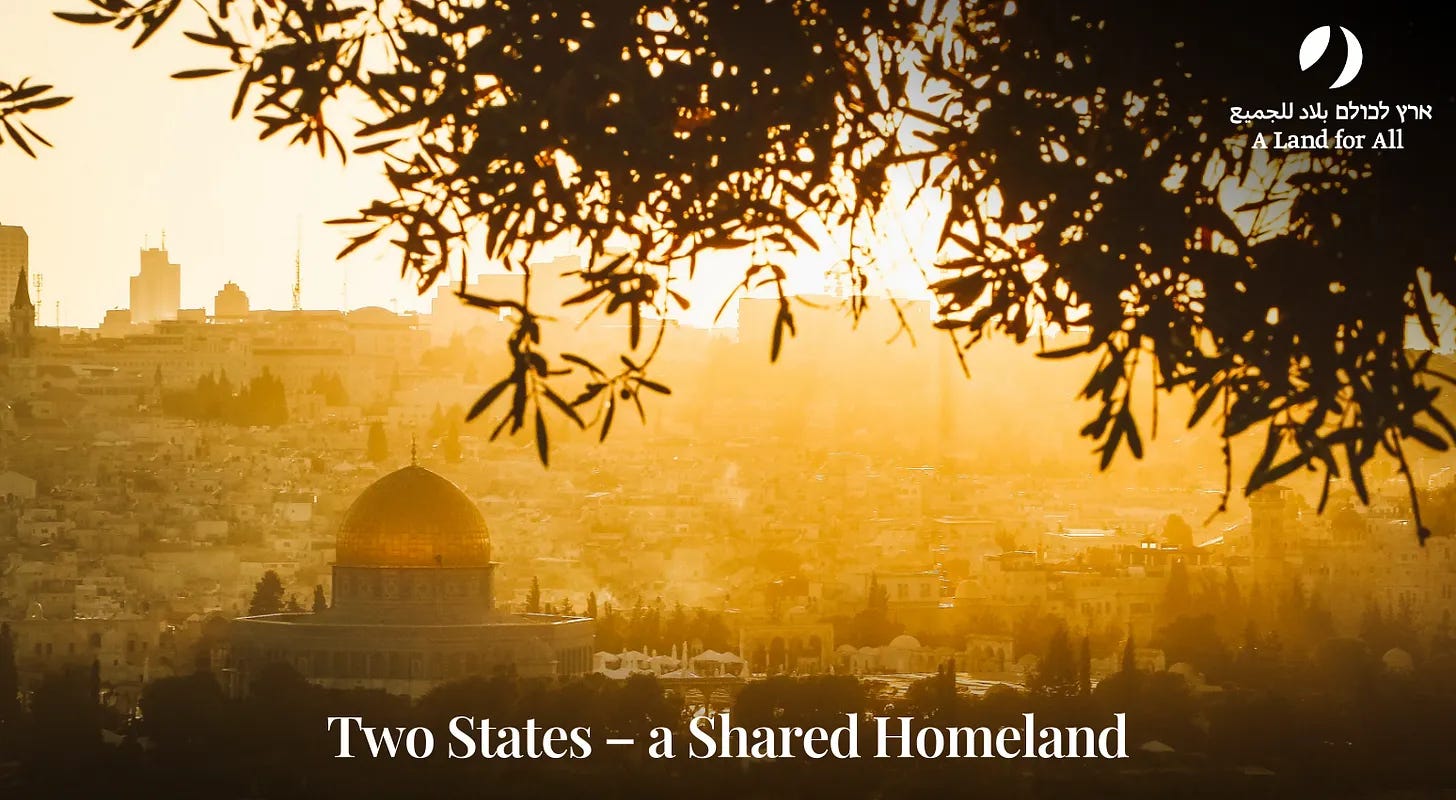
This is not a utopia without partisans. It is, almost point for point, the project carried since 2012 by an Israeli-Palestinian movement named A Land for All — Two States, One Homeland, founded jointly by thinkers, jurists and geographers of both peoples, and led today by an Israeli woman and a Palestinian woman. Its proposal starts from a fact that no walls will suppress: the land, from the Jordan to the sea, is felt as homeland by both peoples at once, and no boundary line will ever separate a Jew’s attachment to Hebron from a Palestinian’s attachment to Jaffa. The example of these two cities is eloquent, for it is a crossed one. Hebron, where tradition places the tomb of Abraham and the Patriarchs, one of the holiest sites of Judaism, lies in the heart of the West Bank, that is to say in Palestinian territory. Jaffa, the ancient Arab port, one of the great centres of Palestinian life before 1948, celebrated for its orange groves and its men of letters, is today a district of Tel Aviv, in Israeli territory.
Each people thus carries its deepest attachment towards a place situated ‘with the other’: proof, inscribed in the geography itself, that no frontier will ever bring the political boundary and the map of the heart into alignment. Rather than denying this double bond, the movement A Land for All proposes to recognise it and draw the consequences: two independent states within the 1967 borders, but an open frontier, freedom of residence and movement for the citizens of both states, and a set of shared institutions for water, the economy, the environment, fundamental rights and the joint management of Jerusalem. Separation where it is necessary, partnership where it is possible: a future, in their formulation, that is at once together and separate.
The analogy which this movement itself invokes is the one that the third article of this series had already cited as proof that an abyss can be bridged: the Franco-German reconciliation. Had one told a German of 1945 that his granddaughter would study freely in Paris, that the border between the two countries would vanish, that the same parliament would unite them, he would have held such words for madness. Three wars in seventy years, millions of dead, hatreds deemed hereditary — and yet two peoples eventually understood that their common interests outweighed their differences, and that they did not have to sacrifice their separate identities in order to build a shared future. The difference, and it is a considerable one, is that neither of the two nations inhabited the other’s land; here the two peoples share the same soil, which makes the challenge harsher still, but the stakes identical: to recognise that the other is here, that he will not leave, and that the only alternative to perpetual war is some form of existence side by side. This is, transposed into the grammar of the modern state, the very wisdom of the ford: neither fusion, nor war, but two brothers standing beside one another, each at home yet together.
I do not overlook how distant such a horizon may appear today, still more so after the seventh of October and the long and bloody war that followed it, at a time when the walls are rising and the voices of peace are more inaudible than they have ever been. But one must carefully distinguish between what is distant and what is impossible, for to confuse the two is precisely the gesture of the fanatics. And above all, one must see what this horizon requires concretely of us, here and now, well before it becomes reality. For such a federation to be one day conceivable, the two camps of reconciliation, those lucid and tenacious minorities that the second article named, those peacemakers of both societies, must cease to be minorities.
And the first step towards amplifying their voices costs neither money nor physical courage: it consists in refusing, in our own use of language, the war of narratives that feeds the conflict from afar. For this war is waged not only in Gaza or the West Bank; it is waged also on our screens, in our conversations, in the camps we choose by relaying one narrative against another. Each time one repeats the slogan that demonises a whole people, transforms a real pain into a weapon against the pain across the way, settles in a single word a conflict of which one knows only half, one throws one more twig into the fire — from one’s armchair, and in the belief that one is on the right side.
Conversely, to propagate a different discourse is already an act: one that holds both wounds to be real without setting them in competition, that distinguishes the fanatic from the sincere believer and the leader who exploits a people from the people he claims to serve, that refuses fatality without denying gravity. That, modestly, is what this series will have tried to outline from one end to the other — not in order to be right, but to offer another way of seeing, and therefore of speaking. Let this view and this way of speaking be passed on, let them gain a conversation, a shared article, a spirit that doubted, and already the balance of power between narratives shifts by one notch. Thus, if some readers emerge from these pages with, in their ear, a voice a little different from the tumult of slogans — less assured of holding the right camp, more attentive to the wound across the way — then this work will not have been in vain.
Beyond that first gesture, these artisans of peace must be supported, relayed, funded, heard, multiplied, until their number tips the balance of forces that the extremists now hold. And this is not the business of diplomats alone, nor of governments alone: it is also the business of each of us. To support those who, in both camps, have chosen to see in the other a face before an enemy — through the attention one gives them, through the narratives one relays, through the refusal to yield to the amalgams this series has dismantled one by one — is an engagement of conscience, and an engagement for the future. For the future is not written; it will be made of the decisions and actions that men and women, at every scale, will have chosen to assume or to refuse.
If this path is yours, if you think as I do that wherever we are we can contribute to advancing the cause of peace, there and around us, write to me, or let us speak by video: you will find my contact details and my video calendar on the Opening page. I will suggest a few associations to support there, and a few actions possible here from today — for it would take only a small determined group to begin, together, to make a voice for peace heard. That, at bottom, is the whole spirit of the Waymakers: to carry from one shore to the other the voices open to the future that the tumult of the times covers over.

Conclusion: neither naivety nor despair, but the patience of the ford
The path of Jacob traces, between two symmetrical illusions, a narrow and realistic way which must, finally, be named in all its sobriety. Against the romantic illusion that believes goodwill is sufficient, that wishing for peace would suffice to reach it, the narrative opposes the necessity of a night, of a real transformation that breaks and refounds. And against the perfectionist illusion that waits to be entirely healed, entirely ready, before making the first gesture, it opposes Mahanaim: begin to walk, and it is the movement that will make the crossing of the night possible. Reconciliation is not a moment, it is a process; it begins before one is ready, it passes through a night that cannot be anticipated, it produces not a fusion but a recognition, and it leaves in the body a limp that recalls that one has truly confronted something.
I shall not pretend that this path will be trodden shortly. The night of transformation is not complete for either of the two peoples; at the collective scale, one may even doubt that it has truly begun. Nothing guarantees that Esau will run towards his brother to embrace him: in the text, he arrives with four hundred men, and Jacob does not know until the very last instant whether he comes to embrace or to massacre. The first step is always taken without knowing. But what this series will have tried to demonstrate, from one end to the other, is that there is no destiny here — there is history, and history is made of the decisions taken by men and women. The abyss that Ben-Gurion did not know how to cross will not close of itself, but neither is it graven in eternity. Other abysses, apparently deeper, have been crossed by generations that refused to hold them as a destiny. And if politics alone has never succeeded, it is perhaps because it sought in the maps what was written only in the narratives — those narratives which both peoples revere, and which describe, from millennia past, exactly the night they will need to traverse, and the morning that may follow it.
The ford has a name. The morning was described, long ago, in a text that the heirs of Isaac and those of Ishmael hold in common. Nothing remains, for those who will read it from both shores at once, but to set out — with fear, without guarantee, limping perhaps already — and to recover, through long patience, the direction of what is just.
© 2026 - Dialogues of the New World — Jérôme Nathanaël

To go further
In the face of the trials of our time, what ancient teaching, what new wisdom or what personal experience still helps you to hold steady, to understand, or to discern? Share your thoughts in the comments and let us benefit from your perspective.
If you wish to speak to the upheavals of our age, send me a contribution of roughly one page for the Waymakers section. It will be published under your initials, a pseudonym, or anonymously, as you prefer. Other readers will be able to respond and enter into dialogue with you.”
New here? The Opening page introduces the author, the project, how to take part, contact details, and the agenda.