
Article disponible en français
The World We Cross · The age under strain · 60 min
Reading what our age puts to the test — in us and in our civilisations.

Series: Israel-Palestine — beyond the war of narratives | Article 1 — Fanaticism in the mirror: when the extremes feed each other
There is a way of speaking about this conflict that serves no purpose whatsoever — the way of most public debates: each side brandishes its victims, designates its executioner, selects its quotations, and produces not understanding but confirmation. Everyone departs with their convictions intact, having heard not what is true but what they wished to hear. This war of narratives, a war within the war, proves ultimately as lethal to minds as the other is to bodies.
Palestine before Israel was neither a land without a people nor a land without Jews
This series begins from a premise that many of these debates refuse to state, because it immediately invalidates the one-sided narratives of both camps: Palestine before Israel was neither a land without a people nor a land without Jews. A Jewish presence has been uninterrupted there since Antiquity; the communities of the Old Yishuv in Jerusalem, Safed, Hebron and Tiberias attest to a continuity that two millennia of diaspora never broke, and by 1880 Jews constituted the majority of Jerusalem’s population. But an Arab population had also lived there for centuries, rooted in its villages, its towns and its land. Both these presences are real, documented and legitimate, and it is precisely because they are both so that this conflict is tragic rather than simple, and that it demands a clarity of vision that one-sided narratives are structurally incapable of producing.
It is on this foundation that this series deliberately chooses a different approach. It opens today with the most urgent diagnosis — the two extremisms that feed each other and paralyse any prospect of peace — before tracing back in the next article to the founding choices of both sides. On the Zionist side, Theodor Herzl and Ahad Ha’Am laid down, at the turn of the twentieth century, the terms of a debate that history has never resolved: Herzl, founder of political Zionism, bore the necessity of a refuge-state for the persecuted Jews of Europe; Ahad Ha’Am, founder of cultural Zionism, bore the ethical demand for a spiritual homeland that also had to respond to the moral obligation toward the Arabs who inhabited that land, along with the warning that ignoring this obligation would produce a catastrophe. On the Arab and Palestinian side, voices seeking coexistence did exist, borne by Palestinian notables, mayors, intellectuals and religious figures, some of whom were precisely assassinated for having explored pathways of accommodation. These moderates openly acknowledged that the first waves of Jewish immigration were concretely improving the living conditions of Arab populations, a tangible reality they might have carried politically as the foundation of a lasting coexistence.
Two missed choices: that of Zionism and that of Palestinian nationalism
These two missed choices, that of Zionism and that of Palestinian nationalism, constitute the heart of the second article: understanding what could have been different is the condition for understanding what might still be. The series then traverses in the third article a century and a half of missed opportunities, refused partitions and deliberately sabotaged peaces: the Arab rejection of the Peel Plan in 1937, then of the UN partition plan in 1947, the failure of Camp David in 2000, the assassination of Rabin by an Israeli fanatic in 1995, the continuous expansion of settlement, the Iranian sabotage of any regional normalisation, so many events in which identifiable actors, driven by identifiable interests, preferred the perpetuation of the conflict to its resolution, and which intellectual honesty compels one to name without false balance but without absolving any camp. The last article will conclude on a double opening: what the profound spiritual traditions of both peoples, the Torah and the Quran in their prophetic and mystical currents, carry as resources for reconciliation that politics alone has not known how to mobilise; and the search for the lucid voices that still exist, minority but real groups who, in both camps, refuse the logic of the extremes and who could, if supported and heard, produce a credible alternative to a conflict that nothing obliges us to consider eternal.
The road from Jacob to Esau must be travelled by both camps
Four articles, four Fridays. And one guiding thread: the road from Jacob to Esau, the two twin brothers and grandsons of Abraham, whom the betrayal of a stolen inheritance and twenty years of exile had turned into mortal enemies. From their separation to the night at the Jabbok that transforms Jacob, from that night to the morning of his encounter when Esau, the reconciled enemy, appears to him as the face of G-d — it is this road that each camp will have to travel, as Jacob did, for a genuine and well-founded peace to become possible one day. Because certain truths that political analyses do not know how to formulate have been spoken for millennia in the narratives of peoples, and this conflict, more than any other, demands that we listen to them.
These texts choose neither camp, or rather they choose two camps — that of the peoples, the Israeli and the Palestinian, and not that of their leaders. They choose empathy for both their sufferings, clarity to understand both their histories, and the long patience to find once more the direction of what is right.
“The land of Palestine is an Islamic Waqf consecrated for future Moslem generations until Judgement Day. It, or any part of it, should not be squandered: it, or any part of it, should not be given up. This is the law governing the land of Palestine in the Islamic Sharia and the same goes for any land the Moslems have conquered by force, because during the times of the Islamic Conquests, the Moslems consecrated these lands to Moslem generations till the Day of Judgement.” Hamas Charter, Article 11, 1988
“A Jewish state implies Jewish sovereignty and control over its destiny. This can only be achieved with a permanent Jewish majority and a small, insignificant, and docile Arab minority. But the Arabs will certainly make violent demands for more power, including ‘autonomy’ in various areas of the country. If we hope to avoid this terrible scenario, there is only one course of action: the immediate transfer of the Arabs of Eretz Yisrael to their own lands. For the Arabs and Jews of Eretz Yisrael, there is only one solution: separation — Jews in their land, Arabs in theirs.” Meir Kahane, They Must Go, 1981
In this article :
The temptation of choosing sides
Radical Palestinian Islamism: when the land becomes theology
Jewish extremism and Greater Israel: when the Bible becomes a land registry
Abraham Isaac Kook: the sanctified land, humanity transfigured
Kook the son: when mysticism becomes a programme of exclusion
From doctrine to deeds: Gush Emunim, Kahanism and their heirs
Judaism in its millennial plurality: a tradition these readings betray
When the extremes pave the way for catastrophe: 7 October, war and codependence
The temptation of choosing sides
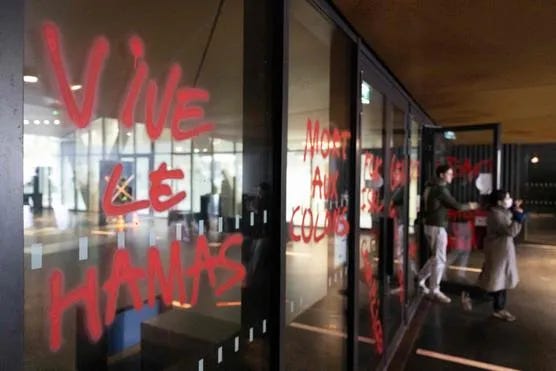
Faced with the conflict between Israel and the Palestinians, there is a temptation to which yielding is infinitely more comfortable than resisting it: choosing a side, designating a culprit, filing away one’s good conscience into a neatly identified category. Media, social networks and demonstrations push in this direction with mounting pressure. Every new event becomes the occasion for a fresh summons: are you for Israel or for Palestine? Do you condemn Hamas or the occupation? The question posed in these terms calls not for an answer but for an allegiance. And any allegiance, in this conflict more than in any other, is the first step toward blindness.
This article, and those that follow, refuses this summons — not by evasion, but because looking lucidly at reality requires precisely that one resist it. What we shall examine today are two extremisms whose most troubling characteristic is not their respective violence, real and documented as it is, and which will be named without euphemism, but their functional relationship: they do not simply oppose each other; they construct each other, lend each other legitimacy reciprocally, and draw from this relationship an energy that neither could sustain alone.
A clarification is immediately necessary. Criticising the Israeli far right with the same rigour one applies to radical Palestinian Islamism is not antisemitism, nor a challenge to Israel’s existence; it is the exact opposite of a mode of thinking that would treat Israel differently from other states on the pretext that it is Jewish. Antisemitism would consist in holding the Jewish people collectively responsible for the acts of its government; political clarity consists in distinguishing a people, its diaspora, its millennial tradition, and the positions of a governing coalition.
Anti-Zionism, beneath which antisemitism today likes to veil itself with a moral pretext — in circles whose radicalism echoes, mirror-like, that of the Israeli far right — consists in delegitimising the very existence of a state. Not its policies, not its leaders, but its right to exist, in the name of a moral requirement that its detractors apply to no other government on the planet. This selective delegitimisation is precisely what distinguishes it from legitimate criticism: one does not call into question France’s right to exist for its colonial crimes, nor Russia’s for its wars, nor China’s for its camps.
These distinctions, which all serious debate ought to have had the decency to uphold, are today more necessary than ever in a context where the wave of international antisemitism, often veiled in performative anti-Zionism, seeks precisely to dissolve them — by making it appear that criticising Ben Gvir and Smotrich justifies attacking all Jews, that solidarity with the Palestinian people implies supporting Hamas, or that reducing Israel to Nazism would license calling for its disappearance. These conflations are falsehoods: naming them for what they are is the condition of any serious thought on this subject.
One must also name an asymmetry that the word mirror in the title must not conceal. These two extremisms are not symmetrical in their institutional position. Hamas is an organisation designated as terrorist by the European Union and the United States, which has exercised total and coercive control over the Gaza Strip since 2007. Itamar Ben Gvir and Bezalel Smotrich, respectively Minister of National Security and Minister of Finance with an additional post in the Ministry of Defence responsible for civilian affairs in the West Bank, are serving ministers of a democratically elected and internationally recognised state. This asymmetry does not exonerate the one so as to indict the other: it obliges one to think with precision rather than with convenient equivalences.
Radical Palestinian Islamism: when the land becomes theology
“It is the nature of Islam to dominate, not to be dominated, to impose its law upon all nations and to extend its power over the entire planet.” Hassan al-Banna, Majmuʿat Rasāʾil (Collected Epistles).
“The Jews will always be a subversive element on earth, prone to fomenting intrigues, provoking wars, and setting nations against one another.” Haj Amin al-Husseini, speech at the inauguration of the Islamic Central Institute in Berlin, 18 December 1942.
The three founding fathers
Hamas (Harakat al-Muqawama al-Islamiyya) is directly descended from the Muslim Brotherhood, of which it has constituted the Palestinian branch since its founding in 1987. This movement must be situated immediately within the Islamic landscape in order to avoid a confusion whose consequences would be grave: the Muslim Brotherhood does not represent Islam in its millennial diversity, that of contemplative Sufism, of the great classical legal traditions which always maintained a distinction, however imperfect, between religious authority and political power, or that of the ordinary piety of hundreds of millions of believers who practise their faith without ambition to govern the world according to Quranic law.
They represent a precise political ideology, a minority one, profoundly contested within Islam itself, born in the specific context of the collapse of the Ottoman Empire, the suppression of the caliphate by Atatürk in 1924, and the shock of colonial humiliation. It is a crisis response to a modernity experienced as aggression, and, like all crisis ideologies, it carries a radicalism entirely foreign to the traditions it claims to defend in their classical expression.
Al-Banna and al-Husseini: the founders of the axis
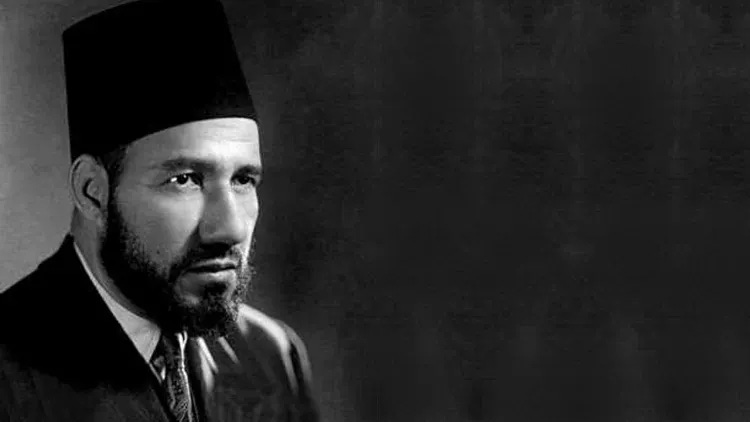
Hassan al-Banna, founder of the Muslim Brotherhood in Egypt in 1928, did not reinvent the combination of politics and religion. Classical Islam, from the first caliphates of the seventh century, had always articulated both dimensions. What is historically unprecedented in his doctrine is the transformation of this articulation into a totalising political ideology in the modern sense of the term, constructed on the model of the great twentieth-century ideologies — fascism, communism — which claimed to furnish a complete and definitive answer to every question of human existence.
The classical Islamic tradition, even in its most political expressions, left considerable room for ijtihad — the effort of human interpretation, jurisprudence adapted to circumstances, the pragmatic flexibility of the schools of law. The great caliphates governed with this flexibility, tolerating diverse local practices and recognising limits to the application of religious law.
Al-Banna breaks with this founding flexibility: Islam is no longer a living, evolving framework but a closed, perfect, total system, simultaneously political, juridical, social, economic and military, which no human adaptation can legitimately touch without committing apostasy. His founding formula — “Islam is the solution” — says precisely this: not Islam illuminates, not Islam guides, but Islam resolves everything, which by definition forbids any compromise with a reality that does not conform to it perfectly.
To this doctrinal rigidification he adds a distinctly modern organisational innovation: a mass structure equipped with branches, subscriptions, a social wing, a military wing, a political wing, applying the organisational techniques of the twentieth century to the service of a theocratic project. It is this crossing of a modern totalising ideology with contemporary mobilisation techniques that constitutes the true rupture, and which explains why the Brotherhood has produced descendants such as al-Qaeda, ISIS and Hamas, whom the historical caliphates would neither have recognised nor approved.
From the 1930s onwards, al-Banna made the Palestinian cause an explicit priority and, in 1948, sent volunteers to fight against the creation of the State of Israel. He found in Palestine a natural ally with whom he shared the objective of a total Islamisation of the conflict.
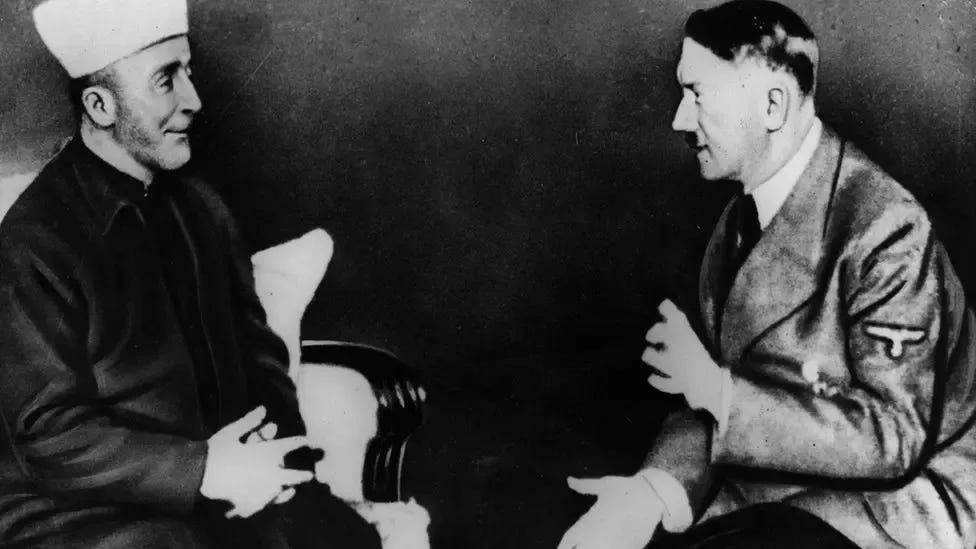
Haj Amin al-Husseini, Grand Mufti of Jerusalem appointed by the British in 1921, was this ally. His trajectory is inseparable from the ideological genesis of Hamas, and it is of a darkness so consistently minimised by the dominant narratives of the conflict as to render it almost unrecognisable. Al-Husseini is the man who Islamised the Palestinian conflict, transforming what might have remained a nationalist and territorial dispute into a holy war of absolute theological dimensions, while contaminating it with a racially inflected antisemitism of Nazi inspiration whose echoes can still be read, thirty years after his death, in the Hamas Charter of 1988.
His collaboration with the Nazi regime is not a wartime parenthesis dictated by circumstance: it is the very heart of his political project. He met Hitler on 28 November 1941 in Berlin, in a documented and subsequently published meeting, in which the Führer laid out the objective of annihilating the Jewish element in the Arab world, finding in al-Husseini an interlocutor not merely receptive but actively engaged. He met Himmler and Eichmann, the architects of the Shoah, and maintained a sustained correspondence with them. He recruited and commanded a Muslim division within the Waffen-SS in Bosnia and Herzegovina — the 13th Handschar Division — whose role in the massacre of civilians is well attested. He broadcast Arabic-language radio programmes from Berlin explicitly calling for the murder of Jews wherever they could be found.
And above all, the least known and most revealing fact of his active complicity in the Final Solution: he intervened personally and in writing with the Bulgarian, Romanian and Hungarian governments to oppose any transfer of Jewish children to Palestine, demanding that they be sent to Poland — that is, to the extermination camps. These letters exist, have been published, and constitute direct and deliberate participation in the Shoah on the part of a man who knew precisely what he was requesting.
This context illuminates his role in the missed opportunities for partition, which Article 3 will examine in detail but which must be anticipated here in order to understand the depth of the refusal. In 1937, when the Royal Peel Commission proposed an Arab Palestinian state on 67% of the territory, with borders incomparably more favourable than any subsequent proposal, al-Husseini led the Arab Higher Committee that rejected the whole without counter-proposal. His objective was not a viable Palestinian state within a framework of coexistence: it was the total absence of any sovereign Jewish presence. In 1947, he organised and coordinated the Arab League’s rejection of the UN partition plan, transforming this refusal into a preventive military mobilisation. From November 1947, even before the proclamation of the State of Israel, he coordinated the first armed attacks against Jewish communities in Palestine and helped forge the military alliance — Egypt, Jordan, Syria, Iraq, Lebanon — that invaded the territory on the day following the declaration of independence of 14 May 1948, with the explicitly declared objective of destroying the Jewish state in its first hours.
Al-Husseini’s trajectory says the essential: the repeated refusal of all partition is not the rejection of an imperfect solution pending a better one; it is the absolute ideological refusal of any legitimacy of sovereign Jewish presence in Palestine, nourished by a racial antisemitism borrowed from Nazism and grafted onto an Islamist fundamentalism. His direct legacy runs through the 1988 Hamas Charter in its antisemitic formulations, in its Article 11 on the inalienable waqf, and in its Article 13 on jihad as the sole response. The lineage is documented, intellectual and political.
Qutb: the radicaliser
Sayyid Qutb (1906–1966) arrives afterwards, as the intellectual heir of an already constituted Palestinian politico-Islamist axis, to push its logic toward its most radical conclusion. Imprisoned then executed by Nasser, he developed in prison a doctrine whose influence on global political Islam would be immense and lasting. His central concept, jāhiliyya — pre-Islamic ignorance — applied to the entirety of the contemporary world, legitimises offensive jihad against every existing regime without exception, including against Muslim societies that do not govern themselves according to sharia.
This intellectual gesture is the hinge between the political activism of the Muslim Brotherhood and global armed jihadism: his writings would furnish the ideological matrix of al-Qaeda, ISIS, and all the jihadist organisations of the following half-century. Where al-Banna had founded the system and al-Husseini had Palestinised it by contaminating it with racial hatred, Qutb furnished it with the mechanics of total and permanent war.
The 1988 Charter: a theology of absolute exclusion
Hamas (Harakat al-Muqawama al-Islamiyya) was officially born in December 1987, on the first day of the First Intifada, as the Palestinian branch of the Muslim Brotherhood. Its founding charter of 18 August 1988 is the direct heir of this triple lineage — al-Banna, al-Husseini, Qutb. It is not a political programme: it is a theology of absolute exclusion.
The waqf, the Dar al-Islam and the dhimmis: why peace is theologically impossible
Article 11 constitutes its core: the land of Palestine is, in the charter’s own words, “an Islamic Waqf consecrated for future Moslem generations until Judgement Day.” The waqf, an Islamic mortmain, definitively consecrated and by nature inalienable and imprescriptible — which no one may sell, purchase or transmit by inheritance — transforms a territorial claim into a religious absolute withdrawn from all political negotiation. But this waqf is rooted in a wider theological architecture that must be named in order to understand why Hamas’s refusal is not a posture liable to evolve with circumstances: it is a structural and definitive religious impossibility.
Classical Islamic jurisprudence divides the world into Dar al-Islam, the House of Islam, the lands governed according to Quranic law, and Dar al-Harb, the House of War, the lands not yet so governed. This partition carries within it a central principle in the fundamentalist reading: a land that has once entered Dar al-Islam cannot legitimately depart from it. Palestine having been under Islamic governance from the Arab conquest of the seventh century until the collapse of the Ottoman Empire in 1917 — a period of more than thirteen centuries — belongs in this logic permanently and inalienably to the House of Islam.
To this impossibility a second is added, of even more precise bearing: the status of the dhimmis. In classical Islamic legal tradition, the People of the Book — Jews and Christians — could reside on Islamic lands under a status of subordinate protection, in exchange for the payment of the jizya and the explicit acceptance of their inferior position. This status rests on an absolute condition: the dhimmis may exist under the protection of Islam, but they may in no case exercise sovereignty or govern lands that have belonged to Dar al-Islam. The very idea of a sovereign Jewish state on the land of Palestine is therefore, in this reading, a double theological transgression: it withdraws an Islamic land from the House of Islam, and it places dhimmis in a position of sovereignty over a land they have no right to administer.
This reading is not that of classical Islam in its historical plurality: thousands of ulema have proposed incomparably more nuanced approaches, and Sufism as well as the reformist currents explicitly repudiate this political totalisation of the religious. What Hamas mobilises is not Islam in its richness, but a selective fundamentalist reading of the twentieth century that wrenches classical juridical concepts from their context to absolutise them beyond what their original formulations authorised.
One does not negotiate with a divine obligation. One does not compromise on an inalienable waqf. One does not recognise the legitimacy of a state of dhimmis on an Islamic land. This is why, since its founding, Hamas has never presented a serious territorial counter-proposal — not for lack of diplomatic competence, but because its own doctrine structurally forbids it from doing so. Peace within this framework is not an insufficient option: it is a theological betrayal.
Article 13: jihad as the sole response
Article 13 of the charter draws the logical consequence of this edifice with a clarity that forecloses any misunderstanding: “initiatives, and so-called peaceful solutions and international conferences, are in contradiction with the principles of the Movement. There is no solution for the Palestinian question except through Jihad.” This rejection is not a tactical posture; it is a structural theological position inherited from al-Banna, contaminated by al-Husseini’s racial antisemitism and intellectually armed by Qutb.
The Protocols and Khaybar: the weapons of a genocidal programme
The charter’s antisemitism deserves to be named without attenuation, and its references explicated for readers who may be unfamiliar with them: it cites the Protocols of the Elders of Zion as a serious source documenting the worldwide Jewish conspiracy.
The Protocols are a forgery fabricated by the Russian Tsarist secret police around 1903, presented as the minutes of a secret meeting of Jewish leaders planning world domination. This document was definitively exposed as a crude fabrication as early as 1921 by the Times journalist Philip Graves, who demonstrated that it was largely plagiarised from a nineteenth-century French political satire, Maurice Joly’s The Dialogue in Hell between Machiavelli and Montesquieu, which made no mention of Jews whatsoever. Despite this public and documented refutation, the Protocols were massively disseminated and used by Nazi propaganda as the theoretical justification for the Shoah.
Their life did not end with the defeat of Nazism in 1945. Translated into Arabic from the 1920s onwards, they are today the object of a massive and organised dissemination throughout the Arab-Muslim world, in bookshops, on markets, in mosques, and even in the school curricula of several countries. Hamas and all the Islamist organisations have made them a central propaganda tool, distributed free of charge, taught to children, cited in Friday sermons. In 2002, Egyptian television broadcast Faris bila Jawaad (Knight Without a Horse), a forty-one-episode serial directly inspired by the Protocols, watched by tens of millions of viewers across the Arab world during Ramadan.
This dissemination serves a precise and murderous ideological logic. If Jews truly control governments, banks, the media and world wars as the Protocols claim, then combatting them is not hatred — it is self-defence. The thesis of the worldwide Jewish conspiracy is the theoretical justification for the call to eradication: it transforms the genocidal project into a moral obligation, even a religious duty. This is why this organisation, founded in 1987, sixty-six years after this document had been definitively established as a forgery, cites it in its charter as a reliable source. It is not ignorance: it is a deliberate ideological choice in the service of a programme of eradication.
The charter also calls for the massacre of Jews with reference to the episode of Khaybar. Khaybar is the name of an oasis in Arabia where, in 628 CE, the forces of the Prophet Muhammad besieged and defeated a Jewish community, in the course of a battle in which many Jews were massacred, their leaders executed, their lands confiscated, and the survivors reduced to the status of tributaries compelled to surrender half of their harvest to their conquerors, before being finally expelled under the Caliph Omar. In the contemporary use made of it by Hamas and the jihadist movements, Khaybar is not a neutral historical reference but an explicit threat of repetition.
The chant “Khaybar Khaybar ya Yahud, jaych Muhammad sa ya’ud” (Khaybar, Khaybar, O Jews, the army of Muhammad will return), intoned at rallies in support of Hamas in Europe and throughout the Middle East, does not merely say we shall defeat you: it says we shall massacre you as your ancestors were massacred at Khaybar. It is a genocidal threat dressed in Quranic reference, whose rhetorical efficacy in jihadist propaganda draws precisely from the brutality of the original message. To cite it in a founding charter in 1988 is to inscribe from the outset the annihilation of Jews — not their political defeat but their physical annihilation — within the programme of the movement.
The charter finally designates the Jews as a people — not Zionists as a political movement — as responsible for the world wars and the great catastrophes of modernity. This slippage from political anti-Zionism to ethnic antisemitism is not a rhetorical clumsiness: it is al-Husseini’s signature inscribed in the founding texts of the movement thirty years after his death, the Nazi contamination operating from beyond the grave, transmitted from generation to generation in the textbooks read by the children of Gaza.
The 2017 revision: a cosmetic adjustment, not a conversion
The new charter published from Doha in May 2017 abandons the explicit references to the Muslim Brotherhood, removes the openly antisemitic passages, and formally recognises the State of Palestine within the 1967 borders. Most specialists of the movement read it as a diplomatic adjustment designed to improve relations with Qatar, whose financial patronage required a Hamas capable of presenting a respectable face to the world, and not as a fundamental ideological transformation. The most compelling argument: the 2017 charter maintains that Palestine is an Arab Islamic land, still does not recognise the State of Israel, and the clause of the inalienable waqf remains intact in substance. Hamas’s positions after 7 October 2023 confirmed that the 2017 revision was indeed cosmetic, and that the theological architecture of al-Banna, al-Husseini and Qutb remains the movement’s operational doctrinal foundation.
In addition: Palestinian Islamic Jihad and Iran’s proxies
The Palestinian Islamic Jihad Movement deserves more than a passing mention, for it illustrates with almost pedagogical clarity what Hamas still partly conceals behind its governmental and social dimension: jihadism in its pure state, stripped of all governing ambition, reduced to its sole military function.
Founded in the early 1980s by Fathi Shaqaqi, a Gazan physician deeply marked by Sayyid Qutb and electrified by Khomeini’s Iranian revolution of 1979, of which he published an enthusiastic apologia in that very year, the movement distinguishes itself from Hamas on several essential points. It has no political wing, offers no social services, does not seek to govern: for it does not wish to build — it wishes precisely to destroy the State of Israel by armed means alone. This nihilistic purity confers upon it a radicalism that even Hamas cannot always afford without compromising its electoral base and its funding. The Palestinian Islamic Jihad rejected the Oslo Accords in 1993 with a rhetorical violence that has never weakened, considering any negotiation an absolute theological betrayal.
Its dependence on Iran is total and declared, unlike Hamas, which maintains a relative autonomy and diversifies its funding between Qatar, Iran and its own sources. The Palestinian Islamic Jihad is directly funded, armed and often strategically directed by the Iranian Revolutionary Guards. Its military operations frequently serve the tactical needs of Tehran rather than the interests of the Palestinian people; Iran can activate this lever at any moment to generate an escalation, divert international attention, or derail a diplomatic process that does not suit it — a spoiling role well attested across several cycles of escalation in Gaza.
Shaqaqi was assassinated in Malta in October 1995, in all likelihood by the Mossad, in what appears to have been an Israeli response to a wave of lethal suicide bombings. His successors, Ramadan Abdullah Shalah, then since 2018 Ziyad al-Nakhalah — today at the head of the movement from Beirut — have maintained the line: no negotiations, no lasting ceasefire, no recognition of Israel in any form whatsoever. The Palestinian Islamic Jihad is living proof that even were Hamas to moderate its position — a hypothesis whose limits the 2017 revision has already exposed — there would always exist within the Palestinian armed sphere an organisation to refuse any compromise and perpetuate the logic of total war. It is also proof that behind the visible actors of the conflict stand regional powers, Iran first among them, whose strategic interest is precisely that peace should never be made.
The Palestinian Islamic Jihad is, moreover, merely the smallest instrument of a wider regional architecture that Tehran has methodically constructed since 1979, and that events since 7 October have made visible to the world: the so-called “Axis of Resistance.” Its components are well known: Hezbollah in Lebanon to the north of Israel, a Shia militia with a considerable arsenal of missiles and rockets, founded in 1982 with the direct support of the Iranian Revolutionary Guards after the Israeli invasion of Lebanon, which opened a northern front from October 2023 onwards, firing daily on civilian communities in Galilee; and the Yemeni Houthis to the south, a Zaydi Shia movement that has controlled northern Yemen since 2014 and which, since 7 October, has multiplied ballistic missile and drone strikes against Israel while at times blocking commercial traffic in the Red Sea, partially paralysing world trade in the name of solidarity with Gaza.
This architecture presents a paradox that must be named: Hamas is a Sunni organisation of Muslim Brotherhood origin, and its most powerful strategic allies — Iran, Hezbollah, the Houthis — are Shia. This crossing of the confessional divide, which has nonetheless drenched the Arab world in blood at least as much as the Israeli-Palestinian conflict, says the essential about the true nature of this axis: it is not a theological alliance but a geopolitical one, whose sole cement is the destruction of Israel and the expulsion of American influence from the Middle East. Article 3 will examine in detail Iran’s role as the systematic saboteur of every peace process for more than forty years, for understanding why peace has been sabotaged requires looking beyond the Palestinian and Israeli actors to the regional powers which have every interest in ensuring it never comes to pass.
Jewish extremism and Greater Israel: when the Bible becomes a land registry
“Where is our Hebron — have we forgotten it?! Where is our Shechem? Our Jericho? Where are they? And the entire bank of the Jordan — every clod of earth, every region, every hill, every valley, every parcel of the Land of Israel — do we have the right to give up even one grain of G-d’s Land?” Rabbi Zvi Yehuda Kook, Lintevot Yisrael.
“There are times when we wish to harm innocents directly. And their presence and their killing are in fact beneficial and help us. For example, harming the babies of the wicked king who are currently innocent; killing them benefits us in wounding and paining the king so that he stops fighting us.” Rabbis Yitzhak Shapira and Yosef Elitzur, Torat haMelekh.
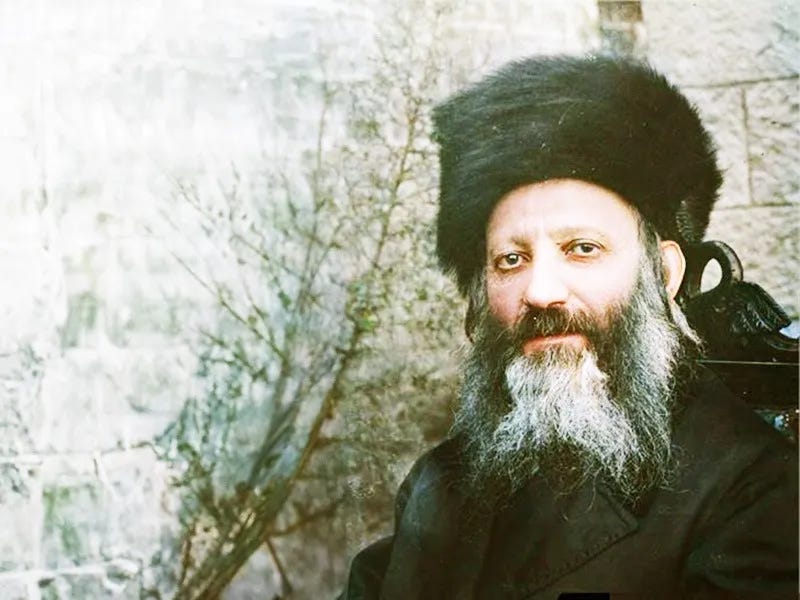
Abraham Isaac Kook: the sanctified land, humanity transfigured
“In every religion, there is a divine spark of morality that sustains it, through which it establishes norms of good and evil. Thus humanity can gradually advance towards belief in divine unity and its moral teachings.”
Rav Abraham Isaac Kook, Le’Nevuchei Ha’Dor
To understand the depth of the betrayal that this Jewish extremism of Greater Israel represents, one must first measure the greatness of what it claims to prolong. This current claims as its intellectual matrix the work of Rabbi Abraham Isaac Kook (1865–1935), first Ashkenazi chief rabbi of Mandatory Palestine, but this lineage is already, in itself, a misreading: Rav Kook was a universal mystic whose thought has been radically distorted by his heirs, to the point that several specialists of his work affirm he would have been horrified by the political uses made of his thought in his name.
Abraham Isaac Kook was first and foremost a contemplative in the most demanding sense of the term, and a philosopher of considerable culture, profoundly rooted in Lurianic Kabbalah and the Hasidic tradition of the Baal Shem Tov, heir to the Maharal of Prague, nourished at the same time by Hegelian philosophy and contemporary science. His thought was not a closed system but a living, poetic, dialectical meditation, resting on a fundamental tension between two ideas he considered consubstantial with human existence: the divine idea — the consciousness of our finitude and the aspiration to confer meaning upon it — and the national idea, the irreducible belonging of the individual to a historical community. Founder of the Merkaz HaRav yeshiva in Jerusalem, he trained a whole generation of disciples in this open dialectic.
His deep approach was that of an actualisation: how to read, in the authentic categories of the Torah, a radically new situation in Jewish history — that of the return toward the land of its memory of a people who had been in exile for two millennia, a return then carried not by religious devotion but by a secular, agnostic, even atheist movement. For Rav Kook, the Exile, the galut, is not primarily a divine punishment but a historical therapy, painful as all therapy is. By tearing the Jewish people away from its land, it provoked a dissociation between the two ideas Kook considered consubstantial with human existence: the divine idea took refuge in interior spiritual life — Torah, prayer, study — but cut off from collective history, it shrank into mere observance, losing the prophetic dimension it had possessed in the age of the kings and the prophets. The national idea survived as an attachment to a people and a memory, but without soil or sovereignty, it emptied of its prophetic substance to become ordinary communal administration. The return to the Land of Israel is therefore, in his vision, the chance to reunify these two ideas that exile had separated and diminished — not an ordinary nationalist fact, but the beginning of an eschatological fulfilment of universal scope.
His response to the secularism of the pioneers is remarkable in its audacity: the atheist pioneers who drained the swamps, built the kibbutzim and spoke Hebrew without Torah did not know what they were doing spiritually, but G-d did. Rav Kook called this dynamic the orot hatohu, the lights of chaos — those intense spiritual forces that manifest in apparently disordered or profane forms but carry within them a real divine energy. His reading was essentially dialectical and inclusive: it integrated the apparent adversary, the secular pioneer, into a larger teleological movement. And this redemption, for Rav Kook, was not merely national but cosmic and universal: the divine light radiating from a restored Israel was to benefit all of humanity. Zionist politics was for him only an instrument, never an end in itself.
One must nonetheless honestly acknowledge an ambivalence in his work, for it is precisely this ambivalence that his son, also a rabbi, would exploit after him. Rav Kook, in his ardour to integrate Zionism into his metaphysics, already held firm nationalist positions regarding sovereignty over Eretz Israel and rejected any idea of territorial compromise that would entail renouncing any part of the country. His sacral vision of the relationship between the Jewish people and the land posed, alongside the universal mystical openness, a claim of national election that could be read selectively. It is these two poles in tension — universal prophetic openness on one side, exclusive national attachment on the other — that will constitute the raw material his son would exploit with a radical but reductive coherence.
Kook the son: when mysticism becomes a programme of exclusion
His son, Rabbi Zvi Yehuda Kook (1891–1982), performs a transformation that inverts the deep movement of his father’s thought. What the father had conceived as an open, universalist, dialectical mysticism, the son closes, hardens and politicises. The victory of June 1967 — the conquest of the West Bank, Gaza, Sinai and the Golan Heights in less than a week — furnishes him with the trigger: he reads it as the spectacular confirmation of his father’s thought, retaining from it only one pole — the exclusive national attachment — while deliberately effacing the other, the prophetic universalism. The Land of Israel in its maximum borders then becomes an absolute requirement, independent of any ethical condition, of any consideration for the non-Jews who inhabit it, of any openness towards humanity as a whole.
In the theses of Kook the son, the non-Jew is no longer a human being whose dignity calls for treatment in conformity with tzedakah and the love of the stranger prescribed thirty-six times by the Torah; he structurally becomes an obstacle to Redemption, a territorial problem to be resolved. The universalism of Kook the father — the redemption of Israel as the first light of a universal human redemption — disappears entirely, replaced by an absolute territorial particularism in which the presence of the other on the Land of Israel becomes problematic by definition. Zionist politics, which Kook the father had carefully positioned as instrument and never as end, becomes in his son’s work the end itself. This is precisely what Hamas does with the Islamic tradition: taking authentic concepts, wrenching them from their context and their dynamic depth, and making them ideological weapons in the service of a programme of exclusion. The mechanics of reduction and betrayal are identical, even if the traditions and the historical contexts differ profoundly.
Four halakhic concepts instrumentalised
This instrumentalisation rests on four halakhic concepts — Halakha denoting the Jewish religious corpus governing practical life — which the ideology of Greater Israel mobilises with the same selectivity that Hamas brings to the waqf, to Dar al-Islam and to the status of the dhimmis: by wrenching each from its original spiritual depth in order to make it an instrument of absolute territorial claim.
The brit: when the Covenant becomes a title deed
The first is the brit, the Covenant, one of the most fundamental concepts in Hebrew spirituality. In its original meaning, the brit is not a notarial act: it is a living relationship between G-d and the people of Israel, carrying reciprocal obligations. The Abrahamic brit (Genesis 15 and 17) promises a land, but it presupposes above all a dynamic of ethical commitment. It is because Abraham takes upon himself the call to embody justice and peace that this promise unfolds. The prophets — Isaiah, Jeremiah, Ezekiel — constantly invoke the brit not to claim territorial rights but to recall that fidelity to the Covenant is measured by justice rendered to the poor, to strangers, to widows and to orphans. Jeremiah even announces a brit hadasha, a new Covenant engraved upon hearts, definitively shifting the centre of gravity of the Covenant towards spiritual interiority.
It is this richness that the fundamentalist reading amputates by retaining only the single territorial aspect. Where G-d promises Abraham a land “from the river of Egypt to the great river, the Euphrates” — not as an unconditional title deed but as the locus of an ethical vocation — this promise becomes in the extremist discourse a permanent and inalienable title transcending all human political arrangement, and the conditions that the prophets placed upon the inhabiting of this land disappear entirely from the picture. The brit thus truncated is the exact counterpart of the Islamic waqf: in both cases, a human claim is withdrawn from the register of the political to be elevated to that of the divine absolute, where compromise becomes sacrilege.
The qedushah ha’aretz: when holiness becomes an idolatry of the land
The second concept is the qedushah ha’aretz, the holiness of the Land of Israel. The Hebrew root Q-D-SH — קדש — means first to separate, to set apart: it is the same root as kiddush, the sanctification of the Sabbath, or kiddush Hashem, the sanctification of the Divine Name through the uprightness of one’s conduct. Holiness, in the Hebrew tradition, is first an ethical quality: “You shall be holy, for I, the Lord your God, am holy” (Leviticus 19:2), a founding commandment immediately followed not by territorial prescriptions but by ethical demands: not to steal, not to lie, not to oppress one’s neighbour, to love the stranger as oneself. Holiness is not a place; it is a manner of inhabiting the world.
This holiness is real in Jewish tradition, but conditional: Leviticus (18:28) states with disarming clarity that the land vomits those who defile it by immoral conduct. By absolutising the physical holiness of the territory at the expense of the moral holiness of those who inhabit it, fundamentalism inverts the very structure of the concept it claims to honour: the qedushah ha’aretz becomes an idolatry of the land, a sacralisation of a geographical object that substitutes itself for the ethical demand that this same concept poses.
The mitsvat yishuv ha’aretz: when spiritual presence becomes colonisation
The third concept is the mitsvat yishuv ha’aretz, the commandment to settle the Land of Israel. In its authentic meaning, it does not designate an obligation of conquest but a spiritual vocation: to inhabit this land is to give oneself the possibility of living the totality of the Torah there and of fulfilling the agricultural commandments — terumah, ma’aser, shemitta — which can only be observed on this soil.
The rabbinical debate on this commandment is revealing: Maimonides did not include mitsvat yishuv ha’aretz in his list of the 613 commandments, considering that it did not constitute a direct biblical obligation; Nahmanides (Ramban) argued the contrary. This divergence between two giants of the tradition alone demonstrates that we are not dealing with a univocal certainty. The tradition has moreover always been prudent in the face of the temptation to force the end, to hasten the coming of the Messiah through human acts, seeing in this a dangerous act of presumption. In this reading, the settlement of occupied territories is no longer an act of devotion but a transgression of trust in G-d and a violation of international occupation law, qualified as illegal by the Fourth Geneva Convention and multiple Security Council resolutions.
Lo tuchanem: a verse wrenched from its context to legitimate expulsion
The fourth concept is the most radical: lo tuchanem, drawn from Deuteronomy (7:2): “you shall grant them no favour.” This verse is set within a very specific passage concerning the entry into Canaan after the Exodus and seven precisely named peoples. Its concern is spiritual — to preserve Israel from idolatrous practices — and not racial. The rabbinical tradition has established that this commandment has no contemporary application whatsoever: Maimonides explicitly states that the Assyrian king Sennacherib mixed all nations together, rendering impossible any identification of the seven Canaanite peoples.
But the Torah itself contradicts this reading through a far more powerful voice: “You shall not oppress the stranger; you know the heart of the stranger, for you were strangers in Egypt” (Exodus 23:9), a formulation that appears thirty-six times in the Torah, more than any other commandment. By extracting lo tuchanem from its context to apply it to the Arabs of contemporary Palestine, the fundamentalist reading — whose political incarnation in Meir Kahane we shall see in the following section — simultaneously ignores a halakhic consensus of two millennia, the teaching of Maimonides, and thirty-six commandments concerning the love and protection of the stranger. It retains the verse that suits it and falls silent on everything that contradicts it: the exact definition of the manipulation of a sacred text.
From doctrine to deeds: Gush Emunim, Kahanism and their heirs
The Gush Emunim: the settlement as faith in action
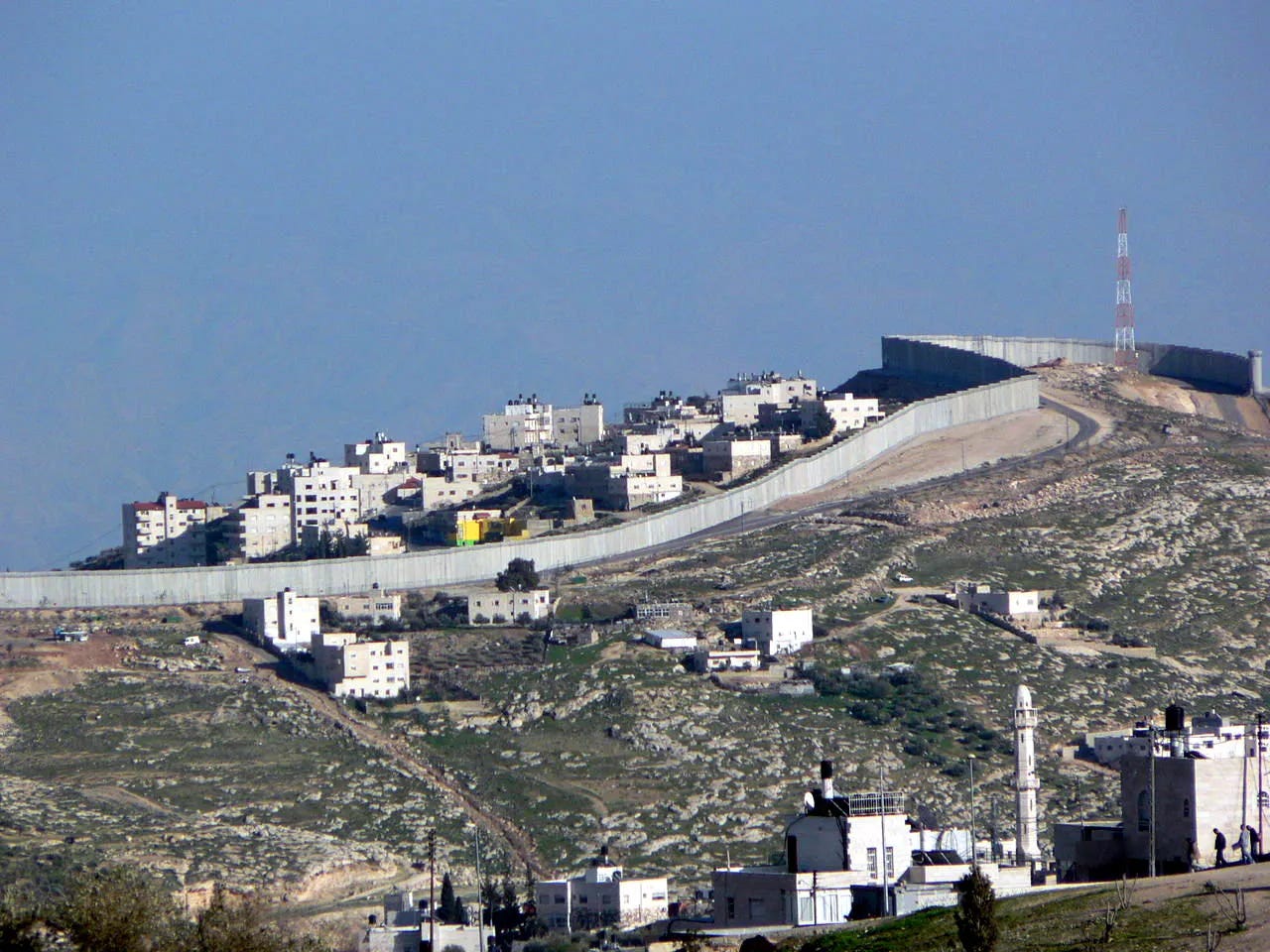
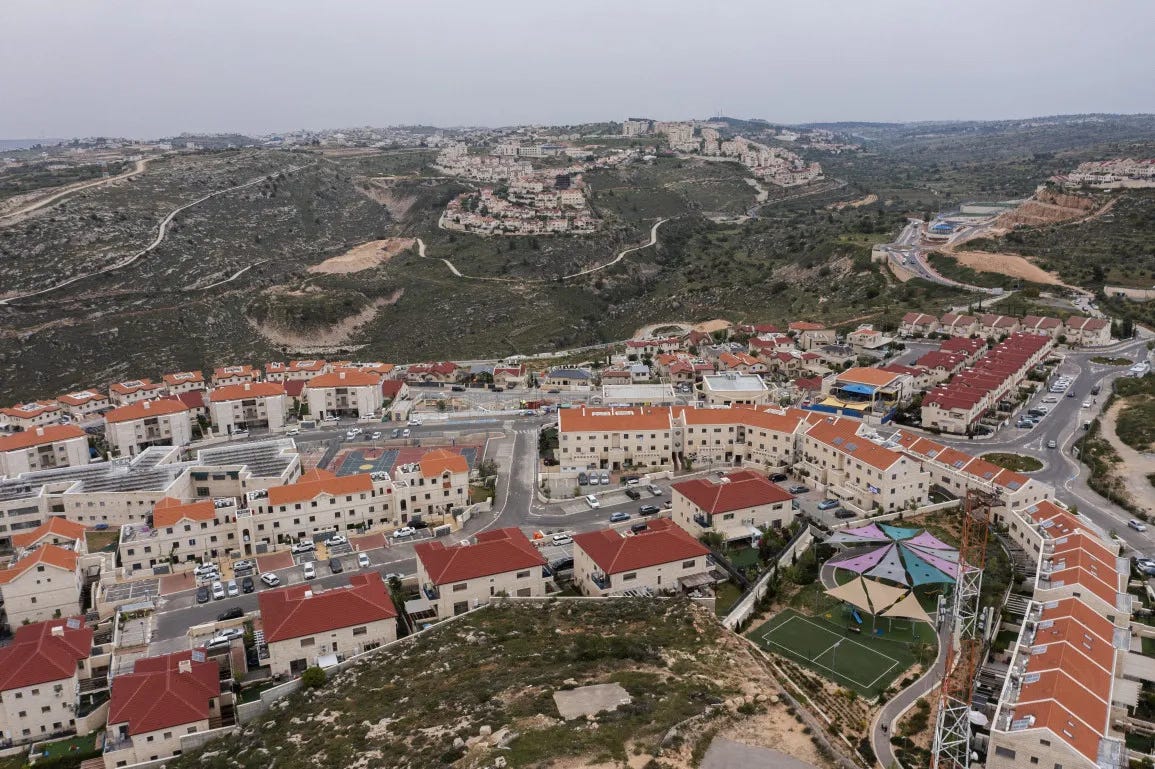
The Gush Emunim, the Bloc of the Faithful, founded formally in 1974 in the trauma of the Yom Kippur War, is the first major movement to translate the doctrine of Kook the son into systematic action on the ground. It settles deliberately in the West Bank, which it always calls Judea and Samaria, refusing the modern geographical designation in order to impose the biblical one that prejudges the conclusion. It creates irreversible facts on the ground before Israeli governments whose postures ranged from active encouragement under Likud governments to feeble resistance or partial freezes under certain Labour governments, but none of which, regardless of its political stripe, proved willing or able to bring this dynamic of expansion durably to an end.
Although the movement no longer exists in any formal sense, its legacy runs through the entirety of the settler movement, whose population has grown from approximately 100,000 at the time of the Oslo Accords in 1993 to more than 700,000 today — an arithmetic progression that renders the two-state solution geographically ever more difficult to conceive.
Kahanism: an assumed radicalism and its return to power
If the Gush Emunim represents the translation into deeds of the doctrine of Kook the son — patient, methodical, working through facts on the ground — Kahanism constitutes its most explicit political formulation: the one that states without circumlocution what the settler movement often applies without wishing to name it.
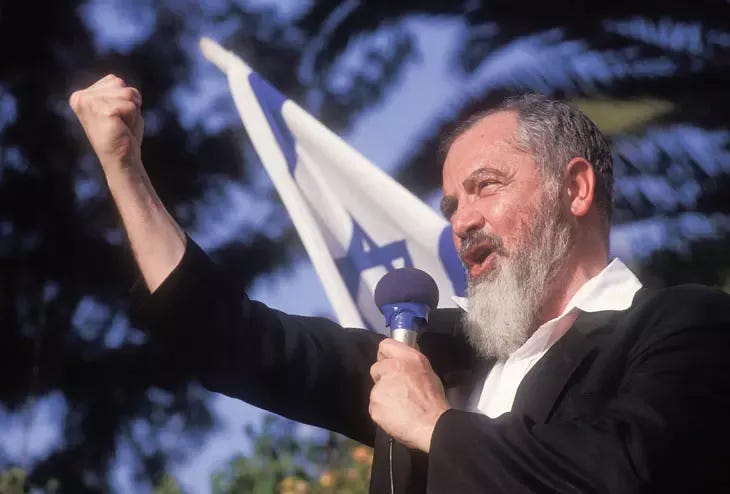
Meir Kahane, an American-Israeli rabbi who founded the Jewish Defense League in New York in 1968 — an organisation responsible in the United States for bombings against Soviet diplomatic representations and Arab-American organisations — and subsequently the Kach party in Israel in 1971, represents the most explicitly racist version of this ideology. Kahanism rests on three pillars: Greater Israel within its biblical borders as a binding divine commandment, the physical expulsion of all Arabs from the territory without exception based on the radical reading of lo tuchanem, and the establishment of a theocratic state governed by Halakha. Elected to the Knesset in 1984, Kahane tabled segregationist bills of such brutality that Parliament amended its rules of procedure to prevent him from speaking in plenary session.
The Kach party was declared a terrorist organisation and banned in Israel in March 1994, in the weeks following the massacre perpetrated by his follower Baruch Goldstein, who had murdered 29 Muslim worshippers at prayer in the Cave of the Patriarchs in Hebron. The United States Department of State and the European Union did likewise that same year — a tripartite designation that says the essential: it was not merely a reprehensible ideology that was condemned, but acts of organised violence meeting the legal criteria of terrorism. This formal prohibition seemed to close a parenthesis.
It did not. Itamar Ben Gvir, today Minister of National Security in the Netanyahu government, displayed in his home the portrait of Baruch Goldstein. He was convicted of incitement to racism and support for Kach in 2007, and declared unfit for military service by the Israel Defence Forces on the grounds that his extremist positions threatened unit cohesion. This man — convicted of racism, declared too extreme to wear the Israeli uniform, public admirer of the Hebron terrorist — became in December 2022 a minister with authority over the police, the border forces and the domestic security policy of a democratic state.
As for Bezalel Smotrich, Minister of Finance and minister with delegated responsibility for civilian affairs in the West Bank, he has publicly declared that the Palestinian people does not exist, that the whole of historic Palestine belongs to the Jewish people and must be annexed to it, and presides over an acceleration of settlement construction unprecedented since the 1990s.
The presence of Ben Gvir and Smotrich in government is not an accident of circumstance: it is the political culmination of a radicalisation for which Torat Hamelekh had already furnished, a decade earlier, the halakhic justification.
Torat Hamelekh: the doctrinal culmination of a radicalisation
In 2009, two rabbis close to the settler movement published Torat Hamelekh, the Law of the King, a work in which they develop halakhic arguments justifying the killing of non-Jews in certain circumstances, including children. The book provoked a scandal in Israel, several of its supporters were prosecuted, but it continues to circulate.
It is not the product of individual madness: it is the logical culmination of a conception that took several decades to radicalise, moving from the mysticism of Kook the father to the political radicalism of Kook the son, from the political to the activism of the Gush Emunim, from activism to the crimes of Goldstein, and on to the ministerial posts of Ben Gvir and Smotrich today.
Judaism in its millennial plurality: a tradition these readings betray
These readings do not represent Judaism in its millennial plurality. The classical rabbinical tradition, moderate Orthodox Judaism, the conservative and liberal currents, the great majority of contemporary halakhic authorities reject fundamentalist interpretations as distortions of the sacred text. The Talmud itself, with its tradition of contradictory debate and permanent interpretive revision, is structurally the antithesis of literalist fundamentalism. What extreme nationalist religious Zionism mobilises is not Judaism in its hermeneutic richness, but a selective political reading of the twentieth century that sacralises a territorial claim by wrenching texts from their context with the same intellectual violence that Hamas visits upon the Quran.
What took place between 1994 and 2022 deserves to be named without circumlocution: what was yesterday marginal, banned and morally ostracised is today at the heart of power in a democratic state. This trajectory is not accidental; it is the product of a progressive normalisation. The thought of Kook the son, which in 1967 appeared to be a minority mystical vision, has produced in sixty years the settler movement, the Gush Emunim, Kahanism, Torat Hamelekh, and finally ministers who govern the State of Israel with convictions that the Torah itself, in its most fundamental prophetic formulations, condemns.
When the extremes pave the way for catastrophe: 7 October, war and codependence
7 October: first a crime, then a fatal mechanism
On 7 October 2023, at dawn, Hamas commandos breached in force the security barriers surrounding Gaza. What followed belongs to the category of facts that admit neither euphemism nor prior analytical distancing, and which demand to be named with a precision that decency does not attenuate but that decency commands.
Let us begin by dispelling a lie that circulates with a persistence that only bad faith can explain: what occurred on 7 October was not an act of resistance. Resistance, in all its historically legitimate forms — the French Resistance against the Nazi occupier, the national liberation movements documented by international law — targets armed forces, military installations, the structures of occupation. It does not massacre families in their homes at dawn, does not rape women in a festival field, does not burn elderly people alive in their kibbutzim, does not abduct infants from their cradles. These acts have a precise name in international law: they are war crimes and crimes against humanity. To dress them in the word resistance is a moral falsification that simultaneously insults the genuine resistances of history and the victims of that day.
The facts, as established by Israeli investigators, international forensic teams and the United Nations Special Representative on Sexual Violence in Conflict, are of a darkness that recalls hours humanity believed it had left behind. One thousand two hundred people murdered within a few hours, the great majority of them civilians. Systematic rape deployed as a weapon of war, documented mutilations, assaults committed before witnesses or filmed. Decapitated bodies, entire families burned alive, children murdered before their parents. The UN Special Representative publicly confirmed these sexual violations, breaking with the habitual caution of international institutions. Several qualified observers — forensic pathologists and genocide historians — employed without hesitation the formulation: the largest massacre of Jews since the Shoah. This qualification is not rhetorical; it is documentary.
What further distinguishes these acts from any ordinary war crime is the deliberate and organised jubilation that accompanied them. The killers filmed in real time from their GoPro helmet cameras, not for tactical reasons, but to share their deeds with their families. A telephone call, which has become emblematic, records a man calling his mother to tell her of his pride at having killed. In Gaza, 7 October was a day of celebration: crowds in the streets, scenes of jubilation, distributions of sweets. Among those who had breached the perimeter, not all were operational members of Hamas — Gazan civilians had joined the movement to participate in the abductions and the looting. This porousness between the terrorist organisation and a part of the population is the measure of the anthropological damage that sixteen years of indoctrination and unchallenged rule inflict upon an entire generation.
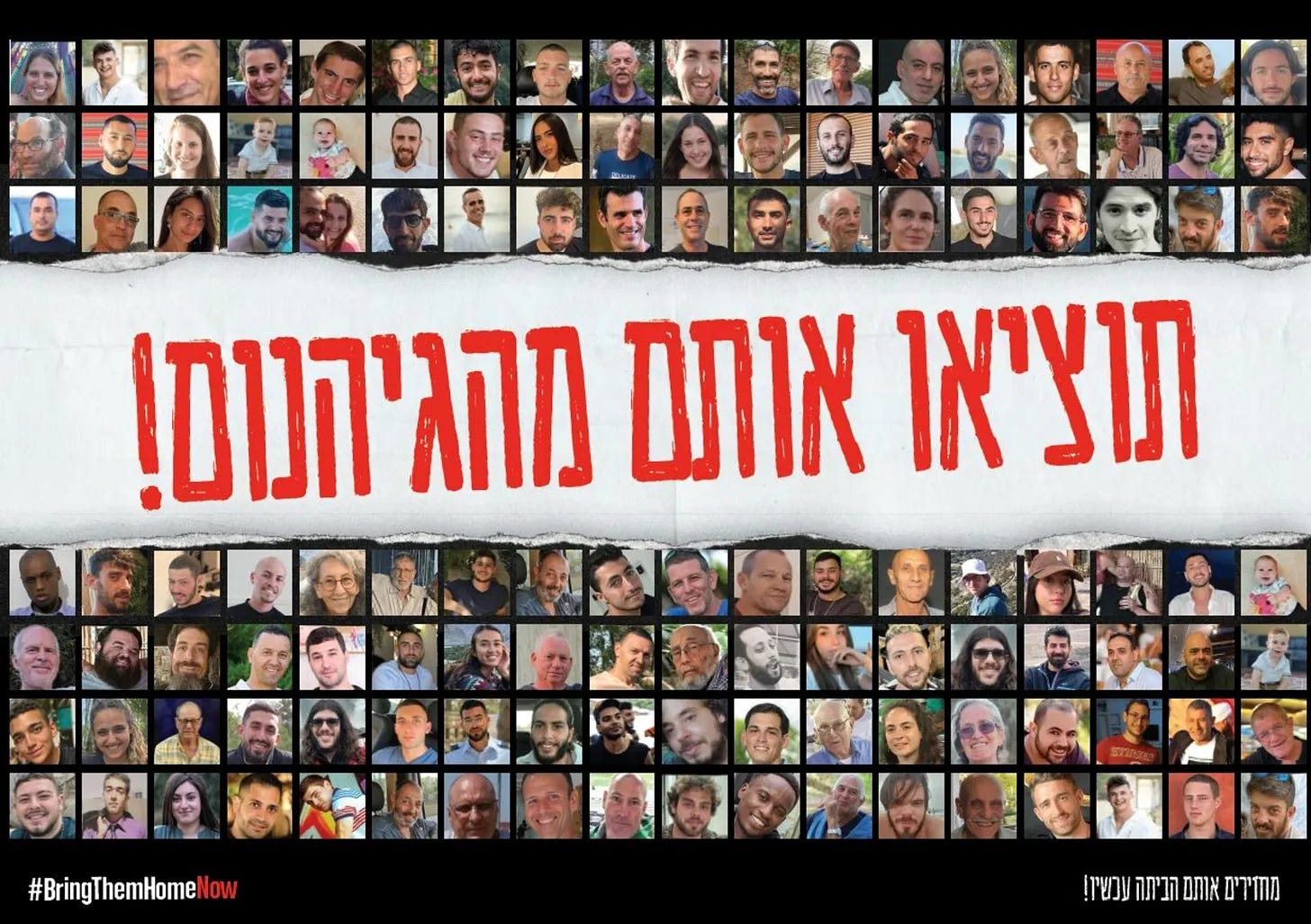
Some 250 hostages were taken to Gaza — infants, children, adolescents, adults, elderly people, among them several survivors of the Shoah. The testimonies of those who returned describe months spent in the darkness of underground tunnels, deprived of light and movement, inadequately fed, subjected to physical and psychological violence. The released hostages arrived in Israeli hospitals in a condition that doctors compared to that of concentration camp survivors. But more than eighty have not returned, among them the Bibas family — Shiri and her two children, Ariel, four years old, and Kfir, nine months old on the day of his abduction, who became with his red hair the global symbol of an absolute innocence swept into horror. When their bodies were returned in February 2025, forensic examinations established that neither an Israeli bombardment, as Hamas had mendaciously claimed, nor any circumstance of war explained their deaths: Shiri and her two children had been deliberately murdered by their captors, the children strangled with bare hands. In August 2024, six further bodies were found in tunnels in Rafah, executed with a bullet to the head — among them Hersh Goldberg-Polin, whose parents had become the global faces of the campaign for the hostages, killed as a rescue operation was closing in.
The exchange of November 2023 had freed 105 hostages in return for 240 Palestinian prisoners — a considerable price, but not without precedent. In 2011, the release of soldier Gilad Shalit had cost 1,027 Palestinian prisoners, among them Yahya Sinwar, convicted for the murder of twelve Palestinians suspected of collaborating with Israel, whose brutality had earned him the nickname the Butcher of Khan Younis. Released by a democratic state in a humanitarian exchange, he became the principal architect of the massacre of 7 October 2023, before being killed by Israeli forces in October 2024. This trajectory speaks to the infernal logic in which this conflict is entrapped, where every decision, even one taken with the best of intentions, can produce consequences that no one had foreseen.
The regional strategic dimension illuminates with stark clarity the cold calculation underlying this attack. In the autumn of 2023, in the wake of the Abraham Accords of 2020 which had brought Israel closer to the United Arab Emirates, Bahrain, Morocco and Sudan, negotiations between Israel and Saudi Arabia had reached an advanced stage — an agreement was described as imminent by several well-informed sources. For Hamas and for Iran, this prospect was an existential threat: were Saudi Arabia to normalise its relations with Israel without the Palestinian question being resolved, the Palestinian cause would lose its central lever and Hamas would lose the justification for its existence. The 7th of October achieved precisely what Hamas sought: to render Saudi normalisation politically impossible, to compel Riyadh to suspend negotiations, to restore the Palestinian question to the centre of the regional agenda. This strategy is of an absolute cynicism, for it sacrificed thousands of lives to preserve the political position of an organisation whose leaders were negotiating from their palaces in Doha. Former directors of the CIA and the Mossad have publicly confirmed that this objective formed part of Hamas’s calculation and that of Iran.
All these facts constitute a crime against humanity in the most precise sense of the legal term, and any analysis of what preceded them or of what they unleashed can only come after this qualification, never in its place. It is only once this point has been established without ambiguity that analysis becomes possible — and necessary, for to understand is not to excuse.
The Israeli military response: between legitimate retaliation and instrumentalised war
The Israeli military response to 7 October must be examined with the same factual rigour as the attack itself — neither minimised in the name of unconditional solidarity, nor deployed in the service of a delegitimisation of Israel whose mechanism we have already named. The declared objective, destroying Hamas’s military and governmental capabilities, was legitimate in principle: a terrorist organisation had just committed the most murderous massacre in the country’s history, and no democratic state would have tolerated its perpetrators remaining in power a few kilometres from its territory. Proportionally, Israel counting approximately 7 million Jewish citizens against France’s 68 million, it is as though France had suffered an attack causing nearly 12,000 deaths and more than 2,400 hostages. One is entitled to doubt that the European populations so mobilised against the Israeli response would have accepted, in comparable circumstances, that their own armies stood by with weapons at rest.
The difficulty of such a response does not, moreover, belong to Israel alone. When the American-led coalition conducted the Battle of Mosul between October 2016 and July 2017 to eradicate ISIS from a city of one million inhabitants — a tactical situation comparable to Gaza in its density, its tunnels and the intermingling of combatants within the civilian population — between nine thousand and eleven thousand civilians were killed according to the most widely cited estimates, with certain Kurdish estimates reaching as high as forty thousand. The coalition received the congratulations of President Macron, the thanks of President Putin and the tributes of the international community, without lasting global protest, without repeated emergency resolutions of the Security Council, without any challenge to the legitimacy of the United States to exist. This asymmetry of treatment deserves to be named — without, however, making of it a blank cheque for Israel.
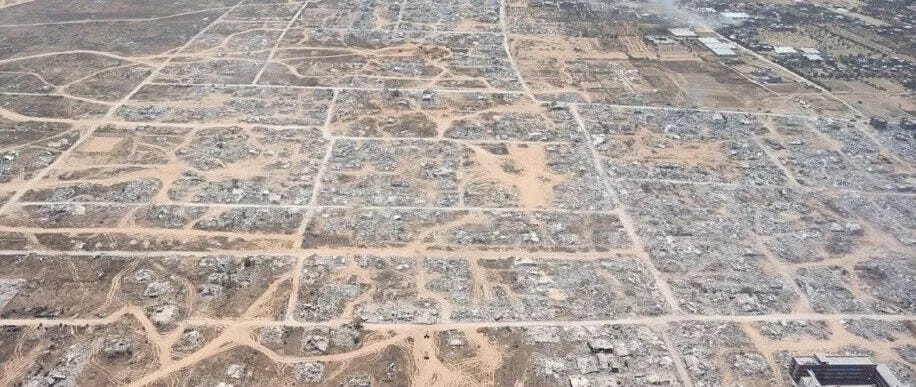
For what took place in Gaza raises questions that go beyond the comparison with Mosul. Israel did practise warnings before strikes — preliminary roof-knocking, telephone calls, alert messages — whose unusual character in the history of urban warfare military observers acknowledge. It opened evacuation corridors. But the designated zones were themselves struck in several documented cases, among them the Al-Mawasi humanitarian zone, and the destruction exceeded what the military objective could reasonably justify. The United Nations Satellite Centre established in December 2024 that nearly 70 per cent of Gaza’s structures had been damaged or destroyed — more than 170,000 buildings; its Office for the Coordination of Humanitarian Affairs that 88 per cent of school buildings had been affected; the WHO that 443 attacks against health infrastructure had reduced to 12 out of 36 the number of hospitals still partially operational in April 2024. In April of that same year, a strike on a clearly identified World Central Kitchen convoy killed seven humanitarian workers — an incident that the Israeli army itself described as a grave error.
But it is the human toll that poses the most fundamental ethical question. The most serious estimates record several tens of thousands of Palestinian deaths — around 75,000 according to the direct count, more if one includes indirect deaths linked to the collapse of the health system — the majority of them women, children and elderly people. Yes, combating a Hamas deliberately intermingled with the civilian population produces destruction bearing no comparison with a confrontation between regular armies. Yes, Hamas prolonged the war by refusing to return the hostages. Yet these realities do not dispense with another: beyond a certain threshold of destruction, an Israel faithful to its own founding values — those of a democracy nourished by the memory of the worst that humanity can inflict upon a people — ought to have had the courage to stop. Even at the cost of negotiating without total guarantees. Even at the cost of leaving Hamas partially intact. Even at the cost of assuming the domestic political consequences. This choice would have been risky. It would also have been the only one consonant with the ethics implied by a state claiming allegiance both to democracy and to the values of the Torah — and that the memory of the Shoah ought to have inspired.
Intellectual honesty and spiritual sensitivity demand that both these realities be named simultaneously, without dissolving the one into the other: the legitimacy of the principle of the military response, and the ethical obligation which ought, at a certain stage, to have bounded its duration and its extent.
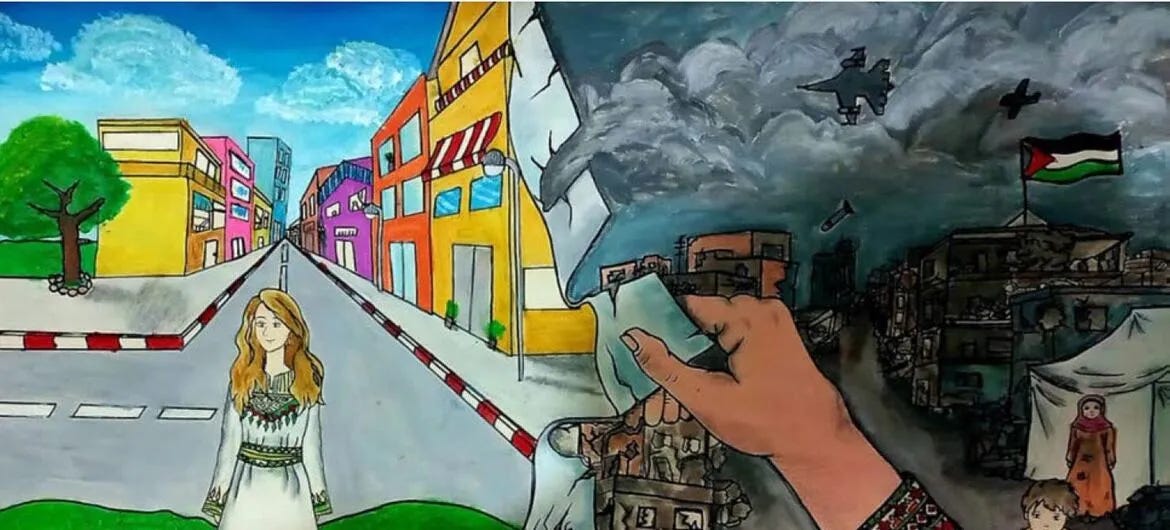
Yet the causes of the prolongation bear the marks of both camps. On the Hamas side, the strategy is transparent: every additional week of war produced images of destruction mobilising world opinion against Israel, fuelling recruitment and justifying Iranian funding. Several ceasefire agreements in 2024 were refused or scuttled in conditions that the Qatari and Egyptian mediators described with mounting frustration. The Hamas leadership did everything in its power to complicate the distribution of humanitarian aid — taxing it, partially diverting it — and to discourage civilian evacuations even when Israel announced the imminence of strikes. Sinwar calculated that every additional Palestinian death was a strategic investment. A population kept under bombardment is, in this chilling logic, more useful than a population in safety.
On the Israeli side, the prolongation also bears a political signature. When it became evident, by the spring of 2024 at the latest, that the total destruction of Hamas was militarily impossible without a permanent occupation of Gaza, the question of halting the operation arose with acute force. Ehud Barak, Ehud Olmert, several former generals and former heads of the Shin Bet publicly affirmed that Netanyahu was prolonging the war for his own domestic political survival: his trial for corruption continuing, his coalition with Ben Gvir and Smotrich contingent upon the continuation of operations, the end of the war risking the opening of an inquiry into the failures of 7 October whose conclusions he dreaded. This thesis, attested by first-rank sources and not established judicially, is sufficiently solid to be named — and it says, once again, that the civilians of both peoples paid the price of a political calculation of which they were not the beneficiaries.
Codependence: a documented mechanism
The central thesis of this article — that the two extremisms feed each other in a logic of reciprocal survival — is not theoretical speculation. It is documented in the facts, and in the sometimes involuntary admissions of its actors.
Hamas: governing through misery, fighting through the dead
On the Hamas side, the logic is as cynical as it is transparent — and among the most systematically passed over in silence in the public debates that claim to defend the Palestinian cause.
Since 2007, Gaza has received tens of billions of dollars in international aid — from the European Union, Qatar, the United Nations, the Gulf states, and the United States before the Trump years. A substantial fraction has been systematically diverted: institutionalised racketeering on goods entering Gaza, construction materials redirected towards the underground military tunnel network — 500 kilometres, more than one billion dollars, funded by European taxpayers who believed they were rebuilding homes and schools. Tens of billions have transited since 2007, enough according to the economists who have studied the file to have built a viable economy there; these funds instead fed the personal fortunes of the leadership and financed the tunnels. Khaled Meshaal is reported to dispose of more than two billion dollars, Ismail Haniyeh is said to have accumulated approximately four billion, Mousa Abu Marzouk is likewise estimated to be a billionaire — fortunes built while the population lived under blockade with an average unemployment rate of 45 per cent. This unemployment is not the consequence of the Israeli blockade: it is the calculated result of diversion. For misery is not, for Hamas, a problem to be solved; it is an instrument of government. Hamas does not administer Gaza; it holds it captive.
Its military strategy obeys the same logic of exploitation — not through negligence but by doctrine. Rockets are fired from densely populated neighbourhoods, arsenals stored in mosques and hospital basements: the operation at Al-Shifa hospital in November 2023 revealed military tunnels accessible from the medical facilities, weapons in hospital rooms, command equipment in areas protected by international humanitarian law. Command centres are deliberately buried beneath civilian buildings so that every Israeli strike automatically produces civilian casualties transformed into political capital. This strategy has a name: the use of human shields — a war crime explicitly prohibited by international humanitarian law. The death of Palestinian civilians is not a regrettable side effect of Hamas’s operations: it is one of their calculated functions. Hamas needs its civilian dead; they are its international political currency.
To this double exploitation — economic and military — is added ideological confinement. Press freedom is non-existent in Gaza: any journalist challenging the leadership or the military strategy would risk his life. In sixteen years of unchallenged rule, Hamas has constructed an ideological prison in which an entire generation has grown up without ever hearing any voice other than that of resistance, martyrdom and hatred of Jews. The polls conducted by the Palestinian Center for Policy and Survey Research — an independent Palestinian body recognised by both camps — measured its extent in the weeks following 7 October: 75 per cent of Palestinians in Gaza and the West Bank expressed support for the attack. Prolonged indoctrination works — this is an anthropological observation, not an excuse. And this generational damage is perhaps the most difficult to repair in any prospect of lasting peace.
The Israeli hard right and the mechanics of instrumentalisation
On the Israeli extremism side, the symmetry with Hamas is less cynical in its public formulation — one does not film one’s victims to send the footage to one’s parents — but equally real in its political effects, and equally documented for anyone willing to look squarely at the electoral archives and the testimonies of the actors.
The pattern has been legible as a constant for thirty years: every wave of attacks produces a measurable shift in opinion towards the security right, to the systematic benefit of the currents that had asserted in advance that peace was a dangerous illusion. Netanyahu’s first election in May 1996 is the clearest illustration: he defeated Shimon Peres by fewer than thirty thousand votes, in the weeks following a series of particularly deadly Hamas suicide bombings. The chronology between terrorist attack and hard-right electoral victory repeats itself like a political law: the Second Intifada and the election of Sharon in 2001, fresh waves of rockets and the consolidation of the right at every ballot, through to the sixth Netanyahu government of 2022.
This mechanism marginalises the peace activists a little further each time. The word left has gradually become a political insult in Israel. Yesh Gvul, Breaking the Silence, Peace Now — their members are ostracised, their foreign funding subjected to restrictive legislation, their audience eroding election after election. Israeli pacifists have never received official government support, even under Labour governments, which built settlements while verbally endorsing a peace process.
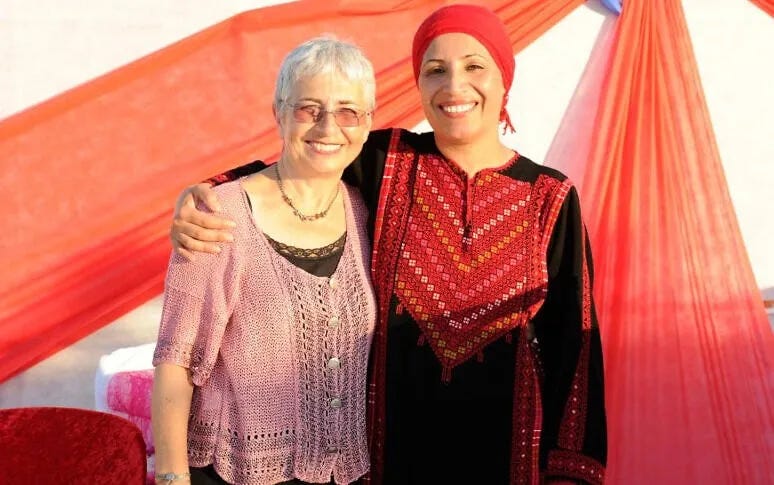
The 7th of October 2023 brought this tragedy to its culmination: the kibbutzim martyred that morning — Be’eri, Nir Oz, Kfar Aza, Nahal Oz — were historic bastions of the pacifist left, populated by activists who had deliberately chosen to live on the edge of Gaza out of conviction, employing Gazan workers and organising transport for sick Palestinian children to Israeli hospitals. Vivian Silver, co-founder of Women Wage Peace, murdered at Be’eri, became its global symbol. Their deaths were used by those who had always maintained that there was no partner to justify the claim that any attempt at dialogue was not merely futile but dangerous.
The counterpart of this dynamic — less often articulated but no less real — is internal Israeli radicalisation. The yeshivas of the settler movement and the settlement environments where Arabs are encountered only as threats or as invisible labour produce a radicalisation that the polls measure: significant fractions of religious Israeli youth today express positions of exclusion that would have been considered marginal in the 1980s and which are today represented in government. The mechanism of radicalisation through ideological saturation is the same on both sides — even if the conditions and the acts it produces are not morally equivalent.
The strategy of “there is no partner” deserves to be named for what it is: not a conclusion drawn from the facts, but a political tool permanently reactivated to justify immobilism and settlement expansion. Launched by Ehud Barak after Camp David in July 2000, amplified over two decades, it has functioned as a self-fulfilling prophecy: by asserting that no credible partner exists, one justifies not building the conditions that would make a partner possible; by pursuing settlement, one creates the radicalisation that eliminates Palestinian moderates and retrospectively validates the argument. This circle is perfect in its circularity: the absence of a partner justifies the settlements, the settlements produce radicalisation, radicalisation eliminates the moderates, the absence of moderates validates the absence of a partner.
This logic includes the deliberate maintenance of the Hamas/Fatah division. The thesis that Netanyahu deliberately allowed Hamas to consolidate its control over Gaza — by authorising Qatari fund transfers estimated at several hundred million dollars annually in order to prevent the emergence of a unified Palestinian leadership — is no longer a researchers’ hypothesis. It has been publicly formulated by former prime ministers of both camps, by former heads of the Shin Bet, and by several members of the Knesset following 7 October. The Knesset member Tzvi Hauser declared before the Knesset that the policy of buying calm with Hamas had failed — a formulation that implicitly acknowledges the existence of this policy. The Haaretz investigation and several inquiries by the Times of Israel have documented its concrete mechanisms.
This thesis is a serious allegation, supported by first-rank sources, contested by Netanyahu, but not established judicially. Its weight is nonetheless sufficient that it cannot be ignored without betraying the intellectual honesty this series claims for itself. For were it to be confirmed, the very nature of the conflict would be transformed: one would no longer be in the presence of the tragic confrontation of two peoples condemned to oppose each other, but of a deliberate manipulation of the impossibility of peace by actors who need this conflict to continue for their political survival or personal enrichment. Hamas and Netanyahu would then share something essential: the objective interest in peace never being made.
The price paid by the moderates — and by the victims
The symbiosis of the extremes has direct victims and collateral victims.
The direct victims are to be counted in both camps, and their number obliges one to step outside any partisan calculation. On the Israeli side: the 1,200 people murdered on 7 October, the families of the 250 hostages many of whom never saw their loved ones again alive, the communities of southern Israel traumatised for generations. On the Palestinian side: the several tens of thousands of civilians killed in Gaza in the months that followed, among them a documented proportion of children and non-combatants, in conditions of urban destruction exceeding anything the region had known for decades.
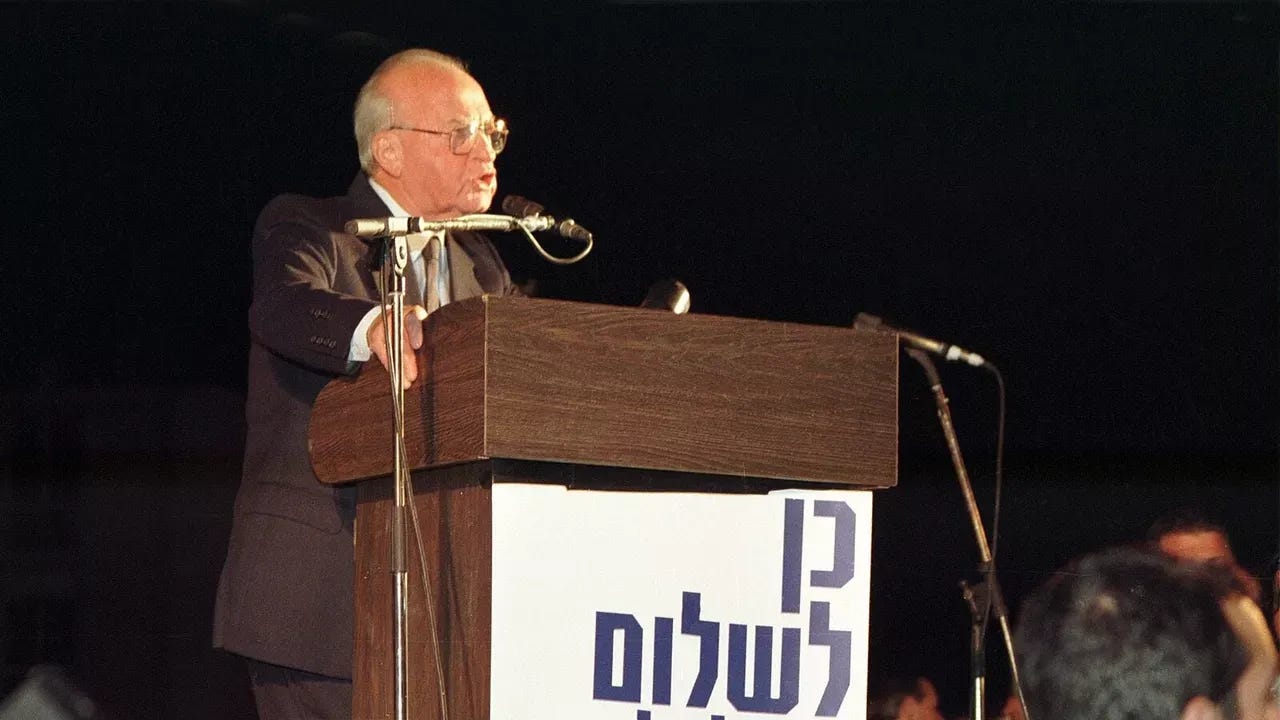
The collateral victims are those of whom less is said, but whose crushing by the extremes is perhaps the most eloquent sign of the state of the conflict: they are the moderates of both peoples. Yitzhak Rabin, murdered in November 1995 by an Israeli fanatic who had decided that peace was a betrayal — not by an Arab enemy but by a compatriot nourished on the ideology of Greater Israel. The Palestinian negotiators of Oslo, disqualified by Hamas as traitors to the cause from the moment the accords were signed. The Israelis who demonstrate against their own government and are treated as traitors by their own camp. The non-violent Palestinians of the West Bank who seek a political space between Hamas and the occupation, and find only the vice.
What the two extremisms share most deeply is this property: they kill their own moderates first — physically sometimes, politically always.
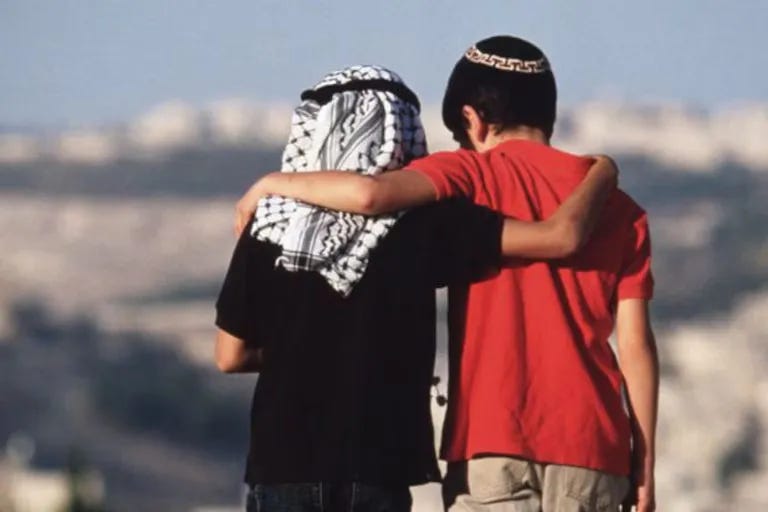
Refusing the abyss as destiny
In 1919, on the eve of all that was to follow, David Ben Gurion spoke before the Va’ad Zmani, the representative body of the Yishuv, with a radical frankness that Tom Segev unearthed from the personal archives of the future founder of Israel: “I do not know a single Arab who would accept Palestine being entirely under Jewish control.” The conclusion he drew was of a disarming lucidity: there is no solution — there is an abyss that no one knows how to cross. He was wrong about the impossibility of the crossing — history has shown apparently deeper abysses traversed by generations who refused to accept them as destiny. But he saw clearly on this point: this abyss does not close of itself. It demands an effort of a different nature from ordinary diplomacy or military victory.
What the two extremisms we have just examined share, beyond their differences of nature and position, is this: they work actively to render this abyss permanent — to sacralise it, to inscribe it in the destiny of their respective peoples, to disqualify as naïve or treacherous those who still believe it can be crossed. In this sense, they do not oppose each other: they collaborate. Their war is their symbiosis.
If the extremisms that today paralyse peace are the terminal stage of an identitarian and political logic, the question imposes itself with equal force upon both camps: when did these logics begin, and were they inevitable?
On the Zionist side: did the movement that founded the State of Israel carry from its very origins the seeds of the drift we have just examined, or did it have a choice — a real choice, documented, articulated by voices that historical urgency reduced to silence but did not extinguish? Herzl and Ahad Ha’Am laid down at the turn of the twentieth century the terms of a founding debate that the urgency of the Shoah settled by force of circumstance, without ever resolving it in its implications. It is to this debate that the next article returns.
On the Palestinian and Arab side, the same question deserves to be posed with the same honesty: was the trajectory of radical refusal — the alliance with Nazism, the rejection of the Peel Plan in 1937, the organisation of the war of destruction of 1948 — the only possible response to the Zionist project, or was it the product of specific choices made by specific actors, for which other, more pragmatic Palestinian voices paid with their lives for having dared to explore alternatives?
These two questions — the missed choice of Zionism and the missed choice of Palestinian nationalism — constitute the guiding thread of the next article. Because if peace has a future, it necessarily passes through the capacity of both peoples to look squarely not only at what the other has done to them, but at what they themselves might have chosen to do differently.
© 2026 - Dialogues of the New World — Jérôme Nathanaël
Next article : The silenced voices: the other Zionism and the other Palestine

To go further
In the face of the trials of our time, what ancient teaching, what new wisdom or what personal experience still helps you to hold steady, to understand, or to discern? Share your thoughts in the comments and let us benefit from your perspective.
If you wish to speak to the upheavals of our age, send me a contribution of roughly one page for the Waymakers section. It will be published under your initials, a pseudonym, or anonymously, as you prefer. Other readers will be able to respond and enter into dialogue with you.”
New here? The Opening page introduces the author, the project, how to take part, contact details, and the agenda.