
Article disponible en français
The World We Cross · The age under strain · 6 min
Reading what our age puts to the test — in us and in our civilisations.

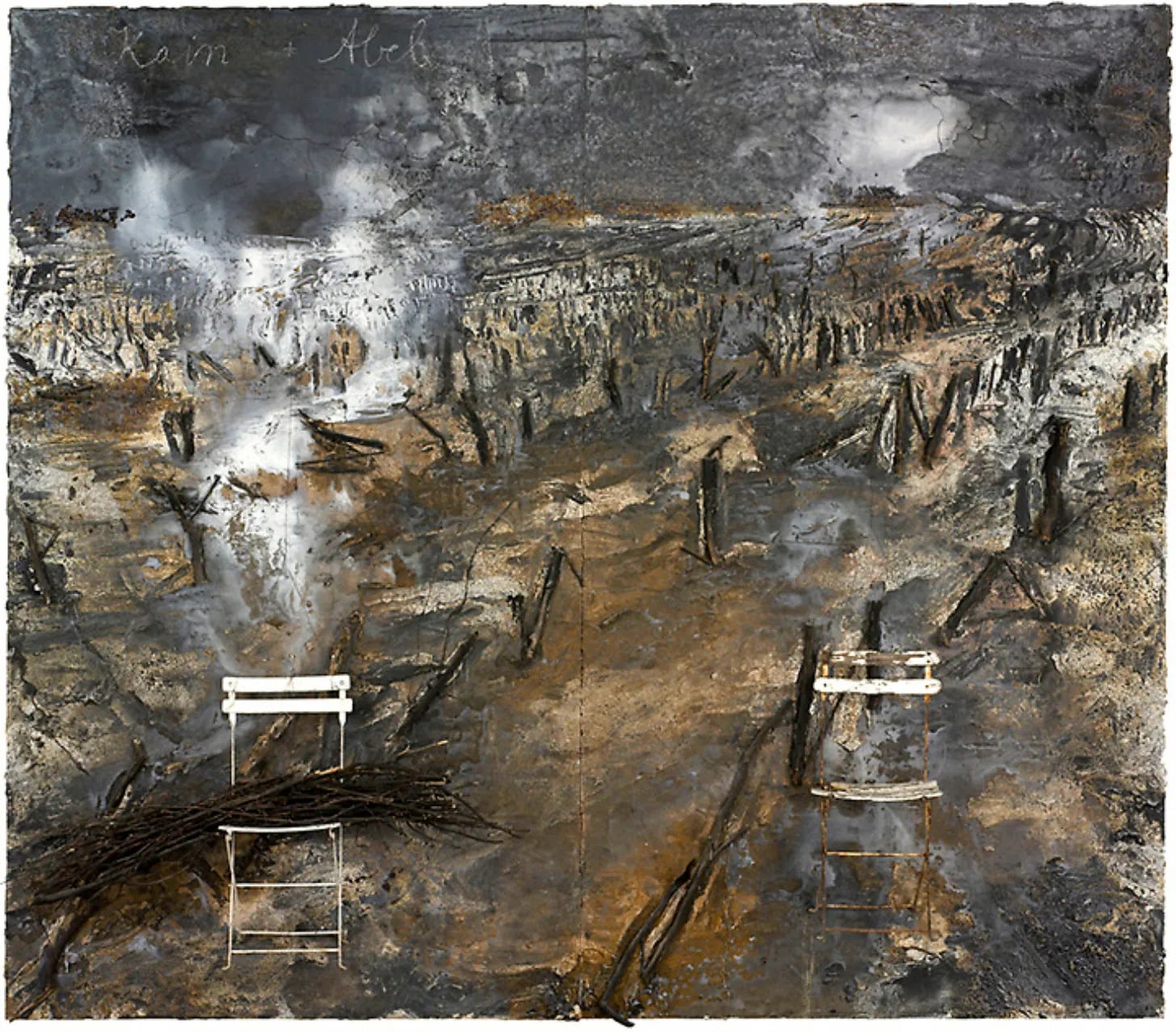
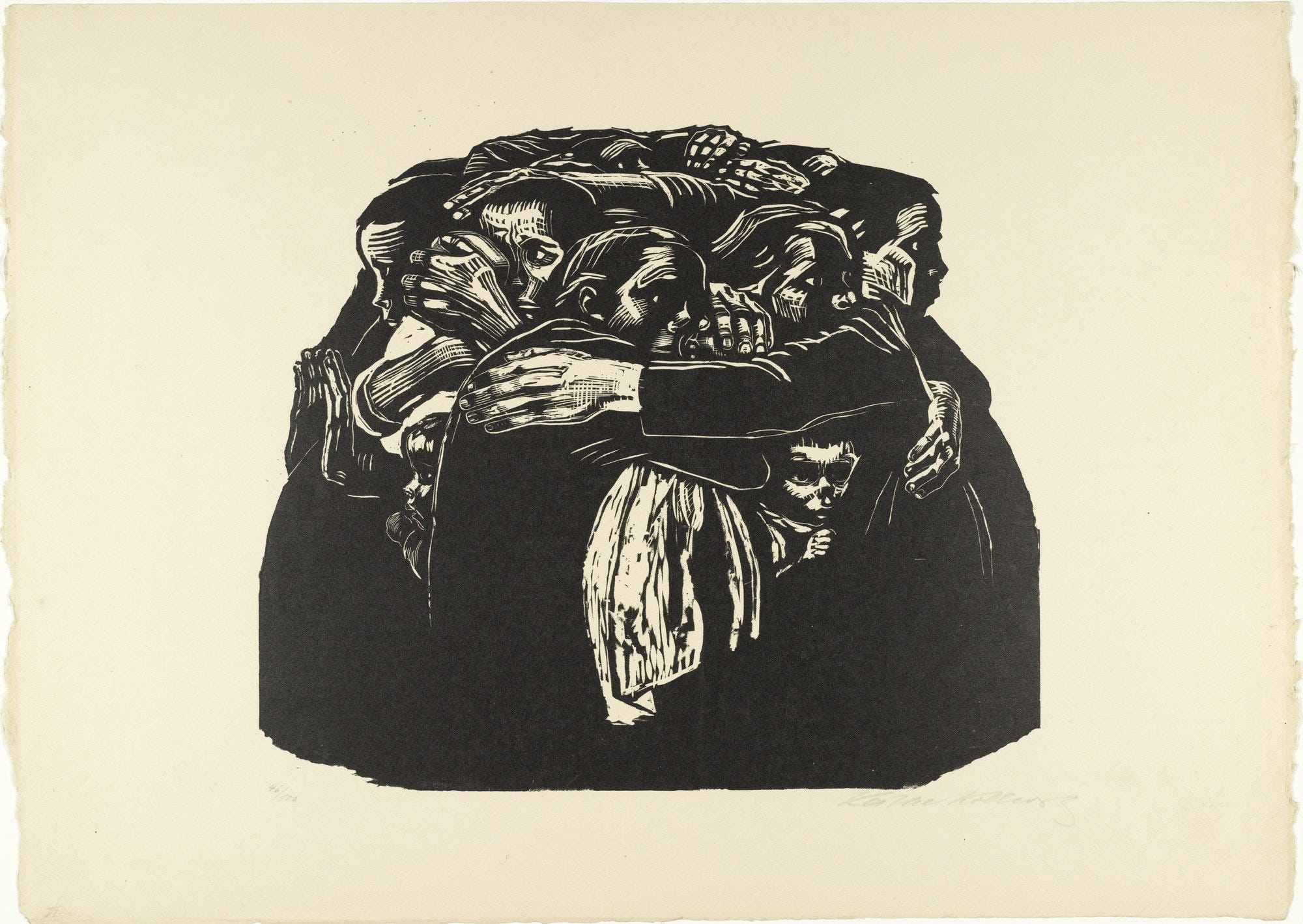
Night has almost fallen. The arid, grey plain seems devastated by fire. I do not know how I came to be here. I walk slowly, hesitantly, among the shadows — vague human shapes I sometimes feel brushing past me. Yet no face calls out to me, I who am among the living, in this place foreign to all memory.
Only a muffled murmur fills the space, telling me that I am moving through a multitude. I begin to make out a few words, like whispers around me: “Killed in Gaza,” “killed at Kibbutz Nir Oz,” “at the Nova festival,” and again: “Killed in Jabalia,” “at Kfar Aza!” then further off, slightly louder: “At Kibbutz Be’eri!” “killed in Khan Yunis…” Other voices draw closer and grow more distinct: “Killed in Mariupol,” “Mosul…,” “Aleppo…,” “Srebrenica,” “killed in Kigali.” All at once I understand: these fragments of sentences are addressed to me. This ageless crowd, in order to exist still, is calling out to me! The terrible litany continues to swell all around: “Killed in Vietnam,” “killed in Hiroshima,” “Stalingrad!” “Dresden!” until it has engulfed me entirely. “Killed at Auschwitz,” “Verdun!” “Waterloo!” — each supplication weighs heavier on my step. I stagger, overwhelmed, more and more moved. Suddenly a brief silence, full and heavy, followed by a harrowing cry: “Killed by the madness of the living!”
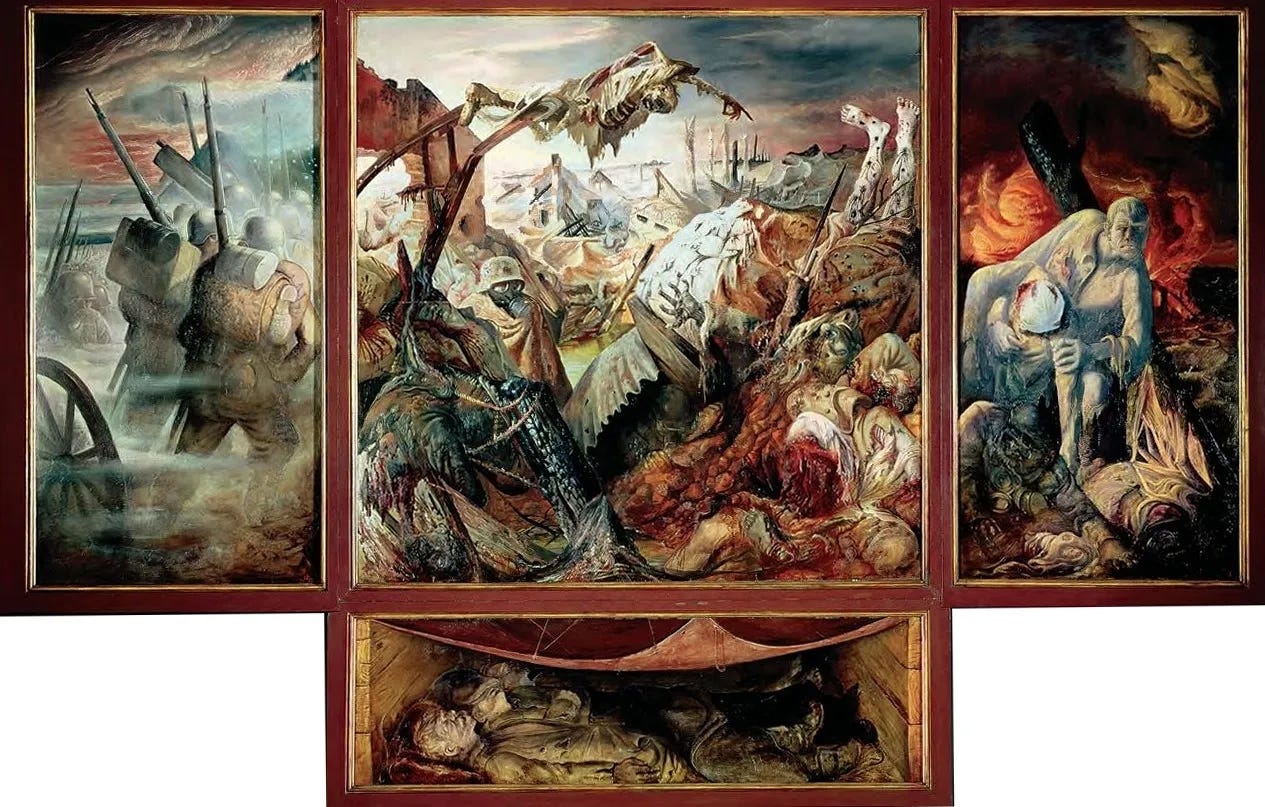
I wake abruptly, drenched in sweat, seized by tears, shaken to the core. I look at the time: three o’clock. Outside, the darkness is absolute, black as the history of the world. Tomorrow morning, the living will rise to slaughter one another. Some will have the glory of defending their own against murderous hatred. Others will obey resentment or indoctrination. And yet all those who have fallen, like all those who will fall, will be gathered into a single people in that other world I have glimpsed. They will swell those multitudes who weep over their lost lives, their blood mingled with the earth, crying out towards an implacable sky.
Faced with this irreversible misfortune, all certainties — those good or bad reasons to kill or to be killed — appear to me so provisional and so tragic. That terrible cry, “Killed by the madness of the living!”, still echoes in my head and obliges me, like a summons from my dead brothers, to try to reduce the customary violence of this world.
In this article:
Am I my brother’s keeper?
Many hotbeds of war
The lucrative industry of war
Are we truly civilised?
Cain: an interior anatomy of violence
We are Cain’s heirs
The contemporary faces of Cain
The only remedy: transformation from within
Learning to love — truly
Am I my brother’s keeper?
It is truly time that human beings chose love, as Martin Luther King proclaimed, he who said that “hatred is too great a burden to bear.” We may observe this each day, both in the wars and massacres that punctuate our history and in the countless conflicts of our societies: terrible are the consequences of these hatreds with their many faces, from which none of us is entirely exempt. Some conceal themselves beneath the veil of propriety or diplomacy. Their ferocity is no less for it, as they await only a fitting occasion to set the world alight or to gnaw at the daily lives of our fellow human beings, burdening them with fears or illusions. These hatreds drape themselves in so many tawdry trappings, in arguments of common sense or vengeance; they vary in intensity, erupting explosively or living secret lives — yet all share a common matrix: they are all daughters of Cain, that first murderer in history who, when questioned by G-d about the fate of the brother he had just killed, replied with this founding abdication:
“Am I my brother’s keeper?” (Genesis 4:9)
Many hotbeds of war
When I look at the world today, civil wars and wars between nations are spread across the entire planet, though the media most often highlight only those pitting Ukraine against Russia, or Israel against Hamas, Hezbollah and Iran.
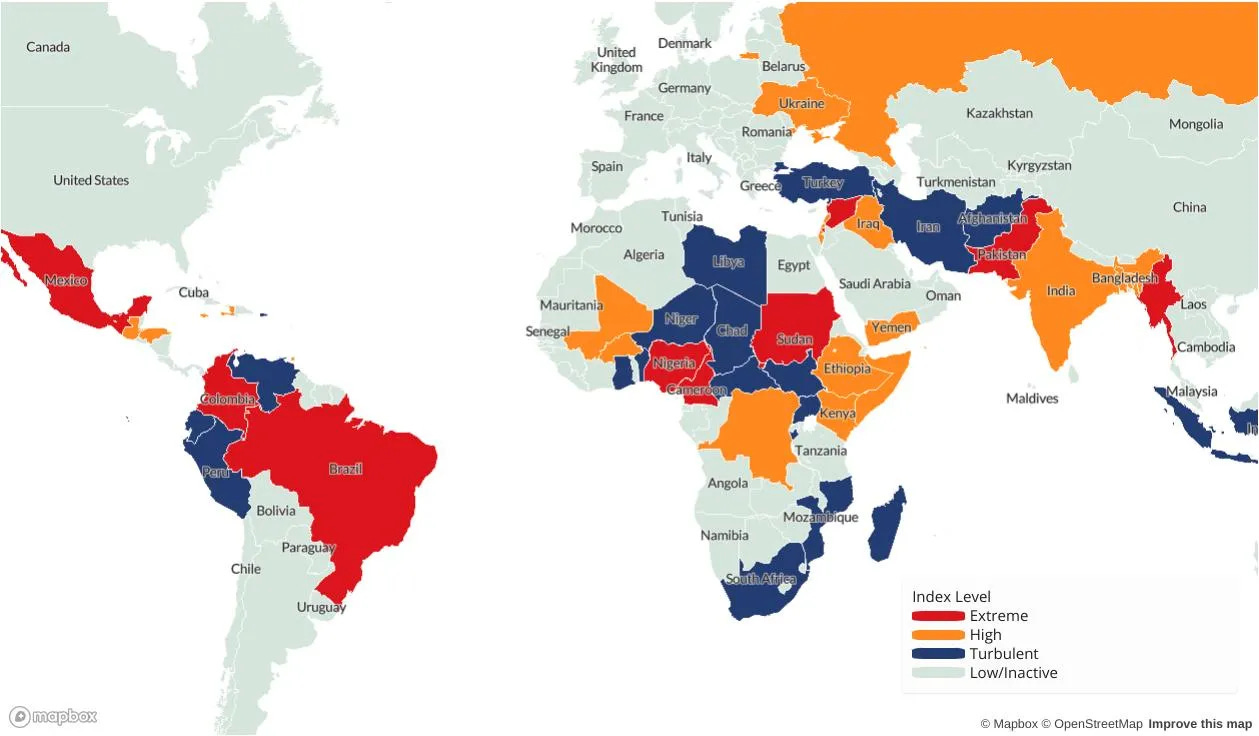
To measure the true extent of this disaster, one must accept looking squarely at figures that well-protected consciences prefer to leave in the abstraction of organisational reports. The ACLED (Armed Conflict Location and Event Data) estimated in a report of July 2024 that 50 countries are in the grip of violence: one person in seven worldwide is said to have been exposed to its consequences.
The map below, taken from their Conflict Index, shows the scale of it.
The AOAV (Action on Armed Violence) recorded approximately 34,000 civilian deaths worldwide in 2023: an increase of 130 per cent compared with 2022, with victims in Gaza accounting for 39 per cent of that total. On the military side, Media Zona estimated in November 2024 that Russian losses in the war in Ukraine exceeded 77,000.
Thus, a few hours’ flight from Paris, we watch helplessly as barbarism makes its tragic return. Yet this return is hardly surprising: cyclically, the violence of war recurs upon the earth. Is each period of peace merely the provisional rest of a humanity exhausted from having shed too much blood? It sometimes takes only a few months, at best a few decades, before human beings succumb once again to their morbid addiction to carnage and destruction.
The lucrative industry of war
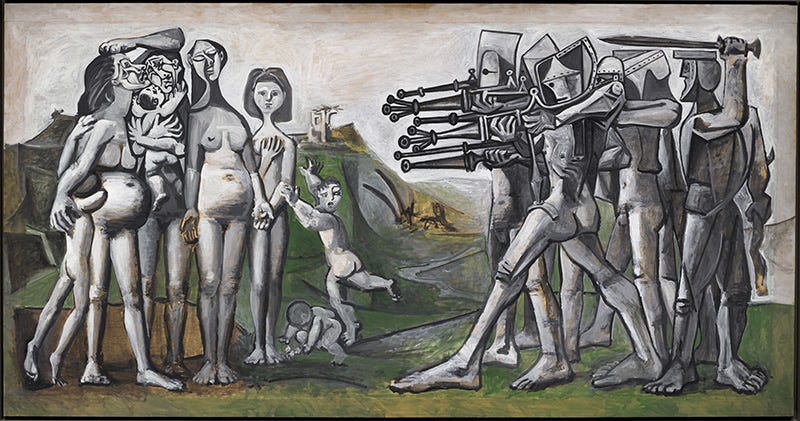
The twentieth century was that of mass slaughter on an unprecedented scale. Increasingly lethal weapons, from the great guns of Verdun to the atomic bombs of Hiroshima and Nagasaki, produced human losses at a level never before reached in history: approximately 8.5 to 10 million soldiers killed in the First World War, to which must be added 6 to 7 million civilian victims; then, in the Second World War, 21 to 25 million soldiers and 50 to 55 million civilians, swept away by combat, bombardment, massacres, the Shoah and famines.
And yet the industry of war continues to thrive. It is here that the ledger of reality reveals its most unbearable truth. In 2023, when 200 million children were suffering from malnutrition and UNICEF was devoting 3.63 billion dollars to them, global military expenditure stood at 3,000 billion dollars, nearly 827 times more. This budgetary balance of power is not a misallocation of priorities that better policies might one day correct. It is a civilisational choice, repeated consciously or unconsciously, generation after generation, that reveals the essence of what our societies truly value, far removed from declarations of principle and charters of human rights. In this bleak picture, France accounts for 11 per cent of global arms exports, third behind Russia (16 per cent) and the United States (40 per cent).
Let us pause for a moment on this arithmetic of shame. Three thousand billion to organise death; three point six billion to try to spare children from it. If one wished to summarise in a single figure what our so-called contemporary civilisation truly offers for the future of its children, that figure would suffice.
Are we truly civilised?
Can a globalised world that allows millions of children to die of hunger while others grow rich by the billion from the commerce of death be called civilised? Personally, I do not believe it can.
The dissonance is vertiginous: on one side, surgeons transplant hearts, biologists decode living matter down to its most infinitesimal sequences; on the other, armies pound residential buildings with those same derived technologies, and financial markets flourish on this commerce of destruction. Behind the cultural and technological veneer that makes our societies appear advanced, barbarism holds sway today as it did in the Neolithic, but with a capacity for destruction our forebears could not have imagined.
What Auschwitz revealed with unmistakable clarity — and I return to it here briefly, having treated this question in its full depth on the occasion of Yom haShoah — is that technical rationality, bureaucracy and scientific thought, when severed from all ethical and spiritual compass, can become the most efficient instruments ever devised for the extermination of human beings. That danger is not past. It accompanies every technical advance we make without having simultaneously accomplished the corresponding inner work. We have manifestly still not undertaken, as a collective, to plumb our inner depths in order to eradicate there whatever carries the seed of violence and war.
Cain: an interior anatomy of violence
This tenacious incapacity to plumb our depths, precisely where violence takes root before rising to the surface as wars, hatreds or organised indifferences, has a name, a face and a history. To understand its mechanics, let us return to the oldest account humanity has transmitted on this subject, not as a religious curiosity, but as a mirror of redoubtable precision on human nature. The historical genealogy of this primal murder, from the Neolithic mass graves to the genocides of the twentieth century, I have traced elsewhere. What concerns me here is different: not the map of the massacres Cain has produced across the centuries, but the interior anatomy of Cain himself — the psychological, philosophical and spiritual mechanism that drives him to act, and that continues to act within us.
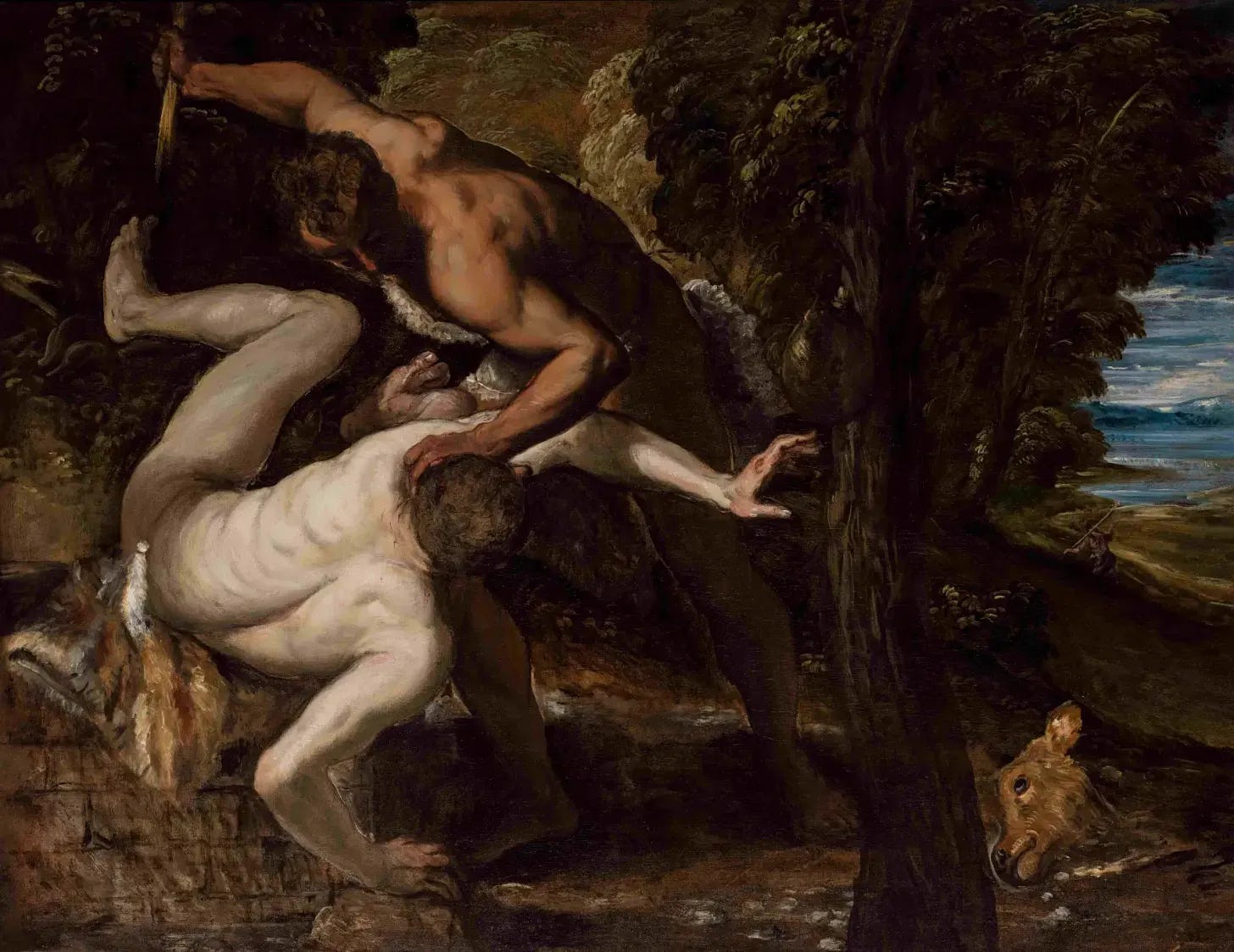
Genesis, in its fourth chapter, tells the story of Adam and Eve’s two sons in sixteen verses of quite stupefying anthropological density. Cain, the elder, is a tiller of the soil: a man of settled earth, of property, boundary and accumulation. Abel, his younger brother, is a nomadic shepherd: a man of the flock, of movement and shared space. Both make an offering to G-d. He accepts Abel’s sacrifice and not Cain’s. The Bible, in what constitutes one of its most vertiginous silences, offers no explanation for this preference. No declared fault on Cain’s part precedes the divine refusal, as though the text wished to make us grasp that the injustice Cain then feels is an original condition of human existence, an irreducible given with which every living being must learn to contend.
Cain burns with rage and shame. His face turns away. And G-d addresses him with words of troubling gravity: “If you act well, will you not hold your head high? But if you do not act well, sin is crouching at the door: it desires you, yet you must master it.” This formulation is striking in its psychological modernity: G-d does not condemn Cain a priori; he describes an interior dynamic — something waits, crouching in the shadow of his soul, ready to spring if the guardian relaxes his vigilance. Were Cain to consent to look his anger in the face, he might then learn to transform it; but Cain does not hear. He invites his brother into the fields and kills him.
When G-d then asks, “Where is your brother Abel?”, Cain utters what is perhaps the most revealing response in all of human history: “Am I my brother’s keeper?” In a few words, he enunciates the prototype of all moral abdications, all retreats into self-interest, all organised indifferences to the fate of the other. This response traverses the millennia without ageing a single day: one hears it resonate behind every politician who refuses to look at world hunger statistics, behind every investor who signs arms contracts without questioning their destination, behind every citizen who averts his eyes from the misery of his neighbour.
We are Cain’s heirs
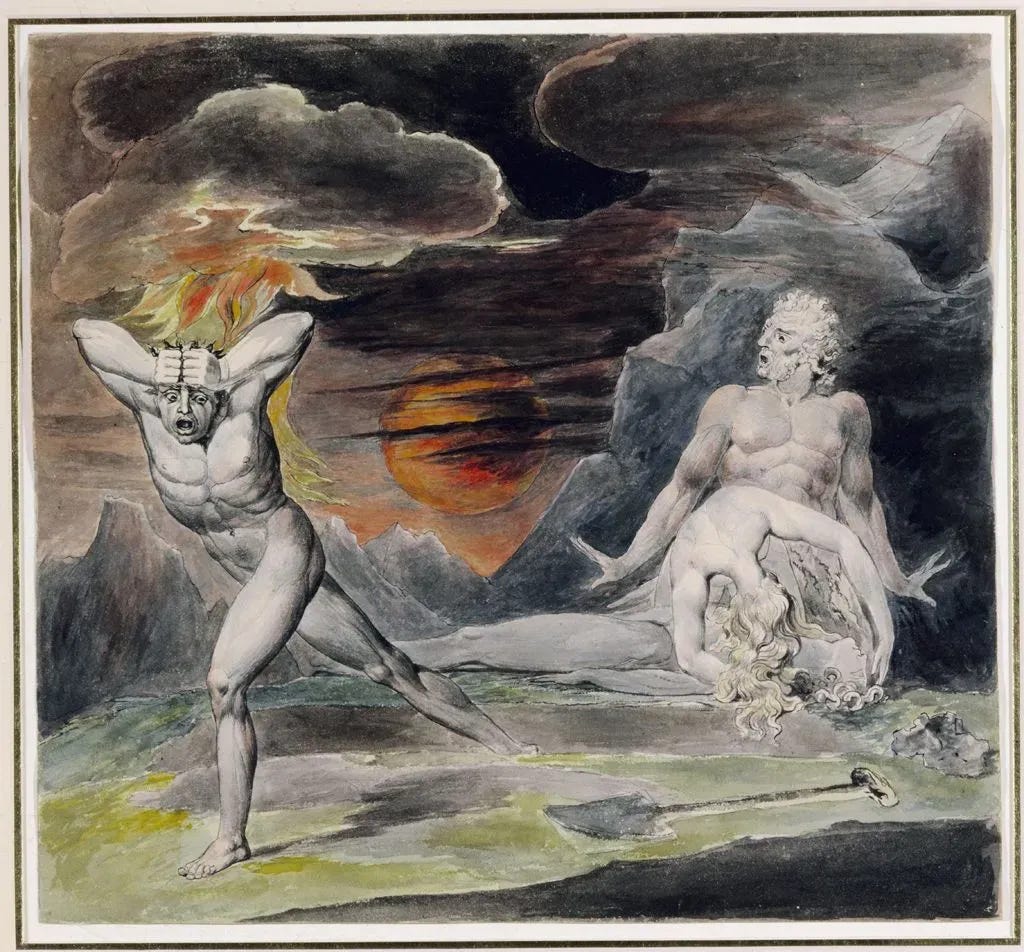
This truth deserves to be faced without evasion or mitigation: we do not descend from Abel. Abel died without issue, he was cut off too soon, erased from the chain of generations. It is Cain who fathered the nations, who built the first cities, who developed the arts, crafts and trades. The mark that G-d set upon his brow we all bear, invisible and indelible, inscribed not only in our cultural memories but in the most archaic structures of our psyche.
Freud, in his essay Civilisation and Its Discontents (1930), named it the death drive,Thanatos, that inner force impelling us towards the destruction of self and other, in permanent tension with Eros, the drive towards life, union and creation. War, on this reading, is not an aberration external to the human being, an accident of history arising from institutional malfunction: it is the collective expression, organised and amplified by states, of what each individual carries in seed form in the least illuminated regions of himself.
René Girard deepened this intuition decisively with his theory of mimetic desire, which is worth dwelling upon, for it illuminates an aspect that neither Freud nor political scientists are quite able to grasp. Cain does not simply suffer from being refused by G-d: he suffers from seeing that Abel is desired where he is not. It is not the object of the offering that matters, but the preference — that gaze of the other that falls elsewhere than upon him. From that moment, what Cain wants is no longer merely to be accepted; it is to be Abel, to occupy his place in the divine gaze. This desire to occupy the other’s place, to possess his recognition, his status, his territory, is according to Girard the engine of all human rivalries, from marital conflict to wars between nations, by way of economic competition and identity struggles.
The brother becomes a rival precisely because he is close, because resemblance renders the difference in destiny unbearable. Fraternal mimesis then turns inexorably into sacrificial violence whenever no spiritual or symbolic authority intervenes to interrupt its fatal spiral. The scapegoat — Abel — provisionally absorbs collective violence, but does not suppress it: he merely defers it until the next explosion. The universal history of wars, persecutions and genocides is, on this reading, nothing but a long succession of scapegoats who have never sufficed to slake the mimetic thirst of their murderers.
Saint Augustine, fifteen hundred years before René Girard, had intuited something similar in seeing in Cain the figure of the Earthly City — that human organisation founded on self-love pushed to the point of contempt for G-d and for the other — and in Abel the figure of the City of G-d, whose tragic vocation is to be ceaselessly sacrificed by the logics of the world yet never to disappear entirely. These two cities coexist not only in the course of collective history but simultaneously within each human soul. What each individual carries, each society amplifies; and what each society amplifies, history inscribes in letters of fire and blood upon the dark plains I traversed in my dream.
The contemporary faces of Cain
It would be convenient — and profoundly false — to confine Cain to the trenches, the airstrikes or the gas chambers. The Cainite impulse invests all spaces of collective life with equal destructive efficacy, often without a single drop of blood being shed. The managerial violence that methodically grinds individuals down beneath the imperatives of profitability, the organised public humiliation on social networks where anonymous crowds set upon designated victims, the predatory economic competition that impoverishes entire nations to enrich a handful of shareholders, the institutionalised indifference to the slow death of millions of migrants, malnourished children or abandoned elderly people: all of this bears the same signature as the first murder in the fields.
And everywhere, the same response from Cain: “Am I my brother’s keeper?”
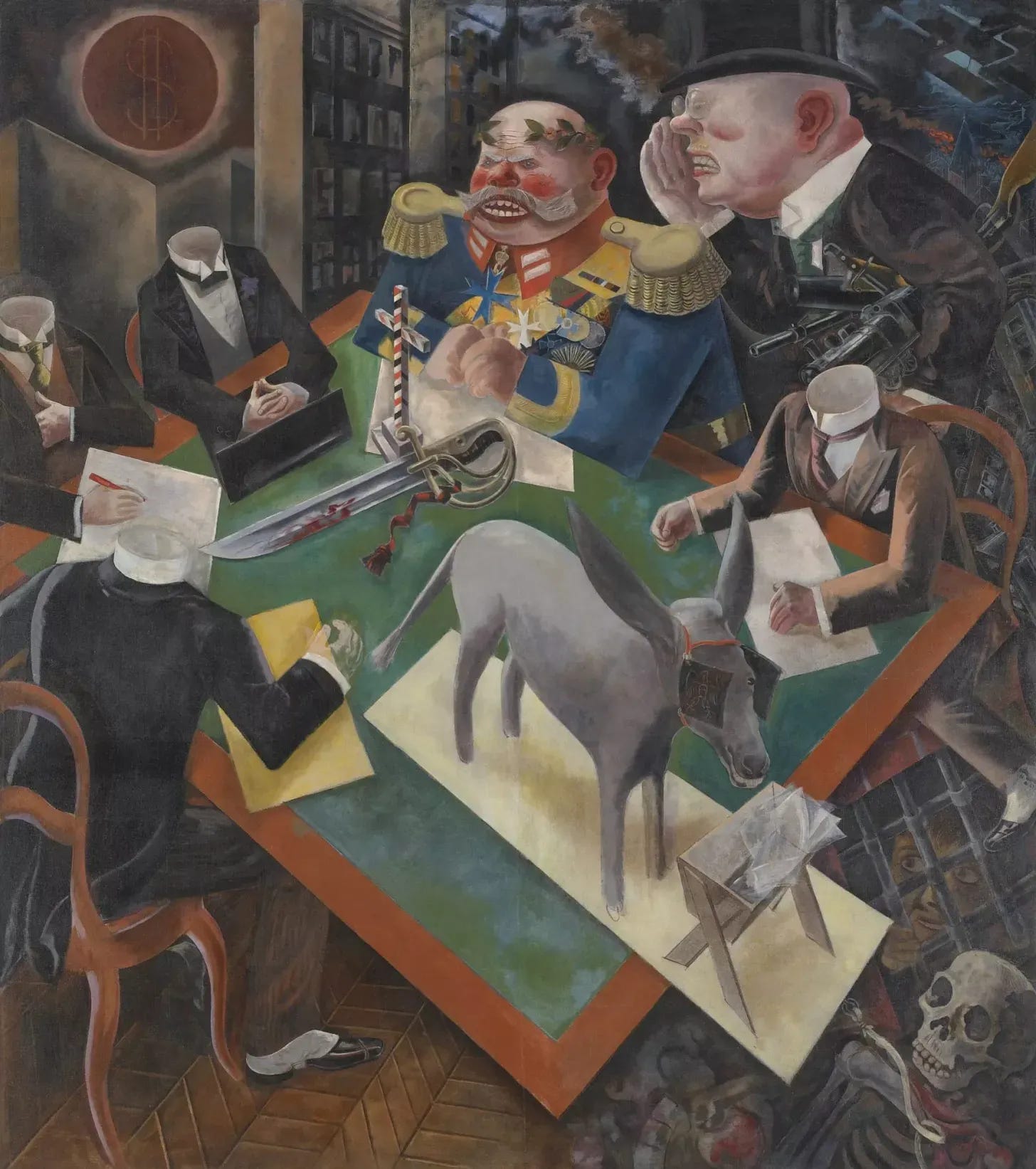
Behind the figure of 3,000 billion devoted to armaments, there is no accounting error: there is the result of thousands of individual decisions taken by educated men and women, often cultivated, often fathers and mothers, often capable of generosity in their private lives. The financial analyst who structures an investment fund in the arms industry, the engineer who optimises the flight path of a combat drone, the lobbyist who secures the release of an export contract to an authoritarian regime: none of them thinks he is performing a murderous act. They have simply, each at his own level, answered as Cain did — their brother is not their concern, their expertise is their concern, their career is their concern, their shareholders are their concern. The growing sophistication of our technologies changes nothing in this fundamental equation: it merely increases the efficiency of destruction and the distance between killer and victim, rendering the act cleaner, more abstract, easier to delegate and therefore easier to bear without undue guilt.
Cain decides, time and again, that his brother’s blood is of no consequence to him, and that his own immediate interest or his own fear outweighs every other consideration.
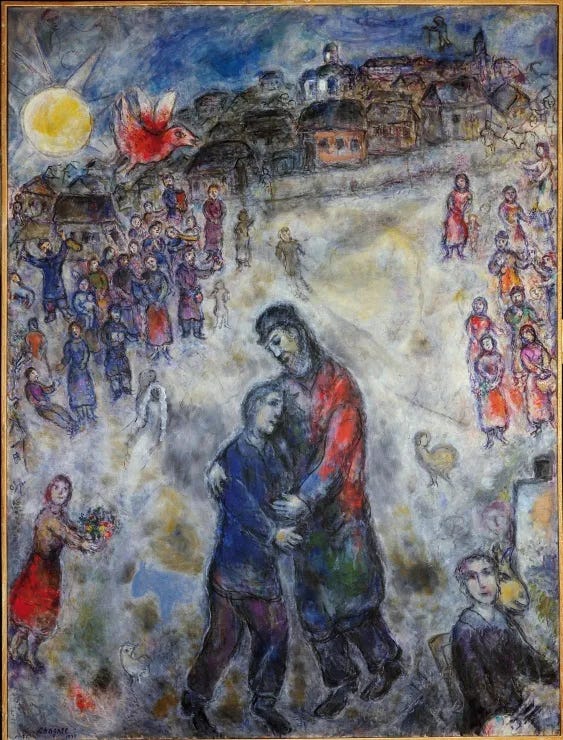
The only remedy: transformation from within
Faced with this diagnosis, the usual responses very quickly show their limits. Diplomatic solutions, disarmament treaties, Security Council resolutions, economic sanctions: all these responses are necessary given humanity’s present condition, yet none is sufficient, for they operate solely upon symptoms without ever reaching the source. The wound that has been bleeding since Abel is not institutional — it is interior, and it is there that the transformation must occur, at a level that neither politics nor technology can reach.
Three great spiritual traditions, among many others that converge upon the same reality, allow us to take its exact measure and to sketch its concrete paths.
Christian mysticism speaks of metanoia — the complete turning of one’s interior orientation, the passage from self-love to the love of G-d and of one’s neighbour — as a radical rupture accomplished not through the accumulation of knowledge nor through good intention, but through a decision of the whole being, sustained by a daily practice. What the Desert Fathers called nepsis — interior spiritual vigilance — is precisely the antidote to what G-d describes to Cain: something crouching at the door. One cannot afford to leave one’s door unguarded.
Sufism names the jihad al-akbar the great combat of the soul — not the outward war against the enemy, but the inward war against the disordered passions of the soul: jealousy, wounded pride, the resentment that settles in and festers. This combat is called great precisely because it is the most difficult, the most protracted and the most decisive: to win every outward battle without having waged it is to have won nothing at all, as the history of empires that vanquished their enemies before collapsing under the weight of their own inner contradictions bears witness.
Theravāda Buddhism proposes mettā — loving-kindness — not as a feeling, but as a deliberate and progressive practice: one begins by cultivating benevolence towards oneself, then extends it to those one loves, then to those who are indifferent, then to difficult relationships, then to enemies. This progressive, concentric deployment is not an exercise in naivety but a rigorous training of the will, comparable in its discipline to that of an athlete or a musician. Mettā does not suppress the reality of conflict; it transforms the gaze of its practitioner upon the adversary — no longer an enemy to be destroyed, but a suffering being carrying, in his own way, his share of Cain.
Martin Luther King had understood this in exemplary fashion: before taking to the streets, before mounting a platform, before facing the batons of the segregationist South, he worked each day upon his own interior Cain — the fear, the anger, the resentment, the temptation to answer violence with violence. Gandhi through his long campaigns of resistance, Mandela through his years of captivity, Etty Hillesum writing her diary in the Westerbork transit camp before boarding the train to Auschwitz: all bear witness to the same reality. Profound spiritual transformation does not anaesthetise pain nor suppress reality in its brutality; but it prevents brutality from triumphing definitively. It keeps alive, even in the most desperate circumstances, an irreducible space of inner freedom from which love may spring as act rather than as sentiment.
It is this space of love that we must develop within ourselves, then learn collectively to inhabit, to expand and to pass on.
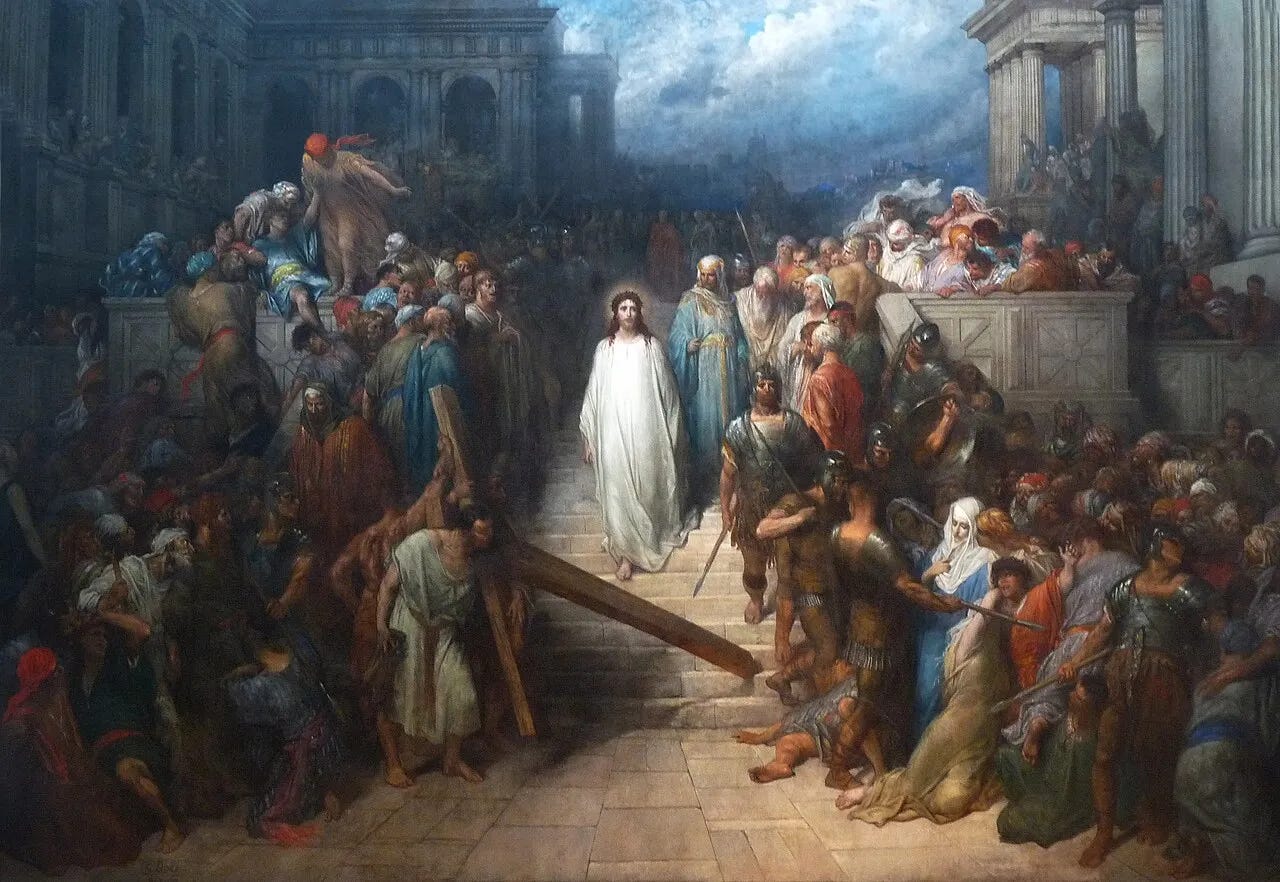
Learning to love — truly
“Learning to love”: the phrase may seem derisory measured against the scale of the evil described, almost naïve in the face of bulldozers, cruise missiles and armed drones. It is not, provided one understands which love is meant. Not romantic and sentimental love, as fragile as wet paper in the first contrary wind; nor the superficial benevolence that smiles at everyone without ever risking or giving anything. The love of which the mystics speak, the Stoic philosophers, the therapists of reconciliation and the builders of peace, is an active, demanding, disciplined force — a permanent labour upon one’s own structures of fear, competition and closure.
This love begins each morning, long before the bombs have had time to sound: in the way one listens or does not listen to one’s neighbour, in whether one responds or not to the distress of a stranger, in the refusal to take part in the destructive rumour, in the choice to see in the adversary not an enemy to be destroyed but a lost brother bearing, in his turn, the mark of Cain upon his brow — the same mark as our own.
This choice, repeated billions of times by billions of people in their daily lives, is the only revolution that could at last change our human condition: not by suppressing Cain, which is doubtless impossible, but by teaching him to hear the voice that has spoken to him since the dawn of time: “Sin is crouching at the door — but it is for you to master it.”
That night, in my dream, those dead asked nothing impossible of me. They simply reminded me that I am alive, and that the living still have a choice.
For Abel continues to cry out towards the sky. And the sky continues to wait for us to answer.
© 2026 - Dialogues of the New World — Jérôme Nathanaël

To go further
In the face of the trials of our time, what ancient teaching, what new wisdom or what personal experience still helps you to hold steady, to understand, or to discern? Share your thoughts in the comments and let us benefit from your perspective.
If you wish to speak to the upheavals of our age, send me a contribution of roughly one page for the Waymakers section. It will be published under your initials, a pseudonym, or anonymously, as you prefer. Other readers will be able to respond and enter into dialogue with you.”
New here? The Opening page introduces the author, the project, how to take part, contact details, and the agenda.