
Article disponible en français
The Eternal Present · Heritages · 29 min
To reread the traditions in order to understand what they have shaped and what they can still transmit.

Serie: The Wound of Duality — and the Return. Article 1
It is a question human beings have never stopped asking, across every latitude and in every language: why do I feel separate? Separate from the Divine or the Absolute, separate from others, separate from nature, separate from myself. This wound of duality — this persistent sense of being an isolated fragment in an indifferent universe — is perhaps the most fundamental pain of the human condition. To address it, humanity’s great spiritual traditions have each elaborated, in their own idiom, remarkably deep and coherent maps of reality and paths of return.
This text is a crossing in three parts. Neither an inventory nor a comparative handbook, but an invitation to descend into the depths of several age-old traditions — kabbalistic Judaism, Christian mysticism, Islamic Sufism, Vedantic Hinduism, Buddhism, Taoism — before giving voice to two twentieth-century spiritual voices whose freshness and urgency yield nothing to the authority of antiquity: the Revelation of Arès and the Dialogues with the Angel.
This first installment maps the veiling and its names, the diversity of visions of the Absolute, and the deep convergences between these traditions. The second and third installments — to be published next week and the week after — will explore the concrete pathways of access: how does one cross the veil? — before examining the irreducible lines of fracture between these traditions, and what they say together to an age that has lost its sense of the Sacred. The goal is not to force an artificial consensus among them, but to seek what they share — and what their irreducible differences reveal about the very nature of the Real that each one seeks to reach.
In this article:
I. The fundamental question: what is the Real?
II. Four major traditions of non-dualism
III. Two Voices of the 20th Century: the Revelation of Arès and Dialogues with the Angel
I. The fundamental question: what is the Real?
The inadequacy of ordinary perception
All great spiritual traditions share a common starting point. Ordinary human consciousness, when left to its habits, does not perceive the world as it truly is; rather, it perceives the world as it is perceived. It slices the world into pieces — me and you, inner and outer, sacred and profane, life and death — and mistakes these slices for absolute realities. In doing so, it misses something essential: a deeper unity that precedes and sustains all these distinctions.
This veiling bears different names across traditions. In Shankara’s Vedantic Hinduism, it is avidyā, or metaphysical ignorance, which projects māyā onto the Brahman, the absolute Consciousness-Being. In Buddhism, it is the mistaken belief in the existence of a fixed, independent self, or ātman, which the Buddha denies through the doctrine of anattā. This belief generates attachment, resistance, and suffering. For Sufis, it is the veil of ghaflah (forgetfulness), which prevents the heart from perceiving that all existing things are epiphanies of the divine. For Kabbalists, these are kelipot, or shells of opacity, that cover the divine sparks scattered during the primordial breaking of the vessels. In the Revelation of Arès, it is the Adamic fault, which is not a moral transgression, but rather an event of dualization. By emancipating himself from the Father through his own misdirected freedom, Adam became “dual, at once image and likeness of the Father and a thinking animal, king of the world.” For the Dialogues with the Angel, it is heaviness—the progressive densification of human consciousness that distances it from its angelic “luminous half”—not as original sin, but as a provisional condition whose overcoming is the very vocation of human beings.
All these traditions affirm that this veiling is not a primary, necessary condition; rather, it is a secondary fracture. Whether historical, cognitive, or karmic, depending on the perspective, it is real in its effects, but not in its foundation. Because it is not a primary condition, liberation, return, awakening, and deification are possible, depending on the vocabulary used.
The Absolute has many faces
Before proceeding, it is important to acknowledge a fundamental diversity that the syncretic temptation tends to erase: the names that different traditions give to ultimate reality are not interchangeable, and their differences reveal distinct worldviews.
Shankara’s Brahman, for example, is a pure, impersonal consciousness — without attributes (nirguna), without will, and without love in the relational sense. It is rigorously solitary at its core. It is designated by the triad Sat-Chit-Ānanda —Being, Consciousness, and Bliss—not as three qualities, but as one indivisible reality. At first glance, Ibn Arabi’s divine Dhāt appears similar — beyond all Name and Attribute — but it retains a core desire to manifest and be known, as expressed in the hadith qudsī: “I was a Hidden Treasure, and I desired to be known, so I created creatures.” The Kabbalistic Ein Sof is the boundless infinity of the Divinity, prior to all manifestation, yet unfolding with architectural precision through the sefirot. The Mādhyamaka Buddhist concept of Śūnyatā is different: not a positive Absolute, Consciousness, or Being, but the emptiness of the intrinsic existence of every phenomenon, including emptiness itself. The Taoist Tao refuses even language: “The Tao that can be named is not the eternal Tao.” In the two contemporary voices that close this mapping, ultimate reality is designated by a single word: Life — not as a biological metaphor, but as the name of Being itself: living, present, loving, and irreducible to any abstraction.
These are not mere terminological disputes. They signal metaphysical positions with considerable practical and ethical implications because the way one names the Absolute determines how one inhabits the world. Yet, these traditions also share something essential: ultimate reality is one, not multiple. The multiplicity we perceive daily is either derived, illusory, or a veiled expression of this fundamental unity.
II. Four major traditions of non-dualism
1. The non-dualism of Being: Abrahamic monotheisms
The three great monotheistic traditions—Judaism, Christianity, and Islam—have each produced mystical currents that push monotheism to its most extreme consequence. If G.od is truly the one and only, and nothing exists apart from Him, then how can a human being face him without being, in essence, in Him? The institutional orthodoxy of each tradition has often tried to suppress this question, which is the secret engine of all the great Abrahamic mysticisms.
Jewish Kabbalah
In Judaism, Kabbalah is an esoteric movement that developed from the 12th century onwards. It culminated in the 13th century with the Zohar, becoming more radical in the 16th century under Isaac Luria in Safed. Kabbalah is the most bold expression of non-duality. Its central concept is Ein Sof, which literally means “Endless.” Divinity in its absolute essence, prior to any name, relationship, or will. Ein Sof is not the personal God of the Hebrew Bible. It is divinity before all its actions, in a silence and fullness that no language can reach and that only the apophatic path can approach. The functional structure of Ein Sof is reminiscent of Shankara’s nirguna Brahman — but while Brahman remains radically impersonal, Ein Sof manifests itself in the ten sefirot. These are the attributes or spheres of divine energy that form the Tree of Life, the architectural structure through which infinite light journeys toward manifested creation.
In Lurianic Kabbalah, this process of emanation is preceded by the Tzimtzum, or the divine contraction. It is the withdrawal of the Ein Sof into itself, which frees up a space (tehiru) where creation can exist. It is a non-dualistic paradox of remarkable subtlety: the divine creates by erasing itself, and the world is only possible because the infinite consented to make itself small. According to the primordial catastrophe, or Shevirat Ha-Kelim (the Breaking of the Vessels), during creation, the vessels meant to contain the Light shattered. This projected divine sparks, or nitzotzot, into the depths of matter, which are covered by kelipot, or shells of opacity. The world, as it is, is a field of captive sparks yearning to return to their Source. The task of human beings—the teshuvah in its Kabbalistic dimension—is to free these sparks through every just act, every intentional prayer, and every gesture of love and truth. This is Tikkun Olam, the repair of the world. It is a simultaneous cosmological and human repair, mending the fracture of Being and the fabric of human relations. Divine sparks scattered throughout creation are not released in the solitude of individual consciousness; rather, they are released in the space that opens up between beings when a gesture of justice, tenderness, or truth bridges the distance that separates them.
The 18th-century founder of Hasidism, the Baal Shem Tov, further radicalized this non-dualism by teaching acosmism. This is not pantheism, which asserts that the divine is the world. Rather, acosmism asserts that the world has no independent reality and only exists in relation to the Ein Sof. Devekut, or adhesion to the Divine, is not a state reserved for a contemplative elite; it is accessible to every human being in daily life through prayer (tefilah), joy (simha), and right intention (kavanah). The boundary between the finite and the infinite is not ontological — it is cognitive. It is our fragmented gaze that creates the illusion of separation.

Christian mysticism
In Christianity, the most rigorously non-dualist tradition is Rhenish mysticism of the 13th–14th centuries, led by the Dominican Meister Eckhart (1260–1328). According to Eckhart, the soul possesses a “spark” (scintilla animae) that has always been united with the Divine. This divine entity is not the personal G.od of Trinitarian theology, but rather the Gottheit (Godhead), the abyssal ground that precedes the three persons. It is the functional equivalent of the Kabbalistic Ein Sof and the Shankarian Brahman. His central aphorism encapsulates his non-dual vision: “The eye through which I see God is the same eye through which God sees me.” There is no human gaze and divine gaze crossing each other; there is one act of vision in which the subject and object reveal themselves as identical at their core. His disciples — John Tauler, Henry Suso, and Jan van Ruysbroeck — developed this legacy with their own emphases. Ruysbroeck expressed this union in a way that no theological formula ever had: the soul is “like a flame in a fire” — it becomes inseparable without ceasing to be itself.
The Byzantine tradition of hesychasm, theorized by Gregory Palamas in the 14th century, proposes a different yet convergent path. Palamas distinguishes the divine essence, which is absolutely transcendent and inaccessible, from the uncreated divine energies through which God communicates with humans in contemplative prayer. This allows for a theosis (deification) that does not abolish the distinction between Creator and creature, but unites them in such an intimate way that the distance between subject and object disappears in the Light of Tabor — the uncreated light of Christ’s Transfiguration, which is accessible even to a body purified by the Jesus Prayer.
Islamic Sufism
In Islam, the most powerful and systematic non-dualist formulation is that of Muhyiddin Ibn Arabi (1165–1240). His doctrine of Wahdat al-Wujud (Unity of Being) asserts that only Allah truly exists and that all of creation is His self-manifestation (tajallī) through His infinite Names and Attributes. Each existent is a “mirror” in which a divine name is reflected and a “face” through which the divine contemplates itself from a particular angle.
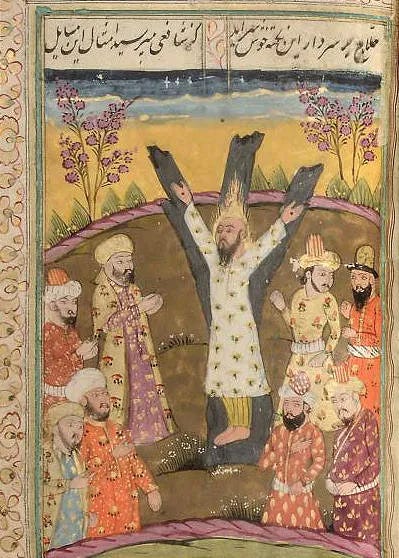
Here, one sees the distance from Shankara, who declares the world māyā, or an illusion to dissolve. Ibn Arabi, on the other hand, declares it tajallī, or a precious and irreplaceable epiphany. Before Ibn Arabi, al-Hallaj (857–922) lived this non-duality thunderously: condemned to death for declaring “Ana’l-Haqq” (”I am the Truth”), he embodied fanā’—the extinction of the individual self in the divine presence—in which Hallaj is no longer speaking, but rather God through the empty space that Hallaj has become.
2. The non-dualism of Identity: Vedantic Hinduism
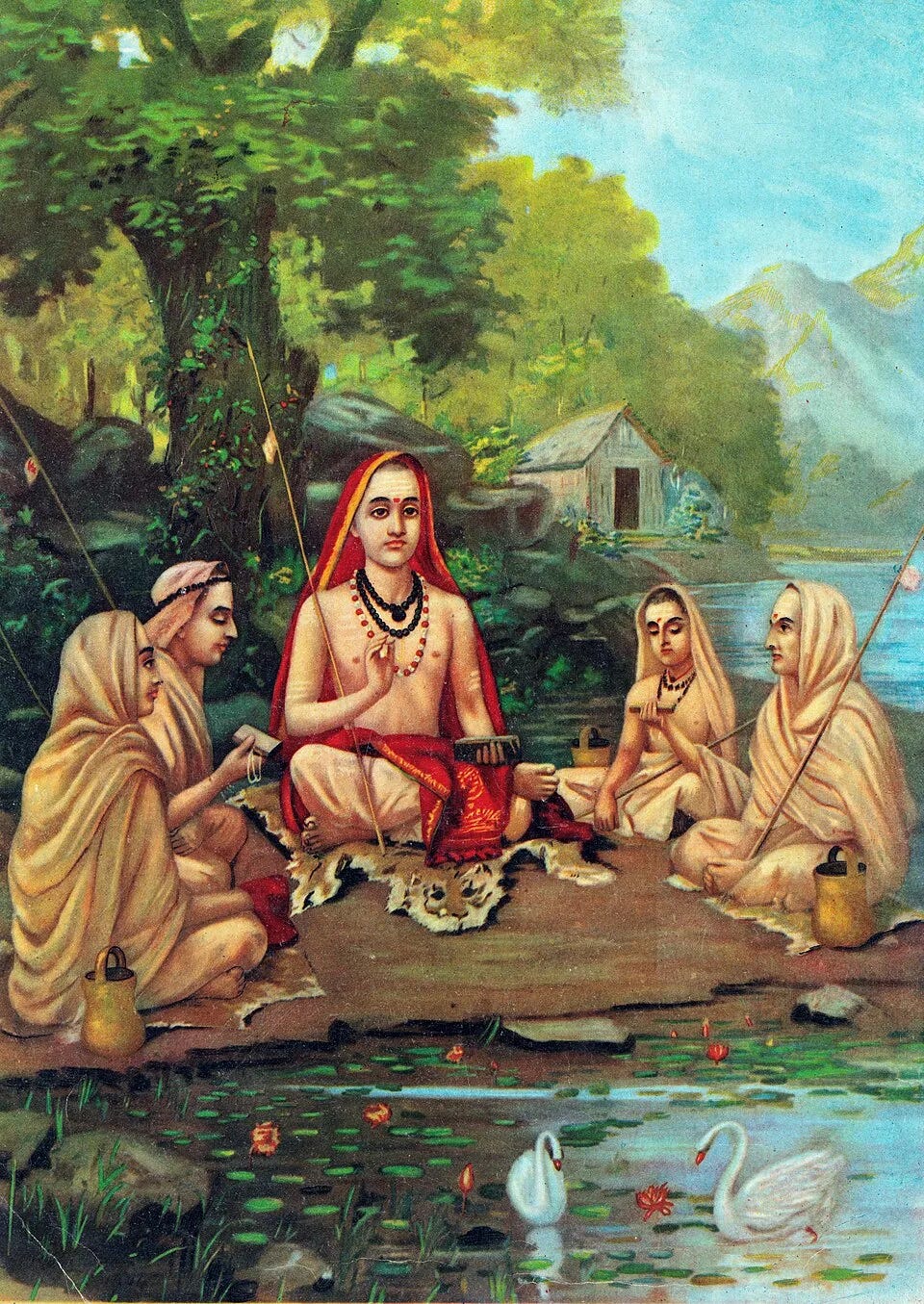
Of all the spiritual traditions, Hinduism — specifically the Advaita Vedanta school — has developed the most radical, systematic, and philosophically coherent non-dualism. Its most illustrious representative, Ādi Shankarāchārya (788–820 CE), deserves an in-depth examination of his work.
Shankara: the radical nature of identity
Shankara was born in Kerala and devoted his short yet intense life to traveling throughout India. He publicly debated his philosophical positions, commented on the Upanishads, the Bhagavad Gita, and the Brahma Sutras, and founded four monasteries (mathas) at the four cardinal points of India. His work constitutes a rigorous reinterpretation of the Vedic texts as well as an original, remarkably coherent metaphysical construct.
His central position is encapsulated in a sentence whose apparent simplicity conceals profound depth: Brahman satyam, jagat mithyā, jīvo Brahmāiva nāparaḥ — “Brahman is real, the world is illusion, and the jīva (the individual soul) is not different from Brahman.” Three propositions, one single movement: affirm the One, relativize the many, and recognize identity.
For Shankara, the Brahman is the only existing reality—pure Consciousness (Chit), pure Being (Sat), and pure Bliss (Ānanda), indivisible. “Aham Brahmāsmi” — “I am the Brahman” — drawn from the Bṛhadāraṇyaka Upanishad, is one of the four Mahāvākyas (literally: “Great Sayings”), revealed formulas from the Upanishads that aim to actualize the ātman-Brahman identity. Shankara places these at the heart of Vedantic teaching. Tat Tvam Asi — "Thou art That" —, from the Chandogya Upanishad, is the declaration addressed to the disciple that what you seek so ardently, you already are.
Māyā is the concept by which Shankara explains the perception of the world as being multiple, diverse, and autonomous. Māyā is neither real nor unreal in the strict sense; it is anirvacanīya, or indefinable. It is neither being nor non-being, but rather a superimposition (adhyāsa) projected onto the screen of Brahman by the power of ignorance (avidyā). The classic analogy is that of a rope mistaken for a snake in the dark. In the light of direct knowledge, the snake (the multiple world) disappears as an illusion and only the rope (Brahman) remains. This devaluation of the phenomenal world is the point at which Shankara departs most radically from all Abrahamic traditions, Kashmiri Shaivism, and, as we will see, contemporary voices. However, it has a rigorous internal logic. If Brahman is the only reality, then multiplicity cannot be real in the same way as Brahman.
From an ordinary perspective, the individual soul (jīva) is a distinct being subject to karma, the law of causality of actions, rebirth, and suffering. However, from the ultimate perspective (pāramārthika), it is always Brahman, misunderstanding itself. Just as the light of a lamp, when projected through different filters, appears multiple and colored without changing its nature, the Ātman (the deep Self) appears multiple and individualized without ever ceasing to be Brahman. Therefore, liberation (moksha) is not a transformation of the soul nor an ascension to Brahman; it is a reversal of perception (jñāna). The jīva realizes that it has never been different from Brahman. There is nothing to accomplish and nowhere to go—only the error that must be dissolved by the light of this realization.
However, the mind must be prepared to receive it. Shankara’s preparatory discipline (sādhana-catuṣṭaya) is rigorous and includes discernment (viveka) between the real and the unreal, detachment (vairāgya) from the fruits of action, the six inner virtues (control of the mind and senses, patience, concentration, faith, and aspiration for liberation), and an ardent desire for deliverance (mumukṣutva). Next is the relationship with the guru, whose role is not to impart knowledge the disciple lacks, but to reveal what has always been present: not an external transmission, but the removal of the blindness that prevented seeing. Finally, there is prolonged meditation on the Mahāvākyas until truth ceases to be an intellectual concept and becomes an immediate, continuous, lived reality.
The jīvan-mukta, or liberated being, continues to act in the phenomenal world. However, he acts like a mirror that reflects everything without retaining anything. He is not identified with the ego or ignorant of his own nature. The world continues to appear, and conventions remain fully operative at their own level (vyāvahārika). The law of cause and effect, the necessity of right action, and the reality of others’ suffering are not denied. However, they no longer hold any existential significance for him because the misconception that took them for ultimate realities has been dispelled — he knows that he is Brahman.
Kashmiri Shaivism: affirmative non-dualism
Centuries after Shankara, Abhinavagupta (950–1016) developed a radically different form of non-dualism in 10th-century Kashmir. This was far from Vedantic Kerala and in a profoundly different Tantric and Shaivite context. While Shankara devalues the world as māyā, which was to be dissolved, Abhinavagupta celebrates it as līlā (spontaneous play) and spanda (living pulsation) of the divine consciousness of Shiva, the personal Absolute of Shaivism. Nothing is excluded from divine reality. Passion, suffering, sensory beauty, and diversity of forms are all vibrations of the Single Consciousness that plays at hiding in multiplicity for the pleasure of finding Itself again. Realization (pratyabhijñā, or re-cognition) is not the dissolution of the world into the silence of the Absolute. Rather, it is the recognition at the heart of the sensible world that everything has always been Shiva playing with Himself. This position is structurally closer to Sufism, Hasidic Kabbalah, and two contemporary voices than to Shankara’s pure Advaita.
3. The non-dualism without the Absolute: Buddhism
Buddhism introduces a radically different perspective into the landscape of non-dualism than all previous traditions because it affirms no positive Absolute on which to base its non-duality, which is more disturbing to any substantialist thinking. Neither Brahman, Tao, Ein Sof, nor God—yet the non-duality is as radical as any other.
The historical Buddha taught anattā, or the absence of a permanent self. What we call “I” is a temporary aggregation of five skandhas, or aggregates: material form, sensations, perceptions, mental formations, and consciousness. These aggregates have no fixed substance. This is not yet non-dualism in the full sense, but it is its foundation: If I have no fixed, separate self, the boundary between myself and the rest of the world becomes porous.
Theravada buddhism
The Theravada school, a faithful guardian of the Pali Canon, stops there in its de-substantialization. Its Abhidharma philosophy maintains that, although the self is empty, the dharmas (elementary phenomena) that comprise it have a real existence, however fleeting it may be. Theravāda preserves a fundamental structural duality: saṃsāra and Nibbāna —the Pāli term for what Sanskrit calls Nirvāṇa. The former refers to the cycle of existences conditioned by karma and ignorance. The latter refers to the unconditioned state where this cycle ends without leaving any residue. Liberation is a transition from the former to the latter. This is a non-dualism of the subject, but not of ultimate realities.
Mahayana buddhism and Nagarjuna
Mahayana took a decisive step with Nagarjuna (2nd century) and his doctrine of shunyata: not only is the self empty of intrinsic existence, but all dharmas, without exception, are empty—including nirvana itself and emptiness itself. The formula is unequivocal: “Saṃsāra is no different from Nirvāṇa.” This is an unexpected point of contact with Shankara, who asserts that liberation is not in any other place than this world because the world is Brahman. Nāgārjuna asserts the same thing, but for a different reason: there is nowhere else to go. However, there is a significant difference: for Shankara, Brahman is real, and the world is an illusion; for Nāgārjuna, nothing has intrinsic existence, not even the positively named Absolute.
The great ethical contribution of Mahayana Buddhism is the bodhisattva ideal: a being who, having realized the emptiness of any distinction between the self and others, chooses to remain in the cycle of existence until all beings are liberated. While Shankara’s Advaita leads logically to an inward-facing liberation —for the jīvan-mukta, others are merely Brahman playing hide-and-seek—Mahayana asserts that if others are not inherently separate from me, my liberation without theirs would be a contradiction in terms. Universal compassion (karuṇā) is the natural extension, not an added moral component, of non-duality.
Yogācāra school
The Yogācāra school, also known as “Consciousness-Only” (vijñaptimātra), was developed by the brothers Asaṅga and Vasubandhu in the fourth or fifth century. This school approaches non-duality from a different angle, focusing on the non-separation of subject and object in consciousness. Everything experienced as an external object is a projection of storehouse consciousness (ālaya-vijñāna). Liberation consists of purifying this consciousness to reveal the nature of Buddha (tathāgatagarbha)—the primordial, awakened consciousness that is always present and never defiled. This notion of pure, original consciousness is closer to Shankara’s concept of Brahman than Nāgārjuna would have liked. The Mādhyamika masters did not fail to point this out.
This fundamental insight—that awakening is a nature to be recognized, not a state to be constructed—is present in both Tathāgatagarbha Yogācāra and Śūnyatā Mādhyamika. It finds its living expression in three major contemplative traditions of East and Central Asia.
Japanese Zen
In Japanese Zen, the heir to Chinese Chan (which itself emerged from the intersection of Mādhyamaka and Taoism), the practice of zazen is not a preparatory exercise for awakening; rather, it is awakening in action. Master Dōgen expressed this idea of the unity of practice and realization in the concept of shikan-taza: simply sitting without purpose or expectation as a direct expression of the Buddha nature already present.
Tibetan Dzogchen
Tibetan Dzogchen, literally “Great Perfection,” developed in the Nyingma and Bön traditions, takes this logic to its most radical conclusion: there is no practice toward enlightenment since enlightenment is the primordial nature of the mind prior to any practice. Its central teaching is based on rigpa, the primordial, clear, vast, and centerless awakened consciousness that constitutes the profound nature of all beings. This consciousness is not tainted by ordinary obscurations, no more than the sky is altered by passing clouds. Therefore, practice does not create rigpa; it dissolves the cognitive and emotional veils that prevent us from recognizing it directly.
Mahāmudrā and the Kagyu lineage
The Mahāmudrā of the Kagyu lineage, literally meaning “Great Seal,” is structurally analogous to Dzogchen, despite coming from a different tantric transmission. Mahāmudrā refers to the ultimate nature of mind—luminous, empty, and cognitively awakened—and to the path of gradually recognizing it. In both Tibetan and Zen traditions, the metaphor is the same: the goal is not to construct something that does not yet exist, but rather to cease obscuring what has always been there.
Chan master Huang Po formulated this convergence with disconcerting precision, and it resonates with equal force in all three traditions: “The only mistake is to seek.”
This is not because the effort is useless—all three traditions involve rigorous disciplines—but because seeking outside of oneself that which has never ceased to exist within oneself is the very structure of delusion. The paradox is complete: Practice is necessary but ultimately dissolves the seeker.
4. The non-dualism of Fluidity: Taoism
Lao Tzu and Chuang Tzu’s Taoism offers perhaps the most poetically honest formulation of the Absolute in religious history. This is because they begin by recognizing the radical inadequacy of language. “The Tao that can be named is not the eternal Tao.” While Shankara builds an impenetrable philosophical edifice to designate Brahman, Lao Tzu immediately dismantles any system by pointing out that the Tao defies systematization.
The Tao is the void from which everything emerges and the fullness from which everything proceeds; it is both immobility and movement; it is the One of which the Two (Yin and Yang) and the ten thousand beings are expressions. Taoist non-duality does not say, “Everything is one” — that would still be too conceptual. Rather, it shows that the yin/yang duality is itself an expression of a deeper unity that can never be fixed in a formula but rather inhabited in the fluidity of existence.
The practical consequence of this vision is wu wei—non-action, effortless action, or action perfectly aligned with the natural movement of things, producing no resistance. Compared to Shankara, the contrast is striking. Advaita calls for a clean break with the world of māyā through discriminative knowledge, whereas Taoism seeks gradual harmonization, the release of resistance, and a return to natural fluidity. The non-dualistic view of evil is particularly significant here and is radically different from all Abrahamic traditions. Yin is not the enemy of Yang; rather, it is its necessary and complementary transitory phase. Darkness is not the opposite of light; it is a prerequisite for its emergence. Rest is not the opposite of movement; it is its breath. Emptiness is not the opposite of fullness; it is its receptacle.
From this perspective, what we call “evil” is not an autonomous ontological reality or an adverse power that opposes good from another principle. Rather, it is a phase of the total movement—a moment in the cycle when force withdraws in order to return stronger and darkness precedes light. The Tao Te Ching formulates this idea with disconcerting precision: “Return is the movement of the Tao.” Everything that descends rises again; everything that contracts expands—not out of naive optimism, but because polarity is the structure of manifested reality itself.
This intuition—that evil is good in gestation, that night is a necessary condition for dawn, and that trial is a disguised ascending force—will not remain confined to Taoism. It will pass through the centuries to resurface with striking vigor in occupied Hungary in 1943. “Evil is good in the making, but not yet ready,” as we shall see in Dialogues with the Angel—a phrase that could have come from the Tao Te Ching itself.
III. Two Voices of the 20th Century: the Revelation of Arès and Dialogues with the Angel
These two texts are testimonies that emerged in the heart of the 20th century in conditions of existential urgency. They bear a spiritual message of such coherence and depth that it cannot be ignored in any honest mapping of contemporary non-dualism. A tradition implies transmission over several generations, a community of interpreters, and hermeneutic sedimentation—a duration that these two texts do not yet possess. Therefore, they do not have the authority of antiquity; they have the authority of freshness and urgency. It is precisely this freshness—the fact that they were spoken yesterday in our world, in our languages, and in the midst of our catastrophes—that gives them particular resonance for contemporary readers.
Two texts received in times of crisis.
The Revelation of Arès is a direct divine message that Michel Potay received in Arès, France, in 1974 and 1977, when the foundations of today’s crises were forming. The message unfolds in two stages: forty appearances of Christ in 1974 and five theophanies of G.od Himself in 1977. Recorded in two texts with radically different modes of expression but both strikingly original in style and theology, the Revelation of Arès is part of the full Abrahamic tradition of prophetic revelations. In this tradition, the Divine communicates directly with humans, without intermediaries, and with full authority as the Author of existence.
The Dialogues with the Angel emerged amid immediate and deadly violence in Hungary from June 1943 to November 1944. During this time, the Wehrmacht occupied the country, and mass deportations decimated the Jewish community. Four artists—Hanna Dallos, Lili Strausz, Joseph Kreutzer, and Gitta Mallasz—chose to live together in a decorative arts workshop in Budaliget to lead a more meaningful life. One day, after Gitta read a text to Hanna, Hanna simply said: “Be careful, it’s no longer me speaking!” She then began to convey words that clearly did not belong to her. Over the next seventeen months, Gitta recorded 88 interviews word for word. Hanna, Lili, and Joseph died in the camps. Gitta, the sole survivor, took the notebooks to France and published them in 1976 with Aubier.
The fact that these two texts were received during the same period, with their publications following each other almost without an interval—the Gospel given to Arès, the first part of the Revelation, in 1975; Dialogues with the Angel in 1976; then, in 1978, the beginning of the publication of the Book from the theophanies of 1977— is a coincidence that I have never ceased to meditate on. However, their respective contexts differ in nature, and this difference itself is instructive.
In Dialogues, destruction is immediate; three of the four protagonists die in the camps, and the luminous word emerges from the heart of annihilation. In the Revelation of Arès, the catastrophe has not yet occurred—it is a premonition in a world that believes itself rebuilt. Night declared on one side, night foreseen on the other: and in both cases, the same paradox that non-dualism has always been able to formulate—the Real does not depend on conditions.
What deeply unites them?
The two texts have numerous structural similarities that justify reading them together.
First, they both name the ultimate reality: Life. The Revelation of Arès states, “Life is being in the infinite, and life having spread throughout this infinite, to be human is to live among countless living beings.” The Dialogues say: “Our life is a transition to the ONE LIFE.” And again: “From eternal life comes temporal life, and from temporal life comes eternal life.” This lexical coincidence is not insignificant; it signals the same profound ontological intuition: the Absolute is not a cold abstraction—not Shankara’s impersonal Brahman, not the de-substantialized Śūnyatā, and not the unspeakable Tao—but rather, a living, dynamic presence that is personal without being personalistic.
Secondly, both reject the dissolution of the person in the Absolute. While Shankara absorbs the jiva into Brahman completely, Theravada Buddhism seeks to escape saṃsāra, and even the most radical Sufism celebrates fanā as the annihilation of the ego, these texts firmly maintain that the person is not an obstacle to union; rather, he is its condition. “One cannot skip the passage through individuality,” say the Dialogues. “The human being is free to be nothing or to reintegrate into Being beyond the Infinite,” says the Revelation of Arès. In both cases, individual freedom is not a residue to be dissolved, but rather, an absolute dignity to be fulfilled.
Michel Potay compares the Revelation of Arès to Shankara: “Shankara is non-duality, with no separation between the being that is each of us and the Whole. This is evident in the Revelation of Arès. Be One in Yourself (xxiv/1).” However, he also emphasizes the differences between the two. While pure Advaita absorbs individuality into Brahman without remainder, the Revelation of Arès preserves individual freedom as a constitutive dignity of the human being, not as a residue to be dissolved.
Thirdly, the Revelation of Arès and the Dialogues with the Angel both affirm the reality and value of the world as a place of transformation. Matter, history, relationships, beauty, and suffering are not illusions, expendable epiphanies, or mere conventions. It is here, in the density of the real world, that reunification with Life takes place. The Revelation of Arès makes collective ethical transformation—love, forgiveness, peace, and the intelligence of the heart—the royal road to this return. The Dialogues with the Angel make the creative vocation of humans their watchword: ‘Creators, not dreamy, sleepy consumers.’
Fourthly, both texts establish a non-dualistic view of suffering and evil. The Revelation of Arès does not present evil, suffering, and death as an eternal metaphysical reality but as a temporary consequence of misguided human freedom. This consequence is reversible through penance—not contrition, but a rebirth of life itself through constant improvement. The Dialogues express this idea strikingly, with a profound echo of Taoism: “Evil is good in the making, but not yet ready.” The burden, the obstacle, the trial — “they become a gift, not a punishment”, because they are the necessary resistance that allows the ascending force to exert itself.
What sets them apart?
These profound similarities should not obscure the real differences that make the two texts complementary rather than identical.
The Revelation of Arès is a direct divine word, without an angelic intermediary, in the full Abrahamic tradition. In contrast, the Dialogues are mediated by an angelic figure — “The Angel is my life-giving half, and I am his life-giving half”; “You are my denser equal” — whose relationship with humans is constitutive of non-duality. In this relationship, two halves of a single being seek each other in structural reciprocity. This reciprocity between humans and angels is nonexistent in the Revelation of Arès, where the relationship with the Creator is asymmetrical by nature. It is the unique contribution of the Dialogues to the mapping of non-dualism.
The Revelation of Arès has an explicit eschatological and communal dimension: penance as the collective transformation of all humanity over generations—the Tiqqun of an entire species. The Dialogues focus on the fulfillment of the individual in their relationship with the angel. Their scope is more personal and silent on collective and cosmological dimensions. These two differences complement each other: one reminds us that spiritual transformation is a collective task involving the destiny of all humanity, and the other reminds us that it begins in the most immediate intimacy—between a human being and the most luminous part of themselves.
Provisional conclusion: the map is not the territory!
Here is the map—or rather, the maps. There are at least six of them, some of which overlap and some of which are irreconcilable. Kabbalah, Christian mysticism, Sufism, Advaita Vedanta, Buddhism, and Taoism are six ways of naming the same wound and designating the same foundation of unity. They are six architectures of the Absolute, whose differences are revelations of the nature of reality that each seeks to attain, not inaccuracies to be corrected. Emerging in the heart of the 20th century and its dangers are two voices that name this reality with a single word: Life. These voices refuse with remarkable firmness to dissolve the person into unity on the pretext of reaching it.
However, a map, no matter how detailed, is not the territory. The most urgent and concrete question that now arises is not how these traditions name what separates us. Rather, it is: How do they propose to cross the veil? What disciplines, practices, and arts of attention have they forged so that knowledge of non-duality becomes a lived reality and not just a beautiful idea? When their paths diverge—on the value of the world, the destiny of the individual in union, and spiritual authority—are these divergences obstacles or doors of their own kind?
The second part of this journey will explore these questions.
→ Next article: The wound of Duality — and the Return (2/3). How the great spiritual traditions, their maps of consciousness, and their practical methods outline paths for transcending duality and returning to unity.
Read also: A word that circulates #2 — and digs into a real question! A dialogue between two readers on spiritual discernment and the Revealed Word, a compilation of four days of comments on this article.
To go further
Kabbalah
— Gershom Scholem, Major Trends in Jewish Mysticism, Schocken Books
— Daniel C. Matt, The Essential Kabbalah: The Heart of Jewish Mysticism, HarperOne
Christian Mysticism
— Meister Eckhart, The Complete Mystical Works of Meister Eckhart, trans. Maurice O’C. Walshe, Crossroad Publishing
— Jan van Ruysbroeck, The Spiritual Espousals and Other Works, trans. James A. Wiseman, Paulist Press
Sufism
— Ibn Arabi, The Bezels of Wisdom (Fusūs al-Hikam), trans. R.W.J. Austin, Paulist Press
— William C. Chittick, The Sufi Path of Knowledge: Ibn Arabi’s Metaphysics of Imagination, SUNY Press
Advaita Vedanta
— Adi Shankaracharya, Vivekachudamani (The Crest Jewel of Discrimination), trans. Swami Prabhavananda & Christopher Isherwood, Vedanta Press
— Eliot Deutsch, Advaita Vedanta: A Philosophical Reconstruction, University of Hawaii Press
Buddhism
— Nāgārjuna, The Fundamental Wisdom of the Middle Way (Mūlamadhyamakakārikā), trans. Jay L. Garfield, Oxford University Press
— Matthieu Ricard & Trinh Xuan Thuan, The Quantum and the Lotus, Crown Publishers
Taoism
— Lao Tzu, Tao Te Ching, trans. Stephen Mitchell, Harper Perennial
— Chuang Tzu, The Complete Works of Chuang Tzu, trans. Burton Watson, Columbia University Press
The two contemporary voices
— Gitta Mallasz, Talking with Angels, Daimon Verlag
— The Revelation of Arès, Éditions Adira (bilingual French-English edition)
— Michel Potay, Blog — michelpotayblog.net — open access, ongoing commentaries
© 2026 - Dialogues of the New World — Jérôme Nathanaël

To go further
Do you see, in our time, a spiritual or cultural heritage that remains active, for better, for worse, or in some ambiguous fashion? Share your reading in the comments to spark discussion.
And if you wish to share more broadly your reflection on the heritages that shape us, send me a contribution of roughly one page for the Waymakers section. It will be published under your initials, a pseudonym, or anonymously, as you prefer. Other readers will be able to respond and dialogue with you.
New here? The Opening page introduces the author, the project, how to take part, contact details, and the agenda.