

Also available in French
The Tents of Shem · Texts · 20 min
To cross the deserts, meditate upon the Words of Life that have come from every horizon.

This text answers the letter that Alexander DJIS, author of La Voie arc-en-ciel, addressed to me on 17 November 2026, Deux tentes sous le même ciel (Two tents beneath the same sky), itself written in response to the first episode of my podcast The Tents of Shem, No oasis holds all the water in the world. I invite you to read it first (french version only).

Dear Alexander,
You wished your letter to be fraternal, and that is how I received it: as the visit of a traveller who stops at the threshold of my tent, greets me, tells me what he has seen along the way and confides to me, with candour, the questions that work upon him. It reached me accompanied by an image, and it is with the image that I should like to begin, because it extends your thought by other means than words. In it one sees two tents pitched in the desert, at nightfall, on either side of a path of sand. The one on the left is filled with books and scrolls; a lantern burns there on a table, but no one is inside. The one on the right opens onto an immense sky where the Milky Way unfurls as far as the distant galaxies, and four people are seated there around a fire, talking. I read in it, perhaps pressing the point a little, a question you put to me in friendship: what if life had left the tent of the Words of Life to settle beneath the stars, there where people speak to one another without a book?
A question asked by a friend deserves better than a defence. I shall answer you, then, by walking from one of these tents to the other, since your image took care to trace a path between them, and a path between two tents already says that one may pass from one to the other.
A tent of books without readers
Let us look first at what your image suggested to me. A tent filled with books that no one enters would not be a tent of Shem. It would be a library, or worse, a storeroom. When Rashi comments on the phrase that describes Jacob as ‘an upright man, who dwells in tents’, he specifies that these are the tents of Shem and Eber, and what he places in them are not scrolls: they are people seated, who question and question themselves. The tent of Shem exists only through those who come there to seek. If your image depicts it empty, then it addresses a deserved reproach to the traditions that have sometimes preferred to keep their books and dictate interpretations rather than welcome the one who seeks, and that have ended, by dint of checking entry passes, with hardly anyone left to read to. That is not the spirit of my Tents of Shem.
Looking again at your empty tent, I think of another, which I evoked at the end of my first episode. In Citadelle, Saint-Exupéry imagines a purple tent that no one inhabits, to which the king returns alone, each year, to sit in silence. That tent is not abandoned. It is empty because one comes there to fall silent. You write that the Surveyor learns to nourish himself on silence itself, without waiting for a higher voice to come and dwell in him. I am not certain that the tent on the left of your image is the opposite of that silence. A lantern still burns there. Someone lit it, and will return.
On one point, you saw rightly
Let us come to the heart of your letter, for on one point you are right, and I prefer to acknowledge it rather than skirt round it. I chose for my podcast a name that carries an asymmetry. In the verse of Genesis, it is Yaphet who comes to dwell in the tents of Shem, and not the reverse. Although I read a hospitality in this verse, and indeed state in the episode that this reversal is my own, my reading keeps Shem in the role of host and Yaphet in that of guest. I even reinforced it by summoning the harnessed chariot of the Katha Upanishad and of Gurdjieff, where Shem holds the place of the master who knows the destination while Yaphet is merely the coachman, and by taking up the tradition that sees in the order of the verse a preparatory school, where the love of the beauty and order of the world prepares for higher questions. I should point out, however, that in the episode Shem and Yaphet are presented as the symbols of two attitudes that dwell in every human being and, on a larger scale, as two impulses that animate civilisations, not as peoples one of which would be destined to dominate the other.
There is nonetheless an order that I maintain, the one that is interior to each person. A gaze that describes, measures and compares needs, if it is not to spin idly, to know towards what it is turning; the Katha says so, Plato says so with his charioteer who struggles to drive his two horses, and you yourself say so with your three watchers, since you place at the centre of your approach the maturing of the Daemon and not the exercise of the mind. We agree, then: there must be someone deep within us who knows which way the march is going.
This is not, for all that, to be taken as an order among the paths, the disciplines or the peoples. Nothing in my reading obliges science to enter a religious tent in order to become legitimate, and the tent of Shem, as I present it, has in any case nothing religious about it: that texts are read there and that dialogue is held around them commits no one to any allegiance. The engineer, the biologist or the philosopher do not work on a lower storey of knowledge; they serve it in another register, with other instruments. As for the question of meaning, which I attributed to Shem, it belongs properly to no tradition: Shem, whom I designate as the faculty of questioning and naming, precedes them all and signs none of them, and this question can dwell in the physicist contemplating his equations as surely as in the reader of the Torah, the Quran or the Vedas.
I would add a detail that the verse contains and which you did not pick up. Rashi works out the ages: Yaphet is the elder, Shem was born after him. It is therefore the younger who opens his tent to the older brother, the one who was there before him. A hospitality that begins by recognising that the other precedes us: that is perhaps the best this verse had to offer, and I had not heard it enough.
Rabbi Yannai’s guest
You write that virtue did not wait for the Scriptures to appear in the human adventure. I answer you with a story that the Jewish tradition, heir to the Hebrew Bible, tells against its own scholars, and which is found in the Midrash Vayikra Rabbah, in chapter 9.
Rabbi Yannai, a master of the Torah, is walking along the road and meets a man dressed with such distinction that he takes him for a scholar. He invites him home, gives him food and drink, then, as was the custom among men of learning, he questions him. Of the Bible, the man knows nothing. Of the Mishnah, nothing. Of the narratives of the Aggadah, nothing. Of the Talmud, nothing. Rabbi Yannai then hands him the cup for the blessing after the meal; the man declines it, and the master, piqued, asks him to repeat after him: ‘The dog has eaten Yannai’s bread.’
The man rises, seizes his host and tells him that he is holding his guest’s inheritance and depriving him of it. One day, he relates, passing in front of a school, he heard children reciting the verse of Deuteronomy: ‘Moses commanded us the Torah, the inheritance of the congregation of Jacob.’ It is not written the inheritance of the congregation of Yannai. The Torah does not belong to those who say they know it. Rabbi Yannai, troubled, then asks him by what merit he has been found worthy to eat at his table, and the man replies that in all his life he has never heard an ill word spoken about someone and gone to report it to the person concerned, and that he has never seen two people quarrelling without making peace between them. The master cries out: ‘You possess such uprightness, and I called you a dog!’
The midrash concludes with a saying of Rabbi Ishmael bar Rav Nahman: right conduct, what Hebrew calls derekh erets, the way of the earth, preceded the Torah by twenty-six generations, those the Bible counts from Adam to Moses. The figure also has a symbolic import, since twenty-six is the numerical value of the letters of the divine Name. The midrash finds the proof of this precedence in Genesis, in the verse where the cherubim guard ‘the way of the tree of life’: the way comes first, that is uprightness; the tree of life comes afterwards, that is the Torah, a word that means teaching. In my approach, the Words of Life are not limited to the Torah: they include all the words of wisdom, whether or not they claim to issue from a revelation, that have nourished human beings in their quest to understand and better themselves and their societies. These words have instructed them, as your texts of the Surveyors seek to enlighten and instruct: all come after the way, and are of worth only if they lead back to it.
You see why this story moves me as I read your letter. The scholar, seated among his books, questions his guest on everything the shelves contain, finds nothing, and despises him. Then he discovers that this man possesses what his books seek to teach, and that he learned it elsewhere. The guest’s two virtues are not chosen at random: he does not peddle the word that wounds, he reconciles those who fight. This is the exact inverse of the metsora of whom I spoke in the episode, the one who ‘brings out an evil name’ and finds himself outside the camp. The man without Torah guards the camp better than the master of the Torah.
Chapter 9 of Genesis, from which my tents take their name, is moreover that of the rainbow: the bow that G-d sets in the cloud as the sign of his covenant with ‘all flesh that is upon the earth’, and which rabbinic tradition links to the covenant made with Noah and all his descendants, that is to say humanity, before Abraham and long before Sinai. I cannot help smiling when I think of the title of your publication, La Voie arc-en-ciel: you walk beneath the first sign of covenant that the Bible ever stretched across the sky, that same sky beneath which you placed our two tents. The Talmud, in tractate Sanhedrin, draws from it seven laws given to the whole of humanity: an ethic common to all the sons of Noah, which asks no one to hold the Hebrew tradition as his own. Your rightness, which precedes every human way of naming it, this tradition too recognises, then, and it gives it a name you might accept: the way, derekh erets, which your title already calls a way, since voie means nothing else.
No one contemplates the Real from nowhere
Yet on another point I should like to hold up a mirror to you, with all the friendship that such a gesture presupposes.
You propose that the two brothers leave their tents to contemplate the Real together, and you see in this shared Real a meeting ground more universal than the words by which we give it meaning. I understand the impulse, and the example of the sciences is a strong one: researchers whom everything separates manage to work together because they question a reality that does not depend on their affiliations. But they agree on how to verify what they find, not on what ought to be done with it. Physics has no religion, it is true; nor does it have a morality or a spirituality. Since Hume, we have known that no accumulation of observations suffices to ground a duty, and the most perfect description of the living world will never tell us, by itself, why it should be protected rather than exploited.
Now, when you define Maat as the deep coherence of the Real, that rightness with which our acts may accord or from which they may withdraw, you are not reporting a laboratory result. You are making an assertion about the nature of the world that no measurement will ever confirm, and which you hold in part, I imagine, from an Egyptian heritage four thousand years old. The Daemon, as you yourself say with an honesty I appreciate, is a hypothesis. The Surveyor, therefore, does not contemplate the Real with naked eyes. He looks at it with eyes formed by a tradition, his own, which he has chosen and has been developing for years. The American philosopher Thomas Nagel called ‘the view from nowhere’ that gaze which would owe nothing to anyone, and he showed that it is never entirely accessible to us. Gadamer said that our prejudices, in the original sense of judgements that come before, are the very condition of all understanding, and that one always understands from somewhere.
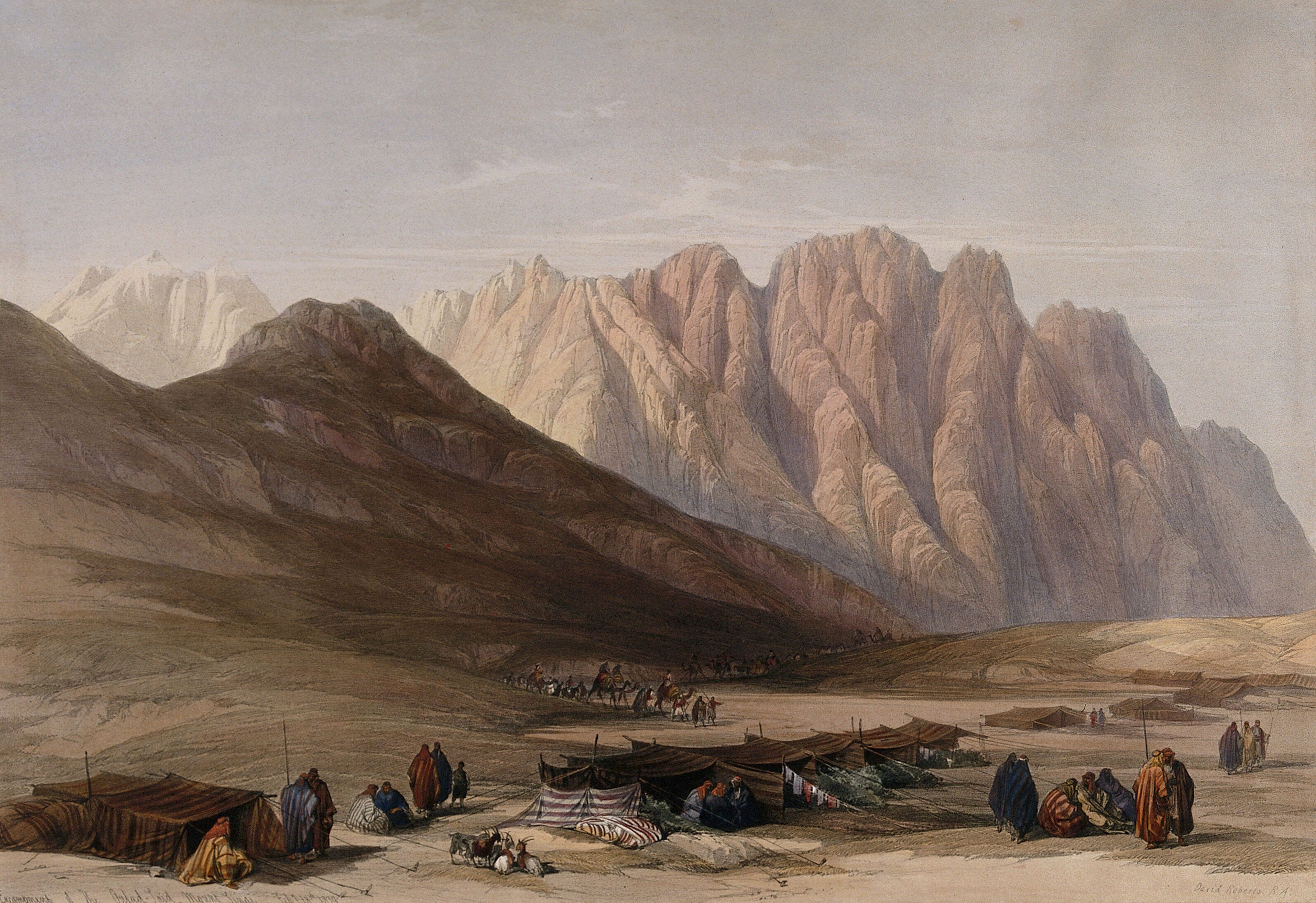
Look again at the tent on the right of your image, that of the Surveyors, I suppose. It has canvas, pegs, a circle of people seated and talking to one another. It is a tent, like those of Shem, where one sits in a circle to dialogue. There are two of us, Alexander, who have pitched tents where Life is shared, and I believe that is good news. What separates us is not that one would inherit a limit or an enclosure while the other contemplated freely, owing nothing to anyone. It is the way in which each of us inhabits what he has received, and that way does not yet say anything about what each will make of it.
There remains the fire. When you place it at the centre of your tent rather than a book, I smile a little, for it is the image I used at the beginning of my episode to say how I stand near the texts: as one stands near a fire, without dominating it, without fleeing it, so that its warmth may still reach us. I like to recall what the Rig Veda says of Agni, the fire: ‘Thou art son of Heaven by the body of Earth’ (III, 25, 1). That fire, the one that burns within him who seeks as much as the one that warms the traveller’s hands, burns beneath your tent as beneath those of Shem. Your fire and my books are perhaps less far apart than the image would have us believe.
Why I keep the texts
You value the Surveyor’s freedom with regard to inherited narratives: he therefore has no need to resolve, for example, the moral difficulties of the curse of Canaan in order to ground his demand for justice. This freedom I respect. I have made another choice, and I owe you its reasons.
I do not read these texts because they would have authority over what I must do. I said so in the episode: the Words of Life are not all equivalent, they do not say the same thing, and I call them so because millions of people have found in them something to live by. It is those millions who keep me there. The verse on Canaan served for centuries to justify the enslavement of Africans. It continues to be read, quoted, preached, and those who have made a weapon of it are not going to stop reading it because others have decided to pass on their way. To leave the texts to those who make of them enclosures or banners, to justify a withdrawal into their certainties and their community, or worse, the exclusion of the other and violence towards him, is to abandon to them also those who listen to them. I prefer to sit in the tent and read aloud, with others, to show that the same sentence can be read otherwise: here, for example, that the Hebrew form is that of a wish and not of a destiny, and that the link between black skin and servitude is the work of readers, not of the text. To read, for me, is also to disarm, and it is time we set ourselves to it. What I seek is the heart that still beats in the text, so as to set free its life and movement. I do not know whether I shall succeed, but I can attempt it, humbly, patiently, with love and respect for all texts and for those who carry them.
My relationship to these Words of Life does not stem from a scholar’s interest in the comparative study of religions and their founding texts. It was born of an existential and spiritual quest that set me on the road very early. I shall not retrace my whole journey here. I should like only to say what underlies a long and demanding undertaking, made of work on oneself and of reflection on the history of our societies, on their failure to offer happiness, dignity and freedom to all. Readings, encounters and experiences have mingled in it.
Readings first: those of authors for whom the human being, in his ordinary state, cannot be taken for granted. Rimbaud, for example, and above all René Daumal, without whom I would doubtless have remained an intellectual curious to understand, instead of becoming a man for whom everything passes through experience and through effort upon oneself. Then an encounter, among others, that of Philippe Lavastine, a great Indologist and translator, who was a friend of Daumal's, and of whom I have spoken in another article. I was a little over seventeen, and he was the first to show me that something else was possible, that the human being could truly awaken and be transformed: it radiated from him. Lastly, experiences, powerful and fairly numerous, of another state: the going out of the self, its provisional dissolution into the infinite, without loss of consciousness, but in another consciousness. They were offered to me as doors, of the kind that change something for ever: one’s gaze upon the world, one’s understanding of beings, and the way one reads texts, meets them, inhabits them as a place of questioning and renewal, never as an enclosure.
That is why I cannot follow you all the way when you say that sacred words are not a necessity of the journey. I note, however, that what was given to me most decisively had nothing of a word about it: it was a silence vaster than myself, close perhaps to the one on which you nourish yourself. But it is that silence which made the texts legible to me, and it is the texts that helped me to recognise it, in myself and in others, and to give it a form that can be shared. For you, these words are not necessary; for me, they have been, and they never cease to nourish me. I ask no one to do likewise, and I do not think that those who await none of these words walk less straight. But I cannot pretend that they have not accompanied me.
Egypt is not narrow
You regret that, in my episode, Egypt appears only under the Hebrew name Mitsraim and in the figure of the ‘two narrownesses’, social and spiritual, from which one would have to come out. My reading was symbolic; it sought in this name a human condition and not a judgement on a people; it in no way denies the wisdom of historical Egypt. And the Bible itself offers, in this sense, arguments that I did not use.
The dual form of the word Mitsraim designates first of all, according to the most common explanation, the two lands of Egypt, Upper and Lower, which the pharaohs wore united on their double crown. What the narrative of Exodus presents as a narrowness is, on a first reading, the oppression of a power that reduces men to the condition of builders of store cities, and not the civilisation that conceived Maat. It is in a more symbolic reading that these ‘two narrownesses’ evoke the narrow interweaving of spiritual strangulation and social suffocation. But a few generations earlier, Joseph, son of Jacob, who had become second to Pharaoh and governor of all Egypt, marries the daughter of a priest of On, the city of the sun. The Acts of the Apostles say of Moses that he was instructed in all the wisdom of the Egyptians. And most specialists recognise in a passage of the book of Proverbs, from chapter 22 to chapter 24, direct borrowings from the Instruction of Amenemope, a text of Egyptian wisdom. In this passage at least, the Bible drank directly from the wells of Egypt.
I have devoted an article to the prophet Amos and to what he sets against law without justice: tsedaqah, that torrent which never runs dry, that right way of being in the world, with oneself and with others, one of whose expressions is a constant attention to the lot of the humble. Its root, tsadaq, speaks of rightness: to be just, to be in the truth, to be in accord with what is upright. It is also the root of tsaddiq, the righteous one, he whose conduct is attuned to what life asks of him. I do not claim that tsedaqah and Maat are the same thing. But they resemble each other enough, and first of all by that rightness which you place at the heart of Maat, for us to set them side by side, beneath the same canvas, and let them shed light on each other. The wisdom of historical Egypt, that of Maat as well as that of Amenemope, has its place in my tents, and not only as the country one leaves.
Three strangers in the heat of the day
The next episode of The Tents of Shem, on 6 December, will pause before the tent of Abraham, and I cannot refrain from confiding its first image to you now, because it answers your letter better than my arguments.
Abraham is sitting at the entrance of his tent, in the heat of the day. He lifts up his eyes and sees three men standing before him. He does not ask their names, nor where they come from, nor which god they pray to. He runs to meet them, bows down, has water brought to wash their feet, settles them in the shade of the tree and has bread prepared. Abraham welcomes before knowing whom he welcomes. It is only afterwards that he discovers whom he has received, and that the text reveals who they were.
Your letter came to my tent in this way. You came from another direction, with your own tradition, your intuitions and your questions, and you brought me something I did not have. It would be strange for me to ask you, before offering you water, to tell me whether you believe in the G-d of Shem. That name, moreover, is only one way among so many others of designating the Mystery, which is and will always remain beyond our understanding, doubtless because it encompasses us all in an infinity that overflows space and time, and which we cannot even think.
Beginning with a question
You propose that one day, beneath the Tents of Shem, the encounter should begin not with a verse but with a universal question. In a sense, this is already the case. Though each episode rests upon a text, the question of meaning always precedes it, a universal question that lives beneath words. The texts come afterwards to nourish it, to multiply it, and above all to question us about what we do with them: do they help us to become better, freer, more conscious, more responsible and more loving?
I take you at your word, nonetheless, and invite you to come and share this search from Sunday 29 November, at the first Circle of study and dialogue (in French only). As I wrote when presenting it, ‘we shall continue to explore there the symbolism of the tent as the image of a non-dogmatic spiritual life, open to living experience and to encounters. Like those nomadic caravans that journey from oasis to oasis, we shall evoke the crossing of the desert, bearers of the precious gifts of the Words of Life which, like the sun and the stars, allow us to orient our march’.
And it is here that I announce it for the first time: I am considering gathering in Paris, most likely from January, and by video for those who do not live in the Île-de-France, a small circle of readers of the Dialogues, to become better acquainted and to exchange around a single question, which seems to me central: ‘Does changing society pass first through changing oneself?’ No verse will open the evening. I would be glad if you came to sit there, with your tradition, your intuitions and your questions, beside others who have others. We may even, as you suggest, share a few moments of silence before beginning.
You write that water belongs to no oasis, any more than rightness belongs to a tradition. I subscribe to that fully: the Water that quenches the traveller’s thirst in his crossing of the desert belongs only to the Life that we all hold in common. I would add only that thirst, too, belongs to no one, and that it is thirst that makes us strike our tents in the morning.
As for your image, let us keep it, lest a tent should become a mere library. I shall come regularly to sit by your fire, beneath the stars. And one evening, come and read with me in the tent you believe empty. It is empty only so long as no one enters it.
In fraternity, and with the pleasure of walking on,
Jérôme Nathanaël
© 2026 - Dialogues of the New World — Jérôme Nathanaël


The Waymakers space
The space below is reserved for free or paid subscribers to the publication. It is not visible to non-subscribers.
... ... ... ... ... ...
Join us
Are you discovering this publication, and does its approach speak to you? I invite you to read the Opening page, which presents the author and the project, then to subscribe, free or paid. You will thereby gain access to the community of The Waymakers: direct communication between subscribers through the Chat and its thematic forums, as well as the possibility of exchanging with the author by email or video.
