

French version available as a podcast
The Tents of Shem · A series of nomadic and spiritual readings · 33 min
To cross the deserts, meditate upon the Words of Life that have come from every horizon.

A single sentence from Genesis gives this series its name: “May G-d enlarge Japheth, and may He dwell in the tents of Shem” (Genesis 9:27). Why a tent rather than a house? In this first post, we will follow this motif from Noah to Moses. I invite you to read in Noah’s three sons three poles within each of us, with detours through India, Gurdjieff, Plato and Saint Paul. We will go with Moses to pitch the Tent of Meeting outside the camp, and we will hear what dwelling means in Hebrew: to be a neighbor. A walk from oasis to oasis, where one drinks, rests, and sets out again. No oasis holds all the water in the world.
Happy reading. See you soon.
Jérôme Nathanaël
Nota bene: The Tents of Shem exists as a podcast in the French edition. In the English edition, it appears as articles: English translations of the transcripts of the French podcast.
The Tents of Shem is a monthly rendezvous, on the first Sunday of every month at 10 a.m. (Paris time): a commentated reading of the Words of Life, moving from one tradition to another. To make sure you don’t miss the next article, subscribe. Next article: Sunday, December 6.
“Hello, and welcome: I am glad to receive you here for the first time, beneath this tent where the distant heirs of Shem, those who seek meaning, still gather, now and again, from far and wide, to celebrate the Words of Life.
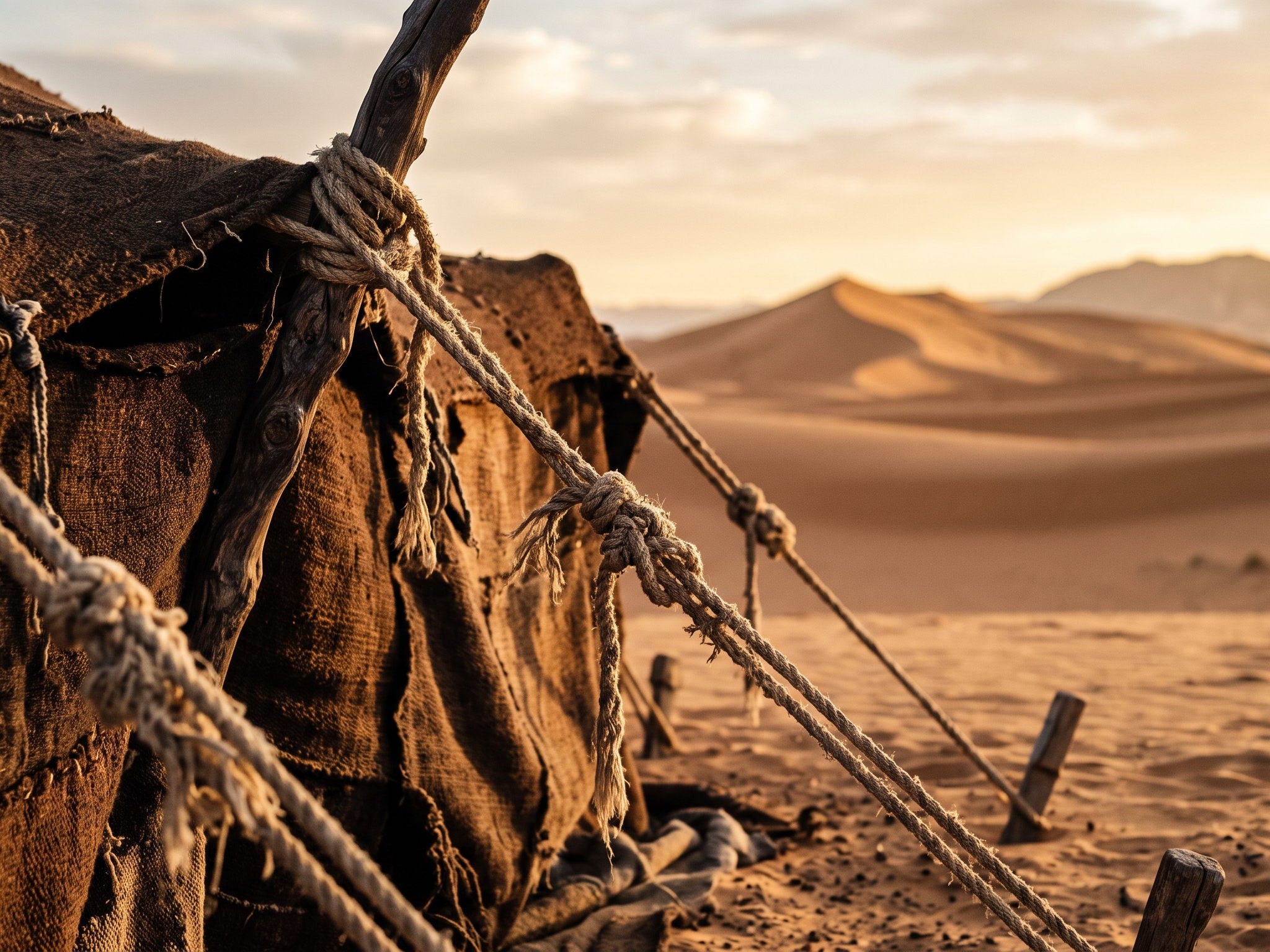
Do you hear it? The wind blowing on the canvas. Here it never quite stops. It swells, it falls, it returns. After a while one no longer hears it: it dwells in this place and this space, as the heart dwells at the centre of man.
I do not know how you came to be here, nor how you found this tent pitched in the middle of the desert. Perhaps because it is neither very far from your paths, nor too deeply hidden in the oasis: just halfway between the world we come from, a few days’ walk from here, and another world, higher and wider, a territory from which a strange light shines that we may glimpse, on certain days, at the threshold of the tent. The world before, where you were still yesterday and which I too left not long ago, is that of noise, of screens, of words that slam, of the invective hurled back and forth from one side of the street, or of the news feed, to the other, of the violence one suffers there, the visible as much as the invisible. I am telling you nothing new. We carry it upon us, this noise. It clings to our clothes and to our brains.
But be reassured: here, together, we shall begin to breathe another air, to take the time to free our minds, to open our hearts and to rediscover the great texts that will give us a horizon towards which to continue our walk.
That is why I pitched my tent in this remote spot: I want to read these texts with you. The Torah, the Quran, the Gospels, the Vedas, the Tao Te Ching, the Pali Canon, and others besides, more recent and less well known. I call them the Words of Life. They are not of equal worth, they do not say the same thing, and I shall not pretend otherwise. I call them so because millions of people have found in them something to live on. And we shall also have to ask ourselves, at times, how some have turned them into weapons of war and domination, how they have made of them flags and guarded territories, to separate human beings instead of drawing them together.
These texts, I do not read them from above. Nor do I read them from afar. I keep close to them, and they question me ceaselessly. As one stands near a fire: without mastering it, without fleeing it, so that its warmth may still reach us. What I hear in them helps to nourish my quest and strengthens each day my will to change myself, to become more awake, more loving and more responsible, and I tell you of it so that we may share it. That is the whole project.
One word, before we go further.
In Hebrew, to read aloud, to call someone and to give him a name are a single verb: qara’. G-d, or however you yourself name the mystery of the Living, calls the light ‘day’. Adam calls the animals, and each receives its name. The word that designates the Bible, Mikra, comes from there. And the word Quran, according to the dictionaries, descends from a neighbouring root, that of reading, of reciting. To read is to call.
So here, we shall call together.
For this first meeting, I have chosen to meditate with you on a single sentence. It is found in Genesis, chapter 9. It is what gave this tent its name. Here is the verse in Hebrew, followed by its phonetic transcription:
Yaft Elohim le-Yefet, veyishkon be-ohalei Shem.
Phonetic transcription: YAHFT eh-loh-HEEM leh-YEH-fet, veh-yish-KOHN beh-oh-hah-LAY shem.
Which means, roughly: may G-d open Japheth, may he enlarge him, and may he dwell in the tents of Shem.
But who is Shem? Who dwells, and in whose home? Why a tent rather than a house? And what can it tell us, who come from a world of walls where everything belongs to someone?
I do not have all the answers. I have a few texts, a few steps already taken, and the wish to show them to you. So, if you are willing, let us now set out.
Shem and the tent
Let us explore the text and look a little way back, for before this sentence there is a scene.
Noah comes out of the ark with his three sons, Shem, Ham and Japheth. The earth is washed, empty, silent. Before the flood, the text tells us, human beings were no more than flesh and violence, and evil dwelt ceaselessly in their hearts. Does that remind you of anything? Then came the great new beginning, to which traditions as far apart as the Mesopotamian epic of Gilgamesh, the Mayan Popol Vuh or the Shatapatha Brahmana in India bear witness. So Noah comes out of the ark, and then he plants a vine. He drinks of its wine, grows drunk, and there he is, naked, in the middle of his tent. Hold on to that detail: his tent. The text could have said his house. It says his tent.
His son Ham passes by, goes into the tent and sees his father, and runs to tell it outside to his brothers. Shem and Japheth, for their part, take a garment. They lay it upon their shoulders, they enter backwards, their faces turned the other way, and they cover their father without looking at him. Rashi, one of the most subtle commentators on the Torah, who lived in Troyes, my native town, in the eleventh century, notes a point of grammar: the verb ‘to take’ is in the singular. It is Shem who takes the cloak, and Japheth who follows him. The initiative of covering the father’s nakedness falls to Shem. The ancients add that the two brothers advanced with their hands over their faces, so as to see nothing: respect down to the very gestures.
When Noah wakes, he speaks. And here is a strange thing. He does not bless Shem. He says: ‘Blessed be the Lord, the G-d of Shem.’ What he blesses is the bond. What matters in Shem is less himself than what passes between him and G-d. And ‘to bless’, here, is not only to thank or to praise: it is to pledge oneself to put one’s strength at the service of what G-d expects of man. Noah does not pay a compliment, he makes a commitment.
And this G-d of Shem is not just any god. The ancient worlds had terrible gods, before whom one trembles and whom the mighty of the earth imitated, so that the peoples would prostrate themselves. The G-d of Shem is a G-d who raises man up: he gives each a worth that cannot be lost, and that is what Noah experiences. It is indeed this G-d who inspired Shem to hide his father’s shame, to honour him in spite of everything, and a trace of it is to be found in one of the precepts inscribed on the tablets of Sinai.
And then there is the name of this son. Shem means precisely ‘name’. It is the ordinary word, in Hebrew, for the name given to a being, a thing, a god.
This word has a curious history in Genesis. The very first time we meet it, in chapter 2, it designates a river: the Pishon, one of the three rivers of the garden of Eden, the garden of delights promised to human beings in the persons of Adam and Havah, Eve, who are doubtless peoples rather than individuals. A little further on, Adam gives their names to the animals, the shemot. At Babel, men say to one another: let us make ourselves a name. And shortly after, G-d says to Abraham: I shall make your name great. Mark the difference. At Babel, one fabricates one’s name. With Abraham, one receives it. Shem, who bears this word in his own name, stands between the two; he is the name, the capacity to live out meaning.
Nothing proves that the text contrived this play of correspondences on purpose: it is the Hebrew ear that hears it, and has done so for a long time.
Here now is my reading: Shem is he who still knows the names, in the sense in which the Torah understands it. Like Adam, who had the spiritual awareness to name each animal, each living energy, and who, in naming, grasped its essence. To name, here, is not to label: it is to understand what a thing truly is, beyond what it appears to be. Shem is the mind that seeks meaning, and the heart that is born of it.
Now, the tent.
A tent, what is it? A shelter that one carries. One pitches it in the evening beside a spring, one folds it in the morning, and one sets off again. One does not attach oneself to a place. One attaches oneself to a direction and to the next spring. The nomad does not walk into the void: he goes from oasis to oasis. Each is a halt, a well, a little shade, a few days’ rest. And each reminds him that he has not arrived.
This is the image I propose to you to illustrate a spiritual life. A walk from oasis to oasis. One drinks there, one rests there, one meets other travellers there, one learns there. But one does not settle there believing one has exhausted the spring, nor claiming that there is only one gesture by which to drink from it.
This image does not belong to a single tradition. In India, at the Kumbh Mela, a city of tents rises out of the sand on the riverbank. Tens of millions of pilgrims pass through it, each group of saints pitches its camp, and a few weeks later everything is taken down, as if the city had never existed. The wandering monks, Hindu, Jain or Buddhist, walk all year round, except during the monsoon: several months’ halt, while the rain passes. Among the Mongols, the word ger designates both the house and the felt tent. At the top, a ring of wood lets the light in and the smoke out: an opening onto the sky. The door, for its part, faces south. Among the Lakota, one of the peoples of the Plains, the tipi is a circle: the ground is the Earth, the walls are the sky, and the poles, planted in the one, rise towards the other. And according to tradition, the first words of the Buddha after his awakening are addressed to a builder of houses: I have seen you, you shall not build again. The rafters are broken, the ridge-beam is destroyed. The house, here, is the self, that self which shuts us in and separates us, unless it is a tent, like Abraham’s, open to the four horizons, to welcome and feed the traveller on foot. And this self, which is sometimes as lofty and as impregnable as a citadel, once it is no more than a modest tent, one can take it down, set it moving again, and pitch it elsewhere, from another perspective, without its ceasing to be a light canvas beneath which to shelter.
A city that is taken down, a ring open to the sky, a circle between earth and heaven, a house that is pulled down. These traditions did not confer with one another. Each looked at the same thing from its own side, without drawing the same practices from it, but perhaps keeping the same impetus.
A poet gave a name to those who walk thus, from one culture to another. Kenneth White, a Scot settled in France, who died in 2023. He called them intellectual nomads: those who cross territories and cultures to open a space clearer and more alive than the culture in which one has settled. He cited Nietzsche and Rimbaud, not saints. He himself kept his distance from the religions, and I do not draw him to my side. For I sign no manifesto, I take out no party card; a nomad belongs to no territory, he crosses the frontiers of human beings while avoiding the customs posts, and simply stays longer in the places that are more hospitable to him. I salute him in passing, as one salutes at the well a traveller going in another direction, who also has something to tell of the desert.
Japheth, Ham, Jerusalem and Athens
Let us return to the sentence. It has a sequel, and the sequel changes everything.
‘May G-d open, or enlarge, Japheth.’ Japheth is the eldest of the three sons. His name and the verb of the sentence sound alike in Hebrew. The verb comes from a root that speaks of opening: to open a space, to open a mind, to make it welcoming, available to impressions from outside. The Sages, for their part, hear in it beauty too, yafeh, through a play on words. And Jewish tradition attaches to Japheth one of his sons, Yavan, which designates Greece. The text cites Shem first, out of regard for his merit, say the Sages, but Rashi does the sum: Noah was five hundred years old at the birth of his first son, six hundred at the coming of the flood, and Shem is only a hundred years old two years after the flood. Shem was therefore born after Japheth, and Ham is the youngest. It is the elder whom the verse invites to enter his brother’s home, beneath his tent.
I confess that I like this reading. Japheth is the mind that describes. He is turned towards the outside: he observes, he measures, he compares, he classifies, he builds. And from this observation of the world, on the horizontal plane, a meaning is born, that of the world as it shows itself, and feelings too, those that the gaze brings to birth: wonder before order, a taste for the beautiful, the joy of understanding. Human feelings, born of the attention paid to the real. The Greeks, Athens: these are philosophy, science, measure, art. A passage of the Talmud, in tractate Megillah, hears the verse thus: the beauty of Japheth shall come to lodge in the tents of Shem. And it draws from it a concrete example: the Torah may be written in Greek. Beauty and reason have their place beneath the tent.
Shem, for his part, does not describe: he seeks the meaning of things, their essence, what links them to something greater than themselves, and it is from this quest that his heart is born. Two minds, two ways of questioning the world: the one from within and by essence, the other from without and by description. And the verse does not set them against each other. Imagine the scene. Japheth arrives before his brother’s tent, with his measuring instruments, his maps, his precise words. He hesitates at the entrance. The verse does not tell him: leave everything outside. It tells him: enter.
Note one detail. Japheth is Shem’s brother: same father, and the text gives Noah but one wife, the one who goes up with him into the ark. Their descendants, for their part, take different roads. In the following chapter, Genesis ranges them each apart, ‘according to their lands, their tongue, their clans and their nations’, the text tells us. One origin, then, and paths that part. Yet the verse promises Japheth a place in his brother’s tent, though his own children will not speak the language of the children of Shem. In the sources, this tent of Shem is first of all a lineage: Israel or, in the chronicler Ṭabarī, the Arabs and the descendants of the prophets. I propose that you read in it a hospitality. I say it plainly: it is a reversal, and it is mine.
And there is an order in the sentence: Japheth first, the tents of Shem afterwards. One tradition sees in it a preparatory school. To learn to look, to love the order and the beauty of the world, is to make oneself capable of higher questions: what is all this for, and what does it mean? This will, moreover, be Abraham’s way, as the Midrash HaGadol, a medieval Yemenite compilation, tells it to us, and the Quran also. Before the splendour of the moon, the sun and the stars, he questions himself and, seeing that they appear and disappear, he intuits a higher dimension that includes them. Beauty prepares for meaning, provided it does not stop at itself.
A word on grammar, because it matters. Who dwells in the tents of Shem? The verb is ambiguous. In the reading I propose to you, it is Japheth, and beyond him the whole of humanity, who learns from Shem to build his dwelling in such a way that G-d may reside in it. But the Targum Onkelos, the ancient Aramaic translation, understands it differently: it is G-d who makes his presence dwell in the tents of Shem. Rashi follows this reading, and sees Israel in it. Two readings of the same verse. I keep both in my ear.
So, Jerusalem and Athens. They have been so often opposed. As early as the year 200, Tertullian asked, irritated: what has Athens to do with Jerusalem? For him, nothing. I believe on the contrary that they have much to say to each other, and that the verse says so. It is easy to caricature: Athens would ask how, Jerusalem why. It is not so clear-cut. The Greek philosophers asked why, with the Good, with final causes. And the Hebrews devised a lunisolar calendar of great precision. Let us speak rather of two accents. Rémi Brague, commenting on Leo Strauss, adds a third city: Mecca. Three cities that speak to one another, or that no longer do.
I propose another reading. In the text, there are three sons. And what if we saw in them, not three peoples, but three poles of each one of us? Shem, the mind that seeks meaning, and the heart that is born of it. Japheth, the mind that describes the world, and the feelings born of the gaze. And the third, the force, the raw heat, the energy that drives and acts. Functions, not peoples. A human being needs all three, and they go awry when one of the poles takes up all the room.
This image of a being of several storeys, I am not the first to meet it. India drew it in the Katha Upanishad, in the first chapter, third valley, verses 3 to 9: the body is a chariot, the senses and the feelings that flow from them are the horses, the intellect is the charioteer, and the master of the chariot is the Self.
Listen now to the version that Gurdjieff transmitted, according to Ouspensky: a carriage, horses, a coachman and a master. The carriage is the body. The horses are the feelings. The coachman is the ordinary mind, the one that says ‘I’. And the master, the true one, is most often absent or asleep, so that the coachman drives without knowing where he is going.
And here I find again the three sons of Noah. The horses, the force, the warmth of feeling that carries one away: that is Ham. The coachman, the self, who watches the road, describes it, adjusts it on the horizontal plane: that is Japheth. And the master, he who knows the target and the meaning: that is Shem. The text of the Katha gives the name of charioteer to the intellect that discerns, but it adds that everything depends on what this charioteer turns towards, and that he who follows his master reaches the end of the road.
Plato, too, saw a team. In the Phaedrus, at 246a and 246b, then 253c to 254e, the soul is a winged chariot: a charioteer, and two horses, one white and docile, the other black and unruly. The charioteer struggles to lead them towards what is true.
And this body-chariot, Saint Paul calls a tent. Second Epistle to the Corinthians, chapter 5, verses 1 to 4: ‘our earthly home, this tent’. The Greek word used here, skēnos, belongs to the family of skēnē, which renders, in the Greek Bible, the Tent of Meeting in the desert. Paul, incidentally, earned his living thus: Acts, chapter 18, verse 3, says that he made tents. A chariot that rolls, a tent that is pitched: in both cases a dwelling that moves, and he who inhabits it is there only in passing.
There remains the third son. Ham, whose name speaks of heat. His descendant, Canaan, receives in the sentence a word that hurts: ‘May Canaan be their servant.’
I shall not pass over it. This verse served, for centuries, to justify the enslavement of Africans. So let us say what the text says. It is Noah who speaks, not G-d. It is Canaan who is cursed, and not Ham. No skin colour is mentioned. The Hebrew word, eved, is broad: it designates Moses, ‘servant of G-d’, as well as the Hebrew debtor who must be freed in the seventh year, or the foreign slave acquired for ever. ‘Slave’ does not suffice to translate it, nor does ‘servant’.
See what tradition makes of this word. For the Hebrew slave, the Talmud, in tractate Kiddushin, comments on a verse of Deuteronomy, ‘he fares well with you’: the master shall not eat fine bread while the other eats coarse bread, shall not sleep on soft sheets while the other sleeps on straw. Hence the saying: he who acquires a Hebrew slave acquires a master for himself. For the foreign slave, the law is harsher, and yet Maimonides adds that the way of piety is never to humiliate him nor to make him bear a heavy yoke, and that cruelty is found only among idolaters. Exodus, for its part, frees the slave who has been wounded in the eye or the tooth.
This does not mean that practice always followed the texts, nor that slavery is thereby justified. But we are very far from the plantations of the American South, where the human being became a hereditary commodity. As for the link between black skin and servitude, it appears later: in the seventh century in the Islamic world, in the fifteenth in Europe. It is readers who made it, not the text.
And yet attentive readers have heard something else in this verse. First, the Hebrew form is that of a wish: ‘may he be’, not ‘he shall be’. Noah does not decree a destiny, he voices a wish. Then, they see in it something precise: force that lets itself be guided by nothing does not build the future, it turns against those it claims to serve. He who wishes to dominate others is first dominated by what dominates him, his passion for dominating. Freedom, for its part, lives only in a moral law that one accepts. Then Noah’s wish is a salvation: may force find its direction in meaning, may it place itself at the service of what surpasses it rather than of its appetites alone. Servant, here, means: oriented.
And in the same Bible, much later, a poem, Shir haShirim, the Song of Songs, which Christian Bibles render as the Canticle of Canticles, tells us: ‘I am black, and beautiful as the tents of Kedar.’ A tent, again. I close this chapter. I do not forget it.
The descendants of Shem
Let us now follow the line of Shem. The text gives it just after Babel, as if drawing breath.
A few generations later, a man leaves his country. Abram, who will be called Abraham. And the text says a thing that I love: he arrives somewhere, he pitches his tent, he builds an altar, and he calls upon the name of the Lord. In a single verse. The tent, the altar, the word.
To call upon the name of the Lord: the verb is qara’, the one I spoke to you about earlier. Specialists dispute what is to be understood by it. To invoke? To pray? To proclaim? A researcher, Ephraim Landau, reads in it the desire to meet G-d and to be near him. I find that this suits a man who has just pitched his tent. And it is the same word, shem, as at Babel. There, the builders wanted to make themselves a name. Here, Abraham calls upon a Name that is not his own.
Then there is that mysterious king of Salem, Melkitsedeq. Salem, same root as shalom, peace; Melkitsedeq, ‘king of justice’, in the sense of one whose conduct is adjusted to what is true. He brings bread and wine to Abraham, he blesses him, and he is ‘priest of G-d Most High’. Priest is said here cohen, and one must not understand by it one who commands the faithful. The word speaks of service, of him who stands before G-d. And I propose that you hear in it, as a reading that is mine and not an etymology, he who, by his example, brings others nearer to G-d.
Who is this Melkitsedeq? Rashi, taking up the Talmud, answers: it is Shem, son of Noah, in the guise of a priest-king. And the Talmud, in tractate Nedarim, page 32b, adds something astonishing: the priesthood was to have come from him. But Melkitsedeq blessed Abraham before blessing G-d, and Abraham answered him: does one place the blessing of the servant before that of his master? At once, the office passed to Abraham. I retain from it that the tent of Shem is not a title deed. It passes.
In the next generation, Isaac marries Rebecca and brings her into the tent of his mother, Sarah. Rashi relates that, in Sarah’s lifetime, three signs were to be seen there: a lamp that burned from one Sabbath to the next, a dough that always rose, a cloud above the tent. At Sarah’s death, everything ceased; when Rebecca enters, everything resumes. A cloud over a nomad’s tent: one would think already of the desert to come, the one into which would enter, with Moses, a people freed from the twofold constriction, social and spiritual, from which it suffered in Egypt. The Hebrew name of Egypt, Mitsraim, has a double form, which tradition hears as ‘the two narrownesses’, from the root tsar, narrow.
Rebecca, pregnant with twins, feels a struggle within her and goes to ‘consult the Lord’. Rashi specifies where she goes: to the school of Shem and Eber, to a sage. Rabbeinu Bahya sees in it a principle: he who seeks G-d seeks first someone who speaks on his behalf, as a messenger bears the name of him who sends him.
The boys grow up. Esau hunts. Jacob, for his part, is ‘an upright man, who dwells in tents’. Rashi explains: the tents of Shem and Eber, tents of study, where one sits and where one asks questions. That is what it means, for this tradition, to dwell beneath the tents of Shem: places where one learns to seek.
Others came later to sit beneath the same canvas. In the Gospel of John, the Word ‘pitches his tent’ among us. In the Letter to the Hebrews, Abraham lives in the tent as a stranger, awaiting a city with firm foundations. In the Muslim chronicler Ṭabarī, Shem settles in Mecca, and the prophets come from him. And a hadith reported by Bukhari has the Prophet say: be in this world as a stranger, or as a traveller.
Three traditions, one tent. Each reads it in its own way. They do not say the same thing, and yet all have met there.
The tents of the desert
Let us pass now to the desert. The real one. That of the forty years.
A people comes out of Egypt. Hundreds of thousands of persons, tents as far as the eye can see, a camp at the foot of a mountain. And at Sinai, something happens that I find striking: the text says that Moses brings the people out of the camp, to meet G-d. Outside the camp. Already.
You know the rest. Moses climbs, he stays forty days. Below, the people grow impatient and make a golden calf. Moses comes down, sees everything, breaks the Tablets. He stands at the gate of the camp and cries: who is for the Lord? To me! The sons of Levi gather about him.
And then, in chapter 33 of Exodus, this happens. Moses takes his tent and pitches it outside the camp, at a good distance. He calls it Ohel Moed, the Tent of Meeting. And the text adds: whoever seeks the Lord goes out to the Tent of Meeting, outside the camp.
Whoever seeks. Kol mevakesh. Not the priests. Not one tribe. Whoever.
Why outside the camp? The commentators do not all answer alike.
For Rashi and for Ramban, it is the sign of a rupture. After the golden calf, G-d said that he would no longer go up in the midst of such a people. Moses draws the consequence: when the master sets someone aside, the disciple sets himself aside too. The tent is outside because the Presence has left the centre.
Ibn Ezra sees things differently: it is not a punishment, the tent is apart because of the Glory, which speaks to Moses from a distance.
Rashi adds that it is also a place of study: those who seek a teaching of the Torah go there. And Rabbi Jonathan Sacks reads in it a protest: by pitching his tent outside, Moses tells G-d that the people have no need of him, Moses, but of G-d. A people needs proximity, more than greatness.
According to Ramban, Moses takes out his tent after the sin, goes up the mountain twice more, Yom Kippur comes, forgiveness, then the people build the Mishkan while Moses remains outside. At last the Mishkan is set up in the middle of the camp, G-d speaks from there henceforth, and the tent outside vanishes from the narrative.
So, the Mishkan. The word means ‘dwelling’. It comes from the verb shakan, to reside, which we have already met in our verse: ‘he shall dwell in the tents of Shem’, veyishkon. Same root. When the cloud settles upon the Mishkan, the text uses this verb again: it dwells. And it is the cloud that decides on departure. When it rises, the camp strikes the tent. When it stays, the camp stays. A dwelling that commands departures.
This verb has a cousin: shakhen, the neighbour. In Hebrew, to dwell is to be a neighbour. One settles truly only if one makes room for one’s neighbour. In Isaiah, children return from exile in such numbers that they say to their mother, Zion: ‘the place is too narrow for me, make room for me, that I may settle.’ The Hebrew verb means literally ‘come near’, and Rashi understands it so: move aside, so that I may settle. To dwell, then, is to squeeze up. And if G-d ‘dwells’ among men, it is as a neighbour: near, but without either absorbing the other. Here is a safeguard against every fanaticism: the divine is man’s neighbour, it does not devour him.
Let us return to the Mishkan: it is more elaborate than Moses’s tent, that is true. Planks, curtains of linen, of blue, of purple and of scarlet, on which cherubim are embroidered. But look at what is put over it. A roof of goat’s hair. This roof is called ohel. The tent. And over that again, skins. From outside, dark hair. Within, splendour. When the cloud comes, the text says that it covers the ohel, the tent, and that the glory fills the mishkan, the dwelling. The tent protects, gathers, makes the meeting possible. The dwelling keeps the Presence. The two words work as a team, and one even finds the expression Mishkan Ohel Moed: dwelling, tent of meeting.
Remember also what G-d says to King David, through the mouth of the prophet Nathan, when David wishes to build him a house: ‘since the exodus from Egypt, I have not dwelt in a house, I have walked in a tent and in a dwelling.’ A G-d who walks. Yet, in this same chapter, G-d promises that a son of David will build a house for his Name, and Solomon built it. The Bible keeps both, the tent and the Temple, and it keeps their quarrel too.
Around the Mishkan, the camp is organised in circles. Rashi speaks of three nested camps: the camp of the Presence, within the hangings; the camp of the Levites all around; and the camp of Israel. The further one moves from the centre, the less near one is. And beyond the three, there is the outside. And whom does one send outside? The text gives the list: he who has a discharge, he who has touched a dead body, and the leper, the metsora. ‘So that they do not defile their camps, in the midst of which G-d dwells’, the text tells us. And here a connection stops me. The Sages hear in the word metsora an expression: motsi shem ra, ‘he who brings out an evil name’. The slanderer, as it were. He who slanders, indeed, places himself outside the common camp: he has defiled its balance, whereas that camp is meant to allow life to dwell in it in fullness, in concord. Thus, for the commentators, the skin disease marks the evil word. He who has separated a husband from his wife, a friend from his friend, is himself set apart. Miriam, who spoke against Moses, is put outside for seven days, but the camp waits for her: it does not set out again without her.
On the one hand, then, he who has misused the word, the name, goes out of the camp. On the other, whoever seeks the Name goes out of the camp too. And the verb is the same in Hebrew: yatsa, to go out. Motsi, for him who brings out an evil name. Yetse, for him who goes out to seek. It is a connection that I make; no commentator I have read makes it. But I note that Moses pitches his tent exactly where the law afterwards relegates the excluded: outside the three camps. The outside is therefore not only the place of the impure. When the Presence leaves the centre, the outside becomes the place where one finds it again. One must sometimes leave the common camp, move away, set out in search, in order to meet the Presence.
The Letter to the Hebrews will take up the image: let us go out to him, outside the camp, bearing his reproach, for here we have no permanent city.
The oasis and the invitation
There. We have walked a little, you and I.
I should like to tell you, to close, why the desert. The rabbis of the Midrash asked why the Torah was given in the desert. They answer: because the desert belongs to no one, like water and fire. And they add: he who does not make himself like a desert, open to all, cannot acquire wisdom. No one possesses the desert. No one possesses the Word.
So, an oasis. It is not a goal. One arrives there parched, one drinks, one sits beneath a palm tree, one talks with those one meets there, one fills the waterskins. In the morning, one strikes the tent. Each oasis teaches us something, the next something else. None contains all the water in the world.
Saint-Exupéry had seen this. In Citadelle, known in English as The Wisdom of the Sands, a chief leads his men to the conquest of an oasis, and tells them that once conquered, it will be only ‘another form of encampment in the desert’. And in The Little Prince, it is the little prince who says to the stranded airman: ‘what lends the desert its beauty is that it hides a well somewhere’.
I believe that this is what a tent of Shem is. A place where one stops to drink, where one can say what one is seeking without being asked where one comes from, or what map one carries. A place where one can discuss, contradict oneself, be mistaken, begin again. The Talmud relates that two schools, that of Hillel and that of Shammai, disputed for three years. A voice from heaven finally said: ‘the one and the other are words of the living G-d.’ And the law followed Hillel, because his disciples were patient, and because they taught first the opinion of the other. Such is the rule of the tent: one begins by giving the floor to him who disagrees. And to dwell, I told you, is to be a neighbour: one has room only if one leaves some for the other.
Saint-Exupéry imagined, in the same book, two enemy sovereigns who both believe in G-d. They pitch a tent of truce in the middle of the desert, they leave their armies far off, kneeling, and they meet beneath the canvas to pray together. A tent between two camps, where one lays down arms and seeks. One would think of the Tent of Meeting. He imagines another, a purple one, left empty, to which the king returns alone, each year, to sit in silence.
Let us not forget the pegs. A tent has its rules. Among the Mongols, one does not step on the threshold of the ger, one does not turn one’s back on the altar. And the chief of Citadelle is no dreamer: he defends hierarchy and what outlasts men. Isaiah, for his part, says: ‘enlarge the space of your tent, lengthen your cords.’ And he adds: ‘make your pegs firm.’ A tent without pegs flies away. A tent without cords covers no one. But with pegs well planted and cords well stretched, it can be open and hold in the wind.
That is what I wish for you. May your tent be beautiful. May it be open, and may it hold.
You have just read the English translation of the first episode of The Tents of Shem, a podcast recorded in French. If what you read has done you good, subscribe so as not to miss the next article. You can listen to the original episode on the French edition of Dialogues du Nouveau Monde, and on the usual podcast platforms. Tell me what you thought. And in the section The Waymakers of these same Dialogues, to which this series belongs, you can send me a page, which others will be able to read and respond to.
Next time, we shall go back to see Abraham’s tent, at the hottest hour of the day, when three strangers present themselves there. Abraham is, for the three monotheistic traditions, a common symbolic ancestor: through Isaac, for Judaism and for the Christianity that derives from it, and through Ishmael, for Islam.
Thank you for stepping in. The wind is still there. See you soon.”
Jérôme Nathanaël
© 2026 - Dialogues of the New World — Jérôme Nathanaël


The Waymakers space
The space below is reserved for free and paid subscribers of the publication. It is not visible to non-subscribers.
… … … … … …
Join us
Are you discovering this publication, and does its approach speak to you? I invite you to read the Opening page, which presents the author and the project, and then to subscribe, in the free or the paid version. You will thus gain access to The Waymakers community: direct communication between subscribers through the Chat and its thematic forums, as well as the possibility of exchanging with the author by email or video.
