
Article disponible en français
Notebooks of life · Travels · 26 min
Approaching the places, the wanderings and the retreats where the earth keeps memory of the human quest.

Series: Le Puy-Arès 2026: an account of an inward journey | Article 5
12 July 2026
Dear readers,
This is the last article in this series, inspired by my three-week journey between Le Puy-en-Velay, Conques and Decazeville along the Via Podiensis, one of the routes to Compostela, and by my spiritual retreat at Arès. The four preceding articles can be reached through the link above. They recount the quality of the encounters between the walker-pilgrims, the spiritual benefits of long walking as I experienced them, the abbey church of Conques with its tympanum and its stained-glass windows by Pierre Soulages, and finally Decazeville, that former mining and steel-making town, now fallen on hard times, which is attempting to come back to life.
Today I want to tell you about the final stage of my journey, a week’s spiritual retreat at Arès, a small town in the Gironde where, in 1974 and 1977, a man named Michel Potay claims to have received, from the One whom some call Life, G-d, Adonai, Allah, the Eternal, others still the Nameless or the Wholly Other, a message calling for a profound refounding of our societies through the sole weapons of brotherly love and an active spirituality freed from dogma. This message has known several editions under the title The Revelation of Arès, and the latest, called the fiftieth-anniversary edition, appeared in 2025 under the title The Sign, a few months before Michel Potay’s death.

Before going any further, it is probably worth summarising in a few lines what this Message asserts, since its main lines will be called upon throughout this article. According to it, neither religions with their rites, nor politics with their laws, have resolved the problem of evil and the ills it causes in human lives. The messages, such as the Torah, the Gospels, the Qur’an or many others, which urged human beings to overcome evil, have been altered by manifold theological deviations that have weighed down and veiled their meaning, causing the original living impulse to degenerate into religious systems, themselves the models for political systems, which separate human beings into compartmentalised or even opposed communities.
The Message of Arès calls for spiritual life to be set free by returning to the demanding foundation that alone can overcome evil: freely engaging in a slow and genuine work of betterment and self-transformation, which is the path towards the integral realisation of the human being, the reactivation and embodiment of his sublime potentials of oneness, love, freedom, creativity and understanding of the universe, potentials that will then connect him to every particle of Life running through the universe. Then, through the progressive spreading through society of the active good generated by those engaged in this path of exemplary living, the world will be able to begin changing in depth without falling back into past errors.
Thus individual salvation is not a matter of divine favour granted as a reward for the accomplishment of rites and the observance of rules, even rules of love, codified in human registers. Likewise, the outcome of history will depend on human beings themselves, not on some planetary upheaval brought about by a higher or divine identity. It is the sum of the thoughts, the words and above all the actions on our planet that determines the overall direction taken by our collective destiny: a direction that may lead towards a definitive return to bestiality, with humanity losing all memory of its sublime origin, or even towards total destruction, or, conversely, towards the advent of a world of peace, justice, fairness and love. The human being is the sole creator of his individual spiritual destiny, just as human beings as a whole are the creators of their collective historical destiny.
So much for the central axis of the Message of Arès. What remains is to ask whether one can give credence to the founding event on which this Message rests. The time of the prophets, of the rishis of the Vedas, of the nabis of the Torah, of the Jesus of the parables or of the messenger of the Qur’an being far behind us, the possibility of the supernatural erupting into the life of a man in the twentieth century seems scarcely conceivable, even to believers whose own religion nonetheless reports such founding events. In our technological societies, which have expelled from the realm of the possible any phenomenon that science cannot immediately explain, the categories of believing or not believing appear to be the only ones relevant when faced with the unknown and the extraordinary.

I am therefore aware, in beginning this article, that I am unwittingly drawing a dividing line between those of my readers who will lend an ear and those, perhaps the more numerous, who might legitimately feel a reflex of unease or even rejection: here we go again, another believer, another religious type, worse still some visionary about to tell us of revelation, of a G-d who speaks. Believing or not believing is indeed immediately the alternative posed. Is it a matter of believing the man, his message, the G-d in whose name he claims to speak? The question is, moreover, a many-sided one.
Now, I am neither a believer in the common sense of the term, ‘one who holds a religious faith’ according to the Oxford Dictionary, nor indeed an unbeliever, in the sense that the universe would be for me nothing more than an immensity of assorted matter, our life being reduced to trying to enjoy ourselves as fully as possible until death. I would even venture to say that I stand beyond this alternative, and that this question concerning the events of Arès, revelation or not, a G-d who speaks or not, legitimate enough at first sight, does not seem to me a question that can be grasped while remaining within the binary logic, true or false, that is habitual to us. What I would like to show here is that neither belief nor its rejection can truly settle such questions: only the doing (the lived trial, the personal accomplishment) can, and this, as we shall see, is precisely what this Message teaches and makes possible.
Let us first see why judgement alone does not suffice. Depending on the frame of thought that is yours, the events of Arès fall on the side of the possibly true or of the probably false. From the scientific approach, they can be neither verified nor fitted into any current scheme for representing reality, and are therefore false. From the angle of a spiritual seeker or a historian of religions, they resemble other events of which the founding writings of religions keep record (those concerning Moses and the burning bush, for instance), and could therefore be true, subject to the authenticity of Michel Potay’s testimony. It is possible to debate the matter at length, which is in any case unproductive, since none of the partisans of true or false can supply any evidence to validate his opinion.
Many human questions can only be properly grasped if we accept setting aside, for a time, our most common mental reflexes of immediate, unreflective acceptance or rejection, and admit that our beliefs, like our disbeliefs, for as long as we have not examined them in depth, are not truly our own, but those we inherit, first from our families, then from our circle of relationships and from the surrounding culture. It is only at this price that we can understand that our habitual binary logic is sometimes insufficient for thinking things through.
I shall take but one example, borrowed from the scientific domain: quantum physics had to renounce, as early as 1927, the strict alternative between the wave-like and the particle-like nature of light. The principle of complementarity, formulated at the time by Niels Bohr, holds that these two descriptions, mutually exclusive according to classical logic, are nonetheless both necessary to account for the whole of the observed phenomenon. A discipline as demanding as physics has thus established experimentally that an alternative may be wrongly framed even before being settled, and that there exist levels of reality where the excluded middle of our ordinary logic simply ceases to apply.
What holds for light may perhaps hold for the question at hand: the choice between believing and not believing is less a matter of judgement to be rendered than of a frame to be widened. And, in this instance, the way of widening that frame has always been, for me, not to content myself with intellectual speculation alone but to pass it through the crucible of experience. Thus, faithful to this intuition, I submitted my thinking, from adolescence onward, to the findings of practice, and this is why questions of faith have never really concerned me. I later discovered, moreover, that according to the Buddhist tradition, the Buddha systematically refused to settle certain questions, for instance when they concerned the eternity of the world, its spatial finitude, the relation between the life principle and death, or the post-mortem destiny of one who has attained awakening, beginning with that of the Buddha himself.
The Cūḷamālunkyovāda Sutta, one of the sections of the Pali canon recording the discourses of the Buddha, thus depicts the monk Māluṅkyaputta who, exasperated by the Buddha’s silence on these points, threatens to leave the monastic order unless he is answered. The Buddha replies with the famous parable of the man struck by a poisoned arrow, who refuses to have it removed until he knows the name, the caste, the height and the village of his assailant: that man dies before obtaining his answers, exactly as one who made the liberating practice conditional upon the prior resolution of these metaphysical questions would never attain the cessation of suffering he seeks.
Metaphysical reflection does not thereby become useless; it must only serve and follow the living experience of self-transformation. This primacy of the lived journey over speculation finds, moreover, a very concrete echo in the experience of the path: as on the road to Compostela, one must set off walking rather than remain for days at a stopping place, poring over a map that is but one possible representation of a reality exceeding it.
This is why, two years after discovering, in April or May 1975, a small pamphlet called ‘The Gospel delivered in Arès’ (the name Michel Potay had given to the first part of the Message), I had decided to travel to Arès to meet the man who had published it and to visit the places where the event it recounts had occurred. That visit and that meeting allowed me to move from the interest that the text and the outlook it carries had aroused in me from my first reading of it (an outlook that, to my mind, is liberating for humanity) to the certainty that Michel Potay’s testimony is truthful, which allowed me to answer the question of authenticity raised above. For all that, I did not know a great deal more about who G-d might be, but I had a strong intuition that here lay a path by which to lead humanity out of injustice, suffering and illusion, and to recreate a civilisation founded on freedom, love and peace.
Since then, I have gone regularly to Arès, not out of faith but out of conviction: the conviction that this Message, as it was later explained by Michel Potay, and as I have gradually been able to deepen its meaning, answers the twin preoccupation I carried in adolescence, when I made my own the motto of the Grand Jeu: ‘Révélation-Révolution’. For the poets René Daumal, Roger Gilbert-Lecomte, André Rolland de Renéville and the painter Josef Sima, the founders of this short-lived french artistic group at the end of the 1920s, the aim was to practise an ‘experimental metaphysics’ seeking to widen our consciousness until it reached a level of reality broader than our ordinary reality, where the ultimate truth of the world might finally be revealed; this mutation of consciousness, spread through society, was meant to precipitate a Revolution, a radical transformation of human society.
This Message thus answered, for me, this expectation of a clear path, freed from theological encumbrances, which, while standing in continuity with past messages (those of the religions, which have not been fulfilled in their fullness), also honoured the memory of all the struggles for social justice and human dignity. From then on, I placed it among what I call the Words of Life of the twentieth century, those whose regular company seems to me to cast a clear light on the challenges of our time, forever bringing the gaze back to the root of all ills: the lack of spiritual understanding of our human condition, and the absence of love as a factor of cohesion and social progress.
In concrete terms, each visit has thus become for me a privileged moment of return to myself, where I take stock of my life, where I examine what I bring under the gaze of the Wholly Other: my progress along the path of my own betterment, my accomplishments towards the respiritualisation of the world, rather than a moment in which I would come begging for favours and forgiveness, as is often, as we shall see, the aim of pilgrimages.

This year again, at the close of my walk from Le Puy-en-Velay to Decazeville, I therefore travelled to the site of the events on which this Message rests, for a week that I have called a spiritual retreat rather than a pilgrimage (that latter word seeming to me an awkward term, given the weight it carries of a religious past). It remains to be verified what exactly this weight covers.
The various pilgrimages that exist, be they the Christian pilgrimages such as those to Lourdes, Santiago de Compostela, Rome or Jerusalem, the Muslim pilgrimage to Mecca, or the Hindu or Buddhist pilgrimages, all display, once the structure of pilgrims’ motivations is laid bare, a number of constants that may be summarised thus: a desire for purification (whether conceived as forgiveness of wrongs, an increase in personal merit, liberation from karma, or teshuva, a return to G-d), a hope of healing and of the easing of suffering, an expectation of an inner transformation deeper than daily life allows, and a need to reconnect with a sacred memory and with a wider community. The differences then lie in the status of the obligation (the Hajj as a pillar of Islam, as against freely undertaken pilgrimages), in the way grace is conceived (juridical pardon, karmic merit, the intercession of the righteous, purification of the spirit), and in the relation to the body (immersion in water, walking, prostrations, particular dress).
Each tradition unfolds, in its own way, a universal need: to turn space and time into a path of transfiguration, whereby man steps outside his ordinary determinisms to place himself beneath another gaze (that of G-d, of the divinities, of the Buddha, of the righteous) and to attempt a reconfiguration of his life in harmony with what he recognises as Source. Yet the inner posture of pilgrims seems indeed, beyond differences of belief and rite, to remain one of expecting a reward, a favour granted to the pilgrim who has made the effort of reaching the place of pilgrimage, by some higher authority whose good will determines his future. The Christian pilgrims of the medieval period thus walked towards Compostela in reparation for their own wrongs or those of a departed relative, hoping in return to obtain the remission of their sins.
This attitude of personal petition, which of course displays a multitude of nuances and modes of expression according to the individual and the tradition, joins, at the cultural and social level, its collective equivalent, likewise common to most of the great traditions: ‘messianic’ expectation. Beneath the languages proper to each tradition, comparative studies do indeed stress a common core: messianic expectation is the religious form of an anthropological need to believe that a fracture (between justice and injustice, truth and falsehood, Creator and creation, awareness and ignorance) can be mended. In the Abrahamic religions, this mending passes through a personal figure, both sign and agent of G-d’s faithfulness to his promises, who takes upon himself the impossible task of aligning human history with the divine design; in the Indian and Buddhist traditions, it is formulated rather in terms of restoring the dharma, that is, the deep law of things.
Thus the Jews await the coming of the Mashiaḥ, charged with restoring the sovereignty of the people of Israel, re-establishing the Torah in its full force, gathering in the exiles and opening an era of universal peace and justice. Christians await the return of Jesus, the Parousia, which will trigger the judgement of the living and the dead, the end of injustice, the triumph of love, the resurrection, and the full restoration of creation. In Sunni Islam as in Shia Islam, messianic expectation unfolds around the Mahdi, the ‘guide’ who must appear at the end of time (even though the two branches conceive its modalities differently: Twelver Shiism holds him to be the Imam already born and hidden, while Sunnism awaits a figure yet to come), and around Jesus (’Isa), recognised as Messiah, whose return forms part of certain eschatological interpretations; together, they will restore divine law (sharia) in its purity, ensure the defeat of the forces of evil and the establishment of a period of justice in which believers may live their faith fully, before the Last Judgement. In Hinduism, Kalki, the tenth and final avatar of Vishnu, is to appear at the end of the present age of Kali Yuga, characterised by decadence, deceit and violence, in order to restore the dharma and inaugurate a new age of righteousness, the Satya Yuga. In Buddhism, the figure closest to a ‘Messiah’ is Maitreya, the future Buddha awaited as the fifth Buddha of the present aeon (this aeon designating, in Buddhist cosmology, the immense cosmic cycle over which a thousand buddhas succeed one another), who will come once the teaching of the historical Buddha has declined, to restore the Dharma and once more offer a clear path towards awakening.
It is clear to see, then, whether at the individual or at the collective level, that spiritual realisation, as the fulfilment of a personal life, or the realisation of an ‘ideal’ society, as the fulfilment of history, depend in the last resort, in all these traditions, on the good will of a higher authority, variously conceived and named, yet summoned, through personal prayer or communal commitment, to intervene as quickly as possible in order to accomplish what is considered not to depend entirely on human beings. And the various pilgrimages take their place within this long, patient supplication of humanity, as tools for eliciting divine clemency in the face of human suffering. Christianity has pushed this logic further than any other tradition, going so far as to assert that the man Jesus was none other than G-d who had offered himself in sacrifice in human form, so as to redeem outright the sins of those who would believe in this mystery and follow the authority of his representatives on earth (the Church and, for a long time, the nobility that served as its secular arm).

Now, this is precisely what the Message of Arès comes to overturn. As we saw in the introduction, at Arès the pilgrim is restored to his full freedom and dignity, salvation there never being the fruit of a favour but of work undertaken upon oneself. Within this framework of understanding, two passages from two texts separated by several millennia resonate, for me, with the meaning that my coming to Arès takes on, and restore, it seems to me, the deep meaning of what a pilgrimage is, beginning with that of our life itself, which is then nothing other than a long pilgrimage towards our Source.
The first is found in the book of Deuteronomy, chapter 16, verses 16 and 17. This passage establishes the three pilgrimage feasts that marked the rhythm of the Hebrews’ year and at which they were required to go up to Jerusalem:
Three times a year, all your males shall appear before the Lord your G-d, in the place he shall have chosen: at the feast of unleavened bread, at the feast of weeks and at the feast of tabernacles. And none shall appear before the Lord empty-handed.
Rather, each shall give according to his means, according to the blessings that the Eternal your G-d shall have granted you.
Deuteronomy 16:16-17
In this passage, ‘shall appear before’ is an attempt to render in current English a Hebrew form built on the root rā’â, meaning to see, here conjugated in its reflexive-passive form in the imperfect (the literal translation would rather be ‘all your males shall make themselves seen of the Lord’, here elohim, the plural form of eloha, which a kabbalistic reading designates as the divine aspect that is omnipresent within the living, and whose manifold forces sustain and order existence, in the visible dimension as in the invisible ones). And these males were not to ‘make themselves seen’ ‘empty-handed’, or ‘in vain’, another possible translation.
Pilgrimage, reconsidered in the light of this passage, then takes on a meaning far removed from the common sense of petition or hope of favour ordinarily ascribed to it. The pilgrim comes, this time, to be seen (not in vain, not out of curiosity or idleness); he must come with the gravity of one who knows he is going to be seen and that he cannot come empty-handed, the hand being by its very nature the instrument of action, of the concretisation of thought, of what is accomplished. Thus the pilgrim comes to be seen with what he has accomplished, understood here, since Hebrew thought is above all an ethical thought, as what he has accomplished by way of ‘good works’.
Nothing of a petition here, only an evaluation, and even, if I shed on this word the light of what the Message of Arès teaches me, a self-evaluation: since, after all, if I can be sensitive to a transcendence, to something greater than myself, it is because I have a deep kinship with that transcendence (G-d within me), as Meister Eckhart expresses it in one of his sermons: ‘The eye with which I see G-d is the same eye with which G-d sees me. My eye and the eye of G-d are one and the same eye, one and the same seeing, one and the same knowing, one and the same love.’ The Hindu tradition expresses, moreover, the same notion in chapter 6 of the Chāndogya Upaniṣad, in the famous dialogue between the sage Uddālaka Āruni and his son Śvetaketu: ‘That which is the subtlest of all is the Self of all this. That is the truth. That is the Self. You are That, O Śvetaketu.’ ‘Tat tvam asi‘, ‘You are That’: this is the formula that Adi Shankara, the great architect of Advaita Vedānta, would systematise some twelve centuries later, in a sentence drawing out all its ontological consequences: ‘Brahman satyam, jagat mithyā, jīvo Brahmaiva nāparaḥ‘, ‘Brahman is real, the world is illusion, the individual soul is not different from Brahman’. The transcendent Brahman and the inner ātman, that deep Self which Indian thought distinguishes from the ordinary psychological self, are but one.
It is within this process of sincerity towards oneself, within this demanding confrontation devoid of judgement, crossed only by the loving gaze of that ‘eye in which G-d sees me’, which is the very eye by which I may try to sound myself in truth, that a mystery is accomplished, one that I have felt every time I have come to touch my forehead to the ground where, according to Michel Potay, the Staff of Light rose five times in 1977 to dictate to him the second part of the Message of Arès. A new strength then fills me and renews in me the inextinguishable energy which, since my adolescence, drives me to rise up against the evil that tears at the wonder of our world: the evil in myself first, all those inherited tendencies, like a flaw handed down through the long chain of renunciations of love that makes up the collective history of mankind, which for a long time fed in me the proud and domineering ego that serves as our daily spokesman; the evil in society next, the sleep of illusion that leads us to mistake life for material existence alone, our future for the extension of our living space, our identity for a being separate from others and from the world.
The second passage that resonates with what I have lived at Arès evokes precisely this aspect. It is found in The Book, the second part of the Message, in chapter 41:
I am here.
You come, the brother comes.
The lip takes the Fire from My Hand.
The brow burns.
The Fire enters man.
The Sign 41:1-5
This lapidary French of the original, with its simple vocabulary and a syntax that has always seemed to me close to that of the oldest biblical Hebrew, working through the juxtaposition of words that it is sometimes difficult to join by a conjunction, gives me the impression of a language of fire, as though each word were a flint whose friction against another had the power to trigger the fusion of our language, eroded as it is by millennia of lies, speculations and rivalries. Thus the brother who comes here, to the site of the events of Arès (do we truly measure what ‘brother’ means in the primordial language of the founding I who holds the worlds upright?), the brother who has the lip to speak as the I speaks, that is, to point to a possible way back to happiness for the world, that of love and spiritual freedom which the whole Message recalls, that brother takes the Fire, this Fire of the living Power coiled at the depths of matter as at the depths of the universes and of all the dimensions of Life, directly from the Hand of the One who is its Author. The forehead burns, as though the slag of our troubled thoughts, which screen off the evidence that only spiritual intelligence can perceive, were burning away, and this Fire then enters into man, both as living energy, as warming energy, and as energy that will go on acting within him for as long as the brother renews his choice to advance along the path of good and of love.
For the whole relationship between the Wholly Other, the Nameless, and the human being is nothing but synergy: if man returns towards Him, like the prodigal son in the parable of chapter 15 of the Gospel of Luke, who returns to his father after having entirely squandered his inheritance, the father runs to welcome him and to make merry with him; but if the son turns away again, the father, out of his absolute respect for the freedom he has given him, compels himself to withdraw.
What I am describing here, this intense experience renewed at each visit to Arès, naturally with the nuances imposed by my own shifting inner states from one year to the next, is precisely the illustration of that primacy of the lived journey over speculation which I invoked at the beginning of this article, in insisting on the need to widen the frame within which the judgement between believing and not believing confines us. One cannot stand before the mysteries represented by supernatural events that exceed our means of scientific validation and content oneself with deciding between believing and not believing, a choice founded on everything that pre-exists our confrontation with such phenomena.
For events that found millennia-old communities, such as Moses called by G-d at the burning bush, Jesus and his resurrection, or the rishis of the Veda, and so forth, the force of conviction carried by generation upon generation, together with the fact of being born oneself into such a community of believers, can no doubt carry one’s assent; but for more recent events, whose communities are minute and not yet acknowledged by the weight of history, only personal experience can supply the elements needed for a decision. Just as one afflicted with cancer agrees to try an experimental treatment once others have failed, or as we take up meditation and practise it for a long time before seeing its results, or as the apprentice violinist must spend hours and days training before he can play a beautiful melody, so too there are, at times, paths on the spiritual way that must be walked at night before they are lit up beneath the light of day.

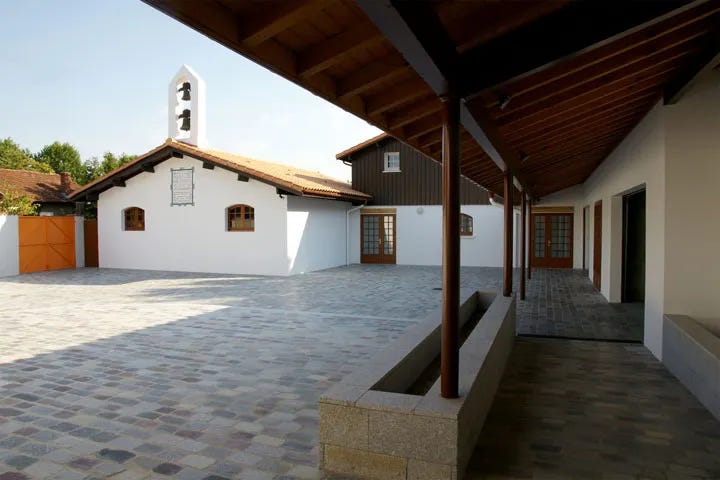
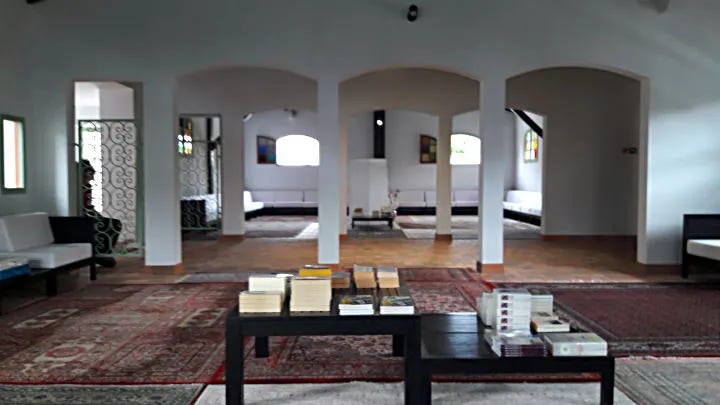
To close this article, I would like to touch on one final aspect linking it to the remarks I made at the end of my recent article on Conques. In speaking of Soulages’ stained-glass windows, I stressed that their simplicity, and the fact that they diffuse light without letting the gaze escape towards the outside, seemed to me to bring the abbey church into a new dimension, that of a spirituality of stripping away and of the shifting simplicity of the Living. At Arès, I found something like a kinship of nature between the atmosphere created by the windows at Conques and what I feel within the house of prayer. Its simple architecture, white walls with a single bell tower, and its interior, likewise white, with carpets covering the floor and a bench running along the walls, always give me that same impression of stripping away, one that brings you back to what is essential and to yourself. This place makes me think, all at once, of the atmosphere of a small Romanesque chapel, of the interior of a plain mosque, and of a Zen meditation dojo. Nothing there distracts the gaze, and each person is alone in his meditation or his chanting, dressed in a white tunic that separates him for a time from his social attire, so as to project him into the world of light.
‘I am here’, says the Message, and if the I who spoke in this place in 1977 remains an absolute mystery, within this ‘here’ I have been able to observe how thought grows light of the useless words that usually turn over in the brain, making way for a sensation, difficult to describe, of a light fullness, and of a here and now that is simultaneously almost outside time. I have lived this experience several times with such intensity that here again the binary logic, true or false, that is habitual to us, is entirely surpassed, and words once more come up against this limit. How is one to describe the sensation of an energy rolling like a wave beneath your feet, when they rest on a perfectly flat floor whose only softness comes from the carpets covering it? Must one concatenate two words and speak of a moving stillness? How is one to tell of the feeling of being empty of oneself and full of oneself at the same time? How is one to speak of that distortion of time I have sometimes felt, that of an eternal instant, or of eternity coiled within the instant?
Do these astonishing moments, which suddenly occur with nothing to herald them, remind us that our perceptions, our emotions, our thoughts, our energy, our very identity, no doubt possess other dimensions, ones to which the emergence of the soul, rising little by little above the daily effort to be better, more aware, more open, may perhaps one day lend a less random consistency, a stability more conducive to a true intelligence and a true vision? I have no formal answer, save the certainty, validated by experience, that the good man awakens to a reality broader than that of our daily troubles, and that this opening is nothing other than the dawn of a new world, built upon another state of consciousness for humanity, one that will be possible if enough human beings desire it and pay its price!

And so this series of articles comes to its close. I have tried to share with you both the itinerary and the reflections the journey provoked in me, giving pride of place to the inner experience from which thoughts are born, rather than to philosophical speculation alone. This is the whole purpose of the Notebooks of life section under whose banner I have placed them: to let you feel the inner movement that precedes words and ideas.
I hope I have succeeded a little in this, at least enough to keep your interest awake and to prompt you to explore a few new angles of view.
I am setting off at the end of this week for a fortnight in the mountains, whence perhaps a few photographs or fragments of text will find their way to you. At worst, I shall see you again at the start of August.
Until then, I wish you all the very best; may the wind of love and freedom pass through your hearts!
Jérôme Nathanaël
© 2026 - Dialogues of the New World — Jérôme Nathanaël

To continue
Have you known a place where something within you fell silent, shifted, or was illuminated in a particular way? Share this living experience in the comments to invite us into movement.
If you would like to say more about a place that matters to you, a contribution of around a page for the Waymakers section. It will be published under your initials, a pseudonym, or anonymously, as you wish. Other readers will be able to respond to it and enter into dialogue with you.
New here? The Opening page introduces the author, the project, how to take part, contact details and the calendar.