

Article disponible en français
The World We Cross · New World · 33 min
To open up perspectives, test out possibilities, seek forms of life more fit to be inhabited.

Series Spirituality and the organisation of societies: article 1 of 6
What the inner life does to societies, what societies do to the inner life.
In this article:
‘Their criterion, I believe, was different: they asked themselves how far they would still be able to live at peace with themselves after committing certain acts; and they decided that it was better to do nothing, not because the world would be the better for it, but simply because it was only on that condition that they could go on living with themselves.’
Hannah Arendt, on those who refused to serve the Nazi regime, ‘Personal Responsibility under Dictatorship’, in Responsibility and Judgment.
A question that runs in both directions
Conviction and responsibility
On 28 January 1919, in the antiquarian bookshop of Carl Georg Steinicke in Munich, a bearded man of fifty-four, an economist and sociologist, the author of The Protestant Ethic and the Spirit of Capitalism (1905), speaks at the invitation of a students’ association. His name is Max Weber, he will die in June 1920, and his lecture is on politics as a vocation. Bavaria has barely emerged from the revolution of November, the Reich has lost the war, Kurt Eisner, the socialist journalist who presides over the Bavarian revolutionary government, will be assassinated less than a month later, and the council republic of Munich will arise in April only to be drowned in blood in May. It is in this atmosphere that he presents his audience with a distinction still invoked whenever ethics and power are in question.
There are, he says in substance, two ways of acting morally, and they do not coincide. The ethic of conviction judges the act by the purity of the intention and leaves the consequences to G.d or to history: he who acts in this way does what is right, come what may, and if the world proves foolish or wicked, it is the world that is at fault. The ethic of responsibility holds the actor accountable for what follows his deed, including the foreseeable consequences that his good intention did not will. Weber does not despise the first; he respects its grandeur, but he refuses to make of it a morality of government. The Sermon on the Mount, he adds, is the absolute ethic of the Gospel, which holds truly only for a saint: one must be a saint in everything, at least in intention, for this ethic to have meaning, and a city cannot be governed according to the demand of all or nothing. Towards the end of his lecture, however, he does not dismiss that demand: politics, he says, means bearing slowly and with all one’s might through hard wood, with passion and a sense of proportion together, and all historical experience confirms that the possible would never have been attained had men not reached again and again for the impossible in this world. The impossible, that other word for utopia!
‘He who is convinced that he will not crumble if the world, judged from his standpoint, is too foolish or too petty to deserve what he means to offer it, and who is nevertheless able to say “all the same!”, he alone has the vocation for politics.’
Max Weber, ‘Politics as a Vocation’ (Munich lecture, 1919).
I open this article with that scene because it contains, within a single lecture given to students, the tension that will run through the six articles of this series and that I make no claim to resolve. On one side, a spiritual demand which, when authentic, asks of him who receives it that he change his life, forgive, renounce domination, and see in the stranger not an enemy but first a neighbour with whom to break bread. On the other, societies in which one must decide, judge, levy taxes, sometimes defend a frontier, feed children whose parents have perhaps read neither the Gospels nor the Upanishads. Weber leaves this tension open, and from it springs the question that carries this whole series, which is mine and not his: what bond is there between the spiritual development of persons and the manner in which a society functions and is organised, and does this bond run in both directions?
One commonly thinks of the first direction, the one that goes from the person to society: individuals transformed inwardly would produce pacified social relations, favourable to collective progress, and better institutions, closer to the expectations of the population. There is a second direction, more rarely looked in the face, which goes from the form of organisation to the inner life: a society can make the quest for meaning easier or almost impossible, according to the space it leaves for questioning or the survival to which it reduces existence, according to the distance it puts between the citizen and the decision or the share of freedom or constraint it imposes on him. I hold both directions to be real, I do not yet know in what proportions, and I warn you from now that I shall probably not know by the end of the six rendezvous of this series!
The moral failure of groups
Two authors, one a contemporary of Weber, the other a little later, put this first direction to a harsh test. At the very time when Weber was speaking in Munich, a young pastor, Reinhold Niebuhr, the future major Protestant theologian of ‘Christian realism’, was running the small Bethel Evangelical Church in Detroit. From 1915 to 1928, he saw his parishioners begin their assembly-line work very early in the morning and leave it exhausted at the end of their long day; he heard sermons on brotherhood adapt themselves without much friction to wages that no sincere Christian would have dared defend; and from this he drew, in 1932, a book whose title says nearly everything: Moral Man and Immoral Society.
Niebuhr’s thesis is subtler than its title suggests. Individuals, he writes, are capable of sympathy, of scruple, of restraint, and their conscience can lead them to acts of genuine disinterestedness. Groups, whether nations, social classes, churches or companies, are much less capable of calling themselves into question: they have interests to protect or to justify, and they habitually clothe them in the vocabulary of values. A group of honest people can thus accomplish collectively what each of its members would refuse to do in his own name, and the group acts in good faith, because the selfishness to which none of its members would dare yield for himself becomes, on the collective scale, a blind loyalty or a fervent patriotism.
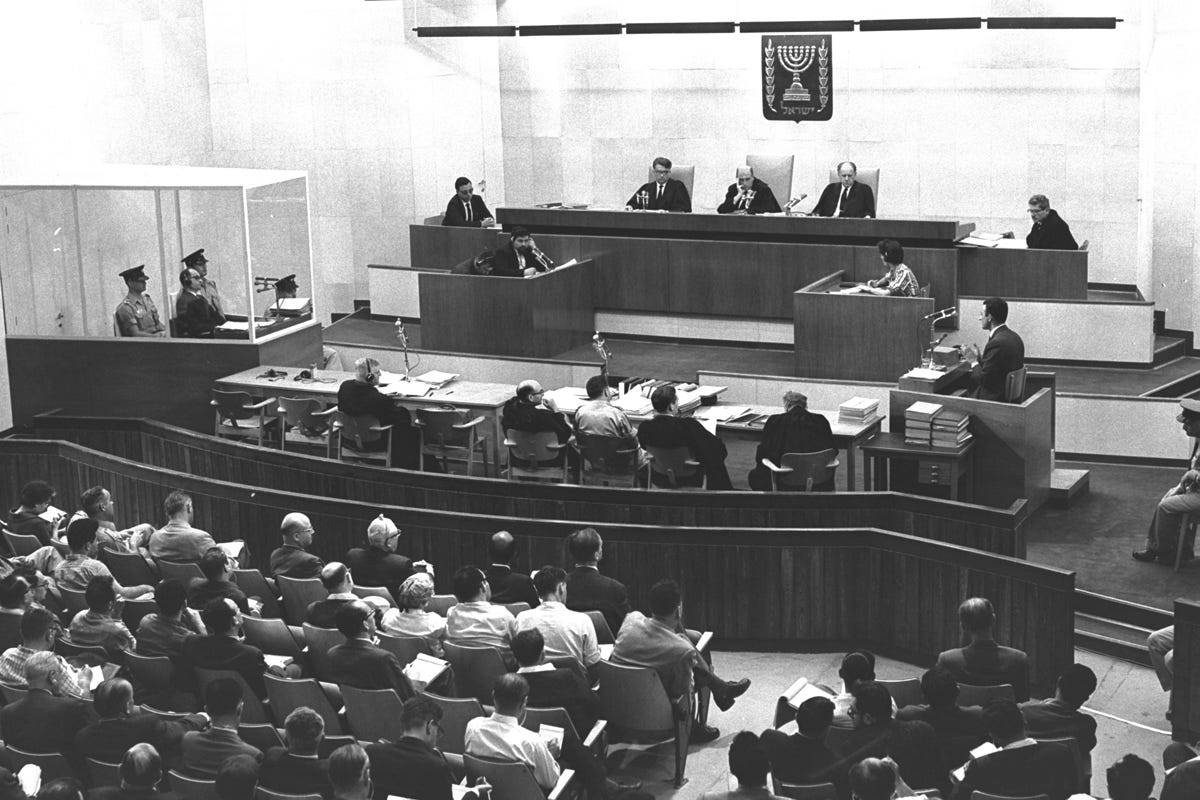
Nearly thirty years after Niebuhr, Hannah Arendt, a German philosopher of Jewish origin, a refugee in the United States and the author of The Origins of Totalitarianism (1951), followed the trial of Adolf Eichmann in Jerusalem in 1961 for The New Yorker, and there met an evil of another nature. She saw there no group interest dressed up as a value: what struck her in Eichmann, that functionary of the deportations and of the Final Solution, was the absence of thought, which she expressly distinguished from stupidity, and a daily manner of applying directives without questioning their horror, whence the subtitle of her 1963 book, ‘A Report on the Banality of Evil’, which has become more famous than the book itself. She also saw in it the effect of a form of power: the essence of totalitarian government, and perhaps the nature of all bureaucracy, she writes in the epilogue, is to make men into mere cogs in the administrative machine, and thus to dehumanise them; and later, in On Violence (1970), she would call this form of power the rule of Nobody, with a capital: a power for which no one can be held responsible. But she refused to let this description serve as an excuse. The defence argued that Eichmann had been only a small cog, a thesis he himself judged beside the point, and Arendt notes that, before a court, all the cogs, however insignificant, are at once turned back into the authors of their acts, that is, into responsible human beings.
‘In Jerusalem, Eichmann was little more than a mask.’
Bettina Stangneth, Eichmann Before Jerusalem.
Niebuhr thus locates the origin of the moral failure of groups in the protection of their interests, Arendt in individual thought, which goes out as soon as the structure thinks in its place: the one looks at collective selfishness, the other at what the structure does to the inner life of those who serve it, which joins the second direction of our question. Arendt’s reading, however, cannot be taken as settled. The German philosopher Bettina Stangneth, author of Eichmann Before Jerusalem (2011), and the British historian David Cesarani, who devoted a biography to him, have shown him to be a convinced and zealous anti-Semite, and the social psychologists Alexander Haslam and Stephen Reicher, who reread the archives of Stanley Milgram’s obedience experiments, maintain that the participants identify with a cause rather than obey like automata. Arendt’s idea remains a working hypothesis, which I shall test in article 5; her political reading of forgiveness, which joins the Sermon on the Mount, will find its place in article 6.
Two hypotheses for an enquiry
Each of the two hypotheses of the series extends one of the two directions. The first, which goes from the person to society, is my starting conviction, and I formulate it in all frankness: there is no lasting civilisation without spirituality, without a source of meaning, of inner demand and of restraint that is reducible neither to interest nor to constraint. But if Niebuhr and Arendt are right, it is weakened before it is even tested: if groups behave according to their interests, and if structures spare those who serve them the effort of thinking, whatever the spiritual quality of their members, one may fear that spirituality is a private luxury which societies tolerate without being changed by it. The second hypothesis, which goes from organisation to the inner life, affirms that when social cohesion unravels, spirituality no longer suffices to carry an ethical progress collectively, because fear, scarcity and distrust divert its impetus towards defence, towards identity, towards the designated enemy. Each of these hypotheses may be false or relative, and must therefore be confronted with the facts. I set myself the rule of seeking the cases that contradict them with as much zeal as those that confirm them, and the care I shall take, at the end of each case, to say what it does not allow us to conclude will help me hunt down their blind spots.
The ground of the enquiry
Three reading pairs, and a backdrop
This double question is not new, and historians of religion and sociologists have already ploughed it in every direction. If I reopen it here, it is because three situations which the present makes pressing impel me to do so. I call them reading pairs, because each sets a spiritual question face to face with a question of organisation, and neither can be understood without the other. I shall develop them only in the last article, and by then I shall no doubt have noted other questions, but I must say now why they justify my undertaking.
Value and commodification
The first reading pair opposes what has a price and what has none. What a society agrees to sell and what it refuses to put on sale says much about what it holds sacred, in the plainest sense of the term: what has no price. The American legal philosopher Margaret Radin studied this frontier in Contested Commodities (1996), concerning the body, sexuality and children. She describes there a dilemma proper to liberal societies, which cherish freedom of choice and, at the same time, the limiting of certain choices in order to protect the integrity of what it means to be a person, and she argues for an ‘incomplete commodification’, in which certain things may be exchanged, but only within a tightly regulated framework. Michael Sandel, a political philosopher at Harvard, carried this question to the general public in What Money Can’t Buy (2012): the market is not a neutral tool, it changes the nature of what it touches and can crowd out values that had no price.
The limit case is that in which the human being himself becomes a commodity, that is, slavery. Our societies have abolished it by law, with the decisive support of religious movements, although other believers claiming the name of Christianity defended it, as in the United States. And yet the International Labour Organization, the Walk Free Foundation and the International Organization for Migration estimated that in 2021 some fifty million people were living in modern slavery, 27.6 million of them in forced labour and 22 million in forced marriage. In fact, our civilisation still tolerates today forced labour in the manufacture of its clothes, its electronic devices and its agricultural produce, through intermediaries it prefers not to look at. It is a textbook case for our question, because both directions can be read in it at once: a spiritual conviction changed the law, then an economic organisation, by the distance it puts between him who buys and him who produces, made invisible what the law forbids.
‘A market economy is a tool […]. A market society is a way of life in which market values seep into every aspect of human endeavor.’
Michael Sandel, What Money Can’t Buy.
Birth, death and dignity
The second reading pair touches human life itself: techniques that did not exist thirty years ago oblige us to decide collectively what we hold to be a human body, a birth, an acceptable end of life. The German philosopher Jürgen Habermas (1929-2026), heir to the Frankfurt School, was already worried in 2001, in The Future of Human Nature, by what he called liberal eugenics, that is, the possibility of leaving to parents the choice of their child’s genetic characteristics before birth. He admitted interventions that treat a serious illness, but refused those that programme or perfect: a child thus programmed would carry within him the intentions of others without ever being able to contest them, and would risk no longer regarding himself as the author of his own life, nor as the equal of those who conceived him. Now our common morality rests, in his view, on this image we have of ourselves as free and equal beings, which justice presupposes without being able to produce, and which he called species ethics.
Sandel, in The Case Against Perfection (2007), arrives by another path at a neighbouring line of division, that between healing and perfecting. To recognise life as a gift, he maintains, is to admit that our talents are not entirely our own work, and that not everything in the world is open to the use we would wish to make of it; to want to master even our genetic inheritance is the triumph of the will over what is given to us, and he sees in it three consequences: less humility, since we would believe ourselves the authors of what we have received; an excessive responsibility, since everything, down to the talents and weaknesses of our children, would become a matter of choice; a weakened solidarity, since those whom fortune has favoured would no longer have any reason to feel indebted for it or to share its fruits.
Neither writes as a theologian, and Habermas even wished to be resolutely postmetaphysical, but both pose a question that bears directly on spirituality, that of what we refuse to do to a human being even if we can, and they invite societies to organise a consensus on a subject where the religions, the traditions of wisdom and consistent materialism sometimes say incompatible things.
Cohesion and empire
The third reading pair looks at the power of states and empires. In the fourteenth century, Ibn Khaldun, a historian and thinker born in Tunis, had described in the Muqaddima a cycle he believed he observed in the dynasties of the Maghreb: a group cohesion, the asabiyya, very strong in the desert, conquers an urban power, grows soft within a few generations in contact with prosperity, and yields its place to another. Religion has a precise role in it. It gives this cohesion a cause and makes it capable of uniting rival clans, but, he observes, religious preaching cannot succeed without an initial group cohesion to carry it. Shared faith therefore amplifies social cohesion without replacing it, and when cohesion wears out, fervour is not enough to hold it back, which joins my second hypothesis.
The same bond operates in reverse when power takes hold of faith. On 6 March 2022, the Sunday of Forgiveness for the Orthodox, ten days after the start of the invasion of Ukraine, the Patriarch of Moscow, Kirill, preaches in the Cathedral of Christ the Saviour. He begins by calling his faithful to forgive offences, then adds at once that ‘forgiveness without justice is capitulation and weakness’. He then develops the argument which, for him, gives the war its meaning. Those who ‘lay claim to world power’ would impose on peoples a test of loyalty, the holding of a Pride march (gay pride), in order to admit them into their world of excessive consumption and apparent ‘freedom’; the Donbass would refuse this test, and that is why there has been an attempt to destroy it for eight years. Now homosexuality is for him a sin condemned by the Bible, and to accept it as a variant of human behaviour would mark the end of civilisation. Hence his conclusion: the war that is beginning is ‘a struggle that has a meaning not physical but metaphysical’, in which the salvation of humanity is at stake, according to whether each stands at the right hand or the left of Christ the Judge.
I do not discuss this thesis here, for the demand it attributes to the West, that of imposing Pride marches as a condition of admission to its world, has no known foundation: it serves above all to make of the adversary a caricature that can be fought in the name of G.d. Its application to the invasion of a neighbouring country has, moreover, been contested, even within Orthodoxy. I retain only the mechanism. In Ibn Khaldun, faith nourishes a cohesion that conquers; in Kirill, a cohesion already constituted, that of a state, summons, through the voice of its patriarch, its own conception of faith to legitimise the war it undertakes. In both cases we see what becomes of spiritual demand when the group that bears it becomes a power: forgiveness, even when preached, and restraint come after the needs of the group, which is precisely the manner in which spiritual impetus can be diverted towards defence, towards identity, towards the designated enemy.
A backdrop: the contemporary acceleration of time
There is, finally, a more diffuse reason which leads me to question the links between spirituality and collective life: it attaches to no event and to no actor that one could point to. Hartmut Rosa, a German sociologist, professor at Jena and theorist of social acceleration, maintains, in Social Acceleration: A New Theory of Modernity (German original 2005), that modern life is organised so that we run ever faster simply to keep our place: techniques, social change and the pace of existence accelerate together, and our societies stand upright only by developing and innovating without cease. This race deprives us of what he calls resonance, the title of his 2016 book (Resonance: A Sociology of Our Relationship to the World), that is, of the capacity to be touched by the world and to respond to it, a relation that cannot be commanded and that requires time.
I add, as an observation of my own and not as a thesis of Rosa’s, what social networks and the continuous flow of news do to this scarcity of time: they forbid nothing, they saturate. A mind solicited every minute by notifications, images and news is no longer prevented from questioning; it no longer finds the occasion, and the quest for meaning, which presupposes slowness, silence and sustained attention, goes out from within, without anyone having decided it or answering for it.
If Rosa is right, the very form of our social organisation has already made of the inner life a luxury of leisure, reserved for him who can slow down, and the direction that goes from structure to soul becomes a matter of public urgency, all the less visible because it is exerted by no constraint: there is neither censor nor decree, only an environment. I shall return to it in article 5, with the caution that a vast body of work demands.
What the figures cannot say
These situations say why the question presses; it remains to know what the data permit us to say of it, and that is little. It would be tempting to treat the first hypothesis, no lasting civilisation without spirituality, by relying on the Seshat Global History Databank, which systematically gathers archaeological and historical data on past societies, in order to verify, for example, whether religions with moralising gods precede or follow the appearance of complex states.
This database, built around the historian and ecologist Peter Turchin, the originator of ‘cliodynamics’, and the Oxford anthropologist Harvey Whitehouse, attempted to answer this across hundreds of societies and ten thousand years: the 2019 article in Nature concluded that social complexity precedes moralising gods. But it was retracted in July 2021, because the missing data, ‘unknown’, had been converted into absences, as had been pointed out by the team of Bret Beheim, of the Max Planck Institute for Evolutionary Anthropology. The authors subsequently affirmed that their conclusions still held after correction, and they published revised analyses in 2022, in Religion, Brain & Behavior. I do not know, as a non-specialist reader, what remains of the initial conclusion.
Other data invite the same modesty. A meta-analysis published in 2024 in Psychological Bulletin, a leading journal of psychology, signed by Kelly, Kramer and Shariff, gathers decades of work on the link between religiosity (affiliation, belief, attendance at services) and prosociality, that is, the propensity to help, to share and to cooperate. It finds a positive but weak correlation, of the order of 0.13 on a scale running from 0, no link, to 1, a perfect link: religiosity therefore explains only a very small part of the differences in conduct between persons. This figure varies above all with the manner of measurement, around 0.15 when persons describe their own generosity, around 0.06 when researchers observe behaviour, for example in a game in which one must decide whether or not to share a sum of money.
This result does not allow us to conclude that believers behave better or worse than others, nor that religion has no effect. The authors discuss three possible explanations of the gap: laboratory tests would poorly capture ordinary generosity, for a game is not life; what is declared would be inflated by the desire to appear generous; or else religiosity and declared generosity would both proceed from a single tendency to self-enhancement. Whichever is right, it would be imprudent to rest a conviction on these averages. This study, moreover, concerns religiosity, not spirituality as I shall define it below, which is one more reason to hold its ethical fruits to be a hypothesis to be tested.
I retain from the first episode that an error of treatment was spotted by peers from outside the team, which is the normal play of research, and from both that neither answers my question. I am seeking a link between an inner development, which concerns persons, and a mode of organisation, which concerns societies, and it is doubtful that a database can reliably measure the degree of spiritual development of a society, or even that such a measure has any meaning. I therefore choose enquiry by case, unable to prove a general law but able to bring to light mechanisms that can be verified elsewhere.
What I call spirituality
Before entering the historical cases, I must make clear how I understand the term ‘spirituality’, for this series would fail from the first article if the word covered at will whatever suits me.
A threshold, then five dimensions
The point of departure that opens the spiritual field is minimal, and I borrow it from Viktor Frankl, the Viennese psychiatrist, survivor of the Nazi camps and founder of logotherapy. He distinguishes, in his vocabulary, the spiritual in the noetic sense, which designates the dimension proper to the human being, made of will to meaning, freedom and responsibility, and the spiritual in the religious sense. The first meaning suffices to mark a threshold: one may speak of spirituality as soon as a person or a group sets out in quest of meaning, whether he does so in a church, in an artist’s studio or before a tree. But this threshold says nothing yet of the quality of what is found afterwards.
Beyond this first threshold, I retain five dimensions. I make of them neither a grid of marking nor a certificate of spirituality: I do not add them up to obtain a score, and the order in which I present them is that of the exposition. Each may be more or less present, even absent, in a given case, so that I describe profiles and not ranks. A hermit may combine a strong self-transcendence and a strong transformation with almost no belonging; a highly structured institution may have vigorous rites and inspire only a weak personal transformation: these are two profiles of different shape, which I do not compare, for a person and a group do not belong to the same scale. This does not mean that all profiles are equal within a single category. Of two persons, the one who transforms himself deeply and lastingly has accomplished more, spiritually, than the one whose life remains unchanged, and of two groups, the one that urges its members to transform themselves does more spiritual work than the one that confines itself to repeating its rites. But these findings hold only between cases of the same nature.
The first dimension is self-transcendence, that is, openness to what exceeds the individual, which may take the form of a relation to G.d, of an openness to non-material dimensions of reality, or of a relation to the infinite without G.d, as described by the philosopher André Comte-Sponville in The Book of Atheist Spirituality, who calls himself a materialist and yet is attached to the life of the spirit. The second is self-transformation, the desire to change, to broaden oneself, to move beyond one’s reflexes, to improve oneself, through prayer, meditation, discipline, penance or study. The third is concern for others, that is, uprightness and compassion in conduct towards those one meets. The fourth is rite and belonging, that is, the gestures, texts and bonds that gather and transmit: it is the most visible dimension, and therefore the easiest to mistake for the whole, whereas it can exist without the preceding ones, and these can exist without it. The fifth, finally, is the scope of responsibility, that is, how far concern extends for what we share and for what is to come: the group, the city, humanity, future generations. Concern for others and this scope of responsibility are quite distinct, for one may be just and gentle with one’s own without committing oneself to the city or to those who will come after, as one may commit oneself to the city without being just to one’s own.
The third and fifth dimensions call for a precaution, because they are the ones I should be most tempted to erect into criteria. If I wrote that only an endeavour which produces ethical behaviour or a commitment to the common good is spiritual, my hypotheses would become tautologies: every failing case would be by definition non-spiritual, and I could never be contradicted. Concern for the collective and for the future is the very bridge that this series wishes to test between the inner life of persons and the organisation of societies: to place it in the definition would amount to taking for granted what is to be sought. I therefore range both concern for others and the scope of responsibility among the hypotheses to be tested and not among the criteria, which the weakness of the correlations between religiosity and conduct mentioned above only confirms.
A scene to anchor the ideas: Budapest, 25 June 1943
So that so abstract a framework does not remain a dead letter, I give it a face. On 25 June 1943, in a rented house at Budaliget, on the outskirts of Budapest, the graphic designer Gitta Mallasz is reading aloud her answers to questions on the meaning of life, when her friend Hanna Dallos, alone with her, warns her: ‘Careful! It is no longer I who am speaking.’ A voice then addresses Gitta, who recognises it as Hanna’s while declaring herself ‘absolutely certain that it is not she who is speaking’; Gitta would later specify that Hanna was never in a trance, not even with her eyes closed. She notes what she hears, and this speech, which the friends attribute to an inner master or to an angel, returns every week thereafter. The group comprises four friends in quest of meaning: Gitta, Hanna, Hanna’s husband Joseph Kreutzer, and Lili Strausz, a movement therapist. Hungary is an ally of Germany and has known anti-Jewish laws since the 1930s, and Hanna, Joseph and Lili are Jewish. What the four thus receive, over seventeen months, through eighty-eight conversations which they would later call Talking with Angels, is at once a spiritual message, an exercise in personal transformation and a support for getting through a catastrophe. Joseph Kreutzer is deported on 3 June 1944, Hanna and Lili on 2 December 1944, after the round-up at the Budapest garment workshop that Gitta managed and where she had enrolled them to protect them, and none of the three will return. Gitta Mallasz, the sole survivor, publishes the text in French in 1976 with Aubier.
This story, taken as a whole, sets the five dimensions mentioned above in tension within a minute space. Self-transcendence takes the form of an openness to a non-material dimension which the participants hold to be real, without my being obliged to subscribe to it in order to describe it. Self-transformation lies in the demand of the text itself, received in the urgency of war and leaving no one at rest. Concern for others appears in the concrete solidarity of the four friends, down to the Budapest workshop that Gitta manages and where she enrols Hanna and Lili among other Jewish women who must be protected. Rite and belonging are these weekly meetings of a group that gathers and that transmits. The scope of responsibility, finally, overflows the circle, since the sole survivor translates, publishes and makes the text known. One glimpses in it already, in outline, the question of organisation: what becomes of such a group when the person through whom the word passes disappears? This story does not answer it; it shows only that the five-dimensional profile can describe a concrete case without reducing it. This question, which the death of three of the four friends makes here cruelly concrete, will be taken up again in article 6.
Where to look, and how
Wilber’s four quadrants, without the levels
A definition does not make a method: I must also say where I shall look, and what I forbid myself. Ken Wilber, an American writer born in 1949, known for his work in transpersonal psychology and for what he calls integral theory, proposes in Sex, Ecology, Spirituality (1995) a map of four quadrants, which crosses the individual and the collective, the interior and the exterior. His work is vast and disputed, and I retain from it here only this map, as a grid for reading any human fact, a conversion, a law, a community, a massacre, which it invites us to view from four angles at once. In the quadrant of the individual interior are found lived experience, intentions, meaning; in that of the individual exterior, behaviour and the body; in that of the collective interior, culture, shared values, common language; in that of the collective exterior, institutions, laws, the economy, techniques. This division has the advantage of reminding us that one goes astray in seeking to explain a social fact from any one of these angles alone: a law does not produce a culture by itself, a culture without institutions vanishes, and a spirituality that translates into no behaviour resembles a rumour.
I shall use Wilber’s quadrants because they describe places in which to look, but I shall leave aside the best-known part of his work, his levels of development. The reason is methodological before being doctrinal: to classify persons or cultures on a scale of consciousness presupposes a criterion that I do not possess and that I should rightly be accused of applying arbitrarily. I have chosen to work by case, and a case is not ranked on a rung, it is described. To describe, however, does not forbid distinguishing: when I say that a person or a group has transformed himself or itself more than another of the same nature, I shall be recording the presence, the absence or the intensity of an observable dimension, a change of life, a practice, an effect on conduct, without measuring a degree of consciousness or placing anyone on a rung.
Seven questions put to each case
So that the six articles may answer one another, I shall approach each case from seven angles, formulated as so many questions, which will allow them to be compared without being confused. There is first the impulse: who bears it? There is its inscription: by what support, text, rite or law, is it fixed? There is its application, by constraint or by consent; its transmission, that is, what becomes of the group and who receives the impulse when he who bore it disappears; the oppositions it meets; the decision-making process, with the question of who decides, who answers for the decision and at what distance from those who follow it. There is finally the angle that extends the second direction of our starting question: what do the organisation of the group, its development and its influence on its age do to the inner life of those who take part in it?
At the close of each case, I shall summarise its profile according to the threshold and the five dimensions, then say what it does not allow us to conclude. When a movement has deviated into persecution, I shall say why this does not prove that every spiritual demand leads there, and when a community has lasted three centuries, why it would be imprudent to draw a recipe from it.
What I am not, and what I promise
I am not a historian by profession, and these texts belong to a personal exploration, resting on readings that I indicate and on sources whose reliability I try to signal. When I have read only an extract, I say so, and when a point is contested among specialists, I say that too. If you spot an error or a case that contradicts my reading, write to me: this series is designed to be corrected along the way.
Next time: the bishop and the sword
The next article, scheduled for Sunday 8 November, starts from Antioch, in the early second century, with the bishop Ignatius who, led to Rome to be martyred, writes on the way to several Christian communities of Asia Minor to urge them to obey their bishop; the article follows the consequences as far as Béziers, in the thirteenth century, where the demand born of the Sermon on the Mount meets the logic of the crusade. Weber asked for passion and a sense of proportion. These are the two requirements I set myself for the next five articles.
Before we meet again on 8 November, I put three questions to you, to which you may reply in a comment or by return of email.
Which case, historical or contemporary, should I study because it contradicts one of my two hypotheses?
Do the five spiritual dimensions I retain seem to you complete, or is there one you would remove, or one that is missing?
Finally, have you seen, in your life or your work, an organisation facilitate or prevent the quest for meaning, and what made the difference?
I shall read everything, and take it into account in the following articles. Thank you for your participation!
See you soon!
Jérôme Nathanaël
Main sources
Max Weber, “Politics as a Vocation” (lecture given in Munich, 28 January 1919), in The Vocation Lectures, Hackett, 2004. The Protestant Ethic and the Spirit of Capitalism, Allen & Unwin, 1930.
Reinhold Niebuhr, Moral Man and Immoral Society: A Study in Ethics and Politics, Charles Scribner’s Sons, 1932. Available on archive.org.
Hannah Arendt, The Origins of Totalitarianism, Harcourt, Brace, 1951. Eichmann in Jerusalem: A Report on the Banality of Evil, Viking Press, 1965. “Personal Responsibility under Dictatorship,” in Responsibility and Judgment, Schocken Books, 2003. On Violence, Brace & World, 1970.
Bettina Stangneth, Eichmann Before Jerusalem: The Unexamined Life of a Mass Murderer, Knopf, 2014.
David Cesarani, Eichmann: His Life and Crimes, Heinemann, 2004.
S. Alexander Haslam and Stephen D. Reicher, “Contesting the ‘Nature’ of Conformity: What Milgram and Zimbardo’s Studies Really Show,” PLoS Biology, 10(11), 2012; S. Alexander Haslam, Stephen D. Reicher, Kathryn Millard and Rachel McDonald, “‘Happy to have been of service’: The Yale archive as a window into the engaged followership of participants in Milgram’s ‘obedience’ experiments,” British Journal of Social Psychology, 54(1), 2015.
Margaret Jane Radin, Contested Commodities, Harvard University Press, 1996. Available on archive.org.
Michael J. Sandel, What Money Can’t Buy: The Moral Limits of Markets, Farrar, Straus and Giroux, 2012. The Case Against Perfection: Ethics in the Age of Genetic Engineering, Belknap Press of Harvard University Press, 2007.
Jürgen Habermas, The Future of Human Nature, Polity Press, 2003.
Ibn Khaldûn, The Muqaddimah: An Introduction to History, Princeton University Press, 1967.
Patriarch Kirill, Sermon on Forgiveness Sunday (Прощёное воскресенье), Cathedral of Christ the Saviour, Moscow, 6 March 2022, official website of the Moscow Patriarchate, in Russian. Personal / AI translation.
Hartmut Rosa, Social Acceleration: A New Theory of Modernity, Columbia University Press, 2013. Resonance: A Sociology of Our Relationship to the World, Cambridge, Polity Press, 2019.
Viktor E. Frankl, The Unconscious God: Psychotherapy and Theology, Simon & Schuster, 1975.
André Comte-Sponville, The Book of Atheist Spirituality, Bantam Press, 2007.
Ken Wilber, Sex, Ecology, Spirituality: The Spirit of Evolution, Shambhala, 2000.
Harvey Whitehouse et al., “Complex societies precede moralizing gods throughout world history,” Nature, 568, 2019, pp. 226-229 (retracted); Bret Beheim et al., “Treatment of missing data determined conclusions regarding moralizing gods,” Nature, 2021 (the critique that led to the retraction); “Retraction Note: Complex societies precede moralizing gods throughout world history,” Nature, 595, 2021, p. 320; Harvey Whitehouse et al., “Testing the Big Gods hypothesis with global historical data: a review and ‘retake’,” Religion, Brain & Behavior, 13(2), 2022, pp. 124-166.
John Michael Kelly, Stephanie R. Kramer and Azim F. Shariff, “Religiosity predicts prosociality, especially when measured by self-report: A meta-analysis of almost 60 years of research,” Psychological Bulletin, 150(3), 2024.
International Labour Organization, Walk Free and International Organization for Migration, Global Estimates of Modern Slavery: Forced Labour and Forced Marriage, Geneva, 2022.
Gitta Mallasz, Talking with Angels, Daimon Verlag, 1988.
© 2026 - Dialogues of the New World — Jérôme Nathanaël


The Waymakers space
The space below is reserved for free and paid subscribers of the publication. It is not visible to non-subscribers.
… … … … … …
Join us
Are you discovering this publication, and does its approach speak to you? I invite you to read the Opening page, which presents the author and the project, and then to subscribe, in the free or the paid version. You will thus gain access to The Waymakers community: direct communication between subscribers through the Chat and its thematic forums, as well as the possibility of exchanging with the author by email or video.