

Article disponible en français
The Eternal Present · Heritages · 30 min
Humanity’s living heritage: traditions, masters of wisdom, sacred places and lives devoted to the quest.

‘Beauty will save the world.’ Fyodor Dostoevsky, taken up and meditated upon by Nicolas Roerich

In the valley of Kullu, in the heart of the Himalayan foothills, there lived in the 1940s an old Russian painter whom the people of the Punjab called, with affection, the Son of the Himalayas. He rose before dawn to paint the peaks. He had crossed the steppes of Siberia, the sands of the Gobi, the Tibetan passes at more than five thousand metres. He had designed the sets for one of the most scandalous creations in the history of music. He had signed an international treaty at the White House. And he continued to paint, each morning, as though the mountain had something to say that colour alone could convey. His name: Nicolas Roerich. The question his life raises is not biographical. It is a question about the nature of the Beautiful, and about what a human being can do with his existence when he decides, lucidly, to make of that Beauty his sole compass.

In this article:
Helena and Agni Yoga: a philosophy of the inner fire
What this life teaches
Epilogue: the thread never broken

A life in quest of Shambhala
There are lives whose coherence is not immediately visible. One looks first at the inventory — archaeologist, symbolist painter, stage designer for The Rite of Spring, explorer of Central Asia, philosopher, founder of institutions, diplomat of culture — and one believes one sees the scattering of a gifted dilettante or the frenzied activity of an insatiably ambitious man. Then something falls into place. One understands that all of it is connected. That the boy who dug up Slavic burial mounds on the family estate at Izvara and the old man who contemplated Kanchenjunga from his studio in Naggar were both carried by the same obsession: to find, beneath the shifting forms of the visible, the deep continuity that connects man to himself across the civilisations.
This obsession Roerich gave several names according to the periods and the languages of his life. He called it Beauty, in the Dostoevskian sense, not aesthetic but ontological. He called it Culture, carefully distinguishing this word from civilisation, which is, in his view, merely its material envelope. He called it Shambhala, that Tibetan word designating a legendary kingdom of wisdom, which he and his wife Helena transformed into an inner orientation. All these names point in the same direction.
Born in Saint Petersburg in 1874, dead in Naggar in 1947, Nicolas Roerich traversed a century of catastrophes (two world wars, a revolution that closed the doors of his native country to him for ever, the rise of the totalitarianisms) without ever abandoning the certainty that humanity was something greater than its convulsions. One does not call that naivety. One calls it a conviction earned in the field, canvas by canvas, expedition by expedition. This article attempts to show how.

The excavations at Izvara: when the earth holds memory
Nikolai Konstantinovich Rerikh was born on 9 October 1874 into a family of the cultivated bourgeoisie of Saint Petersburg. His father was a notary, his mother from a family of merchants. But it is Izvara that counts: the family estate sixty kilometres from the city, where the young Nicolas spent his summers.
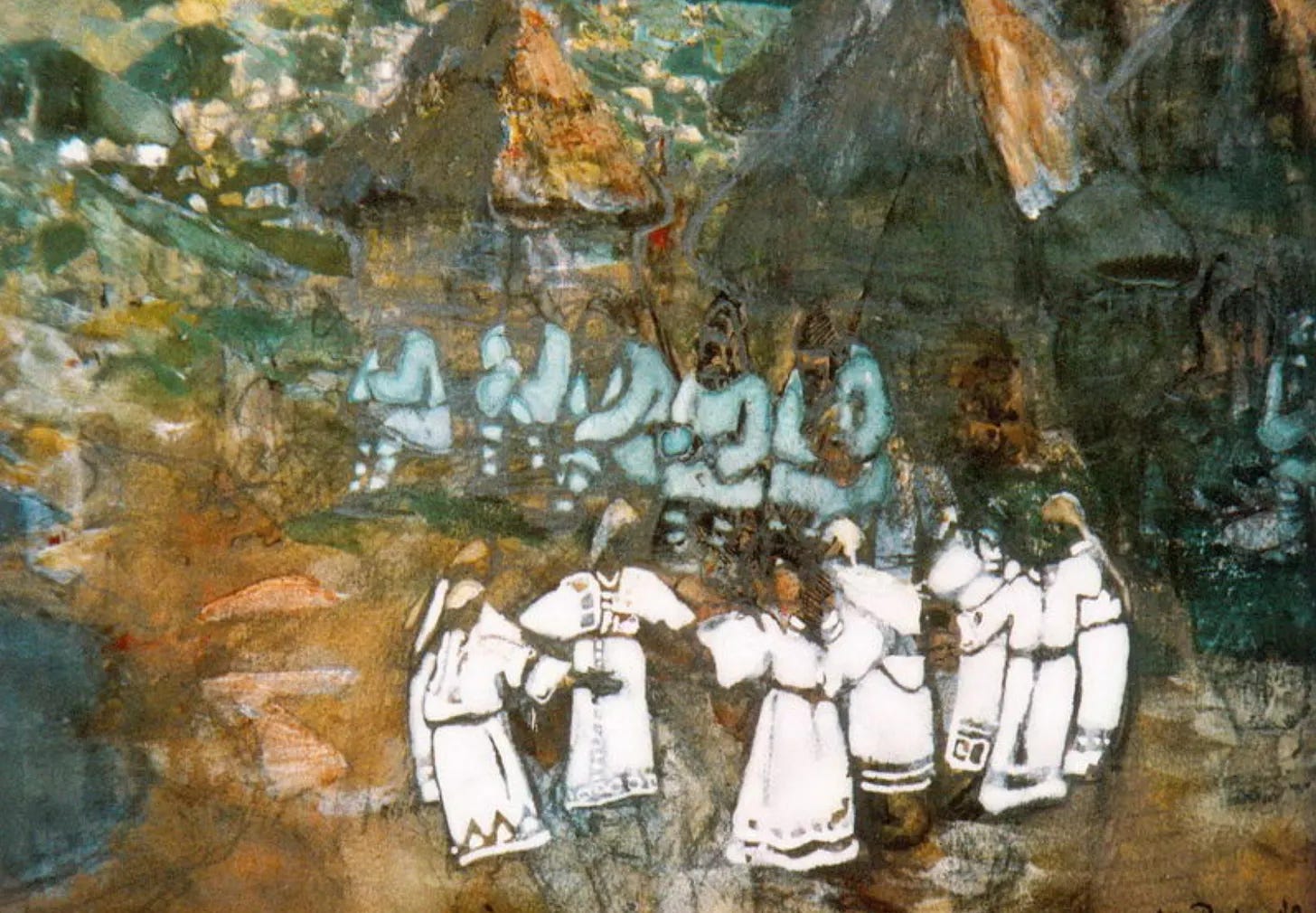
He was twelve years old when he began to excavate. Not the digging of a child at play: he worked methodically, recorded his finds, corresponded with archaeologists. The soil of Izvara harboured Slavic remains from the pre-Christian era — burial mounds, ceramics, traces of rituals whose meaning no one could any longer say exactly. For the young Roerich, these objects had not merely an antiquarian value. They were proof that the earth holds a memory that books do not contain, that civilisations pass but that something of them remains, buried, available to him who knows how to look.
This conviction never left him. It would be the deep structure of his entire work.
In 1893, he enrolled simultaneously at the Faculty of Law and at the Imperial Academy of Fine Arts, two callings of which he already knew which would prevail. At the Academy, he worked under Arkhip Kuindzhi, that Ukrainian painter whose speciality was light: not the realistic light that illuminates objects, but light as an almost autonomous phenomenon, as though the canvases themselves radiated from within. What Kuindzhi transmitted to Roerich was not a technique: it was a question. What is light in a painting? What is one seeking when one paints not what the eye records, but what vision intimates?
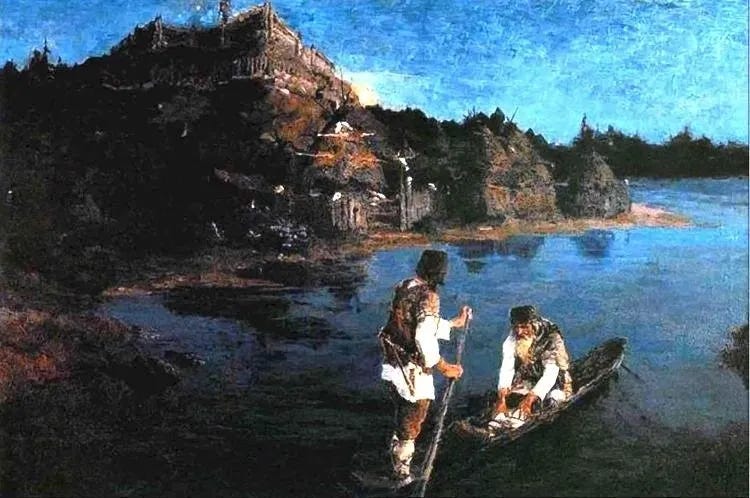
Roerich’s first great painting, The Messenger (1897), answers this question in its own way. A rower crosses a dark river beneath a leaden sky. On the far bank, a wooden fortress. The atmosphere is that of mediaeval Russia, heavy, tense. Something is being prepared, something is about to change, but nothing is yet visible. The tonality is that of a secret being transmitted. Pavel Tretyakov, the great Muscovite collector, bought it at once. The painter was twenty-three.
In 1900, Roerich went to Paris to study in the studio of Fernand Cormon, that master of scenes from human prehistory. His time there opened him to European symbolism, to the debates on primitivism, to the question of what art can do with the memory of origins. He returned changed, confirmed in a path that was neither academicism nor avant-garde, but something he would take years to name fully.

The World of Art and archaic Russia
Back in Russia, Roerich joined the circle of Mir Iskusstva — The World of Art — which Sergei Diaghilev animated with that combination of aesthetic intelligence and organisational genius that would make him the most influential impresario of the early century. Roerich contributed to his journal, exhibited in Russia and in Europe, created mosaics for Orthodox churches, designed costumes. In 1906, he was appointed director of the School of the Imperial Society for the Encouragement of the Arts, a post he would hold until 1918.
But it is his painting that reveals what sets him apart from his contemporaries.
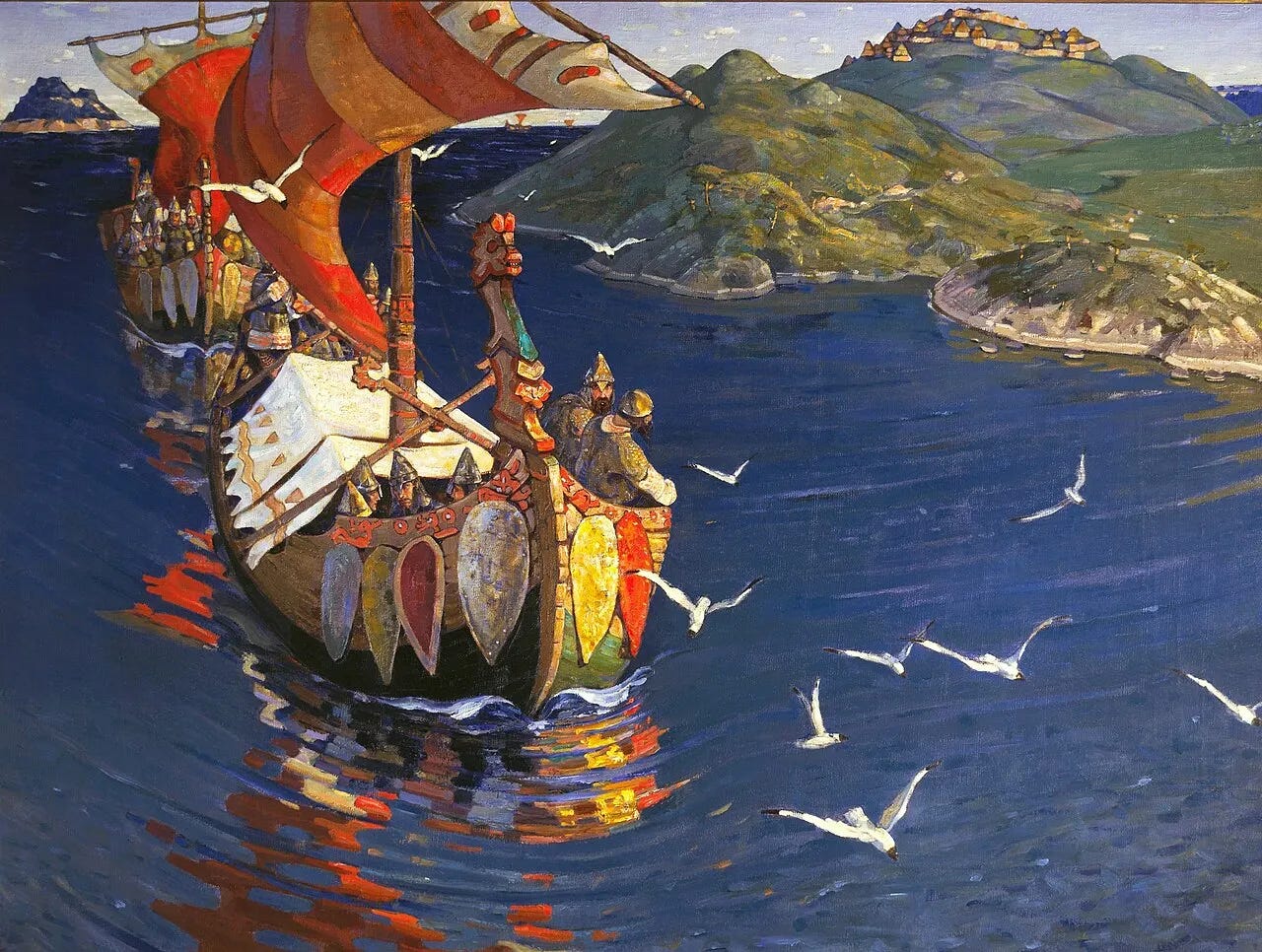
Overseas Guests (1901) depicts Viking longships gliding over a pewter-coloured sea towards misty Slavic shores. The sky is low, of a bluish grey that is neither threatening nor peaceful. The silhouettes on the boats are reduced to their function: human forms carrying something, a presence come from elsewhere. This is not a historical illustration. It is a meditation on the encounter of civilisations, on that undecided moment when the other arrives and one does not yet know whether it is a threat or a gift. Roerich would return to this motif throughout his life: the waymaker, the messenger, he who crosses over to bring what the others did not yet know they were waiting for.
Those Russian years were years of pictorial archaeology. Roerich drew sustenance from pre-Christian Slavic spirituality, from those strata anterior to Christianisation in which man was still in direct dialogue with the cosmic forces. This was not a matter of nostalgia, but of recovering something that modernity had covered over without having resolved it. The rupture between man and the sacred is not an evolution: it is an amputation whose consequences have yet to be fully measured.
All of this converged, in 1913, in the most shattering project of his life.

The Rite of Spring: the memory of ritual
On the evening of 29 May 1913, at the Théâtre des Champs-Élysées in Paris, the premiere of The Rite of Spring unleashed what remains, in the collective memory, the greatest scandal in the musical history of the twentieth century. The audience booed, hissed, cried out. Fights broke out in the stalls. The music could barely be heard.
Roerich and Stravinsky had co-signed the original scenario: Pictures of Pagan Russia in Two Parts. The music, polytonal, rhythmically fractured, violently anti-Romantic, was by Stravinsky. The choreography, with feet turned inward, body curved towards the earth, gestures of a deliberately archaic ritualism, was by Nijinsky under the direction of Diaghilev. The sets and costumes were by Nicolas Roerich.
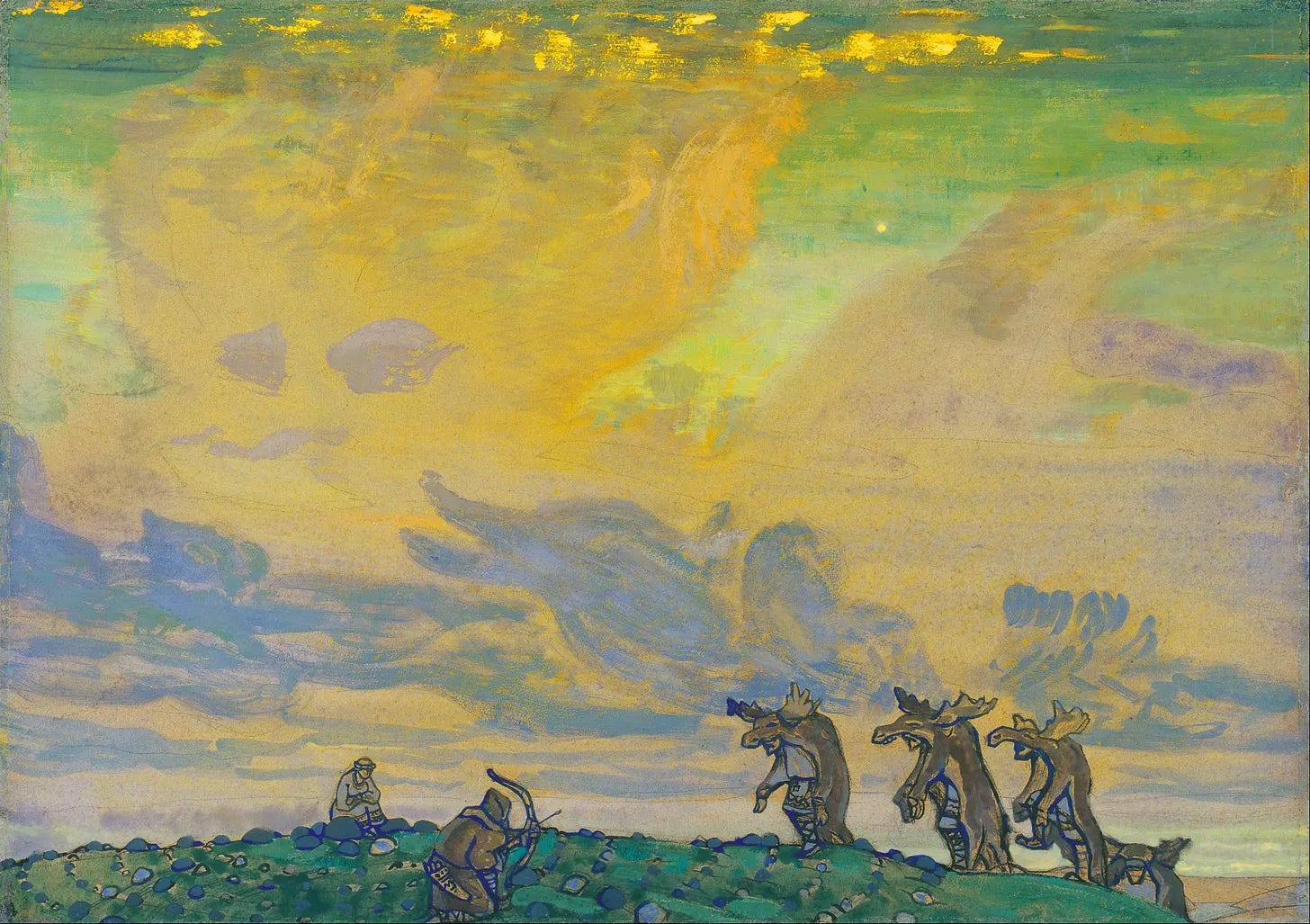
What Roerich painted on those sets is significant: not a dramatic or symbolist landscape, but something deliberately flat, deliberately archaic in its palette — the ochres and muffled greens of the steppe, the treeless horizon, the low sky of the earliest humanities. A space in which the rite is not represented but made possible. Where what is about to happen on stage is not theatre but the summoning of collective memory.
The scandal of The Rite was, in its own way, a confirmation. What the Parisian audience was rejecting was not the formal obscurity: it was the presence of something real. Modern art could well shock by its dissonances. It was more difficult to admit that behind those dissonances lay an appeal to the most buried strata of the collective consciousness. It was not ugliness the audience was refusing. It was depth.
Maxim Gorky, who had observed Roerich closely, described him in those years as a ‘great intuitivist’ — a formula that expressed, better than any academic title, what distinguished him: the capacity to short-circuit the intellect in order to reach directly what civilisations know of themselves without being able to formulate it.

Exile and the call of Asia
The October Revolution of 1917 found him in Finland, where he was staying for reasons of health. The borders closed. He would practically never see Russia again. What could have been a biographical drama became, in his inner logic, a liberation — not a happy one, but a necessary one.
From Finland he made his way to Scandinavia, then to London, where he worked for the Covent Garden Opera and exhibited under the title Spells of Russia. It was there that he encountered Rabindranath Tagore, Nobel laureate in 1913, a figure of universal humanism whom the West had just discovered. The two men recognised one another without needing to explain themselves: two different forms of a single certainty, that Beauty is a shared language, that the cultures of the world have a common bedrock that politics and religion have covered over without ever extinguishing it.
In 1920, Roerich arrived in the United States, where he founded in New York the Master Institute of United Arts, an institution built on the idea that all the arts proceed from a single source and that their division into separate disciplines is a mutilation of the human spirit. He exhibited in more than thirty American cities. European museums, including the Louvre, acquired his canvases. His recognition was international.
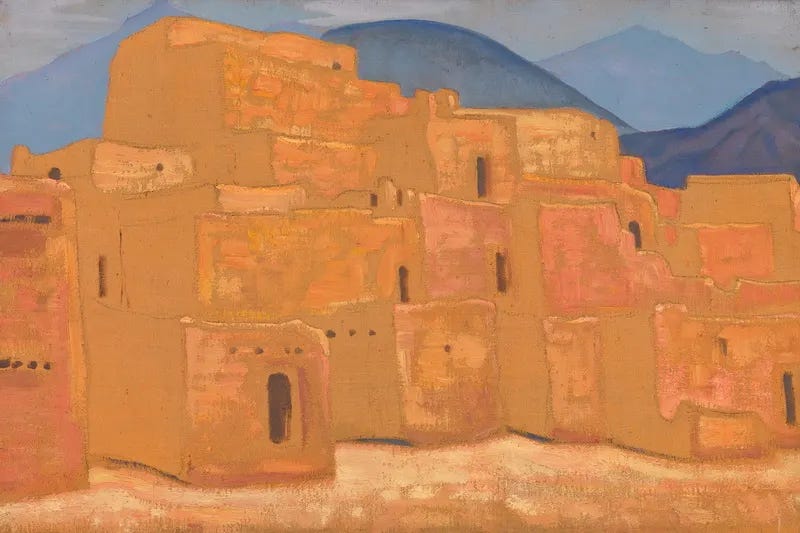
But something in him had never ceased to look eastward.
His turn towards Asia was not a whim of exoticism. It had long been prepared by a careful reading of the works of Helena Petrovna Blavatsky, founder of the Theosophical Society, whose The Secret Doctrine (1888) proposed a synthesis of the great spiritual traditions of the world around a vision of the evolution of human consciousness. Roerich had studied these texts with his wife Helena, born Shaposhnikova in 1879, with whom he had formed, since their meeting in 1899, a complementary couple in thought as in life. She: a musician trained at the Saint Petersburg Conservatory, a self-taught philosopher reading Sanskrit, translator into Russian of Blavatsky’s The Secret Doctrine. He: the artist who translated into images and forms what she formulated in words. Between them, a collaboration that was not a division of roles but a unity of vision worked out simultaneously in two registers.
In 1923, at the age of forty-nine, at the height of his Western recognition, Nicolas Roerich left America and set sail for India.

The great traverse (1924–1928)
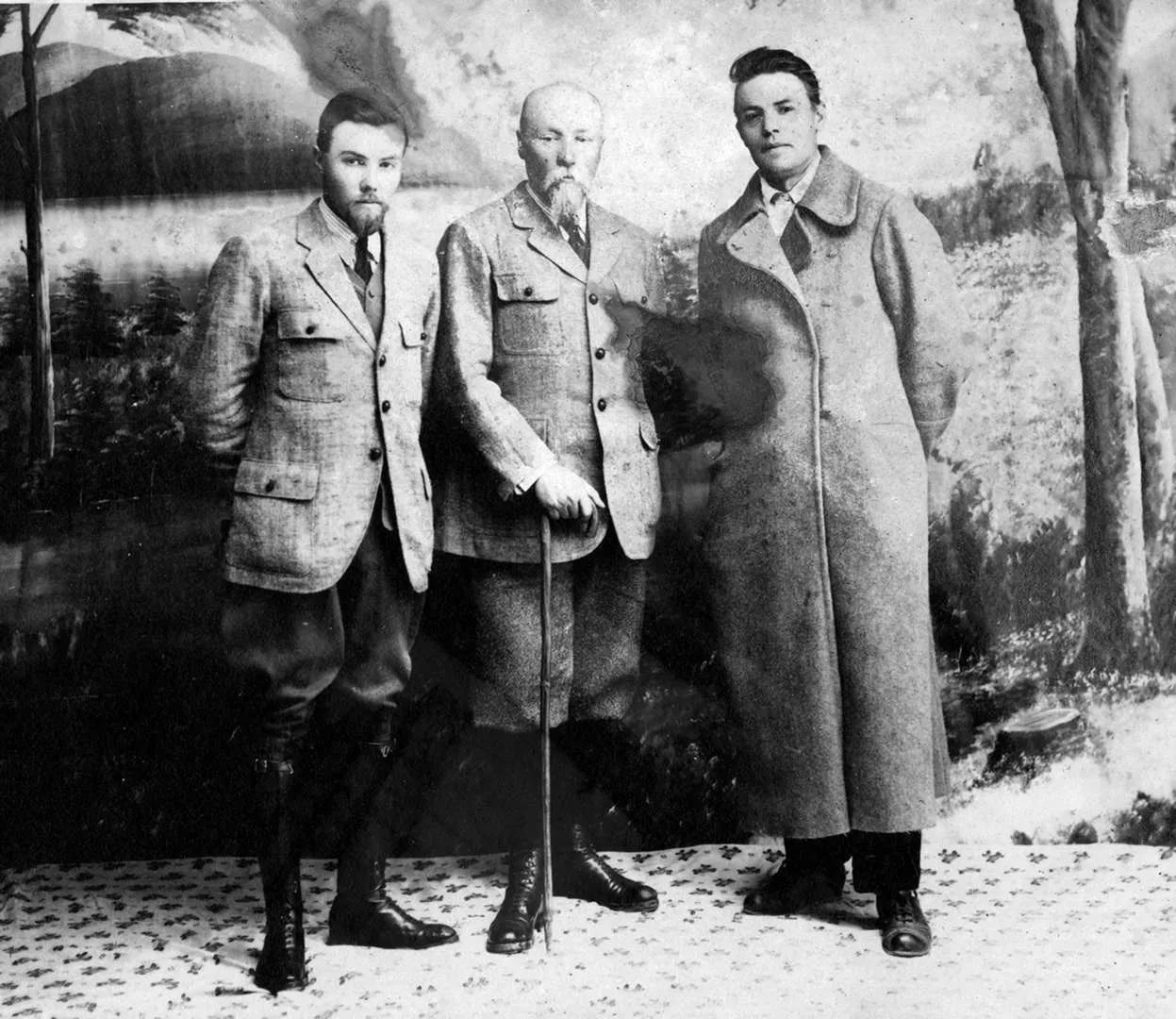
The Central Asian expedition that Roerich led between 1924 and 1928, with Helena and their elder son Georges, an orientalist and Tibetologist fluent in Tibetan, remains one of the great adventures of twentieth-century exploration. Not for its geographical exploits — others had already mapped those regions — but for what it sought, and for what it produced.
The itinerary defies the imagination: Sikkim, Kashmir, Ladakh, the Karakoram, Chinese Xinjiang, Soviet Central Asia, Siberia, Mongolia, the Gobi Desert, Tibet. Five years. Conditions that Roerich’s travel journals describe with a sobriety that renders the violence of the facts more gripping: blizzards in passes at more than five thousand metres, burning sandy deserts, a forced encampment on the Tibetan plateau in the depths of winter, where several members of the expedition came close to dying of cold. Negotiations with suspicious colonial authorities, unpredictable tribal chieftains, Soviet border guards. And encounters with lamas in monasteries lost in the snows, with Tibetan scholars whose language Georges spoke.
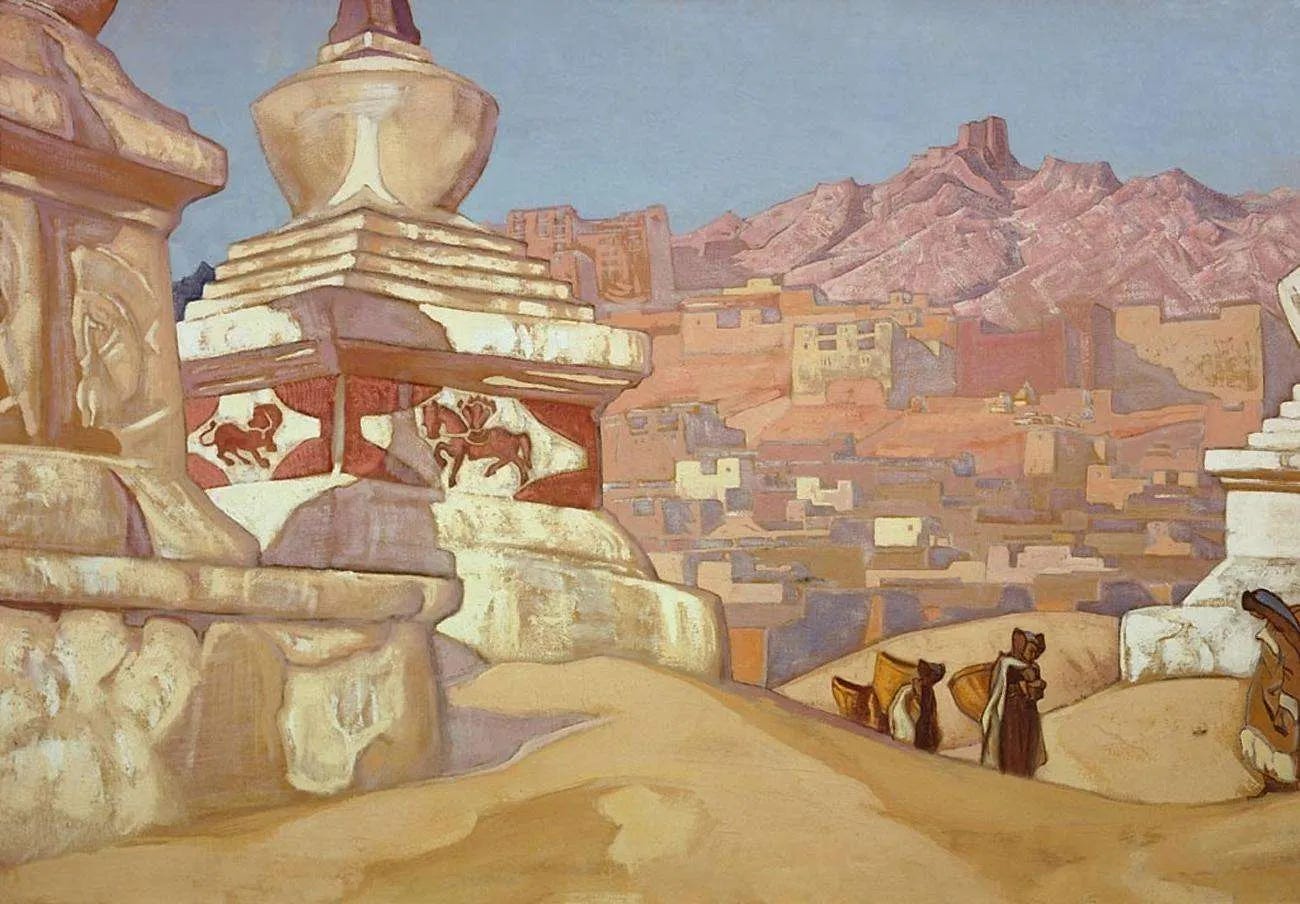
What Roerich was seeking, beyond the scrupulously gathered scientific data — botany, geology, ethnography — was of another order. He was seeking the living confirmation of a conviction that the Tibetan, Mongolian and Hindu traditions seemed to share: the existence of an underground spiritual continuity between the great cultures of humanity, of which Shambhala was the legendary name.
It is necessary to be precise about what this word signifies, and not to confuse several things. In the Tibetan texts of the Kalachakra Tantra, Shambhala designates a mythic kingdom situated to the north, guardian of the deepest teachings of Tantric Buddhism. This is a precise doctrinal representation, not a vague legend. The question of its nature — geographical reality, state of consciousness, intermediate space — has been the subject of debate within the traditions themselves. Roerich, for his part, operated a personal synthesis between these Buddhist sources and the theosophical cosmology of the Masters of Wisdom. This synthesis is creative but it is not orthodox. In Heart of Asia (1929), he reports signs and conversations that confirm his vision, without ever claiming to have found a geographical location, but affirming that he had felt, in contact with the living traditions of Asia, something that overflowed the categories of Western rationality. This conviction may be accepted, questioned, placed in critical perspective. It cannot be ignored when one looks at the canvases of this period.
During the expedition, he produced approximately five hundred paintings. The journey culminated in the founding of the Urusvati Himalayan Research Institute in the valley of Kullu in 1928, the first permanent scientific research centre in India led by Europeans.

The Banner of Peace
In 1929, Roerich set out to give legal form to a conviction he had held since 1904: that the creations of the human spirit — temples, libraries, museums, universities, works of art — deserve an international protection as unconditional as that which the Red Cross affords to the wounded of war. Men fight one another: that is a reality that each generation confirms. But that is no reason for the traces of their greatness to be collateral victims of their violence.
The treaty he proposed, drafted according to the norms of international law by Professor Georges Chklaver of the Institut des Hautes Études Internationales in Paris, stipulates that all educational, scientific, artistic and religious institutions must be recognised as inviolable by all nations, in time of war as in time of peace. The League of Nations approved the principle in 1933.

To identify the monuments and institutions thus protected, Roerich designed a sign: three red spheres encircled on a white ground. The three spheres: art, science, religion — three forms of the human aspiration towards what exceeds it. The circle: the culture that encompasses them and gives them meaning. He called this sign the Banner of Peace — Pax Cultura.
On 15 April 1935, the Roerich Pact was signed at the White House by Franklin D. Roosevelt and the representatives of twenty-one nations. Roosevelt kept a bust of Roerich in his private apartments. The initiative received the public endorsement of Albert Einstein, George Bernard Shaw and Rabindranath Tagore.
On that day, Roerich spoke words that should be engraved on the pediment of every museum, every library:
‘May the Banner float in the wind above the hearths of Light, the sanctuaries and the bastions of Beauty. May it float above all the deserts and the solitary hiding-places of Beauty, so that the deserts may bloom from this sacred seed.’
This pact is not just another legal document. It is a philosophical declaration: the recognition that even in the worst convulsions of history, something exists — the creations of the human spirit — that belongs to all times and all peoples, and that must remain intact. It directly inspired the 1954 Hague Convention for the Protection of Cultural Property in the Event of Armed Conflict, and constitutes one of the normative foundations of UNESCO.
The historical irony is bitter. It was precisely during the months that preceded and followed the signing of the Pact that an expedition led by Roerich in Manchuria and Mongolia, financed by Henry Wallace, Roosevelt’s Secretary of Agriculture, was turning into a diplomatic scandal. Accused of political activities in a territory under Japanese occupation, Roerich was recalled. A spiritual correspondence between Wallace and Helena, in which the minister addressed Roerich as Guru, became public years later. A tax investigation added to the difficulties.
Roerich left the United States in 1936 and never returned. He had wanted to build bridges; circumstances had placed him in contradiction with his own intentions. The Pact outlived him. That is perhaps the best definition of a true legacy. This chapter does not diminish the greatness of his vision. It is a reminder that spiritual depth and political naivety can coexist in the same person, and that great visionaries are not spared the errors of judgement that their century sets before them.

Kullu: the evening light
In 1936, Roerich settled permanently in Naggar, in the valley of Kullu, in what was then the British Punjab. This verdant valley, enclosed between snow-covered Himalayan walls, bathed in a light that Punjabi poets compare to gold dust suspended in the air, became his final studio, his final sanctuary. The local people venerated him. Gandhi, Nehru and Tagore counted among his friends.
He continued to paint with an intensity that never faltered. The witnesses of this period are agreed that he worked each morning before sunrise, in that blue and cold light that precedes the Himalayan dawn — that light which in his paintings takes on an almost phosphorescent quality. The late series — dozens of canvases in which Kanchenjunga, Everest, the snowy passes and the deep valleys return like variations on a single silent theme — achieve a formal austerity and concentration that the language of art struggles to capture. One leaves the register of description and enters something that resembles pictorial liturgy.
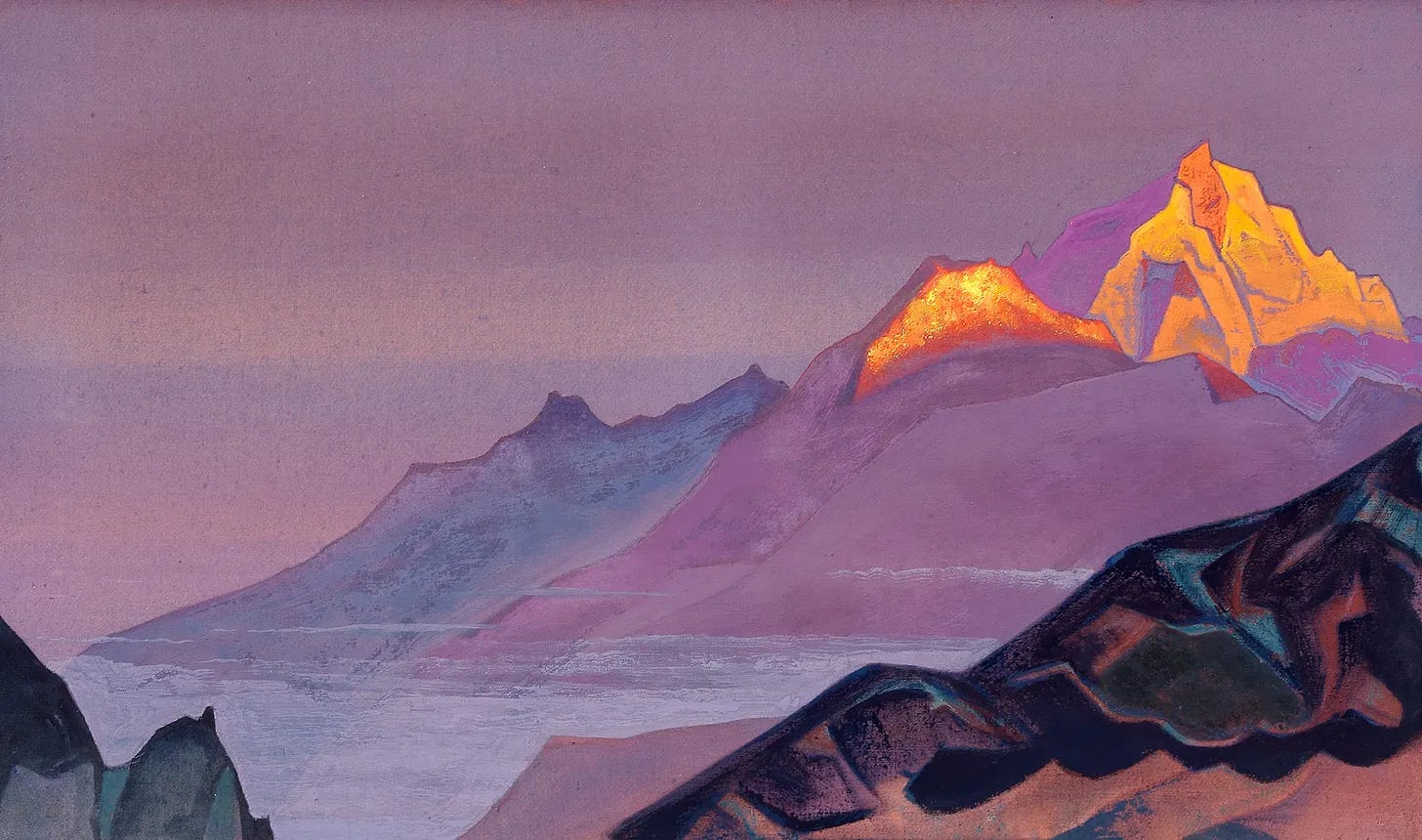
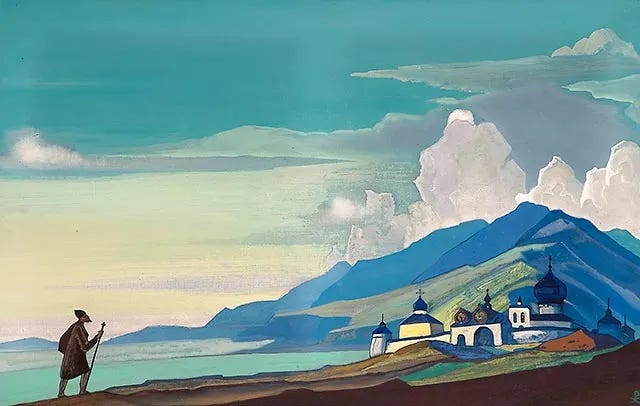
In Path to Shambhala (1933), a path climbs towards snow-covered mountains of an impossible blue. The light comes from above, from a sky that seems to vibrate with a presence. No human being is visible: the way is open for him who looks. This is not a representation. It is an invitation.
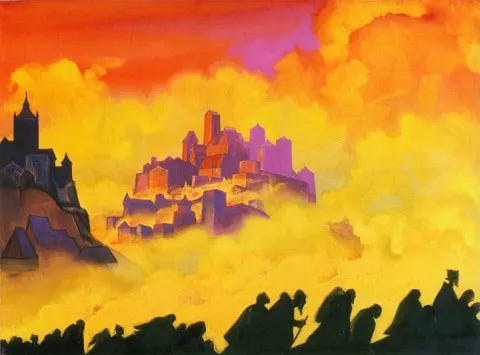
As the Second World War approached, Roerich sometimes darkened his vision: with Armageddon (c. 1935–1936), he showed burning cities, human silhouettes caught in an apocalyptic atmosphere, as though the imminent historical catastrophe were already projected onto his canvas. He launched, without respite, appeals to the entire world for peace and for the protection of culture. His writings of this period bear witness to a man who never separated art from responsibility, nor contemplation from engagement.
Nicolas Roerich died on 13 December 1947, a few weeks after Indian independence. He had asked that his ashes be scattered in the mountains. The same light that had nourished his canvases for thirty years was shining, that morning, on the snow-covered peaks of Kullu.

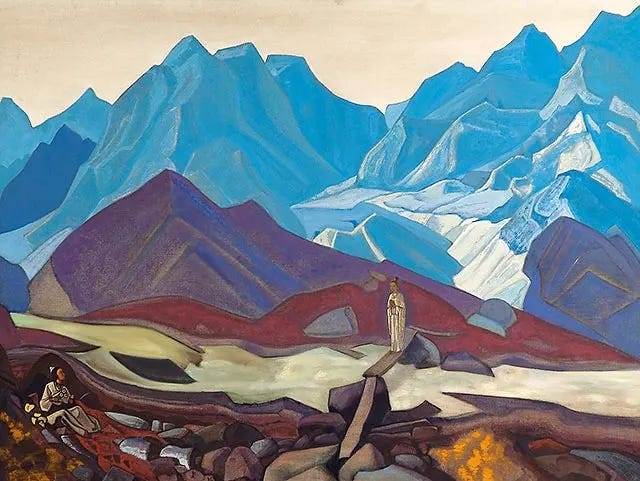
The language of light
It is estimated that Roerich produced more than seven thousand paintings during his lifetime. This figure is staggering, but it explains nothing of what these canvases do to one who pauses before them.
His preferred technique was tempera, an egg-based paint inherited from mediaeval frescoes and Byzantine icons. Where oil paint may darken over the decades, tempera retains its vibration. The tones remain vivid. The blues do not brown. The Himalayan pinks do not fade. This technical choice is not without significance: it was a matter of painting not what passes, but what endures.

The great works of spiritual maturity
Mother of the World (1924) is perhaps the most universal work Roerich ever produced. A veiled figure, immense, occupies the centre of the canvas in a space that is neither earthly nor celestial. Her hands are spread in a gesture that is not an offering but a presence. Her face is hidden. This veil is not an absence: it is an affirmation that what is represented here exceeds any particular face. She is neither the Christian Virgin, nor Kali, nor the Tibetan Tara; she is anterior to all these forms, or rather: she is what all these forms have sought to say. This painting does not ask for allegiance. It asks for silence.
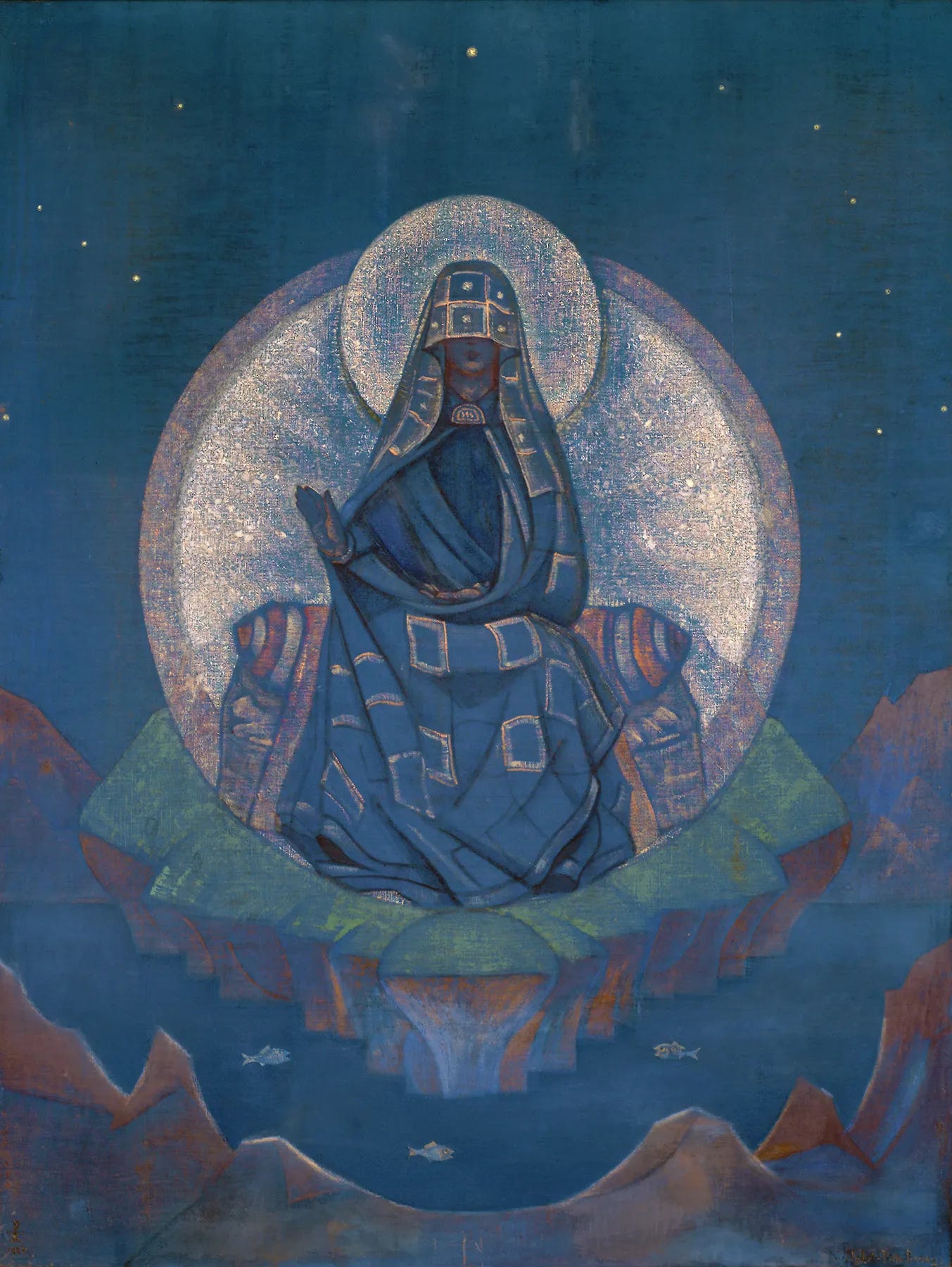
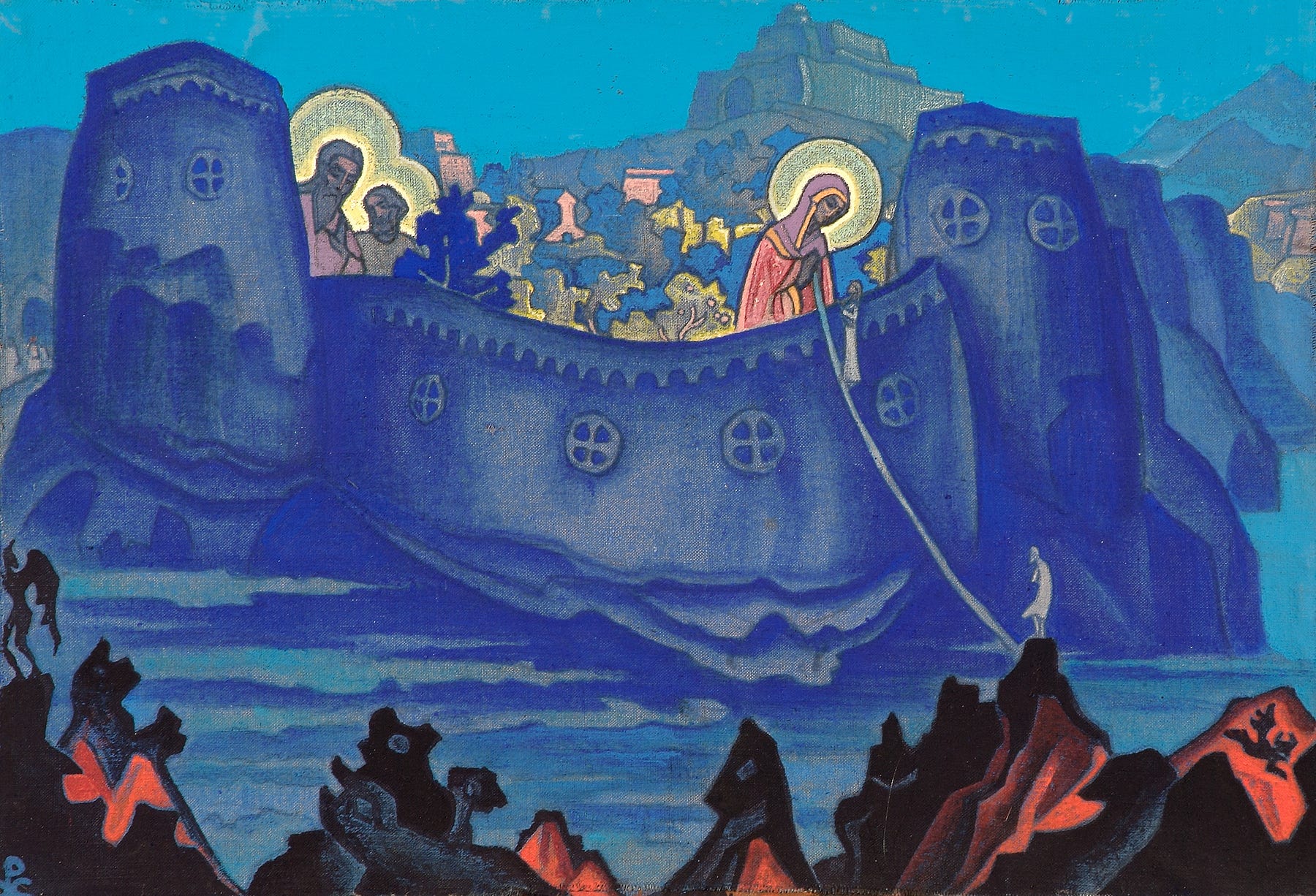
Madonna Laboris (1933) offers something less expected. The divine figure is no longer still and contemplative: she reaches ropes down towards human beings who are climbing the walls of a city under construction. The divine does not save from without; it works from within, alongside man, as though spirituality were also an effort, a participation, a co-construction. It is difficult not to see in this an answer to the question posed by Mother of the World: this veiled presence is not passive. It builds.
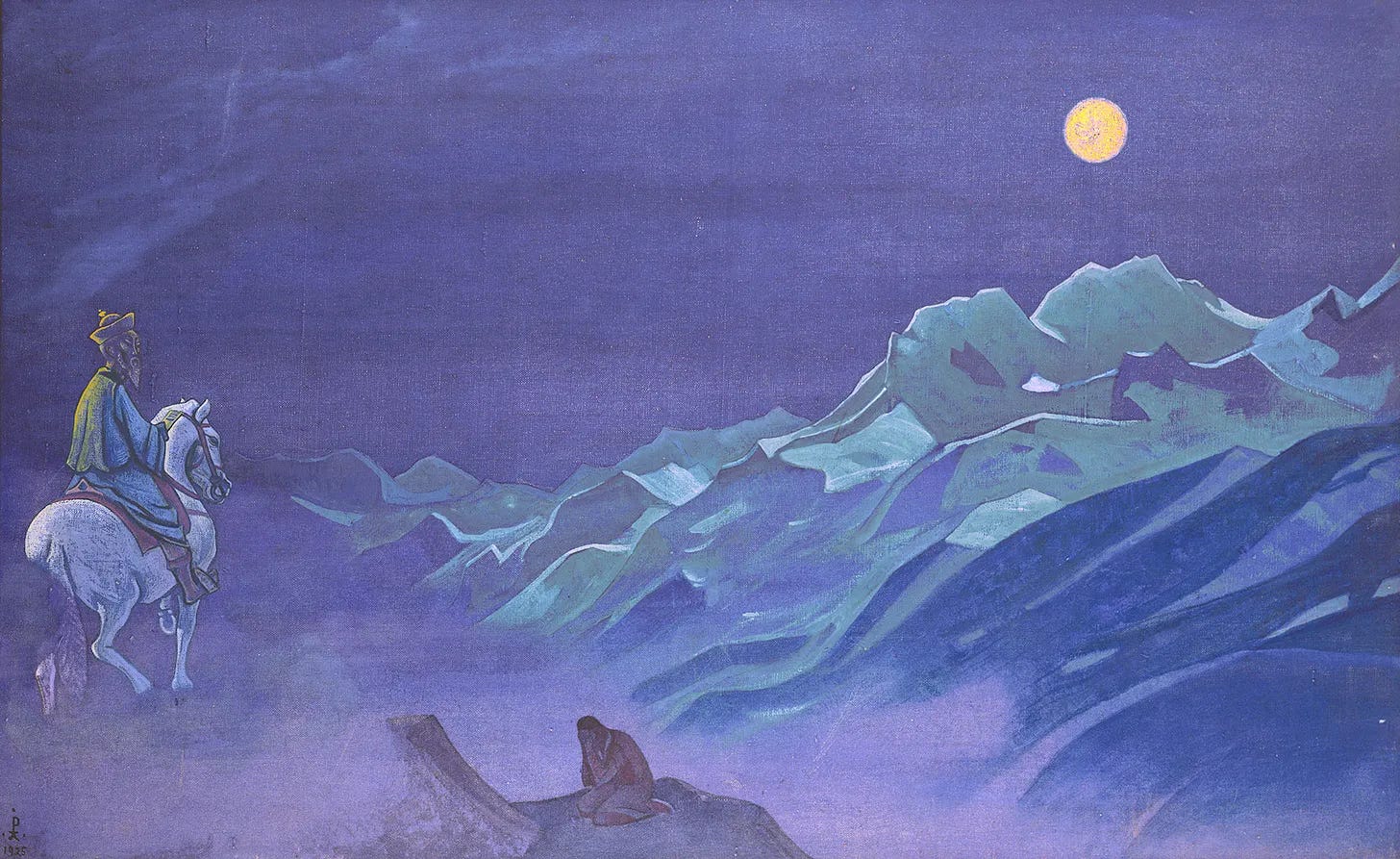
Oyrot, Messenger of the White Burkhan (1925) is the strangest painting, perhaps the most charged, that Roerich produced. A lone horseman advances through a landscape of absolute desolation: infinite plains, distant mountains, an empty sky. No visible destination, no announced purpose. The canvas is linked to the Altaic legend of the return of Oyrot, the mythical hero whose people have awaited for centuries as a sign of renewal. Roerich hears in it an echo that transcends the Altai: the messenger of transformation, the announcement of a change that always precedes its visible accomplishment by a great distance.
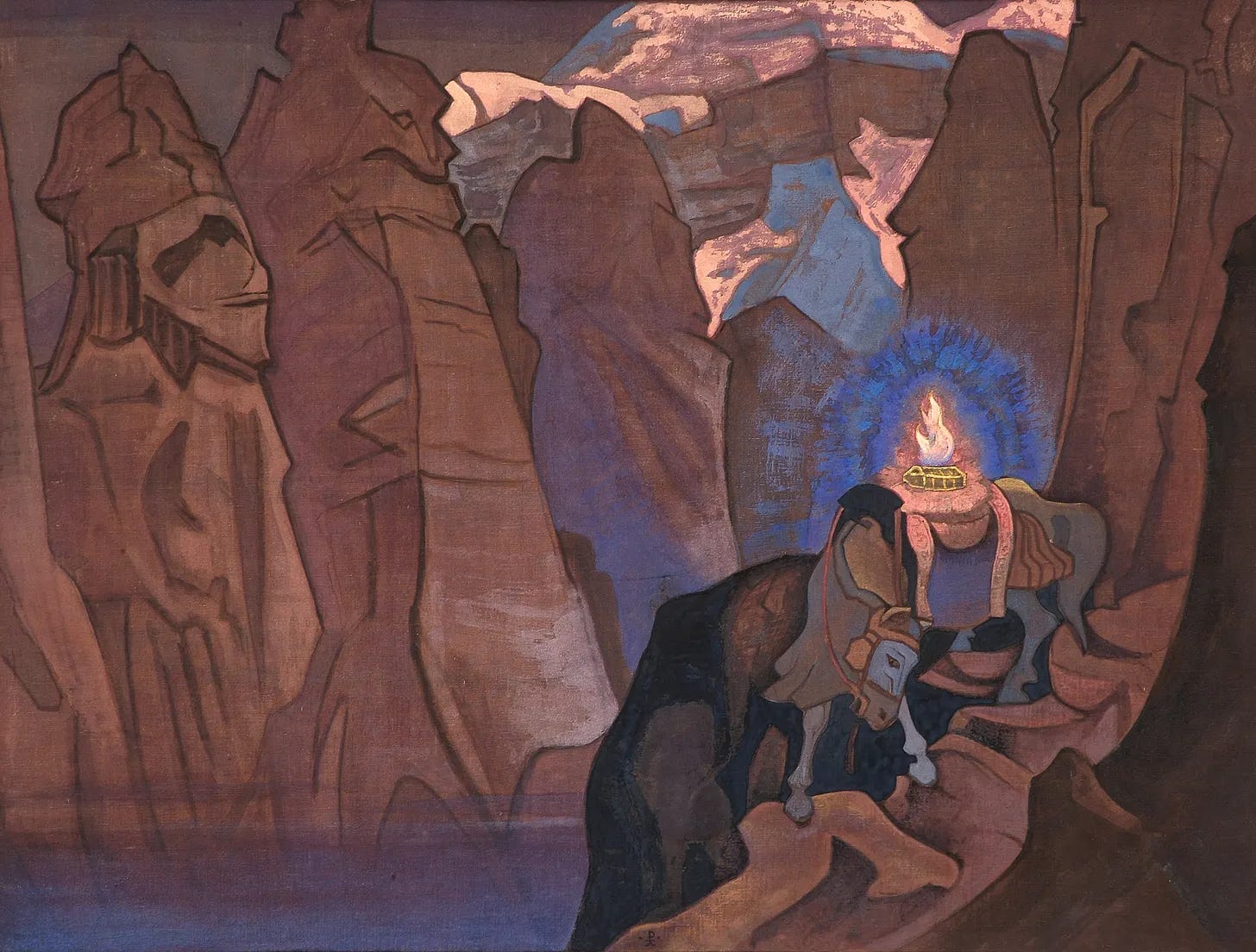
The Treasure of the World / Chintamani (1924) shows a chest being carried through a nocturnal landscape of cosmic gravity. The Chintamani is, in the Hindu and Buddhist traditions, the wish-fulfilling jewel — not in the ordinary magical sense, but as a symbol of the knowledge that fulfils. Roerich connects it to the legend of Shambhala: that supreme knowledge which circulates through time, invisible, carried from one era to another by hands that history will never name.

The Himalayas: another way of seeing
What happens in Roerich’s Himalayan paintings, and particularly in the works of the final period, between 1936 and 1947, has no equivalent in Western painting. One does not find it in the Orientalism of the nineteenth century, which regarded Asia as an object of exoticism, nor in Romantic landscape painting, which sought in mountains the thrill of the sublime. What Roerich makes of the Himalayas is something else, and one must look at the canvases for a long time before understanding in what respect.
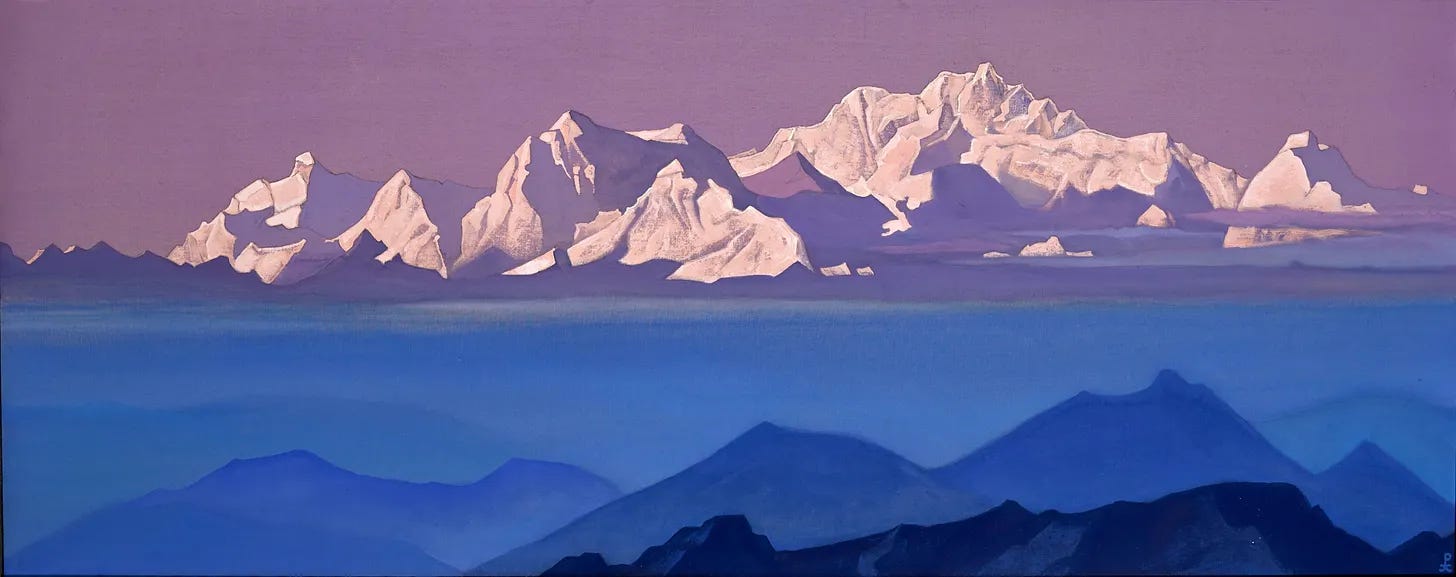
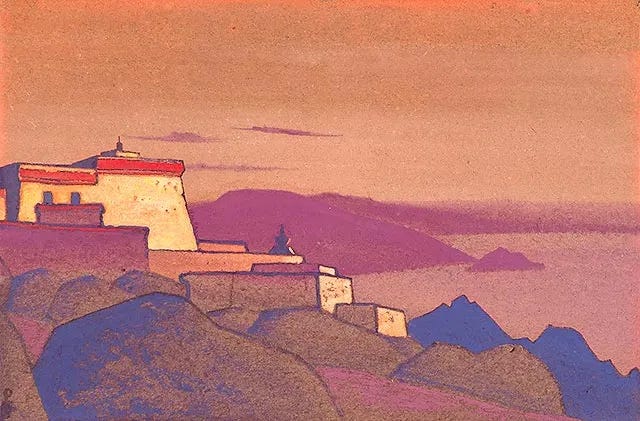
Kanchenjunga, the world’s third highest peak, visible from Darjeeling and from the valley of Kullu, returns in his work as a character. Roerich painted it in dozens of versions over several decades. The mountain does not pose. It is. In the canvases of the late period, the geological forms are simplified to the essential: no more realistic irregularities, no more anecdotal details. What remains is pure presence — as in that representation illustrating the whole chain of Kanchenjunga. The five sacred peaks of the famous mountain float above blue clouds; their snow-covered summits stand out against a spectacular background of magenta. Roerich’s sky is not above the mountains — it is in the mountains, as though the rock itself were made of condensed light.
In the great Himalayan series of the 1940s, painted from his studio in Naggar, perspective has disappeared in the classical sense of the term. There is no longer an external observer looking at a landscape from a fixed vantage point. The canvas absorbs the gaze into what it represents. That cobalt blue covering the shadows of the snowfields: it is not the colour of cold. It is the colour of a bottomless depth. That pink which ignites the ridges at sunset: it is not exactly in nature, and yet it is not invented either. It inhabits the space between perception and what perception intimates.
Roerich had noted in his notebooks that the mountains had led him towards pure colour — not colour that imitates nature, but colour that communicates directly with something in the one who looks. This intuition brought him close, without his having sought it, to a question that his contemporaries were formulating differently. Kandinsky, from Munich, was working on the dissolution of form in order to liberate colour. Roerich, for his part, retained form — the mountain, the pass, the solitary horseman — as though form were the condition for colour still having something to transmit. The mountain as support. The support as threshold.
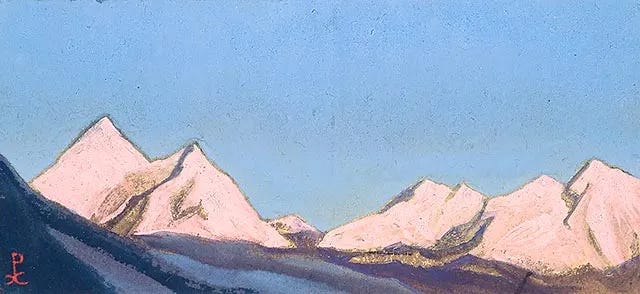
The final Himalayan canvases, those of the years 1943–1947, painted while the Second World War was devastating the world that Roerich had spent decades trying to protect, achieve an austerity that even his closest admirers struggled to describe without resorting to extra-painterly categories. The palette narrows further: snow white, near-black blue, the pink of dawn, the gold of raking sunlight. The forms become geometric, almost architectural. The peaks are no longer wild; they are composed, like mandalas risen from the rock. One has the feeling of standing before works painted not from the outside of things, but from within.

Helena and Agni Yoga: a philosophy of the inner fire
If Roerich is the painter of this vision, it is Helena who is its philosopher, and the word must be heard in its full force. Helena Roerich is not the wife who accompanies and supports. She is the intellectual without whom the thought of the couple would have neither its depth nor its systematic form.
A musician by training, she translated into Russian Blavatsky’s The Secret Doctrine, a seven-year endeavour requiring simultaneous mastery of Sanskrit, philosophical English and a complex esoteric tradition. This translation, published in 1937, remains a reference work. She reads, she argues, she corresponds with scholars the world over. It is she who, from 1924 onwards, receives and writes the texts that will constitute Agni Yoga.
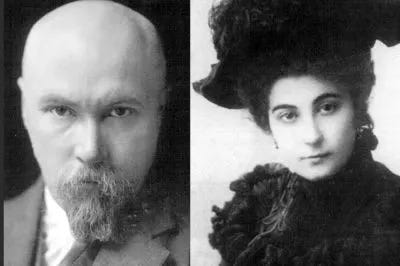
Agni Yoga — or Living Ethics, Zhivaya Etika in Russian — is a corpus of fourteen volumes published between 1924 and 1938, under evocative titles: Leaves of Morya’s Garden, Illumination, Community, Agni Yoga, Hierarchy, Heart, Fiery World. Helena affirms having received them through inner communication with a Master of Wisdom whom she calls Master Morya, in the lineage of the Theosophical tradition. This affirmation must be heard for what it is: a precise declaration about the mode of reception of these texts, which cannot be reduced either to ordinary composition or to fabrication. It may be accepted, questioned, placed in critical perspective according to each reader’s frame of reference. What withstands criticism is the philosophical coherence of the corpus itself.
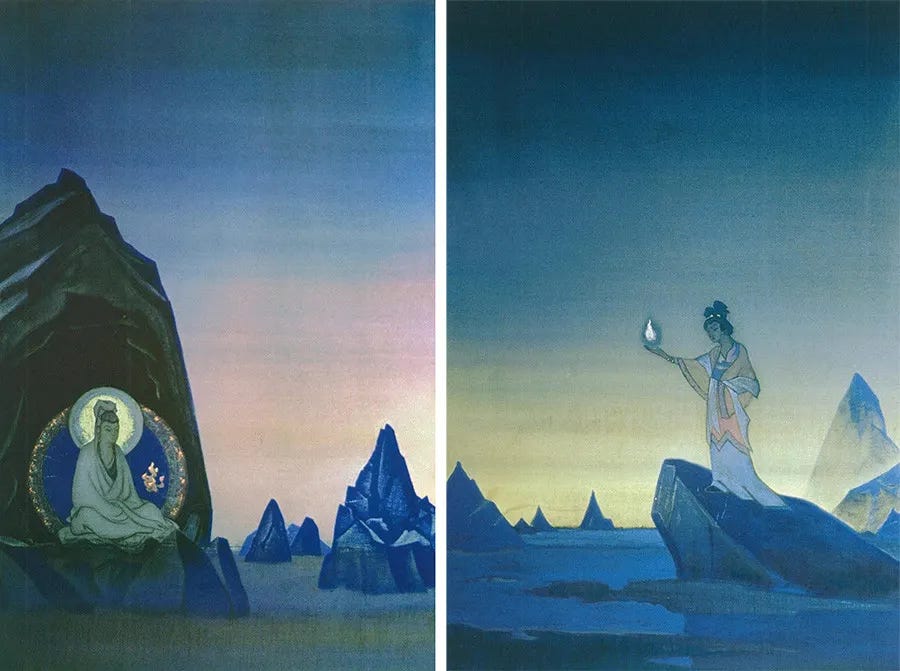
Agni means fire in Sanskrit — not physical fire, but psychic fire, that inner energy which the Indian traditions call prana, the Chinese chi, the Greeks pneuma, the Sufis baraka, the Hebrews shefa. A force that circulates, is refined, can be cultivated or neglected. Agni Yoga teaches that this energy is the central resource of human evolution, and that the responsibility of each being is to purify it through the quality of his acts, his thoughts and his creations.
What distinguishes this corpus from other contemplative systems is its radical refusal of the separation between inner life and engagement in the world. Agni Yoga asks for no retreat, no postures, no membership in a closed community. It asks for a transformation of the quality of our ordinary presence — in work, in human relations, in artistic creation. It is an ethics of daily life, not a programme for spiritual élites.
The distinction Roerich drew between culture and civilisation is the direct expression of this philosophy. Civilisation is the material organisation of collective life: its techniques, its institutions, its laws. Necessary but insufficient. Culture — and etymology authorises this, cultura deriving from cultus, meaning veneration — is the capacity of a people to honour what exceeds it: artistic creation, the transmission of living traditions, the education of the soul. Roerich expressed this in a text he held particularly close to his heart:
‘Culture is the veneration of Light. Culture is the love of man. Culture is a fragrance, the blending of life and beauty. Culture is the synthesis of sublime and subtle progress. Culture is the weapon of Light. Culture is salvation. Culture is the moving force. Culture is the heart.’
A civilisation that has lost its culture is an efficient machine without direction. It can last a long time. But it always ends by turning against those it was meant to serve.
These convictions do not remain in books. They have a geography, a chronology, a flesh: institutions founded, treaties negotiated, thousands of canvases painted before dawn. What Agni Yoga formulates in philosophical terms, the life of Roerich has translated into acts. The question that flows from this no longer belongs to him alone: it belongs to whoever encounters them.

What this life teaches
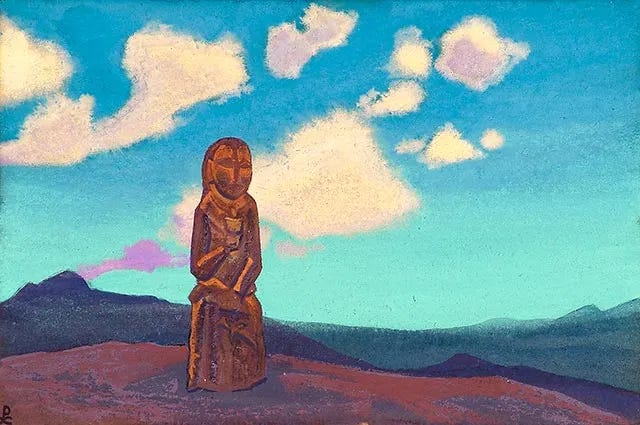
A civilisation that has lost its culture, in the spiritual sense that Roerich had given this term, is not a passing anomaly. It is a structural risk that every age carries, and the twentieth century took it upon itself to furnish the demonstration. Technical sophistication immunises against nothing. Economic power does not orient. What orients is the capacity of a society to keep alive its relationship with what exceeds it: creation, transmission, the quest for meaning. When this capacity dwindles, it is not institutions that falter first; it is something more difficult to name and longer to rebuild. Our age, saturated with means and at a loss as to its ends, has not yet finished measuring what Roerich meant by this.
From this conviction flows his relationship to Beauty, which is neither aestheticism nor consolation, but something more demanding. If culture is that which orients, then Beauty is the mode of orientation itself: not the agreeable, decorative beauty that furnishes interiors and flatters the gaze, but Beauty in the sense that Dostoevsky understood it — a force that transforms whoever exposes himself to it, that obliges him to something, that reveals to him a dimension of reality that ordinary habit conceals. Roerich spent his life seeking this type of Beauty, in the archaic forms of Slavic spirituality, in the Himalayan peaks painted before dawn, in the religious traditions of Asia. He did not seek it to enjoy it. He sought it because he was convinced that it is Beauty which decides, in the end, what humanity makes of its capacities. Dostoevsky’s formula — Beauty will save the world — he did not receive it as a fine phrase. He made of it the programme of an entire existence.
This conviction naturally led him towards a question that geographical distances and the weight of history seemed to render impossible: is there something that connects the great spiritual traditions of humanity beyond their formal diversity? Roerich answered with his life as much as with his writings. Orthodox by birth, nourished by theosophy, deeply attentive to Tibetan Buddhism and Hindu philosophy, he never claimed that these traditions said the same thing — he was not superficial enough for that. What he affirmed is that they seek in the same direction. That the paths are different, that the light is one. He expressed this conviction in a declaration of 1929 with a clarity that has not aged: ‘In our view, the opposition between East and West is a wholly outdated idea. We are loath to believe that there could exist walls capable of cutting in two what is best in humanity: the impulse of creative evolution.’ This is not a pious wish. It is the description of what he himself lived, conversation by conversation, monastery by monastery, tradition by tradition, across tens of thousands of kilometres.
From this recognition there flows a question that Living Ethics addresses to each person — not to spiritual élites, not to initiates, but to whoever has understood something of this movement: what do you do with what you have received? Transmission is not preserved passively. It demands to be carried, extended, embodied in acts. Roerich lived this demand with an intensity that excluded neither errors nor human frailties — the Manchuria affair is there to bear witness — but that never faltered. Every canvas, every treaty, every institution, every expedition was part of the same direction: that of a thread stretched across the civilisations, which he had taken it upon himself not to allow to break in his hands.
These convictions do not form a closed system. They form an orientation. And an orientation belongs to no one — it is of no century and of no school. It simply awaits those who, in their own time and in their own language, decide to commit themselves to it.

Epilogue: the thread never broken
Frances Grant, an American journalist and Roerich’s collaborator in New York, recorded what he had confided to her one day. What inhabited him, he had told her, was man as part of the whole cosmos. And what also inhabited him was the image of a thread — a thread he held at its Russian end, and which reached back, without ever breaking, to its origins in Central Asia. ‘He had the vision of this thread of humanity, always the thread, never broken.’
This thread he followed in the archaeological strata of Izvara, in the snow-buried monasteries of Tibet, in the canvases painted at sunrise in the valley of Kullu, in the treaties submitted to the governments of the world. This is not a metaphor. It is an operative conviction: that humanity is one, despite its fragmentations, its wars, its failures of understanding — one not in its forms but in its aspiration, in that movement which, across the civilisations, always seeks the same thing under different names.
The question of Shambhala, that legendary kingdom which Roerich sought with a seriousness that did not exclude lucidity, was not a geographical question. He never claimed to have found a place. He said he had approached a certainty: that the great spiritual traditions of humanity, if followed to the end of their own logic, converge towards a common hearth that each culture names differently. That wisdom belongs to no tradition, and to no century. That it is transmitted, lost, found again, and that this transmission is the true continuity of history.
What the life of Roerich shows us is the possibility of an existence sustained by a single orientation: Beauty not as ornament but as a form of knowledge, through the exiles, the revolutions, the political disappointments, the errors, the old age. This orientation promises neither success nor the comprehension of contemporaries. It promises something more sober: that acts accomplished in this spirit inscribe themselves in something more lasting than the biography of a single man.
His canvases continue to speak to those who consent to stand in silence before them. Not to seek answers in them — great works do not give them — but to remember that there exists a way of looking at the world that is not separated from the way of inhabiting it.

To explore the work of Nicholas Roerich further, see the website of the Nicholas Roerich Museum, New York: https://www.roerich.org
© 2026 - Dialogues of the New World — Jérôme Nathanaël

To go further
Do you see, in our time, a spiritual or cultural heritage that remains active, for better, for worse, or in some ambiguous fashion? Share your reading in the comments to spark discussion.
And if you wish to share more broadly your reflection on the heritages that shape us, send me a contribution of roughly one page for the Waymakers section. It will be published under your initials, a pseudonym, or anonymously, as you prefer. Other readers will be able to respond and dialogue with you.
New here? The Opening page introduces the author, the project, how to take part, contact details, and the agenda.
The most compelling tension is between Roerich’s vision and his mistakes. A path toward Shambhala can be an invitation to look more carefully, but it can also become a story we impose on a place. That distinction feels central to understanding both the paintings and the traveller.