
Article disponible en français
The Eternal Present · Spiritual awakening · 26 min
To explore the concrete paths of inner transformation.

Series: Towards spiritual sovereignty | Stage 7 — Spiritual sovereignty
Previous article: Inner stability
In this article:
The accomplished tree
The forces that shaped us
The genealogy of our being
The awakening of the inner fire
The ascent: nobility and metamorphosis
The great reversal
The open heart: love, freedom and the repair of the world
One kingdom, a thousand faces
A few makers for the path
The accomplished tree
There are moments, on a path of inner transformation, when something has grown sufficiently stable within us for the gaze to turn back and survey the distance travelled. Not out of self-indulgence or nostalgia, but in order to measure, with the lucidity of the walker who reaches the edge of a mountain pass, what each stage has deposited in him and how these successive deposits have ended by altering not only what he does, but what he is.
The seven-week journey we undertook from the beginning of April has followed the structure of a tree that unfolds slowly from its deepest underground roots to the very summit where it may at last bear its fruit. Love was first recognised as that infinite energy, the primordial sap that irrigates the universe and can flow through us if we consent to open a passage for it in the very flesh of our existence. Discipline then gave it its form, its bed and its bank, transforming a generous yet diffuse impulse into a directed force, capable of acting with precision amidst the rougher circumstances of daily life. Compassion broadened our gaze beyond our own borders, teaching us to bear the suffering of others without losing ourselves in it, in that delicate equilibrium between touching and holding. Constancy taught us that deep transformation does not arise in great surges of energy but in fidelity to small steps, that silent perseverance which makes all the difference between the one who begins and the one who sees things through to completion. Humility restored us to our rightful place in the great fabric of living things, neither crushed by our insignificance nor inflated by our sense of importance, and it was then that inner Stability could at last settle in — that living trunk around which the storms of existence may revolve without sweeping us away.
We have now arrived at the seventh stage, the one in which all these qualities converge and integrate into a reality that can no longer quite be called a quality, for it is no longer an activity or an effort, but a state of being: spiritual Sovereignty. It is not one more step to climb, it is the blossoming — the full expression of that for which the tree exists.
The influences that shaped us
When we begin to observe our own workings with sustained and unsentimental attention, we discover with growing astonishment the multitude of influences that have moulded us, and how deeply our personality has developed out of a need to adapt to the society which becomes ours by birth and whose customs and habits we must adopt in order to find our place within it. This adaptation is neither weakness nor betrayal: it is a vital necessity, the very condition of our survival and our integration into a social fabric without which no human being can develop. Yet it carries a cost we rarely measure at its true worth: the progressive smothering of what is most intimate and most precious within us.
For as observation sharpens, we become aware that our most intimate dimension, that which makes us ourselves in our irreducible uniqueness, our essence, which still expressed itself with remarkable freedom when we were children, has had to fall gradually silent to make way for what we had to do and become in order to exist in our world, to conform to the external models we followed in order to succeed within it, and to satisfy the expectations of those upon whom we depended affectively. The approving or disapproving gaze of the father, the silent fears of the mother, the merciless hierarchies of the school playground, the norms of success of a society that measures a person’s worth by productive utility: so many conjugated forces that have sculpted our personality from a material not necessarily our own.
Or, conversely, we have rebelled against these models and injunctions, imagining that through such rebellion we were asserting our singularity; yet ultimately, this opposition itself is merely another form of dependence upon the world against which one erects oneself, a refusal that still defines itself in relation to what it refuses, rather than from what it truly is. In either case, submission or rebellion, something in our development seems not to belong to us, not to depend on who we genuinely are in our original depth.
We thus observe, sometimes with a sadness we dare not quite name, that our deeper self lies as if asleep, covered over by strata of habits, postures and automatic reactions that constitute a carefully maintained façade which expresses our true essence hardly at all. We are not sovereign in our own kingdom, for ruling over it is an entire assembly of unchosen inheritances, unexamined fears and borrowed desires, which stands in the place of what we might have been had we succeeded in unfolding freely from our centre.
This very observation, set down with lucidity and without self-indulgence, is already the first act of our recovered freedom. For it is in becoming thus conscious of the genealogy of our being under the sway of family inheritance, the codes of the age and of human history, which have determined the formation of that rigid personality that imprisons rather than serves us, that we enter into a slow process of inner awakening and profound transformation, one that will allow us, through discipline, humility and constancy, to attain that inner stability conducive to reducing our inner disorder and gradually reconstructing a harmonious working of our faculties and our gifts. By thus activating our most sublime capacities of presence, love and wisdom, which restore our connection with every aspect of the universe, we recover true sovereignty over our inner kingdom and accomplish at last our genuine spiritual nature.
The genealogy of our being
To recover our sovereignty, that is to say, to be truly ourselves, with all our dimensions in accord with our most just intuitions when we inhabit that inner place of absolute sincerity with oneself, that place no longer troubled by the need to appear and the fear of judgement, we must become conscious of the genealogy of our being and voluntarily resume its development. It is not a matter of erasing what we have become, still less of rejecting our history wholesale, but of performing a kind of living discernment: recognising what, within us, proceeds from our essence and may therefore unfold freely, and what proceeds from an adaptation, sometimes too costly, to demands that were not our own.
This work of inner genealogy is precisely what we have undertaken since the beginning of this journey. It is a matter of re-creating oneself from the stable and conscious place of presence to oneself, from which we may begin to act more freely, to make choices that truly emanate from our deepest being, and to win back, step by step, the reconquest of ourselves. Not through a heroic and solitary act, but through this patient and daily work of observation and discernment, which progressively shifts the centre of gravity of our existence: from the agitated periphery of the ego towards the silent nucleus of our essence.
In thus progressing in self-knowledge through the practice of attentive observation, we cast an ever brighter light upon the impostures of the ego and its pretensions to usurp our real identity. Other forces rise within us, reinforcing our will to express our intimate being and to restore the ego to its true role: no longer the tyrant who unduly occupies the throne, but the competent servant of a nobler cause. For the ego is not the enemy to be destroyed; it is the instrument we must restore to its proper place, within the inner hierarchy of a being who has rediscovered its centre.
The awakening of the inner fire
This journey towards the encounter with oneself, which we undertook when, through a kind of personal revelation or in the course of an existential shock, we glimpsed the possibility of a more authentic and more expansive life, is none other than the path that will lead us to accomplish our spiritual vocation by incarnating our human nobility. So long as our life remains entirely subject to the demands of our ego, which developed in adaptation to the world and to ensure our survival, our energies and resources feed its quasi-automatic and unconscious functioning, and we identify in turn with each of the characters composing it according to the role we happen to be playing at any given moment: the ambitious one, the wounded one, the seducer, the judge, the fearful one, the one who feigns generosity.
We only access our most intimate being, our living essence, the repository of the unique gifts that characterise us, in those rare moments when we are suddenly confronted with the unexpected and deprived of immediate recourse to our habits and our protections. This is why life’s accidents — bereavements, separations, illnesses, the collapse of certainties — are so frequently the occasions that bring us back to ourselves by destabilising the precarious balance of our inner scaffoldings. They are not punishments or misfortunes, but sometimes brutal invitations to inhabit at last what we are, beyond what we pretend to be.
But in responding to the desire for being that has moved through us and impelled us towards change, we have begun to develop a presence to ourselves that reactivates this essence and draws it from the sleep in which it was enclosed, without waiting for the next shock to reconnect with it. It is in continuing to allow ourselves to be traversed by those spiritual intuitions that open us to a near-cosmic consciousness of that universal life of which we are the advancing point upon earth, and in pursuing our work upon ourselves to refine ourselves and grow more sensitive to it, that we recover our spiritual sovereignty little by little.
The celebrated formula from the Rig-Veda that I am fond of citing then begins to take on meaning in this progressive experience of awakening to another perception of ourselves and the world: “O Fire, thou art the son of Heaven through the body of the Earth.” In perceiving, beyond the mechanisms of the multiple personality acquired through mimicry, that there subsists within us something like the embers of an intimate fire, that free essence which founds our uniqueness, our desire to become truly ourselves is kindled; and we now understand more clearly that this inner wealth must, in order to grow, be exercised in the reality of our earthly condition whilst guiding itself upon the celestial horizon that allows us to orient ourselves in our quest. Son of Heaven through the body of the Earth: the spiritually awakened human being is precisely that, that living junction between matter and the infinite, that place where the eternal is incarnated in the temporal to give it its meaning.
The ascent: nobility and metamorphosis
The further we advance with vigilance and exacting attention in our inner transformation, connecting ever more deeply to our essential being, gradually loosening our grip on the demands of the greedy ego and patiently reorganising our inner theatre around our will towards progress, the more our spiritual intelligence awakens. Intuitions multiply, helping us to broaden our gaze and gain perspective over the constraints of daily life. It also becomes easier to improve the quality of our self-observation and to sustain for longer a true presence to ourselves and to the world, without being constantly swept away by the least external solicitation or the slightest fluctuation in our psychological state.
The inner space of stability expands within us, and it becomes possible to gain some distance from our emotions so as to master them when they might formerly have tended to run away with us, like a skilled coachman who knows how to rein in his horses when the road becomes dangerous. In refining our sensitivity and our reflection, we perceive ever more clearly how crude language is in relation to the subtlety of life, and how often words fall short in rendering a feeling or an intuition that touches something essential within us. We discover thus to what extent certain of our opinions, which seemed so definitive and so well-founded, sometimes lose their importance, for we are now capable of approaching any question from multiple angles, without immediately identifying with our inner chatter and our habitual certainties.
This nobility of the human condition, lived by the one who climbs the mountain step by step, is accompanied in this ascent by the transformation of the heart, which opens itself to the fullness of love. For the spiritual essence knows the ultimate goal not through intellectual knowledge, but through living knowledge: in the slow ascent, it is as if drawn towards those lofty summits that bring it closer to its celestial origin, to that kinship with the infinite where love has no more barriers or prisons, but expresses itself freely in the circulation of energies and the permanent transformation of all that is living.
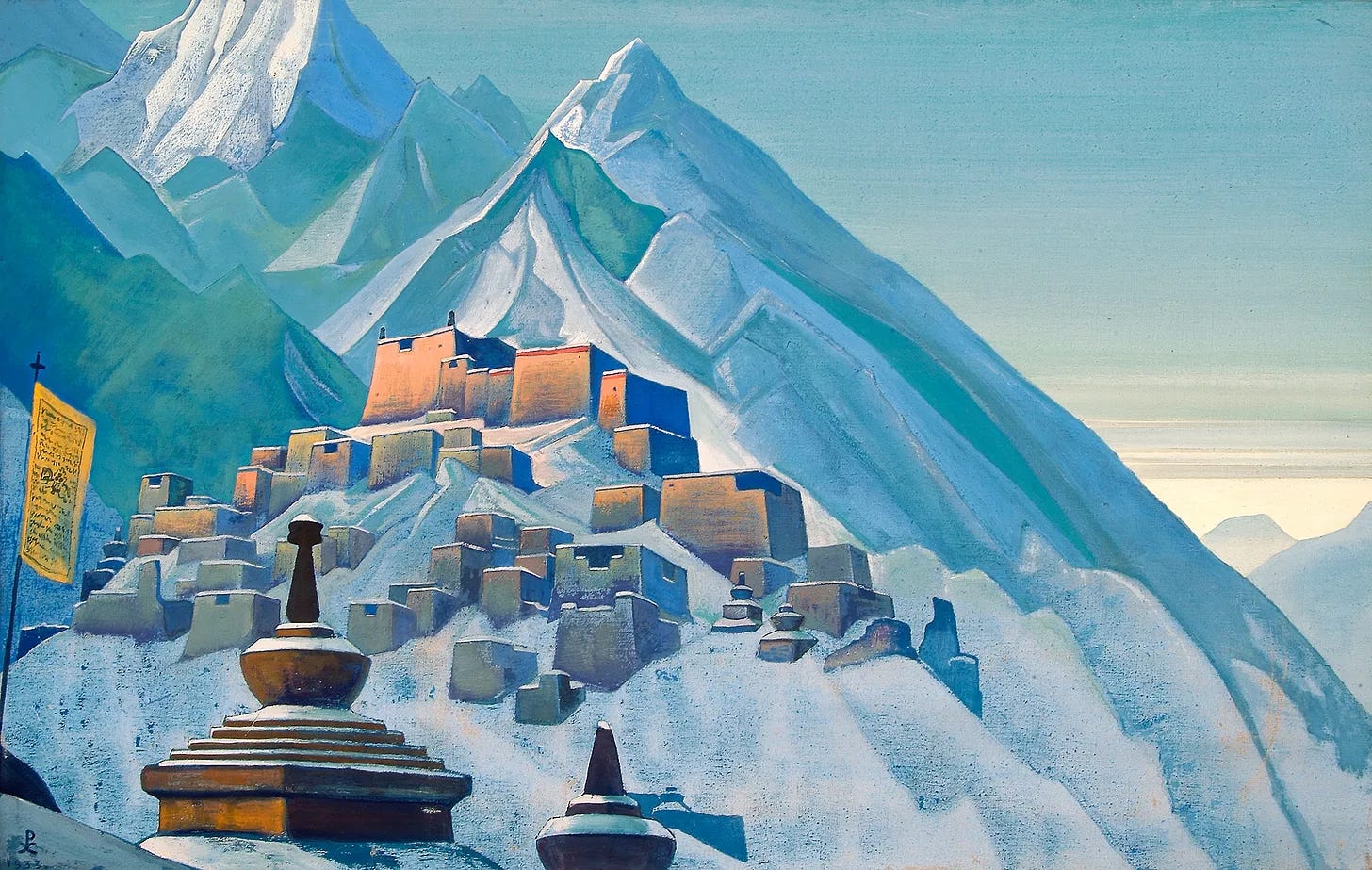
One must nevertheless harbour no illusion about the nature of this ascent: it is not a straight line upward, and metamorphosis is almost never as sudden as the passage from one dwelling to another. It occurs progressively and in stages, with periods of mutation in which the person undergoes inner changes that may sometimes take the form of difficult crises, moments of disorientation, deep doubt, apparent regression, or demanding renunciations that sometimes feel like losses before revealing themselves as liberations. This path demands vigilance to avoid the tenacious snares of illusion and self-deception, and a constant effort to develop our quality of presence, to observe ourselves attentively and to call ourselves into question with an unfailing regularity. But if our desire for being is powerful and nourishes the constancy and courage of our step, then we shall advance little by little up the sometimes steep slopes of the mountain, and the higher we rise, the more we shall activate our potentials and discover the freedom and nobility of our human condition.
The great reversal
When we awaken our most intimate being, that spiritual essence which is the free and unique occurrence of living forces, qualities of consciousness, love and creativity, to place it at the centre of our existence and make it the true master of our ego and of the multiple aspects of our personality, something fundamental shifts in our relationship to ourselves and to the world. Little by little, we succeed in unifying and ordering the characters that compose our inner theatre, in making them work together rather than allowing them to compete for the stage according to circumstances, and we then re-integrate our true human vocation, recovering the dignity linked to our spiritual sovereignty.
Dethroning the ego: the phrase may perhaps sound violent, and it is therefore worth spelling out carefully what it actually means, for one of the most common errors of the spiritual life is to believe that awakening consists in annihilating the ego, in crushing it or in being ashamed of it. That is not the case. The ego is a sophisticated instrument, indispensable to life in the world; it enables us to name, to act, to decide, to protect ourselves. What we seek is not its destruction but that it should serve the essence rather than supplant it, that it should be the skilled arm of a deeper intelligence rather than the blind master of an existence reduced to its own fears and its own appetites.
Step by step, small progress by small progress, we begin to succeed in acting concretely in our existence whilst remaining centred in that still and tranquil place of our deep being. It is a total transformation of existence: from the state of thinking animality living in fear of want and death, contracted in the avidness of an ego that has built itself through mimicry as a citadel of protection against the risks inherent in societies of falsehood, violence and injustice, we accede to the open and luminous consciousness of a being incarnated in the materiality of the terrestrial world, whose spiritual part borders upon the eternity of the living and who perceives itself as bound to and participant in every aspect of reality: the natural world, our human brethren, and more broadly the invisible world and the totality of the universe. A new life becomes possible, in which our most sublime potentials begin to reveal themselves and to unfold within our daily presence.
The open heart: love, freedom and the repair of the world
Every fragment of the living, every thing that appears infinitesimal, is rich with the totality in which it participates, and it is this state of consciousness, on a human scale, that expresses and diffuses itself in the being when its spiritual essence becomes awakened and active within it. It re-integrates itself into the unified and conscious continuum of the living, and in this subtle communication, Love circulates once again. For it is indeed Love, that very substance of the living, which, when it no longer encounters the obstacles of an avid ego held in check by the awakening of the spiritual essence, may permeate the entire being and open its heart, free then to overflow with love for the world.
This is a profound synergy: the effort to transform oneself and awaken one’s spiritual dimension, in liberating and developing our essence, gradually clears the channels of communication through which the abundance of life may pour into our being. Then, in the receptacle of the heart, it is transmuted into spiritual love, that is to say, into an inner disposition to bond with all and to share with them that abundance of which we are the heirs. This does not make of the person a naïve dreamer detached from the realities of the world, but it replaces the closure of the ego and its latent violence with the lucid possibility of actively participating in the repair of the world and transforming it into creative human brotherhoods, what the Hebrew sages call tikkun olam, the repair of the world, which constitutes perhaps the most beautiful definition of that to which we are called in our collective dimension.
In progressively reorienting our existence towards the development of our most sublime potentials, we begin to recover our spiritual dignity and to become bearers of light and hope for the world. Not through pride or proselytism, for authentic spiritual sovereignty has no need to be proclaimed, but because something is modified in our manner of being present, of looking, of listening, of responding. A face that has found its inner axis radiates without effort, and this is perhaps the most discreet and most reliable sign that sovereignty has truly settled: not in grand declarations, but in the quality of a presence that quietly, steadily, gives the other the desire to be himself.
One kingdom, a thousand faces
Within the constellation of humanity’s spiritual traditions, this sovereignty of the accomplished being, this state in which the inner essence reigns freely over the whole of the personality and diffuses its light in the world, has received different names and faces according to languages and cultures, but its deep reality is everywhere the same: the being who has governed himself may at last govern his life with nobility.
In Stoic philosophy, this conviction attains a formulation of striking clarity: only the sage is truly king, for only he possesses mastery over himself. Epictetus, Cicero and Marcus Aurelius each developed the idea that true royalty is not that which titles and thrones bestow, but that which a man conquers over his own passions and his own fears. “What is slavery? The bondage of one’s desires,” says Epictetus. The free man, the inner king, is precisely the one who is no longer the plaything of his impulses but their conscious master.
In Hebrew Kabbalah, this reality receives the name of Malkhut, the Kingdom, the seventh and final emotional sefira of the Tree of Life, the one which concludes the journey of the Sefirat HaOmer that we have traversed in parallel with this series. Malkhut is not an additional quality: it is the receptacle and the actualisation of all the preceding ones. It has nothing of its own, the sages say, except what it receives from the six sefirot that precede it, and it is precisely in this that it is the highest, for it is the integral incarnation, the point at which all spiritual qualities manifest in the concrete reality of life. Malkhut is the world, and the being who has accomplished it within himself becomes, as the tradition says, an Adam Kadmon, a primordial man, a being on the scale of the whole of humanity.
In the Christian tradition, spiritual sovereignty finds one of its most intense expressions in the notion of accomplished divine filiation: to be a “son of God” not by the letter but by the Spirit, to carry within oneself the Kingdom, the basileia, not as an external territory but as a transformed inner state. The apostle Paul speaks of the pneumatikos, the spiritual man, who “judges all things” and is himself judged by no one, not through arrogance, but because he acts from a level of consciousness that surpasses ordinary oppositions. Meister Eckhart, several centuries later, would say that the soul which has accomplished its union with God becomes “queen in its own kingdom.”
Sufism names this state Insan al-Kamil, the Perfect or Accomplished Human Being, the one who, having traversed all the stages of the spiritual itinerary, has become the polished mirror in which divine light is integrally reflected. Ibn Arabi, who developed this concept with the greatest depth in his writings, specifies that this perfection is not a moral superiority in the ordinary sense, but a transparency: the Perfect Human no longer interposes himself between the light and the world; he allows it to pass through him. He is khalifa, the conscious vicegerent of the divine, not through a hierarchical function but through the quality of his presence.
Hinduism designates this realisation under the name of Jivanmukta, the “living liberated one,” the being who, whilst remaining in a body and in the ordinary world, has transcended the conditionings of the ego and realised the identity of his Atman, his essence, with the universal Brahman. This is not a retreat from the world but a presence to the world of a radically different quality: the Jivanmukta acts, speaks and lives, but from a centre that no longer wavers, for he has recognised within himself that which is beyond all birth and all death. The Bhagavad-Gita says of him that he is troubled neither by misfortune nor moved by the desire for happiness; free of attachments, fear and anger, he is called a sage of steady vision, sthitaprajna.
Buddhism approaches this sovereignty through the notion of Tathagatagarbha, literally “the womb of the Thus-Come,” the Buddha-nature present in seed form within every living being. To awaken this nature is to recognise and actualise a primordial dignity that has never been absent but only veiled by the obscurations of the ego. The Dhammapada, that anthology of verses attributed to the Buddha himself, cornerstone of the whole of Buddhist literature, opens with this conviction: “The mind is the forerunner of all actions. The mind is their master; the mind is their maker.” To govern one’s mind is to govern one’s life. The Buddha himself is sometimes named Dharmaraja, the King of the Dharma, not because he exercises power over human beings, but because he reigns fully over his own awakened nature.
Confucianism has elaborated over centuries the ideal of the Junzi, sometimes translated as “the noble man,” “the man of quality,” or “the gentleman” in a profound sense far exceeding any social connotation. For Confucius, the Junzi is the one whose inner rectitude radiates naturally upon the city and upon human relations. He does not govern through constraint but through example and virtue: “If you govern through virtue, you will be like the North Star which remains in its place while all the other stars turn towards it.” His sovereignty is a radiance, not a power.
In Taoism, this reality takes the form of the Zhenren, the true man or the authentic man, a figure celebrated notably by Zhuangzi. The Zhenren reigns without reigning; his authority is that of the empty hub of the wheel, immobile and stable, around which everything turns without sweeping it away. Far from imposing himself upon the world, he accords himself with it through wu wei, action without effort, the doing that follows the natural grain of things. His sovereignty is not a conquest but a return to the original nature, like water finding its true level after all agitations have passed.
All these traditions converge towards one and the same deep conviction: spiritual sovereignty is not a privilege reserved for a few elect souls, but the accomplishment of what every human being carries within as his highest possibility. It is neither granted nor imposed; it is earned through the patience of the journey and recognised in the quality of a presence that has ceased to be at war with itself.
A few makers for the path
These reflections on spiritual sovereignty are not intended to transform us into solemn and imperturbable personages, elevated to the heights of some inaccessible wisdom. Their purpose is to help us recognise and cultivate that inner sovereignty from which life may be fully inhabited, from which we may at last act from what we truly are rather than from what our fears and conditionings make of us. If Love from the first stage was the sap, Discipline the form, Compassion the fruit, Constancy the root, Humility the soil and Stability the trunk, then spiritual Sovereignty is the crown: not an ornament, but the full expression of that for which the tree has existed.
Take a moment of calm and interiority. Allow each of these questions to descend within you without seeking an immediate response. What surfaces with a slight resistance is often what most deserves to be looked at.
1. A few questions to let resonate
On the reality of my inner sovereignty
Is there within me a deep being, an inner instance that I recognise as truly myself, distinct from my moods, my roles and my habitual characters? When I stop and fall silent, do I touch something stable and living, or do I hear only the noise of my preoccupations and my passing identifications? Is my life genuinely governed from this centre, or am I the plaything of circumstances that I undergo rather than orient?
On the manner in which I exercise my authority
How do I exercise my authority, in my family, in my work, in my relationships? Do I lead with benevolence and warmth, or do I impose without always measuring the cost to the other? Do I recognise the limits of my competence and my authority, or do I take firm positions where I have neither the legitimacy nor sufficient vision? Before pronouncing on a matter that concerns others, do I take the time to verify whether I truly have the right and the capacity to exercise that particular authority?
On my capacity to endure in my convictions
Am I able to defend what I truly believe, or do I yield easily to group pressure, to the fear of conflict, to the desire to be approved? Does my sovereignty withstand the test of time and periods of doubt, or does it vanish at the first difficulty? Does my lack of endurance conceal an older wound of self-trust that I have not yet faced honestly?
On the humility of my sovereignty
Does my sovereignty, this consciousness of my own worth and dignity, open me or close me? Does it make me more attentive to others, or more centred upon myself? Is my dignity a sincere rootedness or a façade that protects deep insecurities I dare not acknowledge? Do I feel gratitude for the gifts that life has accorded me, or do I take them so much for granted that I no longer see them?
On my relationship to connection and openness
Does my sovereignty allow me to bind myself truly to others, to let myself be touched, to let myself be enriched by their difference, or does it become a fortress that isolates me under the guise of independence? Do I perceive, in the beings I encounter, their own inner royalty, that fundamental dignity which belongs to every human being whatever his apparent condition?
2. A few gestures for the week
Exercising one’s sovereignty through benevolence
This week, identify a person who depends upon you, or who is close to you within your circle of responsibilities: a child, a colleague, a friend in difficulty. Do something for him or her that is concrete, generous and unexpected, not out of obligation, not in order to be recognised, but because true sovereignty expresses itself first in kindness towards those who place their trust in you.
Checking one’s legitimacy before speaking
Before taking an authoritative position on a question, in a conversation, a meeting or a relationship, pause for a moment and ask yourself inwardly this double question: do I truly have sufficient knowledge to pronounce on this? Do I have, in this situation, the legitimacy to exercise this influence? If the answer to either question is no, consciously choose to listen rather than to assert.
Polishing a domain of one’s inner governance
Identify a domain of your life, a relationship, a habit, a daily organisation, where your manner of acting is still too reactive, too disorderly or too little in harmony with what you know to be right. Without judging yourself, examine it attentively and seek a concrete adjustment, even a modest one, that renders your action in this domain more coherent with your deepest values.
Acting upon a deferred conviction
Is there something you believe in deeply, a course of action to undertake, a word to be said, a commitment to be made concrete, that you have been putting off for too long, through excessive prudence, through fear of others’ judgement, or through doubt of yourself? Choose this week to take a step in that direction. Not everything, a single step. The first is always the most difficult, but it contains within it the essence of the decision.
Giving thanks for one’s own dignity
Take a moment of silence, each morning if possible, to recognise with gratitude that you have been created with a dignity and with singular gifts that belong to you alone. Not in the pride of one who believes himself superior, but in the humility of one who receives and wishes to be worthy of what he has received. This simple recognition, daily renewed, is one of the most nourishing practices there is for consolidating our inner sovereignty.
3. Celebrating this stage, and the path travelled
At the conclusion of this seventh stage and of the entire journey, a closing gesture is called for that is worthy of the path accomplished. Take a real span of time, an evening, a morning, a space you offer yourself deliberately, to pass in thought through the seven stages you have traversed since the beginning of spring.
Return to what you were or thought during the first week, when you asked yourself whether you were truly dwelling in the abundance of love. Measure, without complacency but also without severity, what has shifted within you. Identify a concrete transformation, even a modest one: a bond strengthened, a reaction mastered where you would formerly have let yourself be carried away, a conviction affirmed that you would have silenced, a care given to someone from genuine kindness rather than from obligation. Note it in a notebook, or say it aloud, for what we name and celebrate with just attention, we invite to continue growing.
Then become aware of this: this journey ends, but the path itself does not end. Spiritual sovereignty is not a destination one reaches once and for all, as one plants one’s flag at the summit of a mountain. It is a direction of life, a permanent orientation of gaze and desire, a quality of presence to be cultivated each day in the thousand ordinary occasions that life offers us. The tree, when it has borne its fruit, does not cease to live: it begins again, season after season, to draw from its roots and to reach towards the light.
Good journeying to all.
Jérôme Nathanaël
Some journeys require a more recollected space than public commentary in order to be truly heard. If something in this journey has resonated within you and deserves to be deepened, or if you are passing through a period of transformation and are seeking support, do not hesitate to contact me by email or to book a video exchange. This is not a consultation; it is an outstretched hand, freely and without charge. I shall be glad to meet you.
© 2026 - Dialogues of the New World — Jérôme Nathanaël

To go further
Have you encountered a practice, a discipline, an exercise, or an obstacle that has truly transformed you? Share your testimony in the comments — it will enrich every reader.
And if you wish to express yourself on a subject of spiritual awakening, send me a contribution of roughly one page for the Waymakers section. It will be published under your initials, a pseudonym, or anonymously, as you prefer. Other readers will be able to respond and dialogue with you.
New here? The Opening page introduces the author, the project, how to take part, contact details, and the agenda.