
Article disponible en français
The Eternal Present · Spiritual awakening · 6 min
To explore the concrete paths of inner transformation.

Series: Toward spiritual sovereingty | Introduction
A demanding and luminous crossing toward authentic renewal
Spring offers us the chance to deeply experience the universal archetype of renewal. The Passover celebrations honor spiritual freedom and the victory of Life over the forces of death and confinement. In resonance with this twofold invitation, I propose a seven-week or seven-step journey dedicated to our inner and spiritual flourishing.
Together, we will chart the course of a demanding and luminous crossing, one that moves through progressive awakenings and patient work transforming our emotional life and our behaviors, toward an inner liberation sufficiently embodied to allow us to become truly ourselves in the truth of everyday life. This journey unfolds in seven stages, each to be claimed in one’s own way and at one’s own pace: yet we will have here a clear and concrete direction that allows us to move gradually from an intention of realization to its living enactment, not as an abstract promise, but as a transformation verified in the very flesh of existence.
This path begins first with a shift in perspective: learning to view the world and ourselves through the eyes of the soul, open enough to perceive the abundance of love-forces that nourish the universe and to become their conscious channel. We will then discover how a demanding yet benevolent inner discipline can transform this momentum into active compassion, calibrated to the constraints and harshness of ordinary existence. Then come patient constancy, lucid humility, and living gratitude, qualities less dazzling than love, yet equally decisive in the work of transformation, for they are what allows a sufficiently solid inner stability to take root within us , solid enough for that spiritual sovereignty to be built upon it, sovereignty that each of us senses as our highest calling, and that we will together dare to claim and embody.
The Exodus, the archetype of all liberation
This invitation to renewal takes on particular resonance when we recall that the festival of Pessa’h, which falls at the threshold of spring — the Hebrew Passover, of which the Christian Passover is the spiritual daughter — is not merely the memory of a political liberation. The Hebrew name for Egypt, Mitsraïm, derives from the root metsar, the narrow throat, the mountain pass, the stranglehold, and its dual suffix -ayim opens, in the spiritual and symbolic reading of this name, onto two simultaneous constrictings: the social and political enslavement that crushes bodies and strips beings of all dignity, and the spiritual stranglehold that imprisons consciousness within the limits of an identity reduced to survival, severed from its own depth. Yetsiat Mitsraïm, the Exodus from Egypt as told in the biblical text, is thus far more than a historical event: it can be read as the universal archetype of the twofold liberation that every human being is called to accomplish, first by defying the social conditions that crush them, then by breaking the inner chains that keep them enslaved to their fears, their automatisms, and their illusions about themselves.
For escaping one's inner Egypt, even through a decisive and courageous effort, is never more than the beginning of the journey. The newly liberated slave who desires to reclaim his deeper life soon finds himself crossing a vast and disorienting desert. And he is sometimes tempted to turn back toward the deceptive comfort of his illusions and his former confinements: at least he knew them, at least they belonged to him. Yet it is precisely in this desert, in this destabilizing void left behind by all true liberation, that the most decisive work begins: the work of patient interiority, of transformation quality by quality, until the day when, the traveler having reached the summit of his own secret mountain, Life speaks once again with clarity and directness.
In Jerusalem as in Benares : the degrees of an inner temple
The Hebrew tradition has established a forty-nine-day count, the Sefirat HaOmer, beginning the day after Pessa’h and lasting for seven weeks, leading up to Shavuot, the festival commemorating the Giving of the Torah at Mount Sinai. This counting is not a mere liturgical calendar: it is a symbolic illustration of that discipline of inner transformation which allows one to traverse the desert and reach its heights. It is organized around the seven great qualities of the soul, the midot, which Kabbalistic wisdom names the emotional sefirot, seven structuring forces of the human psyche: generous love (Chesed), creative rigor (Gevurah), harmonious compassion (Tiferet), victorious perseverance (Netzach), humility and gratitude (Hod), foundational stability (Yesod), and embodied sovereignty (Malkhut). Each week of the journey proposed here intuitively follows this movement, not as a pedagogical device, but because these seven dimensions are, at their core, the natural stages of any authentic inner transformation, in Jerusalem as in Benares, in Baghdad as in Kyoto.
It is indeed remarkable that most of the world’s great wisdom traditions have organized their path of spiritual transformation around comparable sequences, as if the human soul universally recognized this inner rhythm. Sufism unfolds the maqâmât, the stations of the heart on the road toward G-d; Tibetan Buddhism traces the path of the pāramitās, the perfections to be cultivated until awakening; the Vedanta tradition articulates its yamas and niyamas in a similar progression; and Christian mysticism, from the Desert Fathers to John of the Cross, has described the stages of the soul’s ascent toward divine union in closely parallel terms. All bear witness that inner freedom is not obtained all at once, but is conquered patiently, quality by quality, as one would climb the steps of an inner temple, each step revealing a wider horizon.
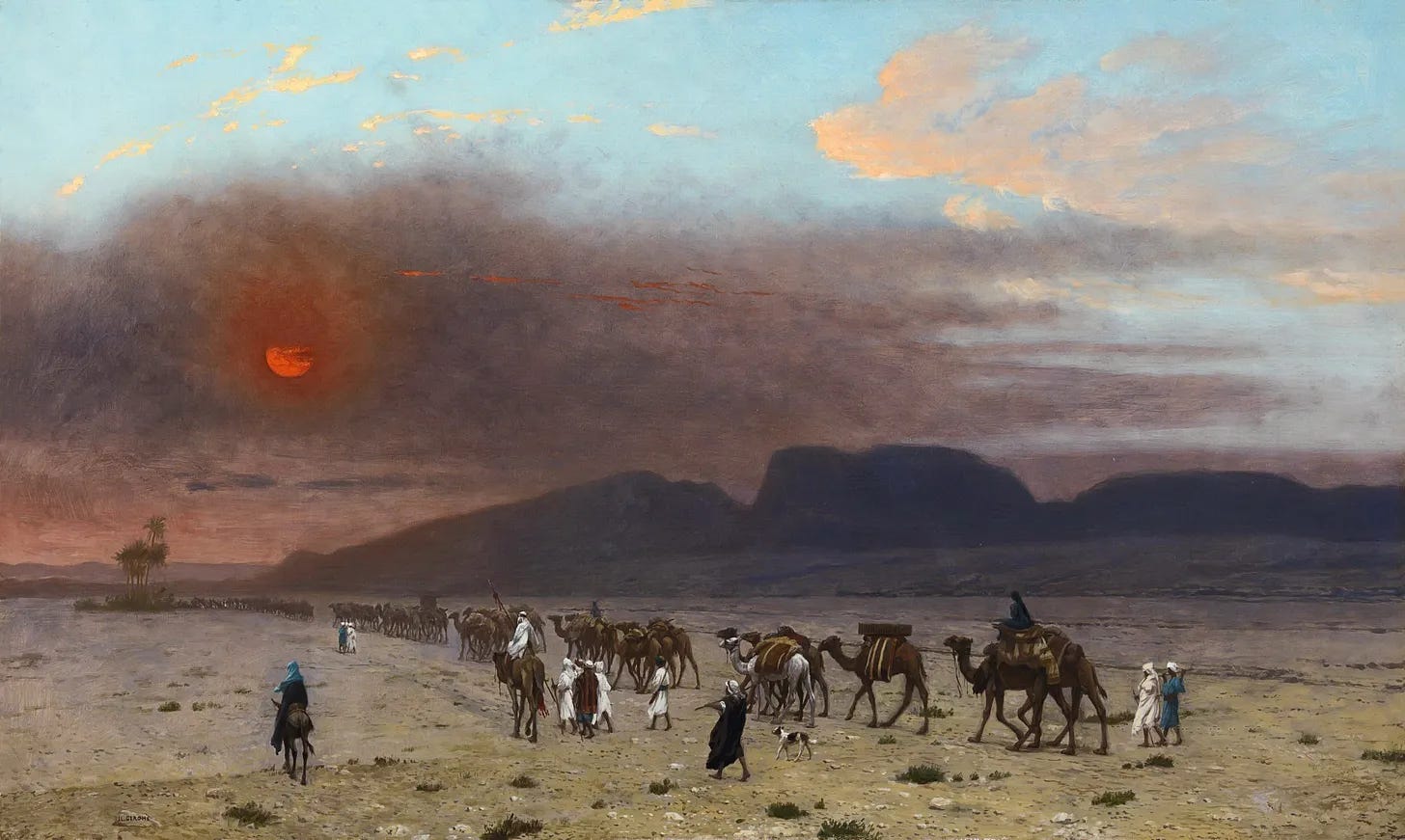
The caravan may now set out toward the first oasis !
© 2026 - Dialogues of the New World — Jérôme Nathanaël
Next article: Stage 1 - The abundance of Love

To go further
Have you encountered a practice, a discipline, an exercise, or an obstacle that has truly transformed you? Share your testimony in the comments — it will enrich every reader.
And if you wish to express yourself on a subject of spiritual awakening, send me a contribution of roughly one page for the Waymakers section. It will be published under your initials, a pseudonym, or anonymously, as you prefer. Other readers will be able to respond and dialogue with you.
New here? The Opening page introduces the author, the project, how to take part, contact details, and the agenda.