

Article disponible en français
The World We Cross · Two quills · 14 min
Dialogues written in two voices, in the tradition of humanist exchanges.

Two quills dialogue · Civilisations to come and spirituality
‘What place might spirituality occupy in the future transformations of the human being and of his civilisations?’
Dear readers,
This article is the first in a series of dialogues between ‘Le Verbe Vertical’, author of Republica Harmonica Epicus, who is also a reader of these Dialogues of the New World, and myself. He has agreed to take part in this exchange ‘in two quills’, around the question set out above, which stopped me short when I read his article, written in french, ‘Ibn Hazm — La Foi Épistémologique’. He is thus, without having chosen it, the true instigator of this exchange, and I thank him warmly for having accepted my invitation to reflect together on the role that spirituality might play in the future of humanity.
I am addressing to him today a first letter, and his reply will be the subject of the next article. Our dialogue as a whole will make up the series ‘Civilisations to come and spirituality’, our contributions appearing in it alternately, at no pace other than that of our reflection.
We both hope to benefit, in this undertaking, from your comments and insights, so as to enrich our debate and broaden our horizons. May you be thanked in advance.
Wholeheartedly with you,
Jérôme Nathanaël
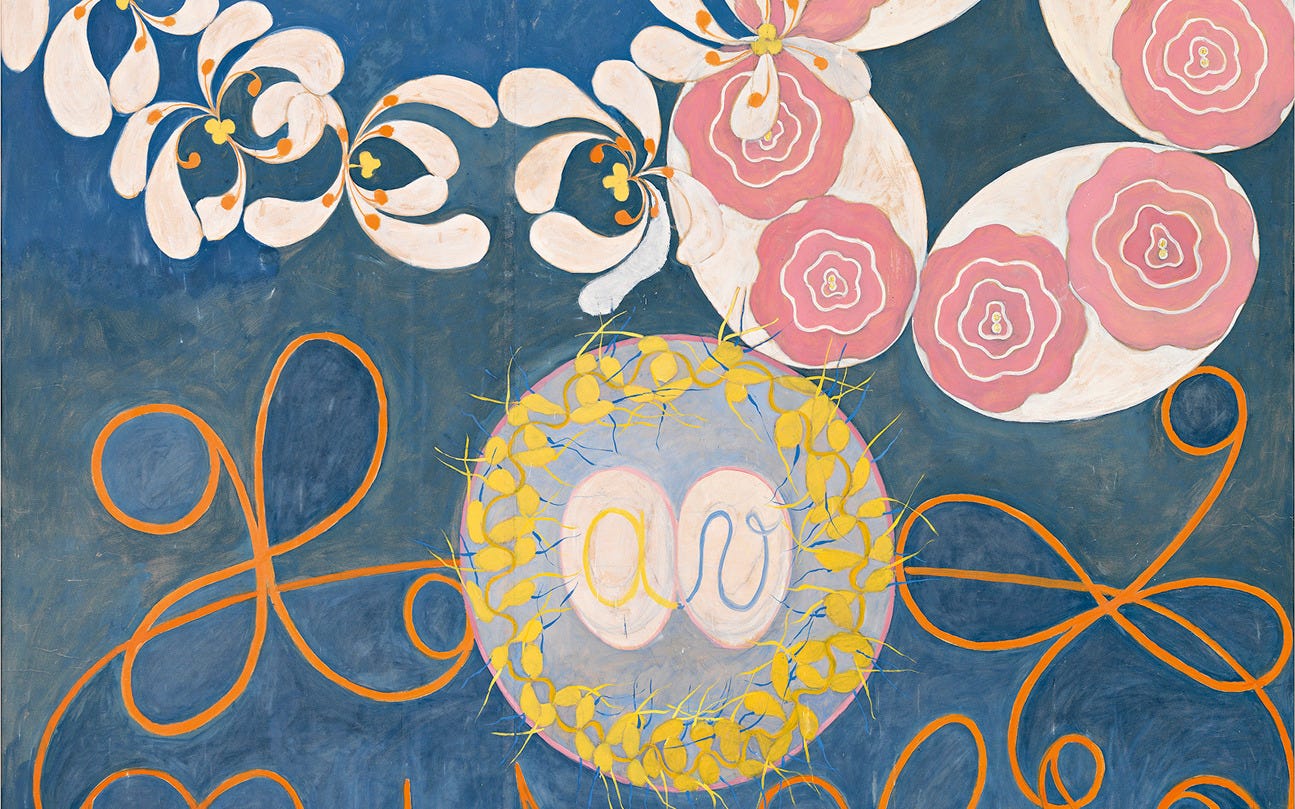
PS: the illustrations for this series will be drawn from The Ten Largest (1907), ten canvases by the Swedish painter Hilma af Klint on the ages of life, conceived for a temple that was never built. She asked that they be kept from view until at least twenty years after her death, reserving them for a world capable of understanding them: her work was not shown until 1986. I shall soon devote an article to her, as I did for Nicolas Roerich.
Letter 1 · Jérôme Nathanaël to ‘Le Verbe Vertical’
Dear friend,
We have settled by common accord, and I announced it to my readers on 18 October, the question that is to occupy us, the one you posed in your article without resolving it. I understand it as I believe you understand it: it presupposes that several civilisations are possible in the future, and it asks whether a spirituality, which it remains for us to define, might or might not bend one or other of those futures. The past and the present therefore enter into it only as reserves of clues. Before answering it, I should like to examine the question for its own sake and to set down a few preliminary remarks.
A denial as a starting point
The phrase most often quoted whenever the relations between spirituality and the evolution of civilisations are evoked is attributed to André Malraux, who is said to have announced: ‘The twenty-first century will be religious or will not be’, which others correct to ‘spiritual’. This formula in fact appears in no text signed by him and, as far as I have been able to verify, he denied it in an interview with Le Point dated 10 November 1975, saying that he knew nothing of the matter but that he did not rule out ‘the possibility of a spiritual event on a planetary scale’. I take this denial as my starting point, because Malraux’s prudence accords with the conditional of your question: to decide whether the century will be spiritual would amount to prophesying, whereas to examine what spirituality might do in it is a hypothesis, that is to say something one can maintain without asserting it and contradict without giving offence.
The intuition that a civilisation may perish for want of a soul is, moreover, older than the phrase lent to Malraux. In the wake of the First World War, in the spring of 1919, Paul Valéry, observing a Europe profoundly traumatised, ruined morally and materially, opened his text The Crisis of the Mind with these celebrated words: ‘We civilisations now know that we are mortal.’ In 1932, in the closing pages of The Two Sources of Morality and Religion, Henri Bergson judged that humanity, immeasurably enlarged by its machines, was awaiting ‘a supplement of soul’. Valéry, Bergson, Malraux: the same intuition returns in every generation, and I know of no inquiry that has soundly put it to the test. On 25 October last, in the first article of my series Spirituality and the organisation of societies, I recalled how thin the data are that might link spirituality and civilisation: an article in Nature of 2019, which concluded from the Seshat database that moralising gods appear only after the complexification of societies, was retracted in 2021, and a meta-analysis published in 2024 in Psychological Bulletin, a leading journal of psychology, finds between religiosity and prosociality only a weak correlation, of the order of 0.13 on a scale running from −1 to 1, and weaker still when actions are measured rather than declarations; and this concerns religiosity, not spirituality. This frail knowledge bears on past societies and, even if it were solid, it would not tell us what spirituality would do in civilisations that do not yet exist, some of which will have no precedent. I therefore read your question as the exploration of several possible futures and of a spirituality yet to be defined, rather than as a forecast about the century.
Futures in the plural
To think the future in the plural is a discipline with names of its own. Gaston Berger proposed in 1957 the word prospective, for an attitude that regards the future as a field of possibilities to be built rather than as the prolongation of the curves of the present; Bertrand de Jouvenel spoke as early as 1960 of ‘futuribles’, the conceivable futures; Jim Dator, of the University of Hawaii, proposes for his part to reduce the scenarios of the future to four generic families. I take these families as working tools, without asking them to foresee precise forms of the future, and for each of them the same question would have to be put with rigour: what might a spirituality do there, and what could it not do? In this first letter I shall confine myself to sketching what these four families suggest to me.
The first scenario is that of continuation. Our technical and commercial civilisation pursues its course, with its gains and its crises. Spirituality would probably keep there the place it occupies today, at best that of a supplement, divided between the wellness market analysed by Jeremy Carrette and Richard King and the minorities who find in it arguments for resisting and for proposing alternatives to general consumerism. I suspect that it could achieve little there, and that the stake would be at most to prevent it from becoming, definitively, one more product.
The second is that of collapse. States break apart and supplies grow scarce. This prospect touches my second hypothesis, according to which the cohesion that unravels diverts the spiritual impulse towards defence, identity and the designated enemy. Viktor Frankl nevertheless described, in the Nazi camps to which he was deported, human beings who still held on because they managed, in spite of everything, to recover meaning, so that spirituality might be there as much what makes it possible to hold together as that on which fanaticisms would feed.
The third is that of discipline: our societies would impose limits upon themselves, by choice or under the constraint of planetary boundaries. Spirituality might serve there to found a consented sobriety, as long traditions of asceticism have done, or on the contrary to legitimise a constraint imposed in the name of a higher order. Everything would then turn on consent, that is to say on what my series sets against each other under the names of ethics of identity and ethics of obedience.
The fourth, finally, is that of transformation. Should a radical mutation occur, technical, with artificial intelligence and biotechnologies, or cultural, touching the very foundations of what enables us to form a society, the profound upheavals it would imply for our conception of the human and of the workings of society would render all our present bearings wholly inadequate. Spirituality would perhaps be there either an engine that would orient this transformation in a positive direction, or a mere by-product subordinated to this new becoming. It is the case in which my definition is most likely to grow old, since forms of the quest for meaning that I cannot imagine might escape the five dimensions by which I try to define spirituality, and to which I return below.
These four families will no doubt mingle in reality, and my sketch leaves in shadow futures that fit them badly, such as civilisations of small federated communities, or societies that would share their world with artificial intelligences. I ask you to complete or correct them, for it is probably there that our two imaginations differ.
Three words that are not self-evident
Let us now reflect on three words of the question that concerns us, whose meaning it seems to me indispensable to clarify as a preliminary to any serious dialogue.
The first is, quite evidently, the word ‘spirituality’. In From the inner forum to the city, a two-way bond, the first article of my series, I set out, in the part entitled What I call spirituality, what I mean by the word: a threshold, borrowed from Viktor Frankl, which is the quest for meaning as soon as a person or a group engages in it, in a Church as in an artist’s studio, then five dimensions that I describe without adding them up: self-transcendence, self-transformation, concern for others, rite and belonging, the scope of responsibility. I make that threshold more precise here, since my article described it as a quest: it is first and foremost a call to which one consents.
In the depths of a person the question of meaning makes itself heard, on the occasion of an upheaval in his life, of an experience or of an irruption that he judges supernatural, and spirituality begins when he agrees to face that call. This consent presages nothing of what he will find thereafter: the quest may die out, close in upon answers received without examination, or deepen into the transformation of the self, without the second outcome following from the first. A person, a group, a civilisation may also remain on the near side of the threshold, either because no one there hears the call any longer, which Frankl named the existential vacuum, or because, once heard, it is refused, stifled or diverted. When I ask what place spirituality might occupy, I therefore do not know whether I am asking about the place of the call and of its welcome or about that of what they become, and I also wonder whether a civilisation can answer a call to refound meaning, beyond the minorities who would recognise and carry it.
This definition is also that of an observer of the present, whereas your question extends it towards futures in which the quest for meaning will perhaps take forms that I do not know how to recognise. I propose that we treat it as a variable: in each future we imagine, we shall ask which occasions of the call it multiplies or suppresses, which dimensions would be present there, which absent, and whether what is sought there still deserves the name of spirituality, avoiding two pitfalls: a definition so broad that everything would become spiritual and the question empty, a definition so narrow that it would exclude in advance what the future will invent. I have, finally, presented concern for others and the scope of responsibility as hypotheses to be tested rather than as criteria, so that a spirituality may occupy an immense place and make a civilisation worse. I do not know what content you give the word, and I would rather learn it from your reply to this first letter than discover, after several exchanges, that we were speaking of two wholly different things.
The second is the word ‘civilisation’. It has a history that forbids using it innocently. It appears in Mirabeau, in L’Ami des hommes (1756), in the singular, to signify the softening of manners, and it bears a judgement from the outset, since there would be civilised peoples and others who would not be. Norbert Elias made of it in 1939 the history of the progressive mastery of violence. The plural, for its part, carves up: Arnold Toynbee, in A Study of History, counts some twenty, Samuel Huntington retains seven or eight in 1993, and the result depends entirely on the criterion chosen. All these divisions nevertheless classify civilisations that have existed or that exist, whereas your question supposes future ones. The criteria then become variables for the imagination: what holds people together (the constraint of a state, commercial exchange, a shared rite, a consented dialogue), their relation to time (duration, or the acceleration that Hartmut Rosa describes), their relation to technology, their scale. The technological civilisation now spreading over almost the whole planet is a point of departure, and nothing obliges us to see in it a horizon. I confess to you that my sympathy goes to the civilisation of consented dialogue, and I tell you so that you may hold this bias at a distance when you read me.
The third, lastly: what do we mean by ‘human’, today and tomorrow? The future transformations of the human may designate very different situations: that of persons who would engage in a conscious effort of work upon themselves, which is the second dimension of my grid on spirituality; that of an evolution of the species, which biotechnologies and artificial intelligence could modify with or without our consent, according to the wishes of the transhumanists, and of which Yuval Noah Harari made a scenario in 2015 in Homo Deus; that, finally, which a profound modification of the conditions of life would produce, without anyone having decided it. Each future no doubt privileges one of them. I cannot decide whether one may speak of a transformation of the human in the sense of the species, or only of transformations of persons whose sum does not make a humanity. Reinhold Niebuhr maintained in 1932, in Moral Man and Immoral Society, that groups are less moral than the individuals who compose them: if he is right, the sum of inner transformations does not suffice to make a pacified humanity, and institutions are needed that are capable of containing the egoism of groups; if he is wrong, we might spare ourselves this detour. On these subjects I merely set out the various questions that the initial question seems to me to imply, without specifying how I mean to answer them.
The paradox of utility
Frankl wrote, in the preface to Man’s Search for Meaning (published in French as Découvrir un sens à sa vie avec la logothérapie), that success, like happiness, cannot be pursued and must ensue, and I believe this holds for meaning. To ask of spirituality a place in the future of civilisations is to ask it to serve, to cement, to repair what technology has put out of order, and nothing guarantees that what is sought for its utility remains what it was. Bergson said ‘a supplement of soul’, and the phrase indicates the place one is tempted to assign to the soul: that which is added after the fact to a body already built. I find it hard to believe that spirituality can be at once that and what I hold to be its nature, a search that one pursues without first expecting from it a social result. It is there too that I propose we carry our debate.
To fix ideas, I see three possible places, without attaching each to a particular future: a foundation, without which no civilisation would hold, which is my first hypothesis; a counterpower, which interrupts the logics of power without replacing them; a residue, that which subsists in the margins when everything else has organised itself without it. One and the same spirituality might hold the first in continuation and another in collapse, and it is this displacement that I should like us to examine.
From where I write
I write this at sixty-seven, and most of the transformations that our question evokes will be accomplished without me. I therefore speak of the future as one speaks of what one leaves behind, rather than of what one will see, which seems to me one more reason to advance only hypotheses here.
Three questions for your reply
So that your letter may find room in which to unfold, I should like to put to you these three questions, which you will answer in the order you choose, and to which you may add your own.
Do you understand the question as I have just set it out, with futures in the plural and a spirituality to be defined, or does the definition I have given seem to you too broad, too narrow or false for civilisations that do not yet exist?
Among the four scenarios above and those I have omitted, which futures seem possible to you, and which would you like to examine first?
In one of these futures, what would a spirituality do, in your view, and where would it remain without effect, or even prove harmful?
I propose, for what follows, that our letters be exchanged at the pace of our reflection and of our availability; that each of us be free to tell the other that he believes him mistaken, as to acknowledge his own error; and that each put forward in complete freedom the arguments or questions he wishes to set out, which is the minimal condition of a dialogue in which one agrees to be changed by the thought of the other.
Yours in friendship,
Jérôme Nathanaël
© 2026 Dialogues of the New World — Jérôme Nathanaël


The Waymakers space
The space below is reserved for free and paid subscribers of the publication. It is not visible to non-subscribers.
… … … … … …
Join us
Are you discovering this publication, and does its approach speak to you? I invite you to read the Opening page, which presents the author and the project, and then to subscribe, in the free or the paid version. You will thus gain access to The Waymakers community: direct communication between subscribers through the Chat and its thematic forums, as well as the possibility of exchanging with the author by email or video.
