

Article disponible en français
Notebooks of life · Texts · 6 min
To write as close as possible to what is surfacing, without always seeking to conclude.

Dear readers,
This little text came to me this morning, while I was reading an exchange between two authors in the Substack Notes feed: first as a comment, then, as I reflected, in the somewhat more developed state in which I offer it to you below.
In my non-religious reading of Genesis, the verse in which man is created ‘in the image and likeness of G.d’ (Gen 1:26) interests me less for what it affirms than for what translations make of it: in passing into our languages, the two Hebrew terms lose most of their relief.
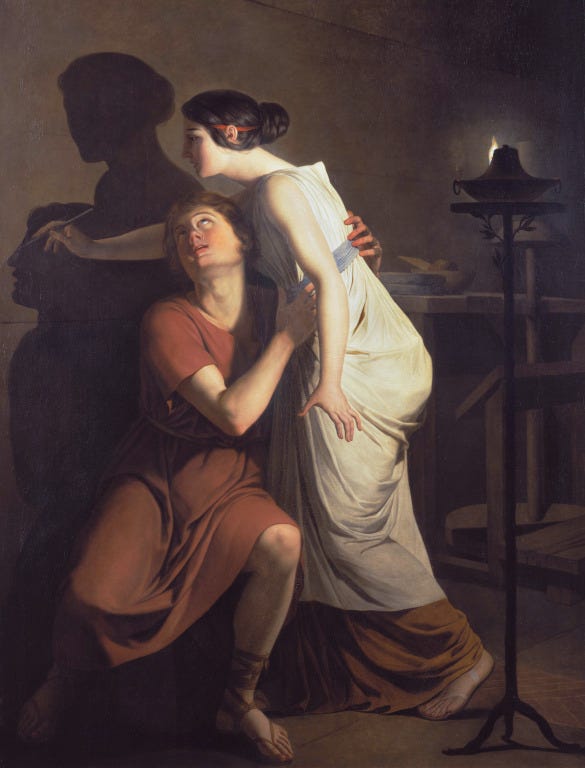
Tselem, which tradition relates to tsel, shadow, designates the projection of a reality upon a support. It is not a copy, but a trace borne by something other than its source: we would be the projections of an infinite reality that we cannot name directly. Demut, for its part, designates the pattern, the archetypal structure. Together, these two words tell us that we carry within us the fundamental architecture of Life: freedom, absolute uniqueness, creativity, the capacity to love, speech.
But a true freedom is also the freedom to be mistaken. It has allowed human beings to make choices that deprive them of realising the sublime potentialities of this structure, which bears fruit only in respecting the primordial law of the universe, which is relation, complementarity and love. We have strayed from it by favouring opposition, competition and violence, and the story of Cain gives the inaugural scene: jealousy, the mimetic desire that René Girard described so well, and finally fratricide. The text does not present this drama as a fatality, since G.d warns Cain that sin lies crouching at his door and that he can master it. The word ‘sin’ likewise impoverishes the original: the Hebrew hatat comes from a root that says missing one’s target, straying from the goal. It is in this same logic that tradition speaks of teshuvah, the return, and that the Latin language speaks of conversio, the act of turning: in both cases, it is not a matter of acquiring a new quality, but of reorienting oneself towards what we already are.
Yet this reorientation is not a single event. If we all have the capacity to embody virtue, it cannot today be actualised in our lives except through a choice ceaselessly renewed and through a conscious, patient effort: to discern in ourselves what stems from the influence, inevitably undergone, of a way of being, individual as much as collective, distorted by centuries of progressive estrangement from the right path, and to set against it the slow and demanding unveiling of our spiritual essence, of its incarnation in our thoughts, our words and our acts.
This has a consequence that I believe essential, that of humility in judgement. In our common state, we are not in a position to discern, beyond appearances and behaviour, what dwells in the deep reality of an individual. An ounce of good embodied by one man may be worth more than a visible and resounding good deed by another, for the former may have more merit than the latter if he has had to wrest his best from a life of accumulated errors, whereas the other would only have had to follow the good examples of a better upbringing. Does the dunce who manages to scrape a 5 out of 20 not have more merit than the gifted pupil who obtains 18?
And you, where do you place the measure of a life: in what is accomplished, or in the distance travelled since the starting point?
Jérôme Nathanaël
© 2026 - Dialogues of the New World — Jérôme Nathanaël


The Waymakers space
The space below is reserved for free and paid subscribers of the publication. It is not visible to non-subscribers.
… … … … … …
Join us
Are you discovering this publication, and does its approach speak to you? I invite you to read the Opening page, which presents the author and the project, and then to subscribe, in the free or the paid version. You will thus gain access to The Waymakers community: direct communication between subscribers through the Chat and its thematic forums, as well as the possibility of exchanging with the author by email or video.