
Article disponible en français
The Eternal Present · Words of Life · 30 min
To read the great spiritual words as living sources.

“Therefore, behold, I will allure her,
I will lead her into the desert and speak to her heart.”
Hosea 2:16
Two thousand seven hundred and fifty years ago, in the northern kingdom, a man named Hoshea ben Beeri received a command unlike any other prophetic injunction in the Hebrew canon: lékh qakh-lékha éshet zénounim — “go, take yourself a wife of harlotry” (Hosea 1:2). No parable, no vision: a marriage of flesh. And a scandal that Hosea would carry through time and humiliation, the persistence of a love that had no reason to hold.
Hosea is a contemporary of Amos, yet the nature of his prophecy is altogether different: where Amos roars like a lion from the steppe of Tekoa, Hosea speaks from an open wound. Where Amos thunders against social injustice, Hosea groans over the rupture of the bond — that bond between YHWH and his people which the prophet will embody in his own flesh, down to his household and the very names of his children.
This text explores why Hosea has not aged a single day, and why the desert to which he invites us is precisely the place that our civilization most obstinately flees, and which nevertheless awaits it like a confrontation that cannot be indefinitely avoided.
The book of Hosea figures in the Hebrew Bible among the Twelve Minor Prophets. Read the full text in Hebrew and English.
In this article:
The man who marries the impossible
The midbar: geography of dispossession
Méfatiha: seduction as reversal
The ba’alim: the names we give our masters
Yada: to know or to consume?
Hésed: the love that does not resemble love
Lo-Ammi: without name and without anchor
The desert that catches up with us
Hosea, or the question of the broken bond
Note on transcription: Hebrew terms follow a simplified phonetic transcription, close to that used in prayer books, rather than the academic SBL transliteration.
The man who marries the impossible
“The word of Hosea son of Beeri, which he received in vision concerning Israel, in the days of Uzziah, Jotham, Ahaz and Hezekiah, kings of Judah, and in the days of Jeroboam son of Joash, king of Israel.” (Hosea 1:1)
The opening is sober, dated, anchored in political history, like that of Amos. But what follows is of an utterly singular strangeness. YHWH speaks to Hosea, bétékhilat dibèr YHWH béHoshéa, “at the beginning of the word of YHWH to Hosea” — and this beginning is not a vision in the Temple, not a voice in the desert, not a burning coal upon the lips: it is a marriage command. Lékh qakh-lékha éshet zénounim: “go, take a wife of harlotry.”
The word zénounim is the abstract plural of zénouna, fornication, but here it qualifies less a profession than an existential orientation: a woman who “goes after” others, who distributes her faithfulness to masters other than her husband. Hosea obeys. He marries Gomer bat Divlaim. They will have three children, and the names that YHWH imposes on these children form a cadence of progressive rupture, each name bearing a heavier weight than the one before.
The first son will be called Yizreel, from the name of the plain of massacre, the place where the house of Ahab, the idolatrous kings of Israel, was annihilated in blood (cf. 1 Kings 21 and 2 Kings 9–10): a memory of violence inscribed in the cradle. The daughter will be called Lo-Ruhamah, “not loved,” the one for whom there is no compassion — the verb rakham designating that visceral, uterine tenderness which the Hebrew language links to the word rékhem, the womb. Even a mother’s compassion is suspended. And the second son will bear the most terrible name: Lo-Ammi, “not my people” — an expression that is the exact counter-point of the founding covenant declaration, véhayiti lakhem léElohim véattem tihyou-li ám, “I will be your G-d and you will be my people,” an alliance now denied syllable by syllable, overturned like an empty cup.
This inaugural prophetic gesture demands more of us than we grant it if we read it as allegory. Hosea is not playing the role of a betrayed husband. He is a betrayed husband — in duration, in the body, in social shame — for in the culture of his time, a wife’s infidelity fell upon the husband with all the brutality of the communal gaze. It is from that place, from this lived and not simulated humiliation, that the Word erupts.
The first hermeneutical lesson of the book of Hosea lies in this fact: the knowledge of G-d of which this prophet speaks is not a theoretical knowledge acquired in the sanctuary. It is born in the wound of betrayed love, of an unconditional love to which nothing any longer responds. It is born in the experience of continuing to love someone who does not return. It is from this place, uninhabitable and yet inhabited, that Hosea speaks.
The question that then arises is as relevant as ever for our own time: among those who speak of G-d today, who speaks from a real wound? Among the managers of religious institutions, the producers of spiritual content, the architects of the mastered mystical experience — who among them has married the impossible?
The midbar: geography of dispossession
Midbar. The Hebrew word for desert carries within it a debated etymology, but one of the most suggestive readings links it to dibèr, speaking, the word, through a shared root of which the desert would be, in a sense, the primordial locus: the place where the Word becomes possible because everything else, all the chatter, has fallen silent.
The desert in the Hebrew Bible is not primarily a hostile landscape to flee. It is the place of the founding encounter. It is in the desert of Sinai that Moses hears the Voice of the burning bush. It is in the desert of the Negev that Hagar, the abandoned servant, receives a promise of a future for her son. It is in the desert of Horeb that Elijah, exhausted and suicidal, is fed and sent farther on. The midbar is the Hebrew name for the place where human mediation falls away, where the profusion of cultural, cultic, and economic intermediaries ceases to screen the person from his own depth.
Now Hosea 2 is structured around a double image of the desert. First, the desert as memory: véholékhtiha bamidbar védibarti al-libáha, “I will lead her into the desert and speak to her heart” (Hosea 2:16). Israel as a woman who must be led into the desert. The reference is transparent: it is the Exodus, the crossing of Sinai, the founding moment when Israel and YHWH were alone together, before the palaces of Solomon, before the trade alliances with Tyre, before the syncretisms with the Canaanite fertility cults. The desert here is the place of the youth of the relationship — anavti lékh hésed né’ourayikh, “I remember the faithfulness of your youth” (Jeremiah 2:2, the same nostalgic register). To return to the desert is to return to the betrothal, before the habits that kill love, before the automatisms that replace presence, before the riches that cause one to forget from whom they come.
But this desert is also, in the narrative logic of chapter 2, a place of dispossession: véhinéh anokhí sag ét-darkhéh basisim végadárti ét-gederotéha, “behold, I will hedge her way with thorns and wall her in with a fence” (Hosea 2:8). Before the seduction, there is the barricade. Before the word to the heart, there is the impasse. The desert is not first of all a romantic invitation; it is the result of a forced withdrawal, the condition in which the person whose habitual roads have been cut off finds himself, whose ordinary providers of meaning and satisfaction no longer function.
It is here that the book of Hosea meets, with a disconcerting sharpness, the situation of our own era.
We live in a time that has organized, with remarkable technical genius, the flight from the inner desert. The permanently connected phone. The uninterrupted availability of content, stimulation, and entertainment. The quasi-infinite supply of substitutes for solitude, which are not remedies for assuming it but ways of never having to cross it, to sit within it, to hear what it is saying. The society of permanent distraction that the philosopher Blaise Pascal diagnosed long ago as the fundamental malady of humanity: “all the misfortune of men comes from a single thing, which is not knowing how to remain at rest in a room.” That society today possesses means that Pascal could not have imagined for ensuring that no one ever has to remain in his solitary room.
And yet, and this is what the book of Hosea says with an almost unbearable clarity, the midbar catches up with us. It simply takes other names. It is called depression, when the nervous system, saturated with meaningless stimuli, falls into the void that hyperactivity was supposed to fill. It is called addiction, when the escalating doses required to simulate the intensity of living reveal, in negative, the real intensity that is lacking. It is called a midlife crisis, when an accumulation of objective successes suddenly turns itself inside out to show its empty lining. It is called professional exhaustion, when the energy put in service of ends one has never truly chosen ceases to be renewable. It is called nihilism, when the narrative by which a civilization understands itself loses its capacity to convince its own members.
These contemporary deserts are not accidents along the way. They are, in Hosea’s logic, the sisim, the thorns with which YHWH blocks our familiar roads — not out of sadistic punishment, but out of stubborn love: the refusal to allow those He loves to anesthetize themselves to death and forget him.
The question this text then poses to our era is of a quiet radicality: what if all these great crises that bar our near horizons — the ecological collapse that renders untenable the logic of endless growth and consumerism, the epidemic of psychic distress that reveals the bankruptcy of happiness-through-accumulation, the disintegration of collective narratives that drains inherited certainties of their substance — were not only catastrophes to be managed, but above all prophetic sisim, dead ends that force us to lift our eyes toward other perspectives? Not that suffering is good in itself, nor that crisis is a divine programme to be embraced with gratitude. But the impasse, when looked at with lucidity rather than skirted with artifice, has the property of rendering visible possibilities that ordinary motion kept invisible: ways of living together, of producing, of consuming, of relating to the earth and to the other, that the habitual road simply did not allow one to see because one was moving too fast and in the wrong direction. The shûv of Hosea — that reversal which engages the body, the will, and one’s practices — perhaps begins there: in consenting to stop before the thorns rather than searching for the next detour.
Méfatiha: seduction as reversal
Lakhén hinné anokhi méfatiha, “Therefore, behold, I will allure her” (Hosea 2:16).
The verb pata is one of the most ambivalent in the Hebrew lexicon. It denotes at once seduction, persuasion, the act of leading into error, and even in certain contexts deception or drawing someone toward something the other would not have chosen spontaneously. The Septuagint renders it by planáo, meaning to lead astray, to cause to wander. The Vulgate by lactare, to entice, to attract by sweetness. The word resists all domestication.
The text declares that the initiative of drawing Israel belongs to YHWH, and that this initiative is not a constraint but a seduction, an attraction that passes through the other’s desire rather than against it. The midbar toward which G-d leads is not a prison: it is a stripped-down space in which it once again becomes possible to hear a voice that the ordinary din was covering.
Védibárti al-libáha, “I will speak to her heart,” literally “upon her heart.” The preposition al in Hebrew indicates here a word addressed directly to the lev, to the heart understood as the seat of interior life, of will, of intelligence and affectivity combined — not the sentimental heart of greeting cards, but the center of the person, the place where real decisions are made, where the fundamental orientations that commit one’s life take effect.
To speak to the heart is the biblical expression for amorous speech, for deep consolation. Dibarou al-lev Yeroushalayim says Isaiah (40:2): “speak to the heart of Jerusalem.” It is the language one speaks after a separation, in the intimacy regained, in the gentleness that follows after an explanation. It is neither the discourse of moral injunctions, nor the language of institutional reforms, nor the rhetoric of public persuasion. It is a word that passes beneath the most skilful defenses and reaches the central place where the other truly lives.
The promise that follows immediately is of an elliptical beauty: vénatáti lah ét-kéramehá misham véét-emeq Akhor lépétakh tiqvah, “There I will give her vineyards, and the valley of Achor as a door of hope” (Hosea 2:17). The force of this verse draws from what the valley of Achor represents in the memory of Israel. Akhor means trouble, misfortune, but the word also designates a precise and painful place. During the conquest of Canaan, after the miraculous fall of Jericho, a man named Achan had withheld a portion of the plunder subject to the sacred ban, the hérem, by which everything contained in the first conquered city was dedicated to YHWH. The transgression remained concealed, and Israel was crushed at the next battle before Ai, a tiny village, after the invincibility displayed at Jericho. This valley floor was therefore, in Israel’s memory, the place of the most bitter collective shame: not defeat before an external enemy, but betrayal from within, the concealed fault that had compromised the entire community at the very moment of its founding act. It is this very place that YHWH designates as the pétakh tiqvah, the door of hope.
This is a prophetic gesture of singular audacity. It does not say that Achor will be forgotten, erased, covered over by a happier memory. It says that Achor will be crossed, like a threshold, like the compulsory passage from one side to the other. The trouble itself becomes the matrix of renewal. The promise of the vineyards, kéramehá, “her vineyards” given back as a personal and intimate possession, is not incidental: in biblical symbolism, the vine is joy, fruitfulness, the Alliance itself. To restore her vineyards to Israel is to give back not only the land but the capacity to produce a fruit that gladdens both G-d and man.
This promise is then sealed upon an image of song: véshara sham kidmé né’ouréha, “she will sing there as in the days of her youth,” Israel will sing as on the day when she came up from the land of Egypt, that is, as at the most founding moment of her identity, at the hour of her original liberation. The people will not sing despite the crossing of the valley of Achor. They will sing through it, because it is there, and nowhere else, that the trouble will have been named, assumed, and crossed all the way through.
There is in this vision a wisdom of trial that has nothing to do with spiritual masochism or the glorification of suffering. What Hosea articulates connects with what the mysticism of all the great traditions calls the dark night or kenosis: that voluntary destitution as the condition of a renewal more radical than any simple return to a prior state. This crossing, which is neither circumvention, nor anesthesia, nor management, is the very path that the name of the Hebrew people carries, the ivrit, the one who crosses over, who changes shore. So the desert cannot be purchased, nor managed, nor confused with a game. It must be crossed on foot, in the body’s own slowness, by a being exposed to what the desert makes one hear.
But our age has produced a wellness industry that is, to a large extent, an industry for bypassing Achor. Mindfulness practices stripped of ethics, meditation as a performance tool, resilience as a managerial skill to be optimized, personal development as a self-project that carefully sidesteps the question of the self in whose benefit it is developing — all of this constructs sophisticated bridges above the valley of trouble so as never to have to descend into it. In doing so, it renders impossible the discovery that the door of hope is found there.
The ba’alim: the names we give our masters
One of the central accusations in the book of Hosea is that of azav, abandonment, expressed through the image of the ba’al. In Hebrew, ba’al, plural ba’alim, means at once the master, the husband, and the name of the Canaanite god of fertility, rain, harvests, and agricultural prosperity. It is both a title and a programme: the ba’al is the one who possesses, who disposes, who furnishes goods in exchange for devotion.
Hosea’s grievance is not that his people worship grotesque statues or manifestly absurd idols. It is that his people have slid, imperceptibly, from a relationship with YHWH toward the consumption of the ba’alim, and that this slide has occurred without visible rupture, almost without anyone noticing, through a progressive substitution of the who by the what. One no longer asks: from whom does this gift come? with whom am I in relationship? One asks: how do I obtain what I need? And the ba’alim are precisely the effective answers to that question, the providers of functional meaning who demand no conversion, no transformation, no relationship, only a ritual gesture, a calibrated offering, a respected protocol, a well-designed transaction.
Véhi lo yad’ah ki anokhi natáti lah hadagan véhatirósh véhayitshar, “and she did not know that it was I who gave her the grain, the new wine and the oil” (Hosea 2:10). The “she” is Israel, likened to the unfaithful wife. The text says something striking about the mechanics of spiritual unfaithfulness: it is not a deliberate act of betrayal, but a progressive forgetting of provenance. The goods continue to arrive. Prosperity continues to unfold. But the thread that linked these goods to their Source has frayed, and what remains is only a consumption of what life provides, no longer a relationship with the One who provides.
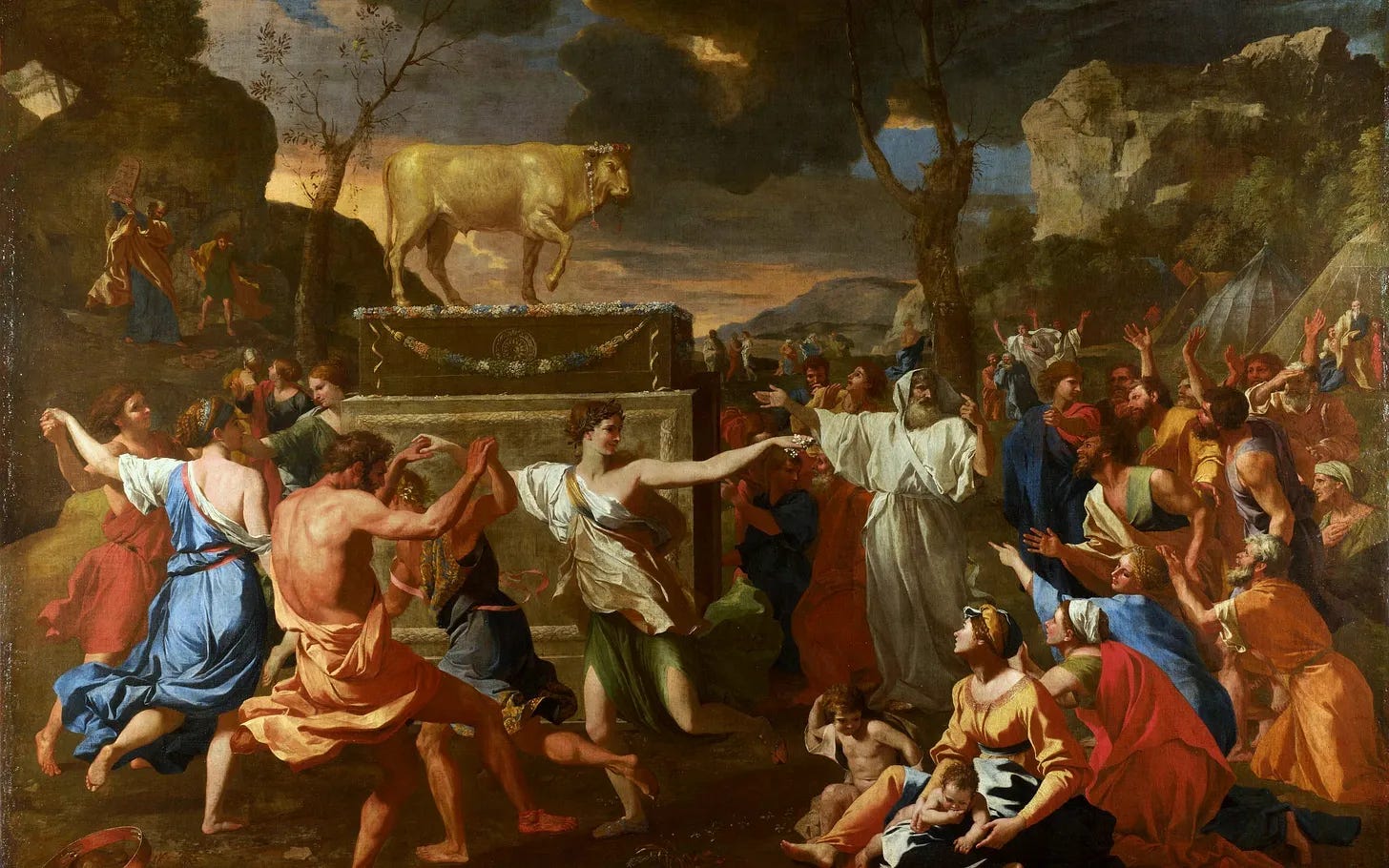
This is the precise definition of what our civilization has done with nature, with intelligence, with creativity, with health, treating them as extractable resources manageable by experts, without bearer, without subject, without mystery. But who are our contemporary ba’alim, these functional lords to whose altars we burn our offerings in exchange for an illusory fertility?
There is the ba’al of economic growth, from which we expect the resolution of the problems that its own logic has engendered, sacrificing on its altar billions of hours of human life, square kilometres of ecosystems, decades of cultural capital, in the hope that the escalation of gifts will eventually produce what earlier generations called a sense of meaning. There is the ba’al of technology, whose perpetual promise is that of the Canaanite ba’al: rain on demand, assured fertility, control over what escapes. There is the ba’al of visibility, that strange new god whose altar is the screen and whose rite is self-exposure, which demands that one convert one’s own interior life into consumable content in order to extract from it the currency of recognition. And there is the ba’al of spiritual efficacy itself, that mercantile version of the inner quest which promises calibrated altered states of consciousness, meditation retreats with performance indicators, a spirituality without kenosis, without darkness, without crossing of the desert.
Hosea does not condemn these ba’alim because they are malevolent. He says something simpler and more disturbing: they cannot give what they promise. They can furnish grain, wine and oil, but they cannot give the da’at Élohim, the knowledge of G-d, which is the Hebrew name for the fullness of existence. And because they cannot give it, their cult always leaves a residual lack that one attempts to fill with an additional offering — until exhaustion, until the desert.
Yada: to know or to consume?
Ki hésed khafátti vélo-zévakh, védá’at Élohim méolot, “For it is faithfulness I desire and not sacrifice, and the knowledge of G-d rather than burnt offerings” (Hosea 6:6).
This verse is to Hosea what Amos 5:24 is to Amos: the dense, central formulation, almost impossible to fully unfold. Two terms condense within it the essential of what can found a spiritual civilization.
Hésed — a word that no one translates the same way twice: love, goodness, mercy, faithfulness, loving loyalty, persisting grace. Hésed is fundamentally a faithfulness that persists beyond what formal obligations require, a love that continues when it could legitimately stop. It is Hosea’s faithfulness toward Gomer, the woman of fornications, incomprehensible in the world’s eyes, disproportionate, costly, non-profitable, as the image of YHWH’s faithfulness toward Israel. Hésed is not the application of a rule. It is an orientation of being.
Da’at Élohim, the knowledge of G-d. But the verb yada, to know, in Hebrew, possesses a richness that the English “to know” does not exhaust. Yada denotes intimate, experiential, relational knowledge, for the same root also describes the carnal union (véhaadam yada ét-Khavah, “and the man knew Eve,” Genesis 4:1). Yada is the knowledge that engages the whole knowing subject, that transforms the one who knows, that leaves a trace in both directions, knowing and being known. Its opposite is not ignorance in the sense of a lack of information: it is non-relation, the act of treating the other as an object from which data is extracted without entering into contact with him.
In Hosea 6:6, the parallel is relentless: hésed versus zévakh (sacrifice), da’at versus olah (burnt offering). Sacrifice and burnt offering are not condemned in themselves; they stand in continuity with the same critique as in Amos 5:21: they are condemned insofar as they function as substitutes for relationship, as transactions that allow one to consider oneself discharged at minimal cost. The zévakh as payment of a debt in order to continue not changing. The olah as a ritual performance that discharges the conscience without modifying behaviour.
This critique reaches something precise in our contemporary relationship to knowledge. We live in a civilization that has a quantitatively prodigious and qualitatively impoverished relationship to knowledge. We know more than any previous generation: we know what our food contains, what the environment is undergoing, what populations exposed to our chains of production endure, what inequalities produce in the brains of children. This knowledge is available, made public, accessible in a few seconds on any screen. And it changes nothing, or almost nothing, in our collective attitudes and practices.
Because this knowing is not yada. It is information processed at a distance, without the subject receiving the information himself being put at stake in the transaction. Yada, in Hosea’s sense, is a knowledge that exposes: it exposes the knower to the reality of what he knows, it does not allow him to remain sheltered behind a dashboard, and it demands a response in the body, in one’s choices, in daily life. It is the knowledge that transforms because it implicates, because it creates a bond, because it engages a responsibility in the etymological sense: the capacity to respond.
The absence of da’at in our relationship to the world is not ignorance. It is something more grave: the capacity to treat the reality of the other — human, animal, ecosystemic — as a consultable datum, without ever being touched in the sense that Hosea understands the lev, that is to say at the heart, at the center, where it truly matters.
Hésed: the love that does not resemble love
Ékh éttenékha Efráïm, amaguénékha Yisraél — ékh éttenékha kadAdma, asimékha kifTSevoyim — nakhpakh alay libi, yakhad nikmrou nikhomáy — “How could I give you up, Ephraim! How could I hand you over, Israel! How could I make you like Admah, set you like Zeboiim! My heart recoils within me; all my compassions are inflamed together” (Hosea 11:8).
This is one of the most arresting texts in the entire Hebrew Bible, and one of the least known. YHWH speaks in the first person, and what He expresses is not the cold sovereignty of an impassive god but the anguish of a love that cannot bring itself to abandon the beloved.
Nakhpakh alav libi, “my heart recoils within me.” The verb haphak is the verb of radical overturning; it is the same verb that describes the annihilation of Sodom by divine fire (Genesis 19). What the text says is that YHWH is himself overwhelmed by his own compassions. He cannot do what the logic of judgment would require, namely surrender Israel to the fate of Admah and Zeboiim, the cities destroyed with Sodom. He is, in a sense, held by the hésed, by that faithfulness which exceeds the formal rights of the contract, which refuses the logical conclusion of repeated betrayal.
Hosea 11 opens with the image of the parental relationship, one of the founding metaphors of the bond between YHWH and Israel: ki-naar Yisraél vaohavéhou oumitsraïm qaráti livni, “when Israel was a child, I loved him, and out of Egypt I called my son” (Hosea 11:1). The image of the father who teaches the child to walk (vaanokhi tilálti léEfráïm, “I taught Ephraim to walk,” 11:3), who carries him in his arms, who bends down to feed him — these images do not function as metaphors in the sense of a distant comparison. They operate as a phenomenological description of what a real love relationship is: patient apprenticeship, physical proximity, an asymmetrical responsibility assumed without calculation.
The verdict falls, brutal: vélo yad’ou ki réfaïtim, “and they did not know that it was I who healed them” (Hosea 11:3). The same blindness to the provenance of gifts as in Hosea 2: the incapacity to perceive the bond between the care received and the One who lavishes it.
Now the book of Hosea says here something that our era has difficulty hearing: the forgetting of the provenance of the care received does not prevent the care from continuing. Hésed will not allow itself to be conditioned by reciprocity. It continues even when it is not recognized, even when it is actively replaced by other attachments, even when it is structurally ignored. It is this unconditional persistence that makes the text of Hosea so disturbing for a time such as ours — a time that has made tangible reciprocity and performance the implicit condition of every relationship, including its most intimate forms.
Our civilization has produced a vision of love that is structurally conditional, founded on exchange, mutual satisfaction, a cost-benefit analysis regularly revised and corrected. Contemporary marriage contracts, in their most candid version, are agreements between stakeholders who commit for as long as the conditions of satisfaction are maintained. This is not a moral critique but the description of a dominant logic. This logic, when deeply internalized, produces a constitutive incapacity to receive or to give an unconditional love, because such a love would seem either impossible or suspect: either the other has not understood that love is negotiated like everything else, or he wants something in return that one has not yet identified.
Hosea says: what is true of YHWH, this persistence of hésed despite Israel’s repeated infidelity, this refusal to draw the logical conclusion from the broken contract, is what must serve as the model for the human community. Ki hésed khafátti vélo zévakh — “For it is faithfulness I desire and not sacrifice”, this is not only a description of YHWH’s love for a people. It is also an anthropology, an injunction about what human beings are called to be for one another and to maintain in their relationships.
Lo-Ammi: without name and without anchor
Hosea and Gomer’s three children bear names that constitute a programme of progressive exclusion: Yizreel, memory of violence; Lo-Ruhamah, no more maternal compassion; Lo-Ammi, no longer my people. These three names form a coherent descent: from historical violence to the extinction of tenderness, from the extinction of tenderness to the rupture of the Alliance itself. Each name withdraws something more fundamental than the last — first the collective memory, then the maternal sentiment, finally the constitutive bond between YHWH and his people.
But the promise of chapter 2 is that of a reversal of these names, and the manner in which this reversal is effected deserves to be examined closely. Véamartém léakhikhem Ammi, véla’akhotékhem Rouhamah, “you will say to your brothers: My people, and to your sisters: Beloved” (Hosea 2:3). The operation is of a disconcerting simplicity in the Hebrew text: the prefix lo, the negation, two letters only, is removed. Lo-Ruhamah becomes Ruhamah. Lo-Ammi becomes Ammi. It is the same reality, stripped of its negation — not a new identity substituted for the old, but a deep identity at last freed from what had been covering it.
This grammatical gesture is also a wisdom of time: the promised reversal does not erase the past. The history of rupture, of betrayal, of dispossession remains inscribed. But the lo that defined it is lifted, and what remains is Ammi, as if the deep reality had always been there, waiting beneath the negation. In Hebrew thought, the shem, the name, is not an arbitrary label: it speaks identity, vocation, one’s place in the fabric of real relationships. To bear a name of negation is to bear the absence of a name, and therefore the absence of oneself.
What is then remarkable is that this reversal of the name does not begin with a divine decree descending upon passive individuals. The imperative véamartém, “you will say to your brothers,” is addressed to the community, and its first recipients are horizontal — brothers, sisters — before the divine promise of renewed betrothal comes to seal what the community will first have accomplished among itself. It is the community that first removes the lo in the way it names its own members. The suppression of the negation is a communal orthopraxis before it is a divine ratification: to say you are my people to the one whom society designates as lo-ammi, to say you are beloved to the one whom the structures of power have rendered invisible. The restoration of identity does not fall from the sky. It begins in the gaze that a community casts on its most vulnerable members, and in the way it names them.
Lo-Ammi is perhaps the most contemporary name in the entire Hebrew prophetic corpus. Not my people. Not identifiable to a group that bears collective meaning. Not connected to a history larger than one’s own. Not inscribed in a transmission. The contemporary lo-ammi does not result from a divine decree but from a cultural logic — that of the autonomous, self-sufficient individual, consumer of his own life as a personal project to be optimized, detached from any belonging that would precede and exceed his own choices.
The sociologist Robert Bellah, in Habits of the Heart, his penetrating analysis of North American culture, was already describing in the 1980s what he called the “manager self,” the individual whose relationships have only two registers available: the therapeutic, centred on his own fulfilment, and the contractual, based on a freely agreed arrangement between parties, with no place for an inherited belonging, for a we to which one would belong before ever having chosen it. Forty years later, this model has been universalized and intensified. Identity is constructed in the mirror of social networks, documented in real time, optimized for engagement. The self becomes a brand, and the brand must differentiate itself to survive in the attention economy. Lo-ammi is the default condition of such an existence: a radical atomization, a foundational solitude that permanent connectivity does not resolve but merely exhibits.
But Hosea goes further. Lo-Ammi is not only a social condition; it is also a spiritual condition, the condition of the person who has lost the thread of his own origin, who no longer has access to the memory of where he comes from nor to the vision of where he is going, and who drifts in the perpetual present of immediate stimulation. The dispossession of the shem is in Hebrew culture the worst of violences: to lose one’s name is to lose the awareness of being in relationship with anything that surpasses one’s own biography.
And it is precisely in this place of dispossession that the promise is pronounced, bimaqom, “in the very place” of negation, not elsewhere, not after a move toward a different life: véhaya bimaqom ashèr yéamèr lahem lo-ammi attem yéamèr lahem bnéy El-khai, “and it will come to pass that in the place where it was said to them: you are not my people, it will be said to them: sons of the living G-d” (Hosea 2:1). It is the same logic as the valley of Achor: the door of hope opens in the precise place of collective shame, not elsewhere, not after the wound has been forgotten. This reversal is not a reward for good conduct. It is the revelation of what was there all along, a belonging that infidelity had rendered invisible without ever destroying it. The deep identity — to be bnéy El-khai, sons and daughters of the living G-d — precedes all performance and resists all betrayal.
The desert that catches up with us
There is today a desert that catches up with us, even on our digital ivory couches, even in our flows of images and sensations calibrated never to allow silence.
We hear it in the epidemic of depression that now touches adolescents in all industrialized cultures, whose hyper-connected brains have never learned to inhabit their own silence. We hear it in the rise of identity extremisms, that desperate search for an ammi, a people, a belonging to cling to, however brutal, against the void of the individualist lo-ammi. We hear it in the saturation of the wellness market, paradoxically inverse to any improvement in actual wellbeing, as if each new meditation application confirmed the growing incapacity to encounter oneself without an intermediary. We hear it in the waiting lists of therapists that have never been so long — not because human beings have become more fragile, but because the inner midbar, repressed by decades of collective stupefaction, demands with increasing insistence its right to be crossed.
Lakhén hinné anokhi méfatiha — the Text says: “therefore, behold, I will allure her.” The desolation is not an accident that could be prevented with the right stress-management tools. It is the logical consequence of a regime of existence that has systematically barred access to depth, and it is also, in Hosea’s reading, the paradoxically necessary space of encounter with oneself.
This desert that we flee is precisely the place where the word can be heard, because it is the only place where the noise of the ba’alim has fallen silent. It is the only place where the question — from where does the good in my life come? — can be asked without immediately being drowned in the flow of functional answers. It is the only place where the yada, that intimate and transforming knowledge, is possible, because the person is at last sufficiently stripped down to be touched by what he or she encounters.
And yet...
We have produced an industry of desert processing that neutralizes its very virtue. The silent retreat on a corporate seminar budget. The five-day digital detox between two quarterly reviews. The eight-week certified mindfulness-based stress reduction programme. These offerings are not all without value; some even open genuine doors. But their dominant logic is that of the ba’alim: to extract a valorizable resource from interior experience, to return from the desert more productive, to transform Achor into a managerial asset. In doing so, they make the real crossing more difficult still — the one that has no guaranteed duration, that produces no measurable return on investment, that demands sitting in the valley of trouble without knowing whether, or when, the door of hope will come into view.
Védibarti al-libáha, “and I will speak to her heart.” This promise is not addressed to the manager of his own interiority. It is addressed to the one who has ceased to manage, to the one who no longer has the resources to maintain the façade, to those whom the desert has dispossessed of enough illusions to allow them to hear something truer than their own projections. Hosea is not a prophet of spiritual performance. He is the prophet of stubborn love, of disproportionate faithfulness, of the word spoken at the heart of a broken reality — not after repair, but within the fracture itself.
Hosea, or the question of the broken bond
What Hosea brings to Amos is not another programme. It is another depth. Amos says: justice must flow like a perennial torrent. Hosea says: before justice even, there is the question of the bond, of the relationship between the human being and what founds him, between the love received and the love transmitted, between the intimate da’at and the practices that express it in the world. Amos diagnoses the barbarity that wears a suit. Hosea diagnoses the inner desert that produces that barbarity — not as an excuse, but as an additional depth: a civilization that has lost the yada can only treat the other as a resource, because it no longer knows that it is knowing the other that constitutes the relationship.
The ultimate hermeneutical question posed by the book of Hosea is perhaps this: are we capable, individually and collectively, of descending into our own valley of Achor, into those places of trouble, failure, shame and disorientation that our architectures of distraction exist solely to avoid, and of remaining there long enough to hear the word that addresses itself to our heart?
Véirastikh li le’olam véirastikh li betsédèq ouvémishpat ouvéhésed ouvérakhamim — véirastikh li béemounah véyadá’at ét-YHWH — “I will betroth you to me forever; I will betroth you to me in justice, in right, in hésed and in compassion — I will betroth you to me in faithfulness, and you shall know YHWH” (Hosea 2:21–22).
The final promise is not a reward for those who would have successfully completed the crossing according to verifiable criteria. It is a promise of betrothal, éroussim, the term for Hebrew betrothal, that is, of a committed relationship, sealed, oriented toward a shared future. The last word of the promise is yada’at, “you shall know” — not obedience to the commandments, nor the perfecting of ritual practices, but: you shall know, that intimate, transforming, reciprocal knowledge that the desert will have made possible by dismantling everything that had been blocking it.
The barbarity that Amos denounced wears a suit. The desert that Hosea names wears our faces. The door of hope is found, says the Text, in the very place we do not wish to descend.
Méfatiha. I will allure you. Bring you back to yourself by bringing you back to the beginning.
The question now is whether we consent to be led.
“Return, O Israel, to YHWH your G-d, for you have stumbled by your iniquity.
Take with you words, and return to YHWH.”
Hosea 14:2–3
© 2026 - Dialogues of the New World — Jérôme Nathanaël

To go further
What does this text make audible for you today? Leave a sentence, a resonance, a disagreement, or a glimpse of light in the comments, so that the word may continue to circulate.
And if you wish to share your reading of a spiritual word, send me a contribution of roughly one page for the Waymakers section. It will be published under your initials, a pseudonym, or anonymously, as you prefer. Other readers will be able to respond and dialogue with you.
New here? The Opening page introduces the author, the project, how to take part, contact details, and the agenda.