

Article disponible en français
The World We Cross · New World · 58 min
To open up perspectives, test out possibilities, seek forms of life more fit to be inhabited.

Foreword
This text is the written and condensed form of a cycle of six lectures given from January to June 2023 at the Moulin à Café, a community venue in the 14th arrondissement of Paris, created on the initiative of the neighbourhood’s residents. This is no idle detail by way of introduction: this way of collectively taking a living space back into one’s own hands, of assuming its management and of inventing something held in common there, already illustrated the philosophy that would run through this set of lectures. In a world that urges us to delegate ever more, our decisions, our health, our education, the direction of our lives, the simple act of standing up, of creating together a space in which one thinks and dialogues, where one ventures into freedom, is already a revolutionary act, the herald of a promising mode of social transformation.
More than three years have passed between those evenings and this article. I had initially intended to wait until I had turned these lectures into a publishable book, but I lacked the time and the peace of mind to bring that project to completion, and it is still under way today. These three years, however, have in no way contradicted what I said then; they have even made several of my observations more pressing: artificial intelligence has settled into our lives faster than any technology before it, political tensions have hardened in France as elsewhere, and distrust of institutions has never ceased to grow. In the face of this situation, and with France’s major elections of 2027 drawing near, it seemed to me that I should defer no longer the publication of this draft of a book, all the more so since what I express in it forms the very foundation of everything I write here, in these Dialogues. I therefore offer this text today as their Manifesto, updated where the times demand it.
This lecture cycle was inhabited by the question I have asked myself since adolescence, and which drew me towards my spiritual research and my path of personal transformation: why are we here, what have we come to do, and above all why does this world function so badly when we have access in it to the most extraordinary resources in human history? My youthful motto was then that of Le Grand Jeu, the literary movement, parallel to Surrealism, founded by René Daumal and Roger Gilbert-Lecomte: Revelation-Revolution, that is to say, seeking to understand meaning while committing oneself to a radical change of society. These two impulses, that of a recovered verticality of meaning and its necessary consequence in an active participation towards the horizon of a better society, have never ceased to carry me since.
The text that follows seeks to produce a great movement of thought, coherent and progressive, freed from the inevitable repetitions of the spoken word in lectures. It may be read in one sitting or in six distinct stages. You will find in it elements I have already addressed in other texts of the Dialogues, set here within a broad picture of synthesis. Each of the observations made, each of the causes put forward and each of the paths proposed, for the person as for society, nonetheless remains a sketch, one that would call for many developments impossible within these pages. Those developments are precisely the subject of the books I am preparing, and one of the undertakings of the Dialogues. The article draws on the spiritual traditions, history, anthropology, philosophy and psychology, not as authorities to which we must submit, but as lights that illuminate our own experiences.
Truth, Kierkegaard said, has value only if it is passionately appropriated by an individual, if it becomes the foundation of his way of being in the world. It is in this spirit that I offer you this journey, which is meant as a manifesto of hope and commitment, a viaticum for a long voyage towards the light and the changing of the world.
The six stages of the path
I. The human being in all his dimensions — Who are we really?
II. The human being in danger — How our age atrophies what we are
III. The genealogy of the old world — How did we come to this?
IV. A society on a human scale — What model would allow the human being to fulfil himself completely?
V. The transition — How do we cross from this world to the other?
VI. Becoming the Waymakers — Daring to be the proof
I — The human being in all his dimensions
Who are we really?
We live in an age in which the question of meaning has become existential on a collective scale. For some years now, I have been observing with growing attention, through my work as a therapist but also as a spiritual seeker, a worsening of depression, a multiplication of suicide attempts, a despair that reaches ever broader sections of the population, including children and adolescents. This is not first and foremost a matter of economics, politics or climatology, even if each plays its part. It is a crisis of meaning.
Viktor Frankl, the Austrian Jewish psychiatrist who survived the concentration camps, observed it with implacable clarity: under conditions of equal distress, those who held out longest were often those who still managed to give meaning to their presence, even, and above all, in the most inhuman conditions. Logotherapy, healing through meaning, which he had begun to develop before the war, found in this ordeal its most terrible confirmation. When a society loses the meaning of its own existence, it perishes, slowly but surely, through attrition from within, long before any visible collapse.
Yet it seems evident to me today that the collapse is becoming visible, even as a distant dawn of renewal breaks through, borne by those whom I call the Waymakers of the New World: all those who have understood that to repair our societies in depth and to set a civilisational renewal in motion first required changing oneself into a being of goodness and virtue, and seeking the social forms that would allow this to be embodied at the collective level.
Five-dimensional man, beyond reductionism
Our contemporary age apprehends the human being in his most easily measurable and manageable dimensions: his body, his primary emotions, his functional intelligence. This triptych, physical, emotional, mental, is enough to run a producer-consumer under tutelage. But it leaves in shadow two essential dimensions whose atrophy is precisely the source of our collective suffering.
The higher emotional dimension, capable of unconditional love, not the possessive or contractual love that our societies normalise, but the love that gives without calculating, that loves the other in his absolute difference, and the higher intellectual dimension, seat of authentic wisdom, which escapes duality to perceive the unity of life, do not develop merely through growing up in good health. They require work on oneself, a deliberate inner undertaking. They are latent dimensions, like the embers of an inner fire: they are never entirely extinguished, but they suffocate if nothing feeds them.
At the heart of this five-dimensional edifice, the spiritual essence, what the Hebrew traditions call neshamah, what the Christian mystics name the divine spark, what the Rig Veda expresses in that dazzling formula addressed to Agni, O Fire, you are the son of Heaven through the body of the Earth (III, 25, 1), constitutes the principle of unity. It is what makes each being absolutely irreplaceable: no DNA is identical, no life can be laid over another, no gift exactly duplicates another gift.
The persona against the essence: the mask and the face
The Latin persona designates the mask worn by the actors of the ancient theatre, a mask designed, according to an old etymology that linguists dispute but whose image remains telling, to carry the voice, per-sonare. Personality ought therefore to be the instrument through which our real being projects itself into the world, the faithful interface between our essence and social reality. But very early on, under the pressure of the needs for adaptation, for recognition, for emotional and economic survival, this personality is formed not as an extension of our essence, but as a façade built through imitation, copying the behaviours that allow us to get by and to function in society, internalising family, cultural, religious and social injunctions.
The result, which anyone who learns to observe himself with honesty and sincerity eventually comes to see for himself, is that we are made up of a multitude of inner characters who step to the front of the stage according to circumstance, often without coordination, sometimes in contradiction with one another, and none of whom truly expresses what we are in our deepest intimacy. The work of spiritual consciousness begins there: not with guilt at not being what one ought to be, but with an exacting lucidity about the way we function, completed by a patient, humble and resolute endeavour to restore to the director the place that is his, he who alone is capable of progressively disciplining all the components of our being in the service of our spiritual essence.
The Hasidic tradition, of which I am particularly fond, readily takes up this saying from the Tikkunei haZohar: there is no place empty of Him. No part of our life is wholly devoid of the presence of the Living One, but to find within oneself the trace of that presence is the beginning of the awakening that will lead, at the end of a long journey, to the threshold of freedom, wisdom and joy, to the summit of the mountain.
The chariot, the charioteer, the archer
To say what the human being is in his totality, the great traditions do not encumber themselves with the categories of contemporary psychology. They speak in images, and these images are often more precise than concepts. The Katha Upanishad describes man as a chariot: the body is its frame, the senses are the horses, the mind the reins, the intelligence the charioteer, and the Self the one who stands in the chariot and gives it its destination. The Bhagavad Gita takes up the scene and gives it flesh: on the battlefield, Arjuna is the archer, and Krishna, the divine, holds the reins at his side. Without this master of the chariot, the chariot may be perfectly built, the horses magnificent, the charioteer skilful: it goes round in circles.
The archer who knows the target is the spiritual dimension of the human being, the one that knows the direction, that gives existence its verticality. And the Hebrew verb that designates sin, ḥaṭa’ (חָטָא), means first of all to miss the mark: the Book of Judges (20:16) uses it of seven hundred elite slingers able to sling a stone at a hair without missing. The Greek hamartia (ἁμαρτία), by which the New Testament names sin, comes from a verb which, in Homer, designates the warrior whose shaft falls short of its target. This first image held within the words is crucial: it shifts the notion of sin from the moral register to the ontological. We are not fundamentally bad. We have simply lost our direction. We have missed the mark not through ill will, but because our inner archer has not been sufficiently developed to aim true.
This image of the chariot is found again in Plato, in the Phaedrus, where the soul is a winged team whose charioteer struggles to bring into accord a noble horse and an unruly one. It is found in the Jewish mystical tradition of the Merkabah, the chariot of fire of Ezekiel’s vision, and in the teaching of Gurdjieff in the twentieth century, who distinguishes precisely the carriage (the body), the horse (the emotions) and the coachman (the intellect), with the master as the fourth term: the one who gives the direction and whom most men have not yet encountered within themselves. These convergences across traditions separated in space and in time are not fortuitous: they point towards a truth of human experience, attested by all who have seriously tried to know themselves.
We are born good and forget how to be so
Experiments conducted in Germany by the psychologists Felix Warneken and Michael Tomasello show it with troubling pertinence. An eighteen-month-old child, quietly absorbed in play, sees an adult he does not know drop an object and fail to pick it up: most of the time, the child interrupts his game, goes to fetch the object and hands it to him, without being asked and without expecting any reward. That same child may, twenty years later, be utterly indifferent to the neighbour who is suffering beside him.
Nelson Mandela, in Long Walk to Freedom, put it with the concision of those who have suffered: no one is born hating another; hatred is learned, and if one can learn to hate, one can learn to love, for love comes more naturally to the human heart than its opposite. Without an education that cultivates this love, what is learned is the whole body of conditioning accumulated through social imitation, layer upon layer, from early childhood: learning to lie a little to escape punishment, learning to compete in order to survive professionally, learning to be wary before loving, learning to keep quiet so as not to disturb. The original goodness does not disappear: it suffocates. The spiritual task is fundamentally a work of de-asphyxiation: giving back its breath to what truly grounds us, our deep essence, the one that makes us unique, and setting free all its possibilities.
The image and the likeness, or the radical dignity of every being
Genesis says that man was created in the image and likeness of God. The Hebrew terms reveal a depth often flattened in translation: tselem, which tradition relates to tsel, the shadow, designates the projection of a reality onto a surface: we are projections of an infinite reality that we cannot name directly. Demut designates the pattern, the archetypal structure. Together, these two words signify that we carry within us the fundamental structure of the Living One: freedom, absolute uniqueness, creativity, the capacity for love, the word.
This is what the philosopher Nikolai Berdyaev, a major figure of Russian spiritual existentialism, expresses in Slavery and Freedom by radically distinguishing the person from the individual: the individual is a biological and sociological category, the atomic unit, the specimen of a species, the number in a series. The person, in the sense he gives the word, and which must not be confused with personality, that persona I spoke of above, is on the contrary a unique, irreplaceable spiritual reality, bearer of a singular creative vocation that places it in direct relation with the absolute. Modern civilisation, whether capitalist or totalitarian, tends to reduce the human being to the individual: a function, a cog. This reduction constitutes the fundamental contemporary form of slavery.
The necessary compass
This cycle of reflection rests on the idea that a new compass has become indispensable, if we wish to restore to human beings a horizon of happiness and to our societies a direction that makes their transformation fruitful. The old one points towards accumulation, domination, competition, separation. The new one must point towards what I propose to formulate thus: to pass from man divided within himself, unaccomplished, separated from others and under tutelage, to man unified, realised, connected and free. These four qualifiers are not an ideological programme; they describe the minimum conditions for the human being to be able to exercise what all the traditions call his vocation: to bring his talents to fruition and to place them at the service of the world.
Certain scientists have sensed, in their own way, what spirituality has always taught. The physicist David Bohm, one of the most profound minds of twentieth-century physics, devoted the end of his life to thinking through what he called undivided wholeness: a universe in which what appears to us as separate objects would be the unfolding of a deeper order, enfolded in each part. This is not a proof of spiritual unity, and I take care not to make physics say what it does not say. But it is an echo, from a man of science, of an intuition the mystics have carried for millennia. The experience of separation is a functional illusion: useful for navigating the phenomenal world, it becomes pathological when it is taken for ultimate reality. Spirituality is not one belief among others: it is the lived experience of this interconnection, felt not as an idea but as a self-evidence of the body and the heart.
II — The human being in danger
How our age atrophies what we are
If the first part set out the horizon, what the human being is capable of being, this second part looks lucidly at where we stand: a being considerably diminished, whose most essential dimensions are progressively strangled by the system in which he lives. This is not a moral judgement, for no malevolence is needed to produce this result; stupidity and short-termism suffice. But it is a factual observation, painful and indispensable if we wish to find remedies that are not mere plasters on deep wounds.
Reduction to the biological being: Covid as revealer
The Covid-19 epidemic acted as a revealer of brutal clarity. In the decisions taken at the top, the lockdowns, the restrictions, the vaccination strategies, the human being was apprehended solely in his biological dimension: confined, controlled, reduced to his status as a body potentially contaminating or contaminated. The psychological warnings, numerous, early and documented though they were, were largely ignored. Questions of meaning, of loneliness, of broken bonds, of amplified domestic violence, of the distress of children deprived of play and contact, were treated as regrettable side effects, not as emergencies comparable to the preservation of physical health.
What was played out there reveals a far older and deeper tendency. Our systems know how to apprehend the human being only in his quantifiable dimensions: his health check, his productivity, his consumption, his carbon footprint. The image that comes to me is that of the ox in the fields: the animal has a bounded space in which to graze, or it is yoked to the plough to accomplish the task assigned to it. I am not saying that we are treated like animals; I am saying that the space in which we can exercise our human genius, our freedom to experiment, our creative imagination, is shrinking steadily. Yet in the decades to come we shall face challenges of unprecedented complexity that will demand the best of human intelligence. At the very moment when these potentials are most needed, they are most atrophied.
The crisis of democracy: when the people no longer govern themselves
Democracy, in its original sense, is government by the people. What we observe today is no more than a procedural caricature of it. Opinion surveys conducted in many European countries confirm it: it is rare to meet someone who votes out of deep conviction for a candidate who truly embodies his vision of the world. Most vote against someone, for the lesser evil, or no longer vote at all, and the rising rate of abstention is the signal not of apathy but of a rational despair towards institutions that have ceased to function for the common good.
In France, the Yellow Vests movement was met with police violence on a scale unseen for decades, eyes put out, hands torn off, amid near indifference from the institutions and the media. The Citizens’ Convention on Climate, whose 150 members, drawn by lot, produced proposals of remarkable collective intelligence, saw its recommendations, which it had been promised would be taken up ‘without filter’, largely filtered or distorted. The 2005 referendum on the European Constitutional Treaty, whose French No was circumvented two years later by the Treaty of Lisbon, ratified by parliamentary means and taking over the substance of the rejected content, illustrates an implicit certainty of the elites: the people may vote, but cannot really decide.
The crisis of thought: when words disappear along with freedom
Human thought develops only within language. Yet the vocabulary of the younger generations is growing poorer at an alarming speed, as comparative studies confirm. Reading is in decline, and attention spans are fragmenting under the constant solicitation of the digital world. The consequence is not only cultural: it is profoundly political and social. The less vocabulary you have, the less you are able to name your experience, to formulate a nuanced disagreement, to construct an argument. And the more you risk expressing your disagreement with your fists, with burning cars, with your silence or with your vote for the most extreme.
The suspension of RT and Sputnik in the European Union, announced by Mrs von der Leyen in the very first days of the war in Ukraine and then decided by the Council in March 2022, illustrates, whatever one’s opinion of that conflict and of those media, a generalised state of mind: they do not want us to think for ourselves; they want us to adopt the official narrative. Yet critical thought, the capacity to analyse contradictory sources, to accept not knowing, to tolerate uncertainty, to distinguish what one knows from what one believes, requires precisely exposure to contradictory opinions. When only one side of the story may be heard, citizens are being taken for fools, whatever the merit of that side.
The perversion of institutions: science, commerce, medicine
Science is an extraordinary achievement of human intelligence. It has made it possible to eliminate diseases, to understand the structure of the universe, to free millions of beings from suffering that would otherwise have been inevitable. But when members of the expert bodies that advised the public authorities on their health and vaccination choices themselves declare ties of interest with pharmaceutical companies whose products are at stake, science ceases to appear as science: it becomes suspected of being the instrument of financial interests that have penetrated the very institution meant to keep them in check. This is not a new phenomenon, but it is taking on proportions today that threaten fundamental trust in shared knowledge, and that trust, once destroyed, is very hard to rebuild.
Commerce, likewise, is an activity fundamentally noble in its principle. The Silk Road carried the knowledge of the East to the West; commercial exchange has fertilised cultures and set ideas in circulation. But a society in which a single individual such as Jeff Bezos personally owns land whose extent far exceeds the area of Paris, while full-time workers cannot find housing, is not a healthy commercial society: it is a society in which commercial logic has confiscated its own purpose and become a machine for concentrating power in the hands of a few, to the detriment of an ever growing number of the destitute. Amazon represents precisely this paradox: a prodigy of logistical efficiency and, at the same time, an instrument for destroying local economic fabrics and for the systematic casualisation of workers.
The crisis of solidarity: when the institutional kills the heart
In France, the Petits Frères des Pauvres (Little Brothers of the Poor) put at several hundred thousand the number of elderly people living in social death, with almost no contact left with anyone at all, and every year people are found who have lain dead alone in their homes for weeks. In a country that spends billions on social policy, this reality says something essential: the institutionalisation of solidarity has gradually relieved individuals of responsibility for the bond. The more care is outsourced to organisations, the less the human heart feels concerned, since others are supposed to see to it. And in this transfer, something vital dies: the capacity to take care of what lies immediately around oneself, to knock on the neighbour’s door, to weave the invisible bonds that make a society still a society and not merely an aggregate of isolated individuals.
The surveys published for several years now by the firm Empreinte Humaine show that nearly one French employee in two reports being in psychological distress. When a population suffers to this degree at work, it is not a problem of human resources management; it is a problem of civilisation. And the space in which the human being can exercise his sublime potentials, imagining, creating, weaving bonds, innovating, surpassing himself, is shrinking on every side: at work, in neighbourhoods that have become places of transit, in public spaces where one no longer dares to gather twenty people to reinvent the world without having to consume.
Transhumanism: the flight of the human towards the inhuman
The horizon our societies offer their members today is revealing. Transhumanism, man augmented by implants, able to live a thousand years, fused with the machine, represents the ultimate logic of a system that can apprehend the human being only through his measurable performance. Death becomes a technical problem to be solved, the body a set of parameters to be optimised, and virtual worlds promise an elsewhere in which the frustrations of the real would vanish, without a single hour spent there ever helping to feed a neighbour in difficulty.
Artificial intelligence, which has established itself in our daily habits within a few years, raises the same question with new acuity. I was a software engineer for part of my life, and I use it myself in my work: I do not regard it as an enemy. But I see three dangers that extend exactly what I have just described. The first is the delegation of thought itself: he who entrusts to a machine the task of formulating his ideas, summarising his reading, writing his letters, gradually loses the use of his own word, and the impoverishment of language I mentioned above risks accelerating to the point of making personal thought superfluous. The second is an unprecedented concentration of power: a handful of companies, in two or three countries, own the models, the data and the energy needed to run them, and decide what billions of human beings will read, learn and believe to be true. The third concerns work: entire professions, including those of the mind, are being redefined without those who practise them having any say in how this is done. The question is not whether these tools should be used; it is whether they serve the archer I spoke of above or replace him. A technology in the service of a human being who knows where he is going can help him to go further; a technology handed over to a human being who has lost his direction takes him where others have decided he shall go.
In the face of this, the spiritual tradition says something simple and radical: death is not the enemy. It is the condition of growth, as the seed must die for the wheat to grow, as the self must consent to be traversed by something greater than itself in order to reach true freedom. The relentless effort to flee death, to deny finitude, breeds a society of ghosts who no longer dare to live fully because they dare not fully die.
III — The genealogy of the old world
How did we come to this?
To diagnose the present without understanding how it came to be leads to superficial remedies that never reach the causes. To understand the deep reasons for our situation, we must go back a long way, not out of nostalgia for some vanished golden age, but because the roots of present problems lie buried in layers of time so deep that no surface reform can reach them.
The tripartite structure: a recurring architecture
Every civilisation that functions answers three fundamental needs of the human being. The need for meaning: why are we here, what is the direction of our collective existence, what unites us in a common vision of the world? The relational need: how do we live together, what are the rules of the bond, the codes that make functional interactions possible? And the economic need: how do we provide for our material needs, how do we survive and prosper?
These three dimensions correspond to a structure found in many civilisations, and which Georges Dumézil brought to light among the Indo-European peoples under the name of trifunctional ideology: sacred sovereignty, warrior force, fertility and production. In ancient India, the brahmins (meaning and spirituality), the kshatriyas (warriors and nobles, social organisation), the vaishyas (merchants, craftsmen and farmers, the economy). In archaic Rome, the divine triad of Jupiter, Mars and Quirinus. In the medieval West, those who pray, those who fight and those who work, according to the formula of Bishop Adalbero of Laon, who would become the clergy, the nobility and the third estate. This recurrence is no cultural coincidence: it reflects a deep anthropological structure.
The three sons of Noah: a political cosmology
Genesis offers a striking image of it through the three sons of Noah. Shem, whose name in Hebrew means the Name, represents the dimension of meaning and of the spiritual: the divine name, the Presence that runs through reality. Japheth, Yefet in Hebrew, which tradition relates both to yafeh, beauty, and to the verb meaning to extend, represents exteriority, form, knowledge of the world, rationality and social organisation. The Greek legacy, Aristotle, sculpture, logical thought, law, is its most elaborate historical embodiment. Ham, whose name evokes heat, represents vital energy, bodily, economic and productive force.
Noah’s blessing establishes a founding order: May God enlarge Japheth, and may he dwell in the tents of Shem, and let Canaan be their servant. The text names Canaan, son of Ham, and not Ham himself, and I wish to make this clear: this verse was twisted for centuries to forge the so-called ‘curse of Ham’ and to justify the enslavement of Africans, which is the exact opposite of the spirit in which I read it. I see in it no hierarchy between peoples, but an order between functions present in every society and in every human being. This threefold movement says something essential: rational knowledge and social organisation must develop within the framework of spirituality, in its service, not in order to obey dogmas, but so as never to lose sight of their ultimate purpose. The tents, nomadic shelters, indicate that this spirituality must remain dynamic, never fixed, never triumphant: a search always open, always in motion. And economic energy must serve this project of human elevation, not direct it.
Transposed into contemporary terms, this model says this: a healthy society is one in which the economy serves human life and not the reverse, in which politics serves the common good and not the preservation of power, and in which meaning, the question of why and of whither, orients and illuminates the other two. Any other configuration produces an imbalance for which we collectively pay the price, and the inversion of this order, in which the economy governs, politics serves it and meaning is relegated to the private sphere, sums up on its own the genealogy of our misfortunes.
Cain and Abel: the first fissure
But immediately after the Garden of Eden, human history shows how this balance deteriorates, and why it is so hard to maintain. Cain and Abel embody two fundamental relationships to the world. Abel, Hevel in Hebrew, breath, that which evaporates, the unattached, keeps flocks and offers God the firstborn of his beasts. Cain, whose name Genesis links to the verb qanah, to acquire, and which also designates the spear, will become, according to the text, the first builder of a city. He tills the soil and offers fruits of the ground, without the text specifying that he put the best of himself into it, which tradition has read as an offering without fervour.
The first murder in history is born not of an initial hatred, but of comparison, of envy and of the inability to transform frustration into a surpassing of oneself. God does not condemn Cain: He says to him, If you do well, will you not be lifted up? It is an invitation. But Cain, instead of choosing to surpass himself, chooses to eliminate the one whose very presence exposes him. Jealousy is not an incidental emotion: it is the anthropological root of violence, the mechanism by which the inability to grow becomes a decision to destroy.
Archaeology confirms that this violence between brothers is not merely an image. In Germany and Austria, at Talheim, Kilianstädten and Schletz-Asparn, excavations have uncovered mass graves dating from around 5000 BC, at the end of the first great farming culture of central Europe: entire villages massacred, men, women and children, not by strangers from elsewhere, but by other farming communities living in the same way, on the same lands, in a time of crisis and rivalry. This age-old atavism of violence is not a biological fatality, but it is a deeply rooted reality that neither good will nor laws can suffice to uproot: only an authentic and profound inner transformation can alter the reflexes that millennia of history have engraved in our collective responses to difference and to threat.
The great spiritual impulses and their recurring fate
And yet humanity has received spiritual impulses of extraordinary power: the Vedas, Buddhism, Taoism, Judaism, Christianity, Islam, to name only the most important. With different symbols and representations, these traditions have always said the same fundamental thing: the human being is not mere matter; his vocation is to weave bonds with others and with the infinite; love and compassion are the paths of his fulfilment. The Sermon on the Mount, taken at its word, is a programme for society: Blessed are the peacemakers, love your enemies, do not repay evil for evil, share, forgive. Applied scrupulously, this programme would transform the world within a few generations.
But each time, the same mechanism is set in motion with a regularity that ought to serve us as a definitive lesson: the living spiritual impulse, Jesus overturning the tables of the merchants in the Temple, the Buddha leaving the palace to live among the humble, the first Christians holding all things in common, the Quakers founding communities of equals, draws sincere beings, then takes shape as an institution, then the institution is captured by individuals who find in the spiritual energy thus mobilised a source of power, domination and wealth. The Inquisition is not an accidental betrayal of the message of Jesus: it is the foreseeable outcome of a spiritual message not integrated into the personal transformation of those who carry it. The energy that was meant to liberate served to dominate.
Michel Potay, who transmitted to us The Revelation of Arès, also called The Sign, says it with prophetic force on his blog: ‘It is when man escapes the slavery of systems that he recovers his own being, close to Being. Every human being draws near to the Good once more when his I becomes we again, or even at times He.‘ The spiritual civilisation we need cannot come from new institutions; it can only come from within persons who have decided to transform themselves.
Voluntary servitude and the invariant of failure
Étienne de La Boétie had understood as early as the sixteenth century, in his Discourse on Voluntary Servitude, a truth we persist in refusing: if we are not free, it is because we are willing to be so. The tyrant has no power but that which is given him; cease to serve him, and he falls of his own accord, like a colossus whose base has been pulled away. If a large majority of society refused the present way of functioning and decided to proceed otherwise, no power could prevent it: the domination of a minority over a people that chose freedom, social innovation and the work of personal improvement would become impossible.
We can no longer imagine any way of functioning without hierarchy, without competition, without institutional lying. This inability to imagine the alternative is itself a product of domination: the fish of the deep, it is said, is unaware that light exists until it is brought up into it. We have been so steeped since childhood in the idea that the present systems are inevitable, as if the decision-making pyramid, generalised competition and permanent delegation were natural givens and not historical constructions, that we no longer believe their transformation possible. This resignation is perhaps the most dangerous symptom of our age.
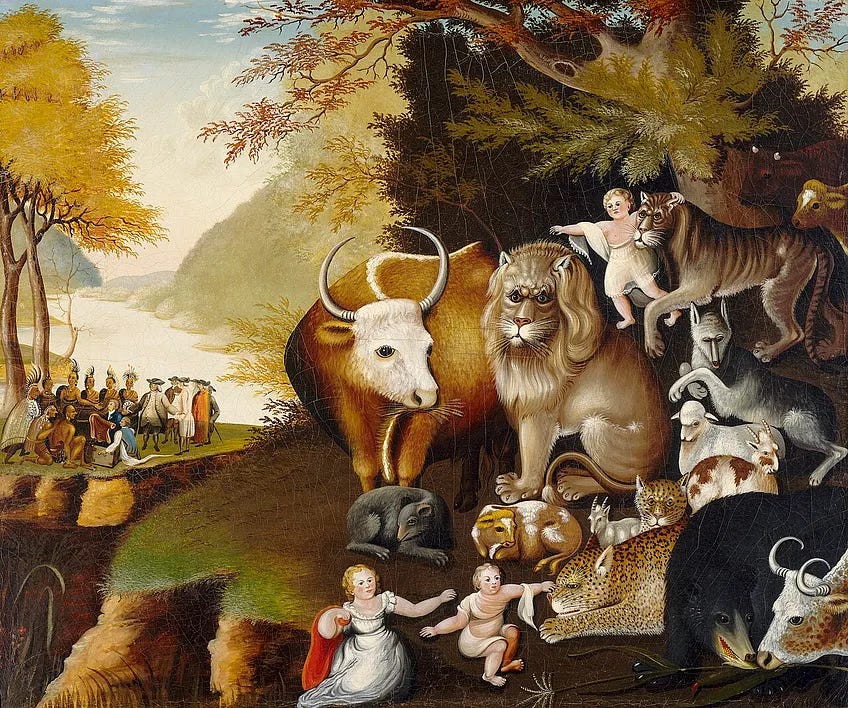
IV — A society on a human scale
What model would allow the human being to fulfil himself completely?
To diagnose is necessary but insufficient. If lucidity about the present world is not to dwindle into discouragement or anger, we must give ourselves a horizon, not a paper utopia without historical experiment behind it, but a set of organisational principles of which fragments have already been tested, at various periods, in various forms, often successfully until outside powers crushed them.
First, meeting essential needs
The foundation of a society that allows each person to flourish begins with an act of radical justice: meeting the essential needs of every human being without exception. Sufficient and wholesome food. Health. Housing. Clothing. Peace and security. An education that develops intelligence and sensitivity rather than formatting them. And time, a balance between personal, professional and collective life that allows the human being to be something other than an exhausted producer-consumer.
To these needs is added one we long believed assured: a habitable world. An earth whose soils nourish, water that can be drunk, air that can be breathed, seasons that can be relied upon. Tradition says it in its own way, by placing Adam in the garden to till it and to keep it: the human being is not the owner of the living world; he is its guardian. A society that exhausts the earth from which it lives cannot claim to serve the human being, since it destroys the very condition of his existence and of that of his children.
Our societies are governed by two mechanisms which, by themselves, suffice to explain most of their dysfunctions: fear and envy. Fear of death, of the other, of want, of exclusion forces us into compromises that estrange us from ourselves and drive us to behaviours we condemn in private. Envy, the constant comparison with others, generalised competition, transforms human relations into relations of force and permanent calculation. Every healthy society must begin by creating the conditions that reduce these two engines of degradation, by guaranteeing that no one will be left in fear of fundamental want.
Educating towards the likeness
If we are born, as I recalled above, with that impulse towards the other which the youngest children display, and if we lose it layer by layer, then education is the first place where the world of tomorrow is decided. A school that ranks from childhood, that rewards conformity more than curiosity, that teaches rivalry before it teaches cooperation, prepares exactly the society we endure. An education faithful to what we are should, on the contrary, cultivate the five dimensions of being: caring for the body, learning to recognise one’s emotions and to pass through them, forming an intelligence capable of doubting and of arguing, awakening the sense of beauty and of love, and leaving each child the time to discover what he has come to bring to the world. This is no pedagogical luxury: it is the only reform that acts at the root, since it forms the adults who will tomorrow inhabit all the other institutions.
Inverting the decision-making pyramid: Dunbar’s number
The problem is not the democratic ideal; it is the representative regime that has taken its name: the scale at which it operates and the way in which it confiscates the real sovereignty of citizens. In France, a deputy represents nearly 120,000 inhabitants whom he cannot physically know. He is elected on an overall programme that he will only partly be able to honour, often subject to systemic constraints beyond his reach, and once he is elected, his fellow citizens have no further lever over him for five years. That is not democracy: it is a virtually unconditional delegation of power.
The research of the British anthropologist Robin Dunbar, in the early 1990s, established that a human being can sustain an active network of only about 150 stable relationships, within a range running from around a hundred to some 250 depending on the person. This limit is not arbitrary: it corresponds to the size of the human groups within which trust, mutual knowledge and direct responsibility can be built until they become natural. Beyond it, relationships become abstract and impersonal, and living solidarity must be replaced by rules and sanctions.
This anthropological datum forms the basis of a radically different system of governance. At the base, cells of 150 to 200 people meet, deliberate, express their collective needs and elect a delegate with an imperative mandate: not a representative one will not see again for five years, but a spokesman entrusted with a precise message, who must report back regularly and can be recalled if his mission is not accomplished. This delegate has no power of his own: he transmits what his cell has entrusted to him.
For questions that go beyond the cell, the delegates meet in assemblies of delegates, at the level of the neighbourhood, then of the town, and so on, according to the principle of subsidiarity: each decision is taken at the level closest to the people it concerns and rises higher only if it must. A question concerning a building is decided in the building, a neighbourhood question in the neighbourhood, a town question in the town. Taxes follow the same path. Collected at the most local level and overseen by the inhabitants in total transparency, they rise in part to the higher levels according to the real needs identified from the bottom up, instead of being fixed from above through budgets decided without consultation.
The Swiss model, with its cantons and communes endowed with wide autonomy, its many elective offices and its culture of the referendum and the popular initiative, offers a contemporary example close to what I am describing. It is not perfect, nothing is, but the sense citizens have there of holding real sway over their collective destiny produces a society that is, on the whole, calmer and more creative.
Selection by lot: giving a voice to those who do not take the floor
This system of delegation nonetheless has a weakness, known to anyone who has ever taken part in an assembly: those who have the time, the ease and the taste for public speaking end up being designated, and then succeeding themselves. The further one moves from the cell, the more this risk grows, and the more the assemblies of delegates threaten to reconstitute, at their own scale, a political class. Selection by lot is the remedy for this drift. It does not replace the delegates: it brings into the deliberation people who would never have put themselves forward, and with them the real diversity of experiences, sensibilities, ages and backgrounds. Nor is it an idea foreign to our institutions. In France, the jurors of the assize courts are drawn by lot from the electoral rolls and try, alongside professional magistrates, the gravest crimes. To decide on the liberty of a human being for years, we dare to trust ordinary citizens: it would be strange to judge them incapable of deliberating on the planning of a neighbourhood or the management of water. This trust, however, is receding: since 2023, criminal courts composed solely of magistrates have been trying a large share of the crimes that previously fell to popular juries.
I see two precise roles for selection by lot. The first is that of citizens’ conventions. At each level beyond the cell, the assembly of delegates, or a sufficient number of cells, may convene a convention of citizens drawn by lot on an important or contentious question. These citizens have several months at their disposal, are compensated for the time they devote to it, hear the experts and the parties concerned, and then deliver reasoned proposals. They do not decide alone: their proposals are submitted to the cells, or to referendum when the stakes warrant it, but none may be set aside without a public and reasoned response. The Citizens’ Convention on Climate, mentioned above, proved what citizens chosen in this way are capable of, and its fate showed what it lacked: precisely this obligation to respond on the part of the State that had convened it. The second role of selection by lot is to compose the users’ committee for major projects, which I describe below.
In both cases, the mandate is short and non-renewable, and anyone may be called upon one day: public office becomes once more an experience shared among citizens, and not a career.
The three committees: a democracy of three voices
For major projects, a hospital, the development of a neighbourhood, the management of a region’s water, I propose that the assembly of delegates concerned should rely on three committees in permanent dialogue, inspired by Noah’s tripartition. Each gives a hearing to a different voice: that of knowledge, that of lived experience, that of wisdom.
The committee of experts brings together specialists chosen for their competence, their independence and their probity, none of whom may have any interest in the project. Its mission is not to decide, but to set out the possible solutions, their costs and what is at stake in them, so that all the others may have a sound understanding of the subject.
The users’ committee is drawn by lot from among the people directly concerned by the project: residents, patients, professionals of the sector. It scrutinises the work of the experts, expresses the real needs on the ground and corrects the blind spots that technical expertise inevitably produces. Selection by lot keeps it from being captured by the best-organised groups or by the loudest voices.
The committee of sages is composed of experienced people, appointed by the assembly of delegates for their sense of the common good, their long practice of negotiation and their ability to foster concord. It is consulted throughout the project. The decision always belongs to the assembly of delegates, but when experts and users cannot reach agreement, the sages serve as arbiters. This committee would give a new place to those elders whom our society isolates in retirement homes instead of listening to them as living memory and enlightened counsel, they who bring the long view, accumulated experience and that intelligence of the heart which no technical competence can replace.
This back-and-forth between knowledge, lived experience and wisdom gradually produces decisions that everyone can accept, not because they satisfy each person perfectly, but because they have been built with everyone. The person who has taken part in a decision, even if he has not obtained exactly what he wished, accepts it infinitely better than the one on whom it has been imposed, for he has been respected, listened to, taken into consideration in his intelligence. This transformation of our relationship to collective decision is perhaps the deepest change this model brings about.
Giving back time, rethinking property
All that precedes has a price we often forget to name: time. Meeting in a cell, following the work of one’s delegate, sitting for a few months on a citizens’ convention or a users’ committee, all this requires hours that most of us do not have. A society in which some hold down two jobs to survive can develop neither inner life, nor openness to others, nor engagement in the community. The democracy I am describing would then remain the privilege of those with the leisure for it, and we should see reconstituted the very political class it sought to avoid. An organisation of work on a four-day week, leaving one day for oneself, one day for family and close friends and one day for collective life, is economically feasible in a society that no longer aims at growth for growth’s sake but at the satisfaction of real needs. This is not a utopia: it is a question of priorities.
Freeing this time means tackling what devours it most, and first of all the cost of housing, which forces so many people to work ever harder merely to have a roof over their heads. It is here that we must rethink a notion we take for granted: property. Property as such is not in question: to own what one has created or honestly acquired is a healthy extension of personal freedom. But a society in which unlimited accumulation coexists with the structural destitution of millions of workers does not organise property equitably. Use-based ownership, being the owner of a dwelling for as long as one occupies it, being responsible for it and seeing to its upkeep, offers an alternative that liberates without confiscating.
Necessary separations, trust to be rebuilt
Finally, a healthy society demands strict separations between spheres that must not contaminate one another. Scientific research cannot depend on industrial or financial interests. Justice must be wholly independent of politics and of the economy. The media cannot be the property of great private fortunes without losing all capacity for free investigation: their funding must be democratic, their oversight collective. Medicine must be independent of economic powers in order truly to serve patients, and this implies the intelligent integration of all human knowledge, natural and allopathic medicine alike, according to their real usefulness and not according to the profitability of their patents.
These separations are not institutional romanticism. They are the basic condition of social trust, without which no democracy, however technically refined, can function. And trust, once destroyed, cannot be decreed: it is rebuilt slowly, through repeated acts of transparency and of loyalty to the common good.
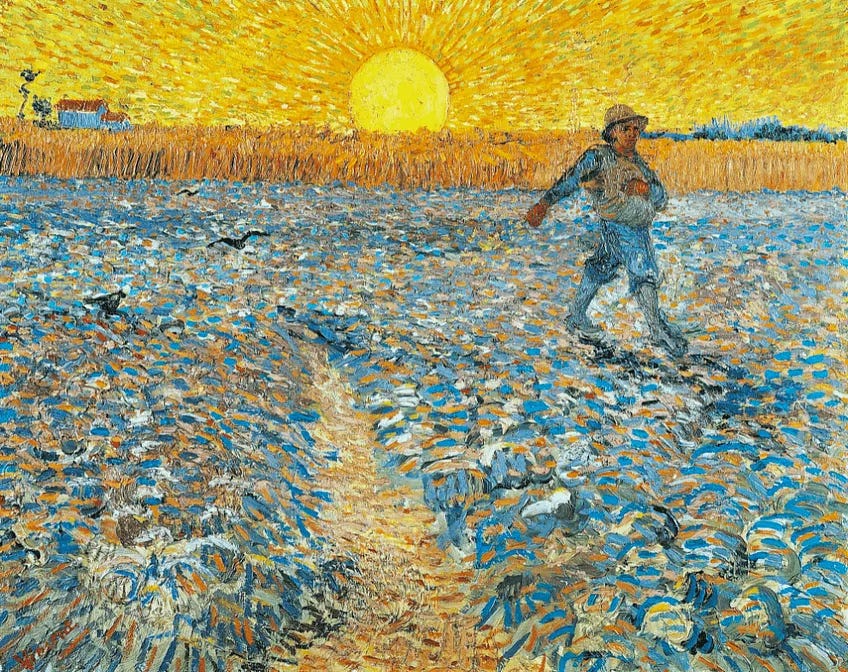
V — The transition
How do we cross from this world to the other?
We now know that the human being is infinitely more than what our age makes of him, and that other forms of society are possible. But between the vision and reality lies the most difficult question, and the one I am most often asked: that of transition. How do we pass from a world that is collapsing to another that is germinating? How do we cross the present without being swallowed up by it?
The political party and the old wineskin
At the end of the fourth lecture, a participant suggested that I found a political party. I took the suggestion seriously, for it is legitimate and springs from an authentic desire to change things, and I concluded that it would inevitably lead us back into the same ruts. To found a political party is to do exactly what every great spiritual or social impulse has done before us: to take something living, vibrant, inward, and immediately project it into an external structure that will at once develop its own interests of self-preservation, its own territory to defend, its own compromises to make in order to survive in the political arena.
No one puts new wine into old wineskins, said Jesus, and the history of his own message proved him right: a few centuries after his death, the word that overturned the tables of the Temple had become the official religion of an empire. The problem is not systems in themselves; systems are tools. The problem is that the human beings who inhabit them have not changed enough to prevent their customary drift. So long as the human being does not transform himself in depth, a change of system changes nothing: new actors play exactly the same play, with the same lines, and change only their costumes.
The transition begins within
The true transition, the only one that lasts, begins within each human being. Not in political structures, but in the quality of presence, of relationship and of love that each person is capable of developing day by day. It is a change in the state of consciousness before it is a change of structures: gradually leaving behind the culture of competition, concealment and fear in which we have been steeped since childhood, in order to experiment with other ways of relating, first in small, protected spaces, where these new ways of being together can ripen before they spread.
This approach follows an organic logic: as a plant grows, this change must grow from the inside outwards, and not be imposed from the outside inwards. When a discipline comes from outside, laws, constraints, sanctions, it is respected for as long as the constraint exists and abandoned as soon as it disappears. When it comes from within, because we have truly understood why it serves us and serves the world, it persists and grows stronger. It is the difference between a child who does not lie because he is afraid of being punished and an adult who does not lie because he has understood that lying destroys relationships and disfigures the soul. And it is time for humanity to come of age.
The difference in speed: the urgency of conciliators
The great concern I carry is that there is a critical difference in speed between, on the one hand, the inner transformation of individuals, which is slow, organic and non-linear, and, on the other, the acceleration of crises that do not wait. In France, on several occasions in recent years, I have had the feeling that we were within a hair’s breadth of civil war. In many countries of Europe and beyond, similar tensions are rising. The risk of a violent explosion, fed by accumulated injustices, gaping inequalities and the absence of prospects for millions of people, is real and growing. As I write these lines, in November 2026, the protest movement born of legitimate strikes by secondary-school pupils, which is now spreading to the universities and to wider sections of the population, shows how close French society is to breaking point, all the more so as some see in it a political opportunity and seek to bring it to incandescence.
That is why the transition cannot be solely inner and slow. It must also develop, in parallel, conciliators: men and women of peace who, when tensions explode, are able to bring opposing parties to speak to one another, to find the possible intersection between contradictory legitimacies, to defuse the logic of revenge. Charles Rojzman, who worked in Rwanda to bring survivors and perpetrators of the genocide into dialogue, using the techniques of social therapy he developed, is a living example. He does not take sides. He hears both. He seeks the intersection. It is a difficult art, precise and demanding, and it may well be the most necessary art in the years to come.
The condition for practising this art is to have worked on oneself enough not to take sides instinctively, to hear the share of truth and of wound in each position, to recognise in every human being, even one whose acts are indefensible, an authentic humanity that suffering or fear has deformed but not destroyed. This requires a spiritual maturity that is not acquired in the space of one evening’s lecture: it is built patiently, daily, through the honest observation of oneself and the deliberate practice of self-betterment and of presence to the other.
Islands of the future in the ocean of the present
Alongside this work of conciliation in times of crisis, it is necessary to create, starting now, at the margins and sometimes against the current, places of social experimentation. Communities, associations, partly self-managed neighbourhoods, mutual-aid networks that already function according to other rules. The oases born of the movement launched by Pierre Rabhi, the ecovillages multiplying across Europe, the experiments in direct democracy in municipalities such as Marinaleda in Spain, workers’ cooperatives, solidarity grocery shops, local currencies: all this already exists and must multiply. These spaces are not refuges in which to flee the world; they are living laboratories where new ways of being together are tried out and proved, and from which they can spread by capillarity.
History invites us to this. The first Christian communities practised radical sharing within an empire that did not officially allow it. The medieval communes of Italy functioned for generations with councils of citizens deliberating by guild, freeing themselves from the tutelage of their lords to invent a different way of living together, before the great families and the signorie took back control. The anarchists of Barcelona in 1936 ran education, health and the local economy through citizens’ committees, with remarkable efficiency, until the war and the forces that fought them, from without as well as within their own camp, crushed them. Kurdish Rojava, from 2012 onwards, experimented with a grassroots confederal democracy in conditions of extreme warfare. These precedents show that local self-government is no chimera. What has always prevented it is the resistance of the powers that found no profit in it.
The question of courage
A participant in the fifth lecture asked me a question that moved me deeply: would you have had the courage, in 1939, to stand on the side of the Resistance? It is the right question, for it sends each of us back to his real inner self, beyond all declarations. I answered with humility: I hope so. But I cannot affirm it with certainty, and no one can: I know how much in me still calls for work, how far the survival instinct and fear can turn aside the best intentions when they are confronted with realities as terrible as those the members of the Resistance had to face.
Aleksandr Solzhenitsyn, who had known the Gulag, wrote with arresting honesty in The Gulag Archipelago that the line dividing good from evil runs not between states, nor between classes, nor between parties, but through the heart of every man. These words say everything about the fragility of what we build within ourselves. The human quality we develop is not a definitive acquisition: it is a persistent orientation, ceaselessly to be reconfirmed, ceaselessly to be begun again. To be aware of this is not a weakness; it is the first condition of all authentic progress, the one that opens us to humility and to the capacity to forgive.
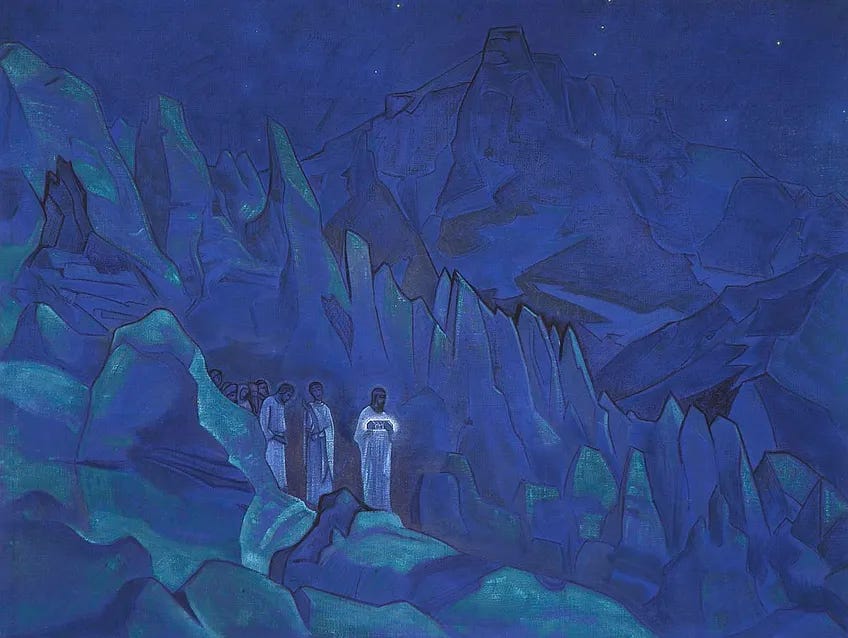
VI — Becoming the Waymakers
Daring to be the proof
Here we are at the end of the cycle, and before the question that can no longer be put off. No longer: what is happening in the world? No longer: what could we do collectively? But: who am I in all this? What is my part? What can I do, I myself, with what I am, where I am, starting today? It is the most unsettling question, because it no longer allows us to remain spectators. It places us at the heart of the problem, and of the solution.
Exodus: a double reading for our time
To draw this cycle together, I chose to revisit the text of Exodus, not as a theological text to be defended or accepted as revealed truth, but as a map of the territory we are crossing, as one of the most beautiful metaphors humanity has produced of its own condition. The power of this narrative lies precisely in the fact that it works on two levels at once, social and inner, and that these two levels answer each other in a troubling way across the centuries.
The social reading is striking. Pharaonic Egypt presented a social structure in which the powerful could procure, at great expense, the scrolls of the Book of the Dead, meant to guarantee survival in the afterlife and reserved for the most part for the wealthiest. Today, the most powerful people in the world promise to vanquish death through transhumanism, augmented man, cryonics, digital immortality. The form has evolved; the structure remains rigorously identical: eternity as a class privilege. And we, like the Hebrews compelled to build the store cities of Pithom and Rameses for Pharaoh, are the producer-consumers under tutelage, the builders of the modern pyramids, beginning with those of digital capital, whose data we produce, whose platforms we consume and whose algorithms we feed without having any say in the conditions of this labour.
The inner reading is just as pertinent, and perhaps more urgent still. Pharaoh, in the Hebrew tradition, corresponds to the yetzer hara, the evil inclination, the pull downwards, towards fear, ego, closure, greed. These forces are not external to us. They are those layers of conditioning whose slow sedimentation since childhood I described above. This inner Pharaoh holds in bondage what we truly are: our capacity for love, for creation, for connection, for radical freedom. Moses, who guides the people of Israel towards their material and spiritual liberation, is his inverse figure: he embodies that inner archer who knows the target. And the Exodus begins there: not a geographical flight towards some virgin island that no longer exists, but an inner exodus, patient and determined, out of the conditioning that inhabits us, most often without our knowing.
The crossing of the desert: the time of apprenticeship
The Exodus does not lead straight from Egypt to the Promised Land. Between the two lies the desert, forty years of crossing, according to the text. This is no mere narrative detail. It says something essential about the nature of authentic change: between leaving a system that has run out of breath and inhabiting the collective in another way, as between escaping our errant ways and changing our lives, there lies a time of apprenticeship, of wandering, of experiment, of failure and of beginning again, which nothing can shorten. A people coming out of slavery carries slavery within it. A being who awakens still carries his inner nights. This people, like this individual, must learn, in the disconcerting space of a new freedom, to govern itself, to trust itself, to treat the other, and to treat itself, without the gaze of master or of servant. This is done neither in a day for the individual, nor in a generation for the people.
The Hebrew word teva (תֵּבָה), usually translated as ark, also means word. Noah’s ark and the basket of rushes in which the infant Moses was laid bear the same name, and the Baal Shem Tov, founder of Hasidism, drew from this a teaching I have never forgotten: to enter the ark is to enter the words of prayer, to shelter in them wholly, and to let oneself be carried by them above the waters. This play of meaning is not fortuitous in a tradition in which words are vessels: it says that the word, naming consciousness, is the vehicle of our transformation. It is not by force, nor by laws, nor by armed revolutions that humanity will cross this age; it is through a transformation of thought, of language, of the way we name the world and take our place in it. We must urgently build an ark of words, an ark of consciousness, so that those who wish to enter it may be carried above the deluge of crises and perils now looming. It is from this ark that the new world will be able to spring.
Reclaiming one’s spiritual sovereignty
We have seen that the persona, instead of carrying the voice of our essence, has taken on over the years ways of functioning that often have nothing more to do with who we profoundly are. We operate on unconscious automatisms, reflexes built in fear and competition, which generate behaviours of which we are sometimes the first to be surprised and dismayed. How could I have reacted like that? That is not what I meant to say. That is not who I am. This dissonance between what we do and what we know ourselves capable of being is the most reliable signal that the inner exodus is necessary.
To reclaim one’s spiritual sovereignty, a term I am particularly fond of because it binds the inner dimension and the political dimension in a single formulation, is to refuse to let external forces define what we are, what we are worth, what we have the right to dream of. It is to return to oneself with the twofold weapon of honesty and compassion: honesty towards one’s own shadows, one’s fears, one’s recurring cowardices, without denying them, without flagellating oneself, but looking them in the face in order to understand how they were built; compassion towards oneself, because what we have developed that is wounded or closed, we built in conditions that were often difficult, and there is no reason to be ashamed of it.
This inner reconquest does not take place in isolation. It is nourished by encounters, by reading, by contemplative practices, by honest dialogues, by moments of silence and of beauty. Beauty, whether musical, pictorial, poetic or natural, is also a spiritual help too often underestimated: it takes us out of ourselves, carries us into a reality that surpasses our petty calculations, awakens in us something that knew, even before we were able to learn it, that the world is greater than our fears.
Dialogue, first cell of the world to come
Everything that precedes converges on a practice we believe we know and rarely practise: dialogue. The cells of deliberation, the three committees, the art of the conciliators, the ark made of words: each of these forms rests on the capacity of human beings truly to speak to one another, that is, to listen without preparing a reply, to set out what they think without seeking to win, to accept being changed by what they hear. David Bohm, already cited, devoted his last years to this question. He distinguished discussion, in which each defends his position as one returns a ball, from true dialogue, in which a group learns to observe together its own presuppositions and lets a meaning emerge that no one possessed alone. Martin Buber, before him, had shown that the human being becomes fully himself only in the relation of I to Thou, the relation in which the other ceases to be an object and becomes a presence.
That is why the publication in which this text appears is called Dialogues. Not because I have found all the answers in it, but because I believe that the world to come is invented first in these modest spaces in which human beings consent to think together: an exchange of letters, a conversation that continues in the comments, a meeting of readers around a table. Every honest dialogue is a cell of the New World, a plot of ground where the rules of fear and competition are suspended for a moment, and where one discovers, if only for an hour, that another way of being together is possible.
The butterfly effect of personal change
Each time a human being changes, even a little, even locally, even imperfectly, something changes around him, and further than he thinks. Theorists of complex systems have given this intuition an image that has become famous, the butterfly effect: in certain systems, an infinitesimal variation can, step by step, produce considerable effects. I do not claim that physics demonstrates the spiritual reach of our actions; I say that the image is apt for describing what we see in families, groups and neighbourhoods, where a single being who changes his stance alters the whole balance around him.
The illusion of separation, I am alone, my action does not count, the system is too big, is precisely what the dominant powers have an interest in sustaining: divide and rule is not only a political strategy; it is an ontological one. Making individuals believe that they are powerless islets prevents them from perceiving that they are nodes in a living network whose quality depends on what each person puts into it. When a human being begins to radiate differently, with more presence, more warmth, more courage in his convictions, more generosity in his acts, it is noticed. It creates a gentle but real disturbance in the surrounding social field. It makes others want the same.
This dynamic of benevolent contagion is perhaps the most powerful force of social transformation there is, and the only lasting one, because it cannot be confiscated, institutionalised or turned against those who set it in motion. A leader can be imprisoned. A human quality passed on from person to person, from glance to glance, from gesture to gesture, cannot be imprisoned.
Being a waymaker: an art of presence
A waymaker does not lead, does not command, does not impose a path. He accompanies someone from one state to another, from despair to a glimmer of hope, from closure to an imperceptible opening, from an inner prison to a space a little easier to breathe in. This requires neither giving a lecture nor writing a book. It requires first of all being present enough to oneself for something to radiate, almost in spite of oneself, a quality of listening, a way of looking at the other as someone who has something important to say, a way of inhabiting uncertainty without collapsing, a renewed joy without artifice, and for this to make the other want to set out on the way.
Philippe Lavastine, one of the waymakers who carried Gurdjieff’s teaching in France and a great connoisseur of the Vedic tradition, was one of these people. I met him three times in my life, when I was barely out of adolescence. Three times only. And those three encounters set off transformations in me that continue to shape me to this day. He taught me nothing in the academic sense. He showed me something, a way of being present, a quality of intelligence of the heart, a sovereign inner freedom that needed no outside validation. That was enough for me to know that it was possible. And knowing that something is possible is, at times, all one needs to set out on the way.
A few years ago, I read in an American newspaper the story of a woman who went to visit her son’s murderer in prison. She had reached within herself a level of love capable of rising above the most legitimate vengeance there is. Her example says something essential about what the human being can become when he decides to bring the best of himself to life in the most improbable conditions. It is not an injunction to self-denial or to an inaccessible sainthood. It is an invitation to believe that this level exists within us, even buried beneath years of conditioning, and that any work that brings us closer to it is worth the effort, even if it is imperfect, even if it is slow, even if it stumbles.
The humility of the path and the firmness of the direction
Becoming a waymaker is not a declaration of intent. Nor is it a claim to wisdom. It is a daily practice, imperfect, built up through the accumulation of small choices. Every morning: what shall I do today to be better than yesterday? Every evening: have I been, in what I have done and said, equal to what I wish to be? Not in order to flagellate oneself when the answer is no, which happens regularly, and more often than one would hope, but in order to set out again. As in meditation on the breath: thought carries us away, it does not matter, we come back. We have drifted off again, it does not matter, we come back once more. And something, little by little, crystallises. A steadier presence develops, a firmer centre takes hold, a finer capacity for attention is honed. In the re-creation of oneself, the process is the same: this prejudice to which I no longer yield after observing it many times, this sorry little selfishness that I long refused to see but end up casting off, this fear of daring overcome by the growing desire to be true. Each victory may seem minuscule, but it is their sum that changes us.
All the books of wisdom converge on this point: the door that opens onto the authentic spiritual path is that of humility, not the humility of self-abasement, which is a perversion of the virtue, but the humility of lucidity: to consider that we are small people on the way, to acknowledge our shortcomings without dramatising them, and to return to our rightful place without inflating or diminishing it. As I like to say: if in this existence I attain one drop of water from the infinity of truth, beauty and love, that will already be remarkable. One drop of water. Humility is finding this real drop precious enough not to sacrifice it to the illusion of an ocean one does not possess.
The river to travel back up and the rivers to pour forth
We are all bearers of a heritage made at once of wonders and of horror. No human being alive today can claim to be nothing but light: we carry within us, in our reflexes, in our fears and our angers, millennia of violence, of betrayal, of collective cowardice, as much as of courage, of generosity, of beauty created against all expectation. We cannot reproach ourselves for this heritage: we are its involuntary heirs. But we can, and we must, work not to be its amplifiers.
After the rivers of blood that have run through history, the wars, the genocides, the inquisitions, the colonisations, the exploitations, it falls to us, generation after generation, to flood the world with contrary rivers: rivers of love, of hope, of beauty, of patience, of forgiveness, of intelligence and of creativity. Not out of naïvety, for we know what humanity is capable of at its worst, but out of a lucid decision that the best is also possible, and that if we do not work to bring it about, no one will do so in our stead. And knowing that almost everything has been tried, except this attitude sustained over time on the scale of an entire society.
Daring to believe and to act
Today, we no longer dare anything. We no longer dare to believe that things could really change. We no longer dare to believe ourselves capable of contributing to that change. Honesty obliges us to recognise that this inability to believe is not lucidity; it is a form of capitulation before a reality we have not yet truly tried to transform. We confuse realism with resignation, and resignation with wisdom. These are three radically different things.
This cycle of reflection had a single aim: to restore hope, not a naïve hope that would ignore the gravity of what is happening, but a lucid hope, one that knows why things have so often gone wrong, that understands the mechanisms of degradation, and that nonetheless sees, with equal clarity, the extraordinary resources every human being carries and which our age has not yet exhausted. One has only to watch a child learning to walk: how many times does he fall, without ever deciding that it is definitively impossible? It is that intelligence, that organic confidence in the possible, which social conditioning ends up stifling, and which the spiritual path seeks to rekindle.
Let us dare to believe that everything is possible. The human being has every power to change everything, and nothing is definitively lost so long as human beings choose to rise. We can found a different world of which our descendants will be proud, a world in which they will say, looking back: ‘At a time when there was every reason to despair, when most people believed that nothing could change, they dared. They believed. They acted to the measure of their strength. And because they dared, we have been able to carry on their work and to see the world transformed.‘
That is what it means to be a Waymaker of the New World.
Jérôme Nathanaël
Postscript. This manifesto is only a threshold. From today, the comments are open to you, as is the Dialogues chat for subscribers. In a few days, I shall devote an article to the Waymakers community, in which I shall set out once more how it works within the Dialogues, for those who wish to continue this path together, through exchange, encounter and dialogue. Then, in a little while, I shall invite you to a first gathering: in person in Paris for readers in the Île-de-France, and by video conference for everyone else.
© 2026 - Dialogues of the New World — Jérôme Nathanaël


The Waymakers space
The space below is reserved for the publication’s free and paid subscribers. It is not visible to non-subscribers.
... ... ... ... ... ...
Join us
Discovering this publication and drawn to its approach? I invite you to read the Opening page, which presents the author and the project, and then to subscribe, free or paid. You will thus gain access to the Waymakers community: direct communication between subscribers through the Chat and its thematic forums, as well as the opportunity to exchange with the author by private message.
