
Article disponible en français
Notebooks of life · Texts · 6 min
To write as close as possible to what is surfacing, without always seeking to conclude.

Our Christian friends, both Catholic and Orthodox, are currently living through the season of Lent, which extends over forty days before the feast of Easter and is marked by dietary restrictions of varying strictness depending on the tradition. This gives us occasion to reflect on the relationship between fasting, renunciation and the spiritual life. Must one truly suppress the body’s needs in order to gain access to the spiritual dimension? Is spiritual development not, first and foremost, an opening of our limited being towards a larger dimension, and a transformation of the self?
Fasting and health
Today, fasting in its many varied forms has become fashionable among those those seeking to regain a healthier way of life, practised as a means of eliminating toxins accumulated in the body and thereby renewing one’s vitality. Some favour periods of complete fasting — a week, for instance — and attend retreats or specialist establishments for this purpose, in order to benefit from appropriate supervision. Others prefer intermittent fasting every other day, or a more moderate form such as skipping one meal a day to give the digestive system sixteen hours of rest. Finally, veganism, the complete abstention from animal-derived products, may also be understood within this same concern.
Yet if fasting and its variants are genuine tools for improving our health when practised with intelligence and moderation, they are also age-old practices found in every religion in the world, regarded as means of loosening the excessive grip of material life and fostering spiritual elevation.
Fasting in the religions
In Catholicism, the rigours of Lenten fasting, observed in memory of the forty days Jesus spent in the desert between his baptism and his public ministry, have gradually given way to simple counsel of frugality and a recommendation to fast only on Ash Wednesday and Good Friday. Yet the season remains marked by a concern for self-improvement and spiritual progress, expressed through recollection and prayer, introspection and self-examination, and a deepening of care for others.
In the Orthodox Church there are four fasts, lasting from fifteen days to more than a month: the Nativity Fast, the Great Lent preceding Pascha, the Apostles’ Fast following Pentecost, and the Dormition Fast in August. These are characterised by dietary restrictions close to veganism and serve as times of preparation and deepening of faith in relation to the corresponding feasts.
In the Muslim Ramadan, forty days during which a dry fast is observed from sunrise to sunset, one finds the same notion of detachment from bodily appetites in order to concentrate on deepening one’s faith, the betterment of oneself, and the strengthening of bonds with others. The various days of dry fasting observed in Judaism, the most celebrated of which is Yom Kippur, the Day of Atonement, likewise place emphasis on these same dimensions.
In Hinduism, the practice of fasting is deeply present and can range from mild privation to the most extreme renunciation. The choice of days and manner of fasting depends upon community, family or individual. It is a moral and spiritual act whose purpose is to purify body and mind and to attract the benevolent grace of the divinities. Two fasts are more generally observed: Ekadashi, occurring roughly twice a month on the eleventh day of each waxing and waning moon, and the fast associated with the celebrations in honour of Shiva at the beginning of the year.
According to tradition, the Buddha long practised the regime of strict austerity and fasting prevalent in his time without attaining enlightenment. Having abandoned this practice and turned his full attention to meditation, he reached liberation from suffering and nirvana. Complete fasting is therefore not a widespread practice within Buddhism. Yet one finds intermittent fasting in the tradition, notably the suppression of the evening meal in Theravada Buddhism, reputed to be close to the original teaching. This restriction, here too, serves to reduce the hold of physical appetites by fostering detachment and concentration on meditative practice.
Renunciation as extreme form
All traditions thus recommend dietary restrictions of greater or lesser severity, intended to foster spiritual progress by moderating the appetites of the body. These take the form either of periodic restrictions to reinforce introspection and practice when linked to feast days, as in the monotheistic traditions and Hinduism, or of a dietary regime bound up with a spiritual discipline, as in Buddhism.
Yet in every religion one also encounters the more extreme figure of the ascetic, who renounces entirely the goods and pleasures of the world. Well known is the eremitic tradition of early Christianity, in which Anthony, Hilarion and many others withdrew into the desert to live in solitude, practising poverty, fasting and prayer.
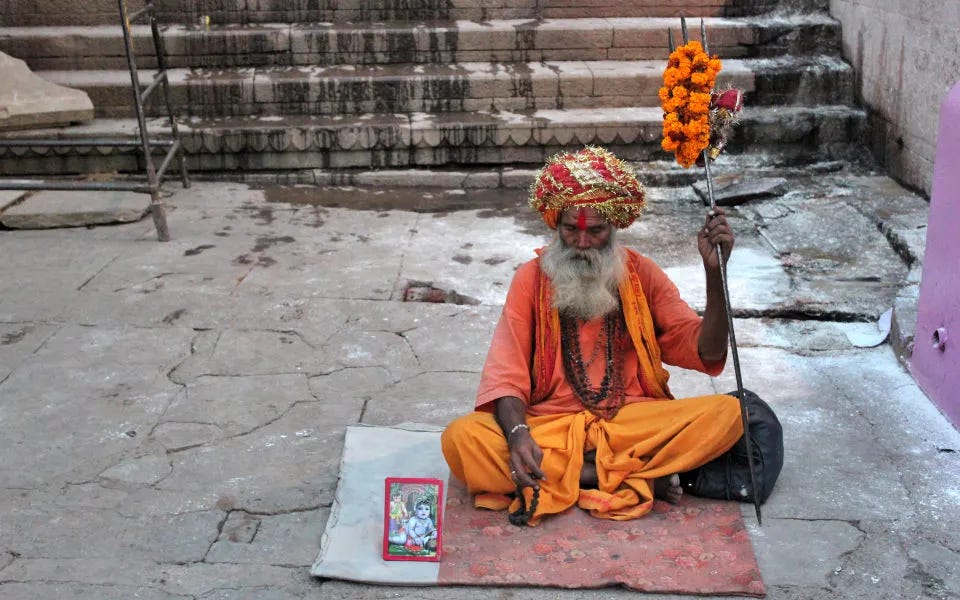
India holds a long tradition of sādhus, in Sanskrit “good men”, who likewise renounce society and travel the roads, sustained by the offerings of the faithful, in order to devote themselves to the attainment of moksha: liberation from illusion (māyā), the cessation of the cycle of rebirths, and union with cosmic consciousness.
A means among others for spiritual development
From the moderation of bodily appetites to a complete renunciation of material life, human beings seem always to have perceived our bodily incarnation as an obstacle to spiritual development.
This has at times given rise to excessive practices that resemble more an anticipation of death than a path favouring the life of the integral human being, realising his spiritual potentials within his earthly reality. But in its most reasonable forms, practising periodic dietary restrictions, in one form or another, has the advantage of loosening our identification with our bodily and material needs and allowing us to learn to meet them with measure and without excess.
When we examine the traditions, we find the same will to master the other dimensions of the human being, perceived here and there as a pitfall in the quest for truth and ultimate spiritual realisation, on account of their disordered functioning.
Thus, through the use of prayer, contemplation or orison, the emotional dimension of the human being, capable of negative emotions such as jealousy or hatred, sorrow or fear, is reoriented towards nobler emotions such as devotion and love of one’s neighbour. The practice of meditation, or the development of metaphysical reflection, makes it possible to attune the human mind to fields of consciousness that are broader and less bound to matter.
Attaining the integral life
In reality, the human being has no need to exchange his material life and renounce its various dimensions in exchange for a hypothetical discovery of truth or access to higher levels of consciousness.
The task is, on the contrary, to succeed in being more fully present here and now, to ourselves and to the world, so as to become aware of the dysfunctions within our various dimensions or centres and to work at reorienting their capacities towards the positive uses for which they are adapted, in order to harmonise their functioning.
By thus liberating his potentials in their most sublime aspects, the human being becomes capable, on this very basis, of accessing, within this life, the integral life and the awakening of his spiritual dimensions: unconditional love and universal intelligence.
© 2026 - Dialogues of the New World — Jérôme Nathanaël

In echo
If this text brings forth in you an image, a memory, a silence, a piece of music, or a few lines, you may set them down in the comments so as to enrich our shared imagination or reflection.
And if you wish to go further, send me a contribution of roughly one page for the Waymakers section. It will be published under your initials, a pseudonym, or anonymously, as you prefer. Other readers will be able to respond and dialogue with you.
New here? The Opening page introduces the author, the project, how to take part, contact details, and the agenda.